Archives
- April 2018
- March 2018
- November 2017
- October 2017
- September 2017
- July 2017
- June 2017
- May 2017
- April 2017
- January 2017
- October 2016
- September 2016
- August 2016
- July 2016
- June 2016
- May 2016
- April 2016
- March 2016
- February 2016
- November 2015
- October 2015
- September 2015
- August 2015
- July 2015
- June 2015
- May 2015
- April 2015
- March 2015
- February 2015
- January 2015
- December 2014
- November 2014
- October 2014
- September 2014
- August 2014
- July 2014
- June 2014
- May 2014
- April 2014
- March 2014
- February 2014
- January 2014
- December 2013
- November 2013
- October 2013
- September 2013
- August 2013
- July 2013
- June 2013
- May 2013
- April 2013
- March 2013
- February 2013
- January 2013
- December 2012
- November 2012
- October 2012
- September 2012
- August 2012
- July 2012
- June 2012
- May 2012
- April 2012
- March 2012
- February 2012
- January 2012
- December 2011
- November 2011
- October 2011
- September 2011
- August 2011
- July 2011
- June 2011
- May 2011
- April 2011
- March 2011
- February 2011
- January 2011
- December 2010
- November 2010
- October 2010
- September 2010
- August 2010
- July 2010
- June 2010
- May 2010
- April 2010
- March 2010
- February 2010
- January 2010
- November 2009
- October 2009
- September 2009
- July 2009
- March 2009
- September 2008
- June 2008
- May 2008
- February 2008
- September 2007
- May 2002
- November 2001
- June 2001
- April 2001
- August 2000
- February 1998
- January 1997
- July 1996
- November 1995
- April 1995
- March 1994
- July 1992
- September 1991
- June 1990
- September 1986
- May 1983
- April 1983
Van at Culloden – January Blues
Van Morrison – 21st & 22nd January 2014
This is the third year in a row Van Morrison has played a series of concerts at Culloden Estate & Spa, on the stage where he recorded his album ‘Born to Sing; No Plan B.’
Previous guests will vouch for the very special atmosphere created in such an intimate setting, recreating the feel of Jazz clubs of yesteryear.
It is an ideal setting for Van to play the songs you know, in the way he feels he should play them now.
Posted in Article
Comments Off on Van at Culloden – January Blues
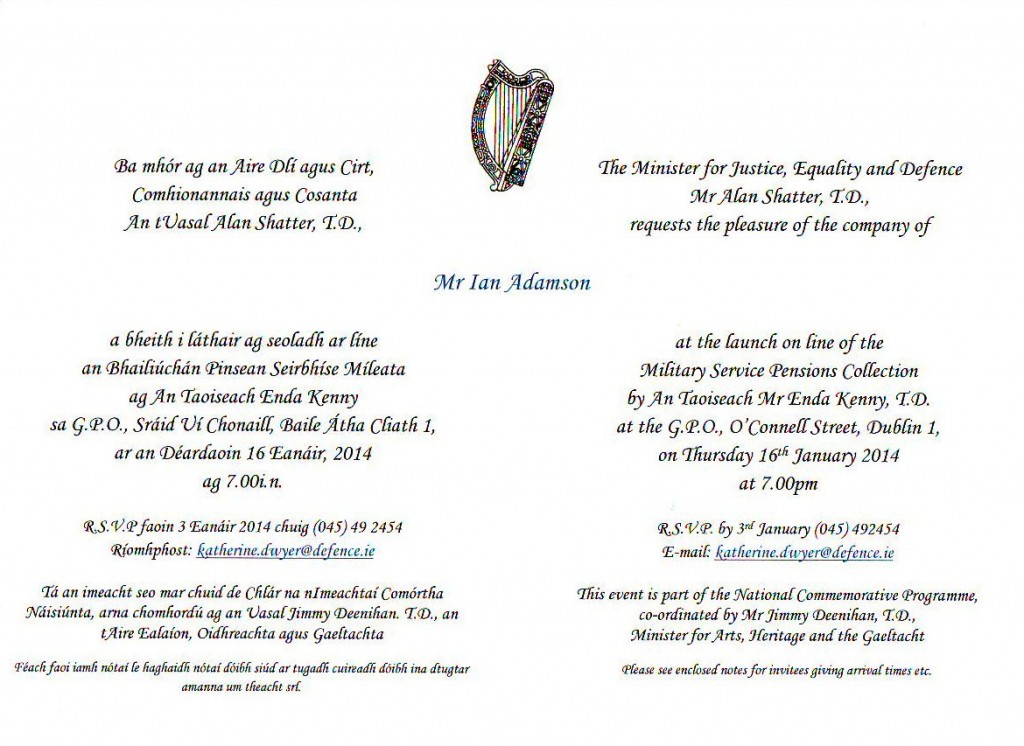
Launch of Military Service Pensions Collection


http://www.militaryarchives.ie/collections/online-collections/military-service-pensions-collection
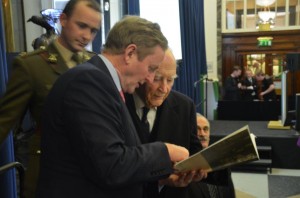
Today I attended the launch on line of material from the Military Service Pensions Collection by An Taoiseach Enda Kenny.
The Military Service Pensions Collection consists of approximately 300,000 paper files, with a number of maps,drawings and diagrams. The files relate in the main to applications by individuals and/or their dependents for the award of pensions and gratuities for people who served as members of the Irish Volunteers, the Irish Citizen Army, the original Irish Republican Army, Cumann na mBan, Na Fianna Éireann, the Hibernian Rifles and the Irish National Army on active service who were casualties or wounded while on duty during the period April-May 1916 to September 1923.
The Taoiseach spoke not only of these soldiers but of those who joined the British Army before and after the Great War, whom he said must be given equal recognition..A beautiful speech. Minister Deenihan spoke of my own work in this field of shared history and Common Identity, which I am pursuing with my colleague in Pretani Associates Helen Brooker.
This is indeed interesting stuff…. For there were applicants who were in the British Army before they joined the original IRA, and there were those who were in the original IRA before they joined the British and Imperial Forces.There was also a lady who was initially denied a pension because a soldier was defined as of male gender.
I was curious to see if anyone emigrated to New Zealand after their service in Ireland
4 applications came from New Zealand (and eight from Australia).
Spot sample ….
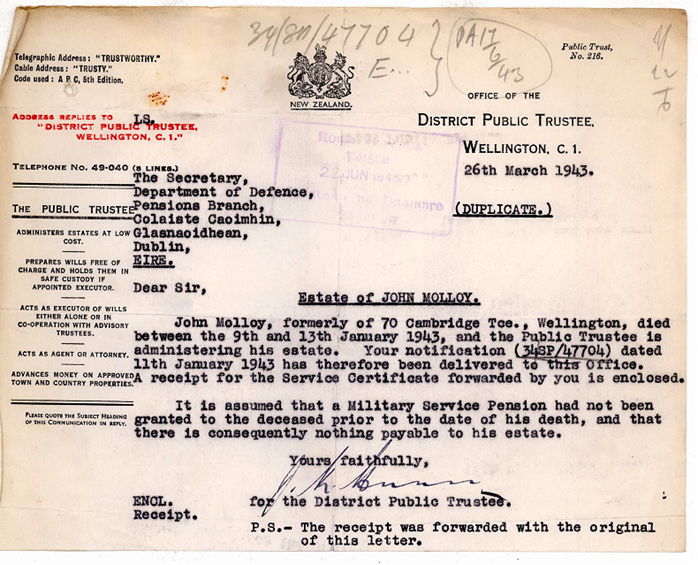
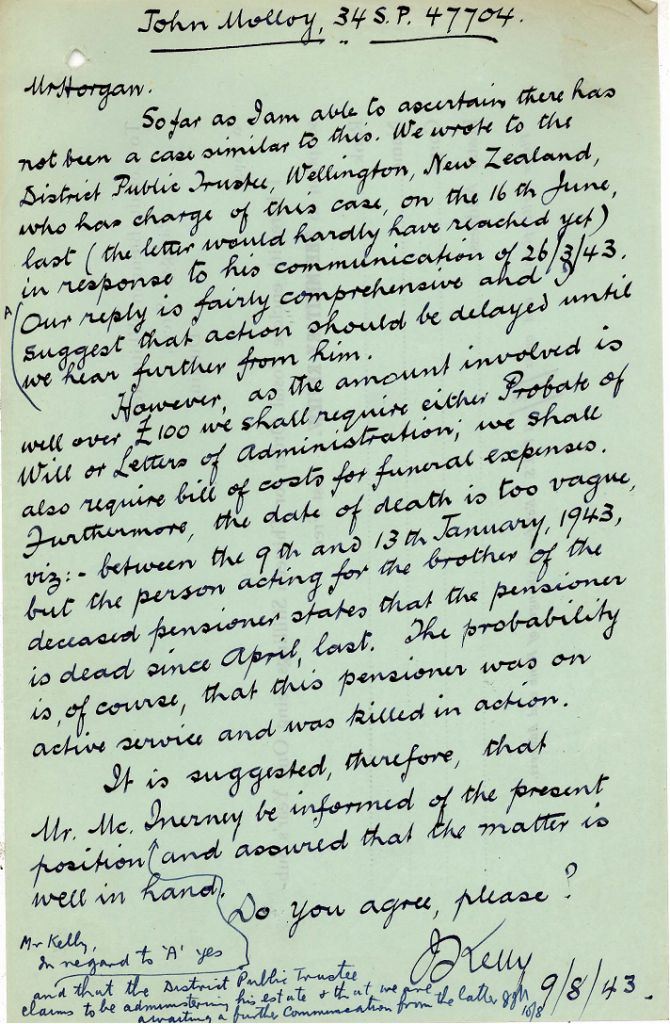
Name: Molloy, John
Location: 17 Childers Terrace, Kilbirnie, Wellington, New Zealand
Not always good news….. by the time John Molloy’s pension was approved in 1943, he seems to have died aged 55 fighting for British New Zealand in the Second World War.
It would be interesting to follow across to Commonwealth War Graves Commission records and try to find out where his service in New Zealand had brought him.
Posted in Article
Comments Off on Launch of Military Service Pensions Collection
Digitisation of Ireland’s World War 1 Memorial Records,
Mr. Eamon Gilmore, T.D.
Tánaiste and Minister for Foreign Affairs and Trade
requests the pleasure of the company of
Dr. Ian Adamson
at the launch of the digitisation of Ireland’s World War 1 Memorial Records,
in the presence of First Minister Peter Robinson MLA and deputy First Minister Martin McGuinness MLA,
in partnership with Google and with the In Flanders Field Museum
to be held in Google Docks, Barrow Street, Dublin 2
on Friday 10th January 2014 at 11.00 a.m.
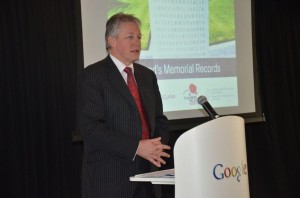
Today I attended the launch of a new archive which lists the 49,000 soldiers from the island of Ireland who died during the Great War or as a result of wounds sustained during battle.
The archive “Ireland’s Memorial Records” has been developed in a cooperative venture involving Google, the In Flanders Fields Museum in Belgium and the Department of Foreign Affairs.
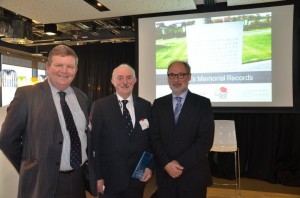
The archive was launched today at Google’s Dublin headquarters by Minister for Foreign Affairs and Trade Eamon Gilmore together with Northern Ireland’s First Minister Peter Robinson and deputy First Minister, Martin McGuinness, MLA.
Relatives of those who died in the war were also present to see the archive launched.
Mr Gilmore said he was delighted to launch such an important archive in the company of Mr Robinson and Mr McGuinness
“While the digitisation and online access to this record will be a rich resource for genealogy, most significant is its value in facilitating the simple and important act of remembering the individuals, Irish men and women, who lost their lives in the First World War.”
Mr Robinson said he very much welcome the opportunity to be involved in the launch of such an important historical project.
“Google and the In Flanders Fields Museum are to be highly commended for this valuable piece of work. As we enter an important decade of commemorations in both our countries, it is my hope that what has been established here today will keep alive the history and the stories of those who did not return from war.
“This work will allow the stories of the fallen to be recorded for the benefit of future generations and will allow us to express our thanks and acknowledge the sacrifice of men who died helping to preserve our freedom.”
Mr McGuinness said the fact that over 200,000 Irishmen fought in the war and over 49,000 were killed showed the human impact of the war on the island of Ireland.
“It is important all their personal stories are told and this innovative project ensures the memory of those Irish soldiers killed will continue,” he said.
“This partnership between Google and the In Flanders Fields Museum has resulted in an incredible source of information for family, students and researchers. I commend Google for their efforts in helping collate this information but more importantly making it accessible. I encourage people to use it and share their stories so future generations can better understand the lives of their predecessors.”
Mr McGuinness said his presence at the event representing a particular strand of Irish republicanism showed an increasing maturity on the island of Ireland.
The records made available on line today were first published in 1923 listing the soldiers from Ireland who died in the First World War. They have now been corrected, updated and made available online as part of the project. The records can be searched by name, place of birth, rank, regiment, service number, date of death and place of burial / commemoration where that information is known.
Ireland’s Ambassador to Belgium, Eamonn MacAodha, has worked closely with Google and In Flanders Fields Museum to realise the project. The Irish genealogical history and heritage company Eneclann worked to digitize available information on the casualties.
John Herlihy, head of Google in Ireland said that Google was delighted to have worked with In Flanders Fields Museum on this significant project.
“This is a great example of technology as a force for good, making information accessible and easily available,” he said
Piet Chielens, Co-ordinator, In Flanders Fields Museum said commemoration was about sharing human experiences and fates, and reflecting on them. “This online commemoration allows people from all over the world to connect with a shared past”.
Ireland’s memorial records can be found at: imr.inflandersfields.be/search.html
Posted in Article
Comments Off on Digitisation of Ireland’s World War 1 Memorial Records,
Turas Opening Ceremony
Tonight, as President of the Ullans Academy, I accompanied our Chair Helen Brooker along with two of our directors, Ruairi O Bleine and Des Meredith, to the opening of a new Gaelic language centre in east Belfast.
The Turas (Journey) centre, based in the Skainos building on the Newtownards Road, houses a classroom, offices and a library/social area.The centre was opened by local man Sam Evans who was a founder member of the Progressive Unionist Party.
Development officer Linda Ervine said a growing interest in the language had led to the need to expand.
Ms Ervine said a “taster” Irish class held three years ago had revealed a surprising level of interest in the language.
“We started a regular class two years ago which was meant to last for 15 weeks,” she said.
“At present, there are eight weekly classes held in the Skainos centre.
“We had to expand to cope with the increasing numbers. Now, around 90% of our learners are Protestants.
“People contact me on a weekly, even daily basis. All we have done is to open the door.”
As part of the growing interest in the Gaelic language in east Belfast, a further two classes, one for children and one for parents, are to be held at Dundonald High School.
Posted in Article
Comments Off on Turas Opening Ceremony
The Return of the Cruthin
On this day, 40 years ago, at the age of 29, I published my first book Cruthin – the Ancient Kindred, which I had written in 2 Watson Street, Sandy Row, Belfast.
I had studied the Cruthin since childhood in Bangor Grammar School, which I attended with David Trimble, to whose leadership I remained faithful. It appeared to me that the history of this important people was being suppressed by the Academic Establishment, because, although they spoke Gaelic in the earliest documentary period in Ireland, they were the original British of these islands, the British Isles.
Today I have become convinced that I was indeed correct in my assessment of the Academic Elite. I had thought that the Cruthin could become the basis of the Common Identity of all the people of Northern Ireland. And so I still think…But the Academic Elite have worked tirelessly to prevent that…So it is now necessary for us to draw back, take stock and face down the Academic Establishment if we are to bring lasting peace to our country…
This year is an important year as the Centenary of the Great War….But let us look forward, rather than backward, using a broader perspective of our past to create a new beginning for all our people…For we are the Children of the Cruthin…And Liberation is our song…
Posted in Article
Comments Off on The Return of the Cruthin
Oul Lang Syne
Granny Isabella Sloan was born in Conlig, County Down, Ireland, at the end of the nineteenth century, when they still spoke Scotch in our village, of which we are extremely proud. She went to Scotland during the Great War to work in Alfred Nobel’s Dynamite factory in Ardeer, Ayrshire and made bombs, because her cousin William Sloan was killed on 1st July, 1916, on the first day of the Battle of the Somme. She married a Scottish soldier and former miner called Robert Kerr and eventually came to live beside the Afton Water, so beloved of Rabbie Burns. When I was aged 22 years, she and my Grandfather presented me with The Alloway Bicentenary Edition of his Poems and selected letters. Rabbie wrote in his own unique idiom, which is a mixture of Scotch and English. So I have translated his famous poem for you into my granny’s original Ulster-Scots for New Year’s Eve.
Auld Lang Syne – Rabbie Burns
Chorus
For auld lang syne, my dear,
For auld lang syne,
We’ll tak a cup o’ kindness yet,
For auld lang syne!
Should auld acquaintance be forgot,
And never brought to mind?
Should auld acquaintance be forgot,
And auld lang syne?
And surely ye’ll be your pint-stowp!
And surely I’ll be mine,
And we’ll tak a cup o’ kindness yet,
For auld lang syne!
We twa hae run about the braes
And pou’d the gowans fine;
But we’ve wander’d mony a weary fit
Sin’ auld lang syne.
We twa hae paidl’d i’ the burn,
Frae mornin’ sun till dine;
But seas between us braid hae roar’d
Sin’ auld lang syne.
And there’s a hand, my trusty fiere!
And gie’s a hand o’ thine!
And we’ll tak a right guid willie-waught,
For auld lang syne.
Oul Lang Syne – Ulster-Scots, Ullans or Braid Scotch
Chorus
Fur oul lang syne, ma dear,
Fur oul lang syne,
We’ll tak a cup o kindness yit,
Fur oul lang syne!
Shud oul acquaintance be forgot,
An niver brocht tae mine?
Shud oul acquaintance be forgot,
An oul lang syne?
An shairly ye’ll buy yer pint-stowp!
An shairly A’ll buy mine,
An we’ll tak a cup o kindness yet,
Fur oul lang syne!
We twa hae rin aboot the braes
An pou’d the gowans fine;
But we hae wander’d mony a weary fit
Sin’ oul lang syne.
We twa hae paidl’d i’ the burn,
Frae moarnin sun till dine;
But seas atween us braid hae roar’d
Sin’ oul lang syne.
An there’s a han, my trusty fiere!
An gie’s a han o thine!
An we’ll tak a richt guid willie-waught,
Fur oul lang syne.
Old Time’s Sake (Long, Long Ago) – English
Chorus
For old time’s sake, my dear
For old time’s sake,
We’ll take a cup of kindness yet,
For old time’s sake!
Should old acquaintance be forgot,
And never brought to mind?
Should old acquaintance be forgot,
And old time’s sake?
And surely you’ll buy your pint-jug!
And surely I’ll buy mine!
And we’ll take a cup of kindness yet,
For old time’s sake.
We two have run about the hills
And pulled the daisies fine;
But we’ve wandered many a weary foot
Since long, long ago.
We two have paddled in the stream,
From morning sun till dine;
But seas between us broad have roared
Since long, long ago.
And there’s a hand, my trusty friend!
And give us a hand of yours!
And we’ll take a deep draught of good-will
For old time’s sake.
Posted in Article
Comments Off on Oul Lang Syne
Lang may yer lum reek
A Blythe Yule an a Guid New Yeir tae yin an aa…Lang may yer lum reek wi ither fowk’s coal (Ulster-Scots)… A Happy Christmas and a Good New Year to one and all…Long may your chimney smoke with other people’s coal (English)…First footers on New Year traditionally brought a piece of coal, so if you had many friends you had much coal…Thus this greeting means..”May you have many friends”….
May the best ye hae iver seen be the warst ye’ll iver see.
May the moose ne’er lea yer girnal wi a tear-drap in its ee.
May ye aye keep hail an hertie till ye’re auld eneuch tae dee.
May ye aye juist be sae happie as A wush ye aye tae be.
May the best you have ever seen be the worst you will ever see.
May the mouse never leave your grain store with a tear drop in its eye.
May you always stay hale and hearty until you are old enough to die.
May you still be as happy as I always wish you to be.
Posted in Article
Comments Off on Lang may yer lum reek
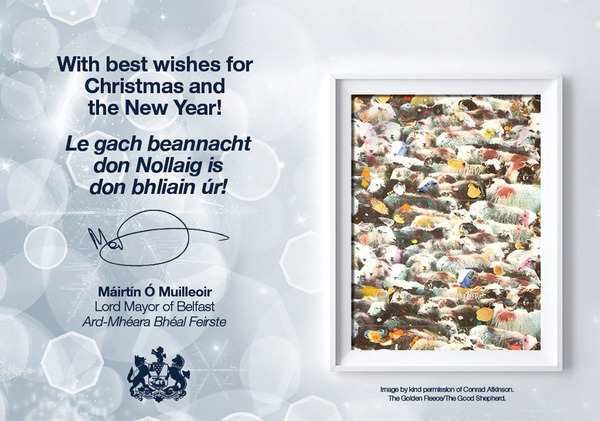
Lord Mayor’s Christmas Message
|
||
Posted in Article
Comments Off on Lord Mayor’s Christmas Message
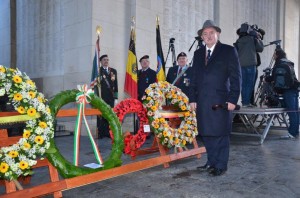
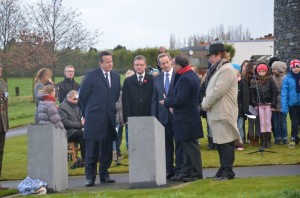
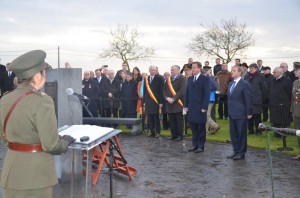
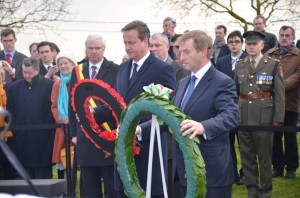
Prime Minister David Cameron & Taoiseach Enda Kenny Great War visit to Belgium
![]() |
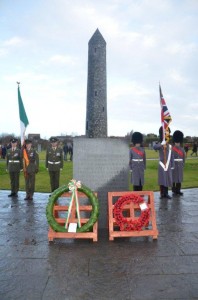
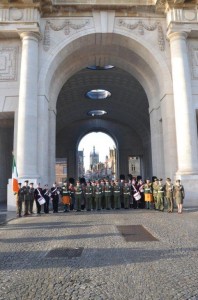
| On the invitation of the British and Irish Governments I was honoured, as Chairman of the Somme Association, to attend this visit to the Island of Ireland Peace Park in Mesen (Messines) and the Menin Gate in Ieper (Ypres).
PRIME MINISTER DAVID CAMERON & TAOISEACH ENDA KENNY
§ Wide coverage in the UK, Ireland and Belgium of the visit of British Prime Minister David Cameron and Irish Taoiseach Enda Kenny to First World War memorials across Flanders in Belgium. Media report on the joint visit to the Island of Ireland Peace Park, the grave of William Redmond, the village of Wyteschaete, the Menin Gate in Ypres, and Tyne Cot Commonwealth War Cemetery, as well as the Prime Minister’s relative Captain John Geddes and the PM’s announcement to provide £5 million to repair First World War memorials. A number of media note that the British and Irish leaders also met Belgian Prime Minister Elio Di Rupo at a ceremony under the Menin Gate in Ypres. Tweets by British Prime Minister David Cameron @Number10gov @Number10press @David_Cameron , the British Embassy to Belgium @UKinBelgium , @BritEmbDublin and @IrishEmbBelgium, Belgian Prime Minister Elio Di Rupo @ElioDiRupo , reached digital audiences of over 3 million. Photos of the visit were also highlighted on facebook pages, including by Downing Street and the British Embassy to Belgium. Articles about the visit and the £5 million funding announcement are featured on the websites of Number 10 and British Embassy to Belgium. |
Posted in Article
Comments Off on Prime Minister David Cameron & Taoiseach Enda Kenny Great War visit to Belgium
The Pictish Nation: 24 – Chapter 8 (Concluded)
S. Llolan, another Briton who laboured in the Forth area, is represented by the Scotic Churchmen of the fourteenth century as ‘a nephew’ of the unhistorical Servanus. He certainly took up the work of the historical Servanus or Serf, and taught and died at Kincardine-on-Forth. The true story of his life had been almost completely forgotten, and the fabulists invented a biography for him. A hand in the Breviary of Aberdeen attaches such absurd fables to his name that even a Bollandist editor was shocked, and wished them erased from the Breviary. The Scotic annalists dated him, after their manner, by the reign of one of their own princes, ‘ Duncan, filius Conaill king of Dalriada, who was slain by Aedhan A.D. d. 576. Aedhan had usurped the Dalriad throne under the patronage of S. Columba, and disposed of his rival, Duncan, at the battle of ‘Telocho’ in Cantyre. Duncan (Donnchadh) was grandson of Comghall,fourth King of Dalriada, and tried to maintain himself on the throne in face of Aedhan : but unsuccessfully. Challoner had some information which indicated that S. Llolan was one of the bishops who came from Candida Casa.One edition has ‘ Whitern,’ another ‘Whithorn.’ It is stated that S.Llolan had a Church-foundation near Broughton, Tweed-dale. The lands of his muinntir called’ Croft Llolan’ were at Kincardine on-Forth, where his bachul and bell were preserved. The old Earls of Perth were the custodians. The bell was still in existence in A.D. 1675.
S. Brioc, a Briton, falls into this group of Britons, because he laboured among the Britons and Picts in the early sixth century, before the Celtic population of the south-west of what is now Scotland had been penetrated by Anglian raiders and settlers. His known Church-foundations were at Dunrod, Kirkcudbright; Rothesay; and “Innis Brayoc,’ Montrose. He ought not to be confused withthatotherBriton.S.Brioc of Brieux in France. When the Gaidheals or Scots became dominant in the Church of Pictland their pronunciation and spelling of his name caused some of his foundations to be confused in later years with dedications to S. Brigid. In the Roman Catholic period his foundation at Dunrod was dedicated to the Virgin Mary. Two other missionaries in Pictland, whose names are still conspicuous in the Church, fall to be noted here, although it is now impossible to give exact dates for them. One is ‘ Mochrieha,’ whose work lay along the rivers Don and Dee in Aberdeenshire; the other is the saint whose name is contained in the thirteenth-century spelling ‘ Lesmahago,’that is, Lesmahagow, Lanarkshire.
S. ‘ Mochrieha,’ to take his name as preserved by the Celts of Deeside, founded one Church, among others, opposite Crook o’ Don, near what afterwards became the city of Aberdeen ; and the site of this Church became in later centuries the site of the Cathedral of Aberdeen. S. Mochrieha’s Cross — a conical stone with a primitive incised Greek cross similar to an example taken from S. Ninian’s Cave at Glasserton — stands on the top of a tumulus among the hut circles and cairns of an ancient Pictish settlement, about two miles north-west of Aboyne. Here also is S. Mochrieha’s Well ; and, before it was broken up and removed, stood the ‘ Cathair Mochrieha. ‘ The name of this ancient Pictish settlement has been completely forgotten. It is overgrown with thick wood. The high ground behind is ‘ Baragowan,’and the wood ‘Balnagowan Wood.’ If there is any grain of historic truth in the folk-tale f of the miraculous bag of seed which S. Mochrieha received from S. Ternan of Banchory, it probably lies in the indication of a working fellowship between the two saints. Every authentic detail relating to S. Mochrieha was garbled by the conformed Gaidheals or Scots of the early Roman Catholic period, probably to secure precedence for Aberdeen over the ancient centre of the Pictish Church at Mortlach.
Just as S. Drostan of Deer, a Briton, who lived before S.Columba, was transformed into adisciple of S. Columba; so, also, S. Mochrieha was represented by the Gaidheals as one of S. Columba’s followers; and their legends proceed to add that he led a mission into Pictland, The scribe who invented that legend of a mission of Gaidheals was probably not aware that even S. Columba was prevented by the language difficulty from undertaking missions into Pictland; that when he visited the
Pictish sovereign his interpreter was the greatest Pictish ecclesiastic of the period; that when heministered to a Pict in the Dalriad area, he required the assistance of an interpreter; that the political relations between the Gaidheals and Picts in S. Columba’s time precluded friendly intercourseand religious missions; and, finally, that Pictland, including the stretch of the Dee, had been more thoroughly christianized than S. Columba’s own Dalriada, in his own time, by S. Ninian and his successor S. Ternan, who had established his Bangor on the Dee with its Church, its manuscript of the Gospels, and its school, at a time when S. Caranoc, S. Ninian’s other pupil, was striving in Columba’s native Donegal to win from paganism the very tribes of the Nialls from whom S. Columba in another and later century was born.
S. Columba’s disciples are known, and S. Mochrieha is not among them, not even when we look for him under the name ‘ Machar,’ which the Latin Churchmen from the Lowlands gave him when they mistook the name of his Church-site on the ‘Machair of Don for the saint’s personal name, and latinized it as ‘Macharius’ and ‘ Mauritius’ The late Dr. Reeves, who in this matter has even misled many who were in a position to know better, never entered on a more hopeless quest than when he set out to identify the saint of Aberdeen in the preserved list of S. Columba’s disciples. His decision lighted on Tochannu Mac-U-Fircetea, whose surname he broke up, to suit his predilection, into the amazing form ‘ Mocufircetea’; and he identified ‘ Machar’ with‘ Mocufir.’ Apart from the absurdity of this name, if the identification had held, it would have resulted in this saint being commemorated by a formal surname instead of by the Christian name, which was the constant practice of the Picts; although, in the case of S. Kentigern,the people substituted the pet name for the stately ‘Kentigern’ which had more befitted the civil dignity which he had rejected. The actual result of the hypothesis of Dr. Reeves has been that certain writers now make confusion worse confounded by referring to S. ‘Machar’ of Aberdeen as ‘Tochannu’ or ‘ Dockannu,’ a name which belonged to a man of alien race in an alien Church.
Lesmahagow marks the site of a Muinntir which was governed by an Ab. The community dates back to atime when this part of Lanarkshire was still Brito-Pictish, that is, before the northward advance of the Angles. The site-name suggests the foundation of an Irish Pict as in theinstance of Lismore. The g in the second section of the place-name, which is also the name of thefounder of the Lis is Britonnic, and renders the saint difficult of identification. In A.D. i 144 the Roman Churchmen glossed the saint’s name as ‘Machutus,’ presumably S. Brendan’s disciple; but he certainly was not this S. Machute. Neither was he S. Maclou or Malo with whom he has also been identified. Extraordinary as it may seem, to anyone but a Celt, the saint’s name was probably Aedhoc which with the honorific mo becomes Moaedhoc; giving the phonetics, with.the euphonic h, Mohaego ,which agrees with the locally accented pronunciation, and the forms ‘ Lesmahago’ (c. 1130) and ‘Lismago’ (1298). The modern equivalent of the Celtic Aed is Hugh, and it is significant that at farms in the uplands of Lanarkshire, and certain districts of Ayrshire, the diminutive of Hugh still takes the form ‘ Hugoc’ Where the saint of Lesmahagow came from is nowhere indicated. Like many other British and Pictish missionaries of his period, whose names only are left, he remains to later generations,like Melchizedec, ‘without father, without mother, without genealogy.’
Posted in Article
Comments Off on The Pictish Nation: 24 – Chapter 8 (Concluded)