The Pictish Nation:15 – Chapter 7 (Cont’d)

Documentary testimony which, thus far, has been comparatively full with regard to the missionaries who went from Candida Casa to Ireland becomes scant with regard to many of the missionaries who, before and after S. Finbar’s time, maintained S. Ninian’s Mission-Churches in the east and north of Pictland of Alba (Scotland). We frequently require to appeal to the face of Scotland for traces of journeys; and when we find ancient Church-sites in the south-west, that is in the Candida Casa district, bearing the names of SS. Ternan, the historical Servanus, Pauldoc (Pawl Hén), Rum map Urbgen, Donnan the Great, Earnoc, Vigean, and Walloc, the foreigner or Welshman, with a score of others not accounted for from the Irish houses; and, again, other ancient Church-sites in the east and north of Pictland bearing the same names; we are confirmed in the knowledge that Candida Casa was the spiritual home and starting-place of these founders. As we have seen, Ternan is recorded as Ab of Candida Casa after S. Ninian the Great and before Nennio ‘the little monk’; S. Donnan is known to have gone from Candida Casa and to have visited S. Ninian’s Churches in the north-east of Pictland, and he and his disciples are known to have founded new Churches in extension of S. Ninian’s work at the various localities where they laboured c. A.D.580.

At the time when S. Donnan, with the unusually large number of ‘fifty-two’ disciples, left Galloway, Candida Casa must have become a rather insecure place to some of the inmates. The Angles, who were pagans, had begun in the sixth century to spread themselves across the island from the North Sea to the coasts of the North Channel and Solway. Their aim was to drive a Teutonic wedge through the heart of the Celts, to separate the Britons of Strath-Clyde from the Britons of what is now Wales; and to force back the Pictsof the east coast to the north of the Tay. S. Kentigern of Glasgow found his fellow-Britons driven into the uplands of Lanarkshire, Galloway, and Cumberland, partly as a result of the aggression of the barbarian Angles, and partly by pressure from Brito-Pictish clans expelled from their own domains by the Angles. These disturbances of the native population and the savagery of the Teutons brought a temporary check to the progress of Christianity. Very likely at this time the documents of Candida Casa were scattered, lost, or destroyed. Some of them survived in thehands of the Angles, because there was an ancient Life of S. Ninian translated into Saxon to which Ailred had access. It was at this time that S. Kentigern was moved to lead a mission southward from Glasgow to preserve the Faith in districts where S. Ninian, or the workers of his house, had long before planted Churches andorganized Communities; and, incidentally, to make some effortto Christianize the pitiless Angles.

By the advance of the Angles, Candida Casawas, at times, surrounded on the land side by unsympathetic foreigners; and cut off for periodsfrom safe communication with its Churches in Pictland. However, the great Pictish communityof S. Comgall the Great at Bangor in Ireland arose to help, and continued to supply a ministry and supervision to the Churches in Pictland which owed their being directly or indirectly toCandida Casa. Although Candida Casa was thus obstructedin its work, it was not overwhelmed by the intrusion of the pagan Angles into Galloway, becausePaulinus, Roman Archbishop of York (c. 627), showed interest in the Church and community of Candida Casa, during his stay at York.

It is important to note this; because VenerableBede who wrote the Life of S. Cudberct (Cuthbert) knew that Cuthbert visited the Picts of Galloway when he was Ab of Mailros (Melrose) shortly after A.D.661. Cuthbert was a pupil of the Celts who had gone over to the Roman Mission, He laboured among the Angles who had been formally ‘converted’ to Christianity by the Roman missionaries a.d. 627, although theCeltic missionaries under Rum map Urbgen, a Briton, had made Christians of the whole Anglian tribe called ‘ Ambrones ‘ at an earlier date. Some of the mediaeval scribes, in ignorance, have transferred this interest in Innis Wytrin, Isle of Whithorn, away from the diocese ofPaulinus to Glastonbury of Somerset. They knew nothing of Glaston of Whithorn apparently.Cuthbert was not only zealous to convert Angles ; but to romanize the Celts who adhered to the methods and usages of the monastic Church of the Britons and Picts. It was in the interests of Rome, therefore, that Cuthbert journeyed to the gates of Candida Casa.

It is not without interest that Venerable Bede gives no particularsconcerning Cuthbert’s reception at the mother-Church of British missions. His silence is noaccident. Does it mark one of the places in his
manuscript, where, as Bede himself candidly tellsus, he excised historical information at the request of those critics who could tolerate no information about Christian work which preceded the Roman Mission and detracted from its claims? Or is it simply one of the many instances in which a Roman author refrains from due reference to the mother-Church of the Britons and Picts, because the ancient date of its foundationand the wide radius of its missions rendered ridiculous the pretensions to primacy of the growing Church of the Angles, and conflicted with the claims of the See of York to jurisdiction wherever the Angles had penetrated? Cuthbert’s mission was earnest enough; because across thebay from Candida Casa he planted the rival Roman Church of ‘Kirkcudbright,’ where we see a Roman foundation, as distinct from a dedication, with the Saxon ‘Kirk’ attached tothe founder’s name instead of the older Celtic’ It looks an unimportant difference; but it indicates that wherever a romanizing agent succeeded, his centre of influence was a Church in charge of a presbyter in some secular township, instead of the Casa or Cell of an Ab in the midst of a religious ‘family’ with Churches, Schools, places of Retreat, and other peculiar pertinents of the Celtic religious clan.

Some have inferred from Bede’s strangesilence regarding S. Ninian’s establishment that Candida Casa had ceased to exist in Cuthbert’s time; but this was not the case, because c. A.D.785 F. A. Alcuin aided and honoured Candida Casa ‘because of the holy men who had laboured there.’ The truth manifestly is that in Cuthbert’s time the Celtic brethren of Candida Casa had no dealings with the representatives of the Roman Mission, and there is no indication that they had been specially enthusiastic over the kindly patronage of Archbishop PauHnus.However, the steady pressure of the Roman missionaries, reinforced by the civil power of the converted Angles, brought, in course of time,’the desired change to Candida Casa. In the third decade of the eighth century it conformed to Rome. From being the mother-Church of the Britons and Picts it was degraded to be the Church of a local diocese, subordinate to York. Even then, some memory of its former positionadhered to it; because its first monarchic bishop, A.D. 730-735, is called Pechthelm, Protector of the Picts, and its third Roman bishop bears the name Pechtwine, Friend of the Picts.

The Roman Church did not treat Candida Casa with due respect as the years passed by. Complaint has been made by the modern Romanist and Anglican that the Protestant reformers after a.d. 1560 esteemed it not. The Protestant only allowed its walls to decay, and its hallowed stones to sink into the dust to be trodden by irreverent feet; but the Roman innovators from the eighth centuryonwards, although they knew the facts, obscured its true origin and character, misrepresented S. Ninian, its great founder, and his work, in the interests of a foreign Church with monarchic forms of government that suited the barbarous Angle, but proved irksome to the Celt with his democratic clan-life and patriarchal chiefs. Moreover, the prelates of York belittled Candida Casa in the interests of the precedence of that growing metropolis of the Angles ; jus tas, in a later period, the prelates of Glasgow belittled it in the interests of the precedency of the See of Glasgow, although they were not above putting forward the historical priority of Candida Casa when it was necessary for the See of Glasgow to resist the pretensions of the prelates of York to spiritual jurisdiction in Scotland.

Nevertheless, Candida Casa under Roman control did not forget all her ancient daughter-Churches in Pictland with their possessions and interests. About A.D. 1223-7, Candida Casa sent out two of her Canons in the footsteps of her early Celtic missionaries. One was a Celt called Maol-Choluim or Malcolme. His object was to win control for Rome over those Celtic Communities and Churches, some of them founded by S. Ninian, which in the isolated and conservative North still adhered to the old ways, and steadily resisted the innovations of the romanized clergy. Maol-Choluim, probably without a thought of his inconsistency, actually carried with him alleged bones of S. Ninian to re-sanctify Churches which the living Ninian had consecrated. Ferquhar of Ross, a western ‘Celt,who,by his sword, was carving a way to favour with the king and to an earldom in the east, found Maol-Choluim wandering in the vicinity of S. Ninian’s Celtic abbey at Fearn, Edderton, which S. Finbar had visited when he was at Candida Casa, and where Reodatius had been Ab in the eighth century. Ferquhar diplomatically gave his support to Maol-Choluim, and established him at Fearn in the old daughter-house of Candida Casa, which was thus romanized. The recovery of the old house was not followed by peace. The native Celts resented the presence of the romanized intruders. About A.D. 1238-42, in the time of the second Roman abbot, ‘owing to the hostility of the natives,’ the abbey was transported to Nova Farina, the present site, where it remained under the control of Candida Casa until near the Reformation,

Posted in Article | Comments Off on The Pictish Nation:15 – Chapter 7 (Cont’d)

The Pictish Nation:14 – Chapter 7

CANDIDA CASA (WHITHORN)

It is now hardly realized that Candida Casa, besides being a great ecclesiastical community under S. Ninian, became, like its prototype S. Martin’s, Tours, a great school and training centre for Celtic missionaries. S.Ninian, as we have seen, broughtthe nucleus of a community with him from Tours; and by the importation of the institutional namesbelongingtothe parent community seems tohave desired to be regarded as presiding over one ofthe outposts of the novel missionary system which S. Martin had set up in Christendom. One of theearly Irish names, therefore, besides those already mentioned, for Candida Casa was Taigh Martain,that is. House of Martin; and, indeed, the first ‘White-Hut’ on S. Hilary’s farm which was givenby the latter for S. Martin’s experiment in communal asceticism and culture became ‘ Taigh ‘Mariain,a. ‘house’as distinct from a Church. We have forgotten now that S. Martin was an innovator,suspected by the orthodox clergy in Gaul ; that no recognized ecclesiastical names fitted his novelties; and that muinniir (family) and taigh (house) were taken from common secular speech and appHed to his institutions. To the Christians of the Imperial Roman garrison and colony among the Britons, S. Ninian, also, would appear an introducer of strange methods. His use of S. Martin’s own name and of S. Martin’s institutional names to cover his work was designed to throw the responsibility on S. Martin for any departure from usual methods.

The Irish sources inform us that S. Ninian, besides his mission to the Picts of Alba (Scotland), conducted a mission to the Pictsof Ireland.This mission cannot be treated in detail here; but it is necessary to refer to it, because from the converts which it produced, or from their successors, came some of the most famous of thepupils of Candida Casa, and some of the most zealous of the missionaries who took up and continued S. Ninian’s work in Pictland of Alba(Scotland). The Irish have preserved S. Ninian’s name in its original Britonic form, namely, Nan or Nen. They add the honorific prefix Mo-. The name becomes Monann or Monenn.

Across the North Channel, nearly opposite Candida Casa, in the shelter of ‘ Loch Cuan,’ now Strangford Loch, in the territory of the Irish Picts,a mission-community was organized in the fifth century at ‘n-Aondruim, corrupted into ‘Nendrum.’ The first resident president of Aondruim, towards the end of the same century, was S.Mochaoi, son of Bronag, daughter of Maelchon, the man to whom S. Patrick was a slave for six years. The community of Aondruim was dependent on Candida Casa; because we find that the’ships’ of S. Ninian’s house were in the habit of calling there; and also that S. Finbar, by order of S. Caolan, his master, who was second Ab of Aondruim, took passage on one of them to Candida Casa for the purpose of completing his education. In the same Pictish district as Aondruim, S. Finbar in the sixth century organized his own ommunity at Maghbile (Movilla) ; and S. Comgall the Great organized the most famous of allthePictish communities at Bangor. The relations of thesePictish communities with one another and with the communities among the Southern Irish Picts,on the one hand, and with the parent community at Candida Casa on the other, explain why so many Irish Picts figure among the pupils of Candida Casa, and why so many of the same people took up and continued S. Ninian’s mission-work in Pictland of Alba (Scotland).

One of the first of S. Ninian’s pupils to followhis master’s example and to organize missions under his own leadership was Caranog ap Ceredig, a Briton, more easily recognized under the later spelling of his name, Caranoc ap Ceretic  He was of the family of Ceredig, ‘Guletic,’ who acceded to the supremacy of the British chiefs in the districts between Severn and Clyde after the Imperial Roman legions had retired. His name will appear again in connection with S. Ninian’s work in Pictland of Alba; but his missions extended to all the Celts, to his fellow-Britons, to the Irish Picts across the North Channel, and tothe Gaidheals or Scots of Ireland, at that time dwelling nearer the Atlantic seaboard than a century later. The Gaidheals regarded S. Caranoc as the first evangelist to visit them. He baptized his fellow-Briton the historical S. Patrick. The Gaidheals also declared that he bequeathed tothem his ‘Miosach,’ which the Nialls carried at the head of their armies.Caranoc is not to be confusedwith Carnech, son of Saran, a Gaidheal who belonged to a much laterperiod, and with whom he had nothing in common but similarity of name.

In one of their ancientbooks it is stated that he belonged to ‘ Taigh Martain’ among the Britons, that is, Candida Casa.He is designated as ‘Ab,’ and so must have filled the presidency for a time between S. Ninian’sdeath and the appointment of S. Ternan. Hewas, however, constantlyengagedon mission journeysuntil his martyrdom. He had communities which he himself had organized, and a settled place forrest and ‘retreat’ at the Cave ‘Edilg.’ He kept S. Ninian’s most distant converts in touch withthe parent community at Candida Casa, and extended S. Ninian’s mission enterprises both inPictland of Alba (Scotland) and in Ireland. One of the Pictish Church-sites bearing his name isas far north as the banks of the Deveron, near Turriff. He is regarded as having introduced the Celtic monastic system into Ireland, as being thefirst Christian Brehon, and as the first martyr.Inthe ancient Irish poem which deals with S. Patnck’s muinntir it is stated that Caranoc baptized S. Patrick. ‘Carniuch (Caranoc) was the presbyter that baptized him (Patrick).’The baptism apparently took place, as we know from other information,during one of Caranoc’s early missions while he was yet a presbyter

This, according to the Life of thehistorical Patrick, must have taken place someconsiderable time after he was fifteen years ofage; because in the Confession Patrick writes : ‘I know not, God knoweth, whether at that time I was fifteen years old, but I believed not in the living God, neither had I from infancy, I remained in death and unbelief The fabulists forgot Patrick’s testimony about himself; and also that infant baptism was not a practice of the time.When S. Patrick began to work in Ireland, Caranoc and he agreed that the one (Patrick) should work to the left,’ that is, the southward, and the other(Caranoc) would continue to work to ‘the right,’ in the northward part. The range and influenceof S. Caranoc’s work in Pictland (Scotland),among the Britons, and among the Picts and partof the Gaidheals of Ireland, show that he considered Candida Casa adequately equipped tofurnish a steady supply of ministers to occupyandhold the spheres of work which he was opening up to the Church.

Although no connected history of CandidaCasa has survived,we are able to secure glimpses of it after S. Caranoc’s time in the Lives of its various pupils. Alcuin, in the eighth century, by his remarks of appreciation, indicates that he knew about its early history.The names of two other Abs whoruled between S. Ninian’s death, a.d. 432, andthe early years of the sixth century have been preserved from oblivion, namely, ‘Tervanus,’ a scribe’s error for Ternanus, and ‘Nennio,’ or ‘Monen,’ a bishop.f Nennio, to distinguish himfrom his namesake the founder, S. Ninian ‘the Old,’ or ‘the Great,’ was called in Latin ‘Mancenus,’ and in native speech ‘Manchan,’ which is Manach, a monk with the diminutive of endearment. He is also referred to as ‘Manchan, the Master’ of the community.One of the features of the parent-muinntira S. Martin’s, Tours, had been that education wasprovided for high and low,the people were trained in agriculture, and gifts of seed distributed toencourage them. S. Ninian, and his communityafter him, faithfully followed S. Martin’s example.One of the pupils who went to ‘Rosnat.’ thename given by the Irish sailors to the locality of Candida Casa,(this is evidently Ros-Nan(t), the promontory of Ninian, and applied to the ‘Isle-head’ at Whithorn, was S. Endeus or Eany.

He was there in the latter half of the fifth century. Hebelonged to the district evangelized by S. Caranoc and the community at Aondruim. His devotedsister Fanchea had been converted first, and inher enthusiasm moved her brother to train for areligious life. S. Eany was a man of influence, an Irish Pict, son of Conall Derg, Prince of Oriel, his mother, Aebhfhinn, being daughter of Ainmire Mic Ronan, king of the Ards (Ulster).After finishing his education at Candida Casa he organized a community of his own and settledat Aranmhor in Ireland. ‘Thrice fifty’ was the number of his ‘family’ there. Through him the influence of Candida Casa and its methods reached to his pupils S. Ciaran of Clonmacnoise,S. Finian of Clonard, and S. Kevin of Glendalough ; and through them again to some of themost distinguished missionary saints of Ireland. S. Eany died on the 21st of March A.D. 540.

While Nennio, known as the ‘ little monk,’ was ‘Master’ at Candida Casa, two Pictish boys were kidnapped from their homes in Ireland, probably to be detained as hostages, and they were carried into the territory of the Britons. The queen ofthe Britons pitied them, and, at her entreaty, the king sent them to be educated at the monastery of ‘Rosnat,’ called ‘Alba or the White,’ that is, to Candida Casa. These boys were called respectively Tighernac and Eogan. Tighernac was son of a Leinster captain who had married Dearfraoich, daughter of the king of Oriel. Eogan was son of Cainech Mac Cuirp of Leinster, who hadmarried Muindecha, who belonged to the district now called Down. After they had been educatedat Candida Casa both these men organized communities and settled with them in Ireland. S.Tighernac’s headquarters were at Cluain-Eois in Monaghan, where still exists the’Cloichteach’or Bell-house, similar to the Round-towers of Eastern Scotland. Angus the Culdee records of Tighernac, ‘Out of him burst a stream of knowledge.’ He died on the 4th of April a.d. 548. Eogan, with his Community, settled first at Kil-na-manach in Cualann, in East Wicklow, andafterwards at Ardsratha, on the river Dearg in Tyrone., He died on the 23rd of August A.D. 570, in extreme old age. At Candida Casa one of S.Eogan’s other fellow-students was Coirpre, whosettled at Coleraine among the Irish Picts, and was ordained a ‘bishop.’

We have noted a ‘ bishop ‘ at Candida Casaand, in this instance, at Coleraine; but it is necessary to remember that at this time there were nomonarchic or diocesan bishops among the Celts. The bishop might be an Ab,but more frequentlyhe was simply a member of a ‘family’ or community, and subordinate to an Ab. The only precedence which he was sometimes allowed was that he dispensed the Sacraments before a presbyter. About A.D. 520 S. Finbar came as a scholar to Candida Casa. He had been a pupil at Aondruim in the territory of the Irish Picts under S. Caolan, the second Ab, When the ‘ships’ of Nennio ‘the little monk ‘came to Strangford Loch from Candida Casa, S. Caolan directed Finbarto sail with them in order to complete his education at the parent-house. Finbar was at Candida Casa, or connected with its work, for ‘twenty years.’ Calculating back from his settlementat Maghbile, this period must have been from about A.D. 520 until a.d. 540. The scholars at Candida Casa when Finbar was a teacher, we learn incidentally, included Rioc, who afterwards became one of the most popular missionary-saints in Ireland; Talmag, a layman; and Drusticc, daughterof Drust, sovereign of the Picts. Another lady, Brignat,(one of the ‘family’ of S. Mo’enna,  in the minds ofthe Scottish people,and by some writers, she is confused with S. Brigid), waseducated at Candida Casa, and S. Mo’enna herself (her name of endearment is sometimes varied to Moninne,her proper name was Darerca),worked in communion with the same house.During S. Finbar’s period at Candida Casa, Nennio ‘the little monk’ ceased to rule; and Mugent, who is also referred to as ‘Master in the city called Candida,’ became Ab.

Posted in Article | Comments Off on The Pictish Nation:14 – Chapter 7

Van in Madison Square Garden, New York

Posted in Article | Comments Off on Van in Madison Square Garden, New York

The Pictish Nation:13 – Chapter 6 (Cont’d)

The ancient Church-sites that represent S.Ninian’s actual foundations among the Britons and Picts were, or are:

at Candida Casa, the mother-establishment, Whithorn, Galloway;

at S. Ninian’s, Colmonell, Ayrshire;

at ‘ Kil Sanct Ninian,’ Ardmillan, Ayrshire;

at ‘Cathures’ on the Molendinar.now the site ofS. Kentigern’s Cathedral, Glasgow;

at ‘An Eaglais,’ the Church, now the Church of St. Ninian’s, Stirling;

at Coupar in Angus, where are S. Ninian’s lands;

at Arbirlot, Forfarshire, where S. Ninian’s Well remains.Here the memory of the locality of S. Ninian’s muinntir was preserved in the name ‘the College,’ which was on the north bank of the ‘Rottenrow’ burn, about a mile north-west of the present Church of Arbirlot. Over twenty years after the dedication, in A.D. i i 78, of the Roman Abbey of Arbroath, the ancient Celtic community of Arbirlot was still represented by a lay Ab and a clerical chaplain, evidently his vicar. Mauricius, Abbe of Abereloth,’ witnessed four charters of Gilchrist, Earl of Angus, between 1201 and I207.

Another site was at ‘S. Ninian’s Inch,’ Arbroath, Forfarshire. The Celtic ‘Inch’ or Innis is no longer current in Arbroath speech. The’ Inch’ was apparently the pasture-stretch on the shore at Seaton, where S. Ninian’s Well is, andwhere there was an ancient Churchyard. The Churchyard was on the high ground of Whiting-Ness headland above the Well. Here several ancient burials were opened out. The original Church was, of course, also at this spot. The situation of the ancient Churchyard, and the position of the Well, with all the surroundings, are strikingly duplicated at S. Ninian’s, Navidale, Sutherland. The whole district is rich in remains of the Pictish Church, including the sites of the Churches of S. Vigean, S. Muredoc, and the graven crosses dug up thereat. George de Brana erected a new Church here in 1483, and dedicated it to S. Ninian, the original founder.

Tracing S. Ninian’s actual foundations farther north, there are sites :

at Dunottar, Kincardineshire, where Earl Marischal, extending the Castle about 1380, invaded the inclosure of the ancient Church of S. Ninian, then in ruins;

at Andat, Methlick, Aberdeenshire. Andat means a Mother-Church;

at S. Ninian’s, Pit Medan, Aberdeenshire. A S. Medan was nearly contemporary with S.Ninian;

at S. Ninian’s, Morayshire, ‘near where Speyenters the sea,’ apparently the pre-Roman Catholic Church of Fochabers;

at S. Ninian’s, ‘ Diser,’ % in Moray, believed to beat Dyke;

at ‘An Teampul or ‘ Tempul Rinian,’ LochNess, Inverness-shire;

at Fearn, Edderton, Ross-shire, the original siteofthe Celtic Abbey of Fearn; and, for a short time, the site of the Roman Catholic Abbey ofFearn.the Roman Abbey was moved to Nova Farina,the present Fearn, south of Tain, in 1238. TheAbbey of Fearn remained a daughter-house of Candida Casa, from the Celtic Church period until about the time of the Reformation. Part of the memorial cross, dating eighth century, of Reodatius, Ab of the Celtic Abbey, has been recovered, and the uncial inscription has been read,’In the name of Jesus Christ. A cross of Christ, in memory of Reodatius. “May he rest(in Christ).” Reodaidhe, Ab of Fearna, according to the Annals of Ulster, died A.D. 762.

Tracing S. Ninian’s foundations still farthernorthward there are sites :

at S. Ninian’s, Navidale (‘Ni’andal’), Sutherland,where in one ofthe graves of the Churchyard were found a bronze knife, a flint implement,and the palmated antler of one of the extinct deer. His well, ‘Tober ‘inian,’ flows in the gorge near the Churchyard.

at S. Ninian’s, Head of Wick, where the inlet below is known as Papigoe, the Papa’s(Cleric’s) inlet,

at S. Ninian’s, Orkney, now North Ronaldshay;

at S. Ninian’s Isle, Dunrossness, Shetland, where the stone with Ogham characters was recovered, which indicates that the site was occupied by members of S.Ninian’s ecclesiastical ‘family.’

This chain of Church-sites, almost prehistoric, and the Church-sites, bearing later native names, that historically were linked on to it, and the ancient stones with Pictish symbols whose meaning has been forgotten, which these sites have yielded, confirm decidedly and accurately Bede’s information that S. Ninian christianized the Southern (our Eastern) Picts; and also Ailred’s statement,drawn doubtless from the Old Life, that he divided the whole land, namely Pictland, into distinct districts.

When, further, we consider this chain of ancient Church-sites bearing S. Ninian’s name in the light of the historical canon  that early Celtic,and especially Pictish, Churches took their names from their founders, the confirmation of Bede and Ailred is conclusive. Historians have seldom troubled to diflferentiate between Churches which were actual foundations by a missionary-saint, and late Churches which were merely dedications to his memory, or dedications under his supposed protection. Even the Roman Church did not dedicate its Churches for some centuries; and, at first, to martyrs only. The Celts did not dedicatetheir Churches until the eighth century whenthey began to be romanized. The Pictish Church, as a Church, did not dedicate at all. The attempts to dedicate Churches in the eighth century, underthe Sovereigns Nechtan and Angus I., and later,when the Pictish Church was closing its existence, were the efforts of individuals who hadcome under Roman Catholic influences.

Such few dedications as were made in Pictland during the last period of the Pictish Churchwere made by Roman Catholics to Roman, not to native saints. Wherever the Roman missionaries were able to assert any power they systematically sought to displace the original and nativesaint who had founded the Church of a town, and tried to substitute a Roman saint. At St. Andrews they displaced S. Cainnech by S. Andrew ; at Rosemarkie they tried to displace S. Moluag by S. Peter; at Deer they tried to displace S. Drostan by S. Peter; at Dornoch they tried to displace S.Finbar by S. Mary; at Arbroath, somewhat later, William the Lion, who betrayed so many of his country’s interests, set up a shrine and stately abbey dedicated to Thomas a Becket, in an attempt to supersede the neighbouring Churches of S. Ninian and S. Vigean, men to whom the district owed a real debt of veneration.

Frequently when the native clerics did not themselves resist, thepeople refused to allow the ancient Celtic foundations to be superseded. At Arbroath Thomas aBecket’s Abbey became a melancholy desecrated ruin; but in the original parishof S.Vigean’s intowhich the Abbey was intruded, one of its two ancient Churches, namely, S. Vigean’s, still survives with someof its ancient Pictish stone crosses; and it has happened similarly elsewhere in Pictland.There was more resentment at the Reformationagainst the Roman Church because it was foreign than has been allowed. The people, frequently, steadily insisted on burying their dead around the spots where the Pictish missionaries had first preached the Gospel to their forefathers, even when the Roman and post-Reformation clergy had withdrawn their patronage from these Pictishpioneers. The efforts of the Roman mission to blot out such names as S. Ninian’s from local memory often resulted in imprinting them more deeply; and so indicating clearly to later generations the older and native missionaries of theChristian Church.

After S. Ninian had established his Mission-Churches, in Pictland and had put them in charge of ‘brethren,’ as Ailred tells us, ‘he bade the brethren farewell and returned to his own Church’ at Candida Casa. At this point the historians usually take farewell of S. Ninian and drop all noticeof his Pictish mission, as if it had been ‘left in the air.’ S. Ninian, however, had organized his great mission to christianize the Picts that there might be abiding protection to the interests of thegrowing Christianity and civilization of the Britons. . He was an ecclesiastical statesman too thorough in his methods to leave his chief mission ‘in the air.’ The existence of the names of his successors in connection with Pictish Churches that owed their origin to Candida Casa ought to have warned historians that S. Ninian’s Mission-Churches survived and continued in communion with Candida Casa; and that they were supplied with a ministry therefrom, or from daughter-houses, long after S. Ninian had passed away.Fortunately there are fragments in the Lives of the Irish Pictish missionaries which settle this beyond dispute.

Posted in Article | Comments Off on The Pictish Nation:13 – Chapter 6 (Cont’d)

The Pictish Nation:12 – Chapter 6

THE BEGINNING AND
GROWTH OF THE PICTISH
CHURCH

Between the years 400 and 432 A.D. the Church of the Picts, as we have noted, was founded, and gradually extended, by S. Ninian the bishop, a Briton, working from the Brito-Pictish mother-Church which he had established at Candida Casa (Whithorn) about A.D. 397- S. Ninian had been a pupil of S. Martin who laboured among the Celts of Poictiers, and who also ministered as bishop at the Celtic military city of Tours from the year 372. S. Martin was regarded as the inventor of a new organization for the Christian ministry; although, in reality.he only revived the old apostolic organization and multiplied it. He embodied active, ascetic, missionary ministers in small clans called muinntirs under a president or father, known, at first, among the Celts by the Greek title of Papa (This name, lifted from the Greek nurseries, was in S. Martin’s time a current title among the Greek Christians for a Christian minister and, later, by the Syrian title of Ab. These religious clans S. Martin fitted into the clan-system of the Celts of Gaul.

S. Ninian imitated his master S. Martin to the smallest detail in method and organization. When he returned from Gaul to Britain, shortly before A.D. 397, he settled at Candida Casa in Galloway with certain companions. Ailred, who had the Old Life of S. Ninian to guide him, but interpreted it  by his own mediaeval ideas, assumed that these companions were ‘masons.’ They were, without doubt, his muinntir or ‘family’ including artisan brethren such as accompanied S. Martin’s other missionaries, and all the Celtic missionaries after them, for the purpose of helping to organize and build up congregations; because to the Celts the Church was the Christian people rather than the Christian buildings. S. Ninian imported even the names of S. Martin’s houses from Gaul to Galloway. CandidaCasa,White Hut,is simply a translation of.’Logo-Tigiac’ or Leuko-Teiac, Bright-White Hut, the name of the bothy on S. Hilary’s farm near Ligugé where S. Martin first organized his ‘family’ or community. For the various forms of this name in Latin Logotigiacum, Locotegiacum, Lucoteiac, of Gregory of Tours, Fortunatus, and Longnon’s map of Gaul.The use of the diminutive teiac or casa prevents us rom thinking of Candida Casa as the conspicuous stone building which Ailred implies. It was more likely to have been, like the buildings which were afterwards modelled from it, a modest house suited for prayer and the dispensation of the sacraments to mall gatherings. This view is supported by the references to Candida Casa when Paulinus of York  and F. A. Alcuin gave help to prevent its dilapidation. These ‘White Houses’ are  found associated with Celtic Churches from Dornoch in the north of Pictland to Ty Gwyn ar Dav mong the Britons, in Wales.

Again, S. Martin’s community were housed, like S. Ninian’s followers who imitated them, in hutlets or cells. The whole community at Tours as called, and the name still survives, ‘Marmoutier,Magnum Monasterium, the big muinntir or community. S. Ninian’scommunity  at Candida Casa was called ‘Magnum Monasterium’ by the Latin writers, indicating that he had also imported the name Mormuinntir. Just as S. Martin had his Cave or Retreat in the sandstone rocks at Marmoutier so S. Ninian had is Retreat at the Cave in the rocks on the shore at Glaston, now Glasserton,a place much venerated of yore, which has yielded many interesting sculptured stones, and whose traditions and antiquity have been ascribed by the fabulists andignorant writers of the middle ages to Glaston of Somerset, now Glastonbury.

In describing S. Ninian’s mission-work in Pictland of Alba, now Scotland, Ailred(109-1166) drawing on
the Old Life, writes: ‘The holy bishop began to ordain presbyters, consecrate bishops, distribute the other dignities of the ecclesiastical ranks, and divide the whole land into distinct districts. Having confirmed in faith and good works the sons whom he had begotten in Christ, and having set in honour all things that referred to the honour of God and the welfare of souls, S. Ninian bade the brethren farewell and returned tohisown Church (Candida Casa).’ This description, allowing for Ailred’s rather grand way of expressing himself,appears to be taken from the Old Life; because the procedure ascribed to S.Ninian and the nature of the work accomplished were contrary to the rules and claims of the Roman Church in whose interest Ailred was re-writing the Saint’s Life.

Venerable Bede (673-735) as Ailred knew, had previouslyin the eighth century, incidentally, and without details, described S. Ninian’s mission into Pictland. Bede, however, was quite untravelled, and drew his geographical details from the library at Jarrow, with the result, as his writings indicate,that he fell a victim to Ptolemy’s Geography and its famous error with regard to Scotland. If amap be sketched according to the measurementsgiven by Ptolemy; Pictland, or the greater part of what is now Scotland, is thrown into the North Sea at right angles to England. Consequently,our westof Pictland (Scotland) was Ptolemy’s and Bede’s north and our east of Pictland was Ptolemy’s and Bede’s south.The persistent failure of historians to translate Bede’s geographical terms into harmony with modern geography has led to the falsification of the localities and the extent both of S. Ninian’s and of S. Columba’s work in Pictland. Ptolemy was wonderfiilly accurate in the data which he tabulated. The error in this instance was due to a mistake in the distance from his initial meridian line to the coast of Pictland or Scotland.

To bolster up the blunder, the ‘Grampians,’ which were nevereither a political frontier or a name* in ancient Pictland.were invented to play the part of ‘Drum-Alban.’ Drum-Alban was the chain of mountains which runs, roughly, northwards from the head of Loch Lomond to Ben Hee in Sutherland, dividing the rivers of Scotland and sending some to theEast and some to the West. The southern end of Drum-Alban corresponds, roughly, to the lineof the border between Argyll and Perthshire. It was the true historical divide between the consolidated nation of the Picts who lay to the East, and the diluted Picts who lay to the West, whoseterritory had been penetrated by the Gaidheals of the Dalriad Colony, and actually overrun bythem, for a time, between the death of Brude Mac Maelchon,A.D. 584, and the reign of Angus I. Mac Fergus,A.D. 729-761. The true name really belongs to Perthshire, and is, correctly, with Latin termination, Graupius (Stokes). The Gaidheals varied it to ‘Dorsum Crup’ and ‘Monid Chroibh,’ to accommodate their dislike of initial G.

With regard to the extent of S. Ninian’s missionto the Picts, Ailred confirms Bede’s account. Bede makes it clear that S.Ninian evangelized the whole Pictish nation, as Bede knew it, namely, Pictland east (Bede’s south) of Drum-Alban, the Gaidhealic or Scotic border (Bede’s north) of Drum Alban was due to S. Columba, that is to say all the Picts in the area ultimately occupied by the Gaidhealic Colonists until the kingdoms of the Picts and Gaidheals were united. Bede’s statement is — ‘For the Southern (our Eastern) Picts themselves, who have settlements up to the inner side of the samemountains(Drum-Alban), long before, as is told, having left the error of idolatry , had received the faith of the Truth fromthe preaching to them of the Word by Ninian the Bishop, amost reverend and most holy man of the nation of the Britons.’

Archaeological examinations of the surface of eastern Scotland have confirmed these accounts of S. Ninian’s work. A chain of S. Ninian’s Church-sites has been traced northwards from Candida Casa, passing through the formerborder-city of Glasgow on the old Brito-Pictish frontier, and extending to S. Ninian’s Isle, Dunrossness, Shetland. At this last site an ancient stone was dug up bearing the inscription in Ogham, ‘The lis (or inclosure) of the son (or disciple) of Ninian the Baptizer.’

Posted in Article | Comments Off on The Pictish Nation:12 – Chapter 6

Van in San Francisco

Posted in Article | Comments Off on Van in San Francisco

The 18th Annual Aisling Awards

 Aisling Awards


Aisling Awards 2013 422111mj13

Screen Shot 2013-11-22 at 11.49.41

This year’s Aisling Award recipients

Education: CBS – Mentoring Programme
Positive Belfast: World Police and Fire Games
Belfast Brand: Skainos
Sport: Cliftonville FC
Business: Duke of York
Culture and Arts: Féile 15
Gaeilge: Blas/It’s a Blas
Roll of Honour: Linda Ervine
Persons of the Year: Joe Brolley and Shane Finnegan

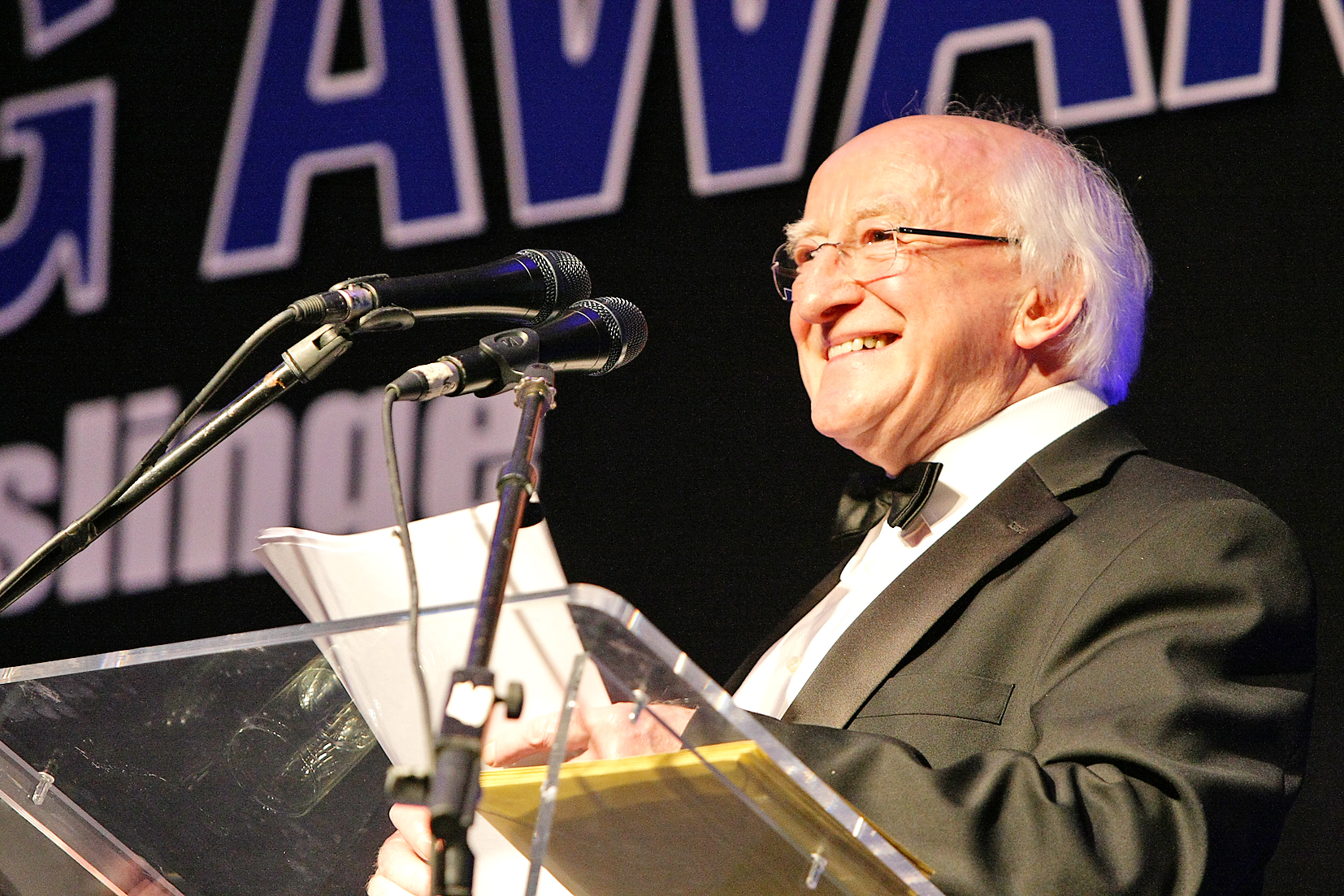
Tonight brought the Aisling Awards into its eighteenth year, rightly known as the “Belfast Oscars” this year was as big as ever.  The Aisling Awards remain the most ambitious awards ceremony in Belfast awarding many groups/persons from Belfast who deserve recognition for what they do, categories included Roll of Honour, Belfast Brand and Business Award.

I attended with my friend Ruairi O Bleine and presented the Positive Belfast Award to Dame Mary Peters, who accepted on behalf of the World Police and Fire Games.

The first nominee in the category was the World Police and Fire Games. In August 2013 Northern Ireland welcomed 7,000 competitors from 67 countries for the World Police and Fire Games. With almost every event open to the public and free of charge, they truly captured the imagination of the local population.  

Also on the short list we had Sólás, a special needs charity based in South Belfast, which supports the educational and social development of children with additional needs. In the past 12 months Sólás has developed additional programmes for children with autism aiming to plug the gaps in the provision of services for special needs kids. 

The Triage Project launched by Springfield Charitable Association in 2012 provides and organizes events on a weekly basis enabling social inclusion and providing support care and advice.  The initiative has now grown to include North and West Belfast. 

The West Belfast and Greater Shankill Integrated Services for Children &Young People programme has worked since 2009 to improve the life opportunities and outcomes for children, young people and families. With the aim of “tackling the scourge of unemployment and poverty” in west Belfast and greater Shankill. 

The judges said that this year they had a particularly difficult decision and that the final call came down to the wire.  But, in the end and after much debate over a two-day period a winner was chosen.

 
Posted in Article | Comments Off on The 18th Annual Aisling Awards

Feast of Columbanus: 2 – Remarks by President Michael D. Higgins

Remarks by President Michael D. Higgins

at the St Columbanus Day Lunch,

Belfast City Hall

Thursday, 21st November, 2013

Lord Mayor

Lord Bannside and Baroness Paisley

Councillors

Members of the Northern Ireland Assembly

Ladies and Gentlemen

Is mór an pleisiúr é bheith anseo libh inniu i suíomh iontach Halla na Cathrach le Lá Cholmáin a shonrú; le breathnú siar thar na blianta cairbreacha ar a bheatha agus an méid is féidir linn foghlaim uaidh a iniúchadh.

[It is a great pleasure to be here with you today in the splendid setting of Belfast City Hall to mark St Columbanus Day, to look back over great time and distance to the life of Columbanus and examine the lessons we can learn from him.]

One thousand three hundred and ninety eight years ago, and over two thousand kilometres from where we now sit, St Columbanus died in Bobbio. It is an extraordinary testament to his influence and legacy that, in the globalised twenty-first century, Columbanus’ message, his vision and his memory are still powerful enough to bring people together from different communities across this island.

I would like to thank very particularly the Ullans Academy and Dr Ian Adamson for inviting me to join you here today. The Ullans Academy promotes a vision of “common identity”. It is a well whose water we share, whose spring carries rich traces of what we shared in the past. At a time and in a place where identity can be used as a tool of division and demarcation, a tool to reinforce the chasms that might keep us apart, the Ullans Academy seeks instead to use identity as an instrument to promote mutual understanding and to explore the many aspects of our history and heritage – such as Columbanus – that we share in common.

Columbanus’ Irishness placed no obstacle on either his physical or his spiritual journey. He was a man deeply at ease with not just an Irish but a European identity, travelling huge distances, and coping with a disjointed Europe, its broken pieces that were emerging from the shadow of the fall of the Roman Empire. A skilled linguist with a fine mind and strong character, he adapted well to the languages and customs of the historic kingdoms that made up the chequered European landscape.

Names like Lombardy, Neustria and Burgundy may no longer be on today’s political map but, in these places, Columbanus wielded considerable influence and their peoples recall and remember Columbanus’ legacy to this day. James Joyce’s manifesto so many generations later to “Hibernicise Europe and Europeanise Ireland” was anticipated many centuries earlier by Columbanus.

The values that Columbanus preached and shared have stood the test of time and are of value as we are challenged to shape the European identity we live and work in today. A part of his rich legacy to us all are the words taken from his letter, and now immortalised in the stone of the Columbanus chapel in St Peter’s Basilica in Rome, “si tollis libertatem tollis dignitatem”. If you take away liberty, you take away dignity.

How true those words still ring across the centuries. Next month will see the 65th anniversary of the UN Declaration of Human Rights. This was a moment when the peoples of the world, in the shadow of a Second World War that saw human behaviour brought to a terrible nadir by the death camps, massive loss of life and immense physical destruction, set out what might be the universal human rights of all people as individuals. How remarkable that we can recognize Columbanus’ seventh-century philosophy in the core principles that the world’s nations endorsed in the aftermath of devastating war and bloodshed.

Columbanus placed a high value on the power of education, the study of texts, reflection and meditation and thus he established many flourishing centres of learning in a Europe of the Dark Ages. His emphasis on knowledge and scholarly learning shone through in a darkened Europe where the fall of the Roman Empire had led to economic and political fracturing, and not just a loss of learning but a hostility to its practice. It seemed very appropriate to me, therefore, that when I addressed the European Parliament in Strasbourg in April, I should invoke the name, memory and inspiring legacy of Columbanus.

Despite his pan-European consciousness and mission, today’s European Union of twenty-eight member states would be an unrecognisable dream to Columbanus. The EU we have, and are challenged with today, is born out of centuries of war and strife and was conceived when a small number of very determined people decided there must be another way, a better way to live, work and prosper together in peace. While it has struggled in recent years to meet the best aspirations of its founders, the European Union is still perhaps the most successful peace project process ever witnessed. Both in terms of the inspiring model it has offered – so often eloquently articulated for many years by, among others, John Hume – and by virtue too of the practical financial support it has provided, the European Union has made a crucial contribution to the advancement of the peace process in Northern Ireland; a contribution which no doubt would please Columbanus.

Making peace is of course only part of the task. Lasting peace requires care, nurturing, reconciliation and facing up with honesty and determination to the legacy issues that will continue to fester if left unaddressed. The Good Friday Agreement provides us with the institutions and principles not only to create peace but to enable it to endure. The names associated with the Agreement may be those of political leaders, but those leaders acted in a context where the broader civic society had made immeasurable contributions to promote the conditions for peace. As a result, in referenda over fifteen years ago people throughout the island were consulted and in both jurisdictions they voted for peace, for stability, for a shared and prosperous future – a future that they envisaged and to which they were willing to commit their efforts.

It would therefore be a mistake to see the Good Friday Agreement and the St. Andrews Agreement as merely structures to accommodate engagement between politicians. Our challenge today is to ensure that peace is not merely seen as a political construct, but rather something valuable that constitutes a living breathing reality within communities, between communities and between both parts of the island.

Columbanus, in founding monasteries throughout Europe, did much more than just create high or abstract institutions. He created living communities where shared values and a sense of solidarity could and did lead to great engagement and vibrancy. He was a man of strong and complex character, independent thought, unafraid to ask the hard questions, even if it meant challenging those in positions of authority.

Had he sought to withdraw or act alone, or had he meekly bowed to the received wisdom of the day, I very much doubt we would be recalling his name with such relevance well over a millennium later.

His story tells us of both the power of leadership and of community. A strong and flourishing communal life gives staying power and enables values and ideals to pass through the generations. It is for this reason that support for a healthy, vibrant and engaged civic society in Northern Ireland is so important to cementing the progress the peace process has made to date.

On this island, the impact and legacy of history continues to shape the daily narratives by which we live. We are now well into what has been called the decade of commemorations, where centenary anniversaries of the signature events for both parts of the island will, I hope, be recalled in a spirit that both respects historical accuracy and complexity. I also hope that tolerance, mutual understanding and generosity will characterize our efforts at engaging with the different, and sometimes differing, narratives that are cherished by each community.

In 2015 we will be commemorating events such as Gallipoli and the march-past by the 36th Ulster Division right outside this very Hall. In the same year, we will be assisted by casting our eye much farther back to commemorate the fourteen hundredth anniversary of the death of St Columbanus. It is my fervent hope that the lessons of his life – its reflection, scholarship and work – will advance the liberating and healing potential of this decade of commemorations and, conversely, will discourage and dislodge any tendency towards exploiting memory that might reignite hatreds or foment division.

On this island, it is our tendency to place a high value on the past and cherish the memory of iconic moments and revered figures that changed the trajectory of history. Our motives, and actions indeed, in delivering this passion for history have however not always been the purest. As we all know, history can be wielded in a deeply negative way, combed forensically to find justifications for grievances against “the other side” and versions of the past used to feed the animosities of the present.

The Ullans Academy is therefore making a very positive contribution by taking that innate and valuable passion for history, that seems to be in the very soil of this island, and guiding us towards a use of our historical curiosity that leads to a more healing and reconciling direction than we might have taken in darker times.

Today’s event reminds us that while the passage of time can change the contours of political maps and perhaps even community allegiances, it does not alter the call of our shared fundamental humanity with its innate decency and dignity, values which unite us all. Instead of history being used to divide, to assert how we are right and others wrong, to nurse grudges and grievances, it can be an instrument of reconciliation, an instrument for the nurturing of a new understanding and tolerance.

Our individual memory we must never forget, is entwined with the memories of so many others. Undoing the knots of memories so as to unlock the power to heal rather than divide is a challenging, often painful, but ultimately rewarding, and even cathartic task. Undoing these knots requires acts of leadership, such as that demonstrated by Lord Bannside when he led his party into a power-sharing government with his erstwhile political enemies. An act of leadership of a different kind was shown by your Lord Mayor when he recently participated in a ceremony of remembrance previously perceived as exclusive to one community.

We know the corrosive effect a frozen version of the past can have on political life and community relations in Northern Ireland. The challenges faced by post-conflict societies are never easy to address. The legacy of conflict leaves many painful issues and we must work through it with honesty, and generosity too, if we hope to reconcile the competing needs for truth, memory and justice with the maintenance of, what is sometimes, a fragile political consensus. At present, there is important work being done to address this difficult and complex dilemma. I wish Dr Richard Haass and all who are at the moment participating in, and contributing to, the Panel of Parties process, well as they seek a path to resolve these and other issues.

To overcome the challenges of conflicting versions of memory, civil society needs sources of vision, courage and much practical and sustained support to help frame in a new way what and how we are to remember, and how we let those memories impact on the work of today. We should not forget however that the challenge of dealing with contested memory is not unique to Northern Ireland and there are lessons we can learn from elsewhere.

In the past year, I have visited three countries in Latin America that are dealing with the legacy of violence. Memory was a recurring theme of these visits and it was instructive and moving to witness, first-hand, how countries like Chile, Argentina and El Salvador were setting about the task of moving – however slowly and painfully – from a divisive past to a shared future.

While each of those countries had their specific circumstances and particular challenges, one common feature was very clear to me; any invented or false amnesia is not the solution – neither for the victims, nor for the future of society if it wished to genuinely move on and flourish. For the victims, the words of the philosopher Paul Riceour:

“to be forgotten is to die twice”.

has a particular meaning, as it has for us all. We have to construct an ethics of memory for our reconstructions of the past and their commemorations.

Whatever mechanisms are ultimately agreed upon for this task, the overall needs of a flourishing and shared society must be at their heart and the memory of victims must appropriately be reflected, and cherished, in thoughtful memorials and initiatives that bring communities together, so that we all learn from the terrible failures of the past. Achieving an ethics of the memory makes, and will make, a demand on all of us, on all sides of history.

There are, of course, also opportunities to create new and benign memories; opportunities to participate in symbolic acts or gestures that can create a new template of shared understanding and reconciliation. The State Visit of Her Majesty, Queen Elizabeth II, to Dublin in May 2011 saw a number of such gestures – including a simple but profound bow of the head and five words in the Irish language. These had a hugely positive impact on how people in the South regarded the nature of the relationship between Ireland and the United Kingdom.

In my State Visit to the United Kingdom next April, I hope to further strengthen this thread of understanding, reconciliation and friendship and to also avail of the visit to highlight particular themes which merit recognition and commendation, such as the very positive role of the Irish community in Britain.

Mar fhocal scoir, ba mhaith liom a mholadh dhaoibh go dtugann ár gceiliúradh ar Cholmán anseo inniu an deis dúinn ár macnamh a dhéanamh ar an gcaoi gur chóir go ndéanfadh sábháilteacht inár bhhéiniúlacht féin muid a mhisniú, ar mhodh gníomhach, chun dearcadh agus tuiscintí an phobail eile a thaiscéaladh agus le dul i dteagmháil leis an dearcadh agus leis na tuiscintí sin.

[In conclusion, may I suggest that our celebration today of Columbanus is an opportunity to reflect on how being secure in one’s own identity should actively encourage us to explore and engage with the perspectives and narratives of the other community.]

Fifteen years on from the Good Friday Agreement and six years after the restoration of the devolved institutions, Northern Ireland has much to offer the world, and equally much to gain from its interaction with Europe. In remembering how Columbanus set forth from Ireland and engaged with the great European leaders and movements of his time, we might all reflect on how an ever more open and evolving dialogue with Europe, built on cohesion and solidarity, can be broadened and deepened, in the interests of all the communities who share this island.

Thank you.

Posted in Article | Comments Off on Feast of Columbanus: 2 – Remarks by President Michael D. Higgins

Feast of Columbanus 1


The President Dr Ian Adamson OBE

& the Directors of the Ullans Academy 

Invite you to the 

‘FEAST OF COLUMBANUS’ LUNCH 

Promoting Common Identity 

On Thursday 21st November 2013

12noon – 2.30pm 

Guest Speakers

President of Ireland Michael D. Higgins

The Lord Bannside PC 

RSVP by 16th November 2013 to

John Laverty – john.laverty@oadi.co.uk or 07880 504742


Venue: Belfast City Hall

Dress Code: Smart Casual

(Drinks reception on arrival) 

This event is sponsored by the Belfast City Council and Reconciliation Fund 

(Please inform us if you have any special dietary requirements)

Picture of St. Columbanus

Columbanus Celebration

Today, Thursday, 21st November 2013, in the City Hall Belfast, an event  took place under the auspices of the Ullans Academy which will have much significance for Northern Ireland. This was the Feast of Columbanus, a celebration of the Life and Work of the Saint.  The two guest speakers will be the President of Ireland, His Excellency Michael D Higgins and the Lord Bannside PC, Dr Ian Paisley. The event will also celebrate the second anniversary of the President’s inauguration. 

Columbanus was a disciple of Comgall of the Cruthin at Bangor ,Co. Down. In 589 he left Bangor for Europe to embark on one of the most remarkable journeys in European history.  The Roman Empire had collapsed under barbarian invasion, and barbarian kings and dukes now ruled Europe.  Order and learning had collapsed and the practice of Christianity had been almost extinguished. Ireland however had been unaffected by these barbarian invasions, so that the Irish Church had survived intact and its traditions of learning had continued unimpaired.

 Pope Pius XI has written: “The more light that is shed by scholars in the period known as the Middle Ages the clearer it becomes that it was thanks to the initiative and labours of Columbanus that the rebirth of Christian virtue and civilisation over a great part of Gaul (France), Germany and Italy took place.” The French poet Leon Cathlin concluded: “We must wait the coming of St Bernard to witness ascendancy comparable to his.  Saint Columbanus is one of the very great men who have dwelt in this land of France.  He is, with Charlemagne, the greatest figure of our Early Middle Ages”, and Daniel-Rops of the French Academy has said that he was ” a sort of Prophet of Israel, brought back to life in the sixth century, as blunt in his speech as Isaiah or Jeremiah…For fifty years souls were stirred by the influence of Columbanus, his passing through the country started a real contagion of holiness.” Indeed he may be considered the Patron Saint of Europe.

Our Feast of Columbanus, held close to his Feast Day, 23rd November, on the coast from which he left, for an audience of Friends of the Ullans Academy,was an opportunity for Community Activists from throughout the island of Ireland and beyond to hear more of their common history and heritage as a prologue to their shared future within these islands..

    
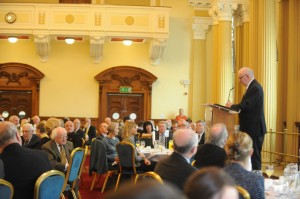
Dr Ian Adamson addressing the 300 guests— with Lord Bannside and President Higgins 


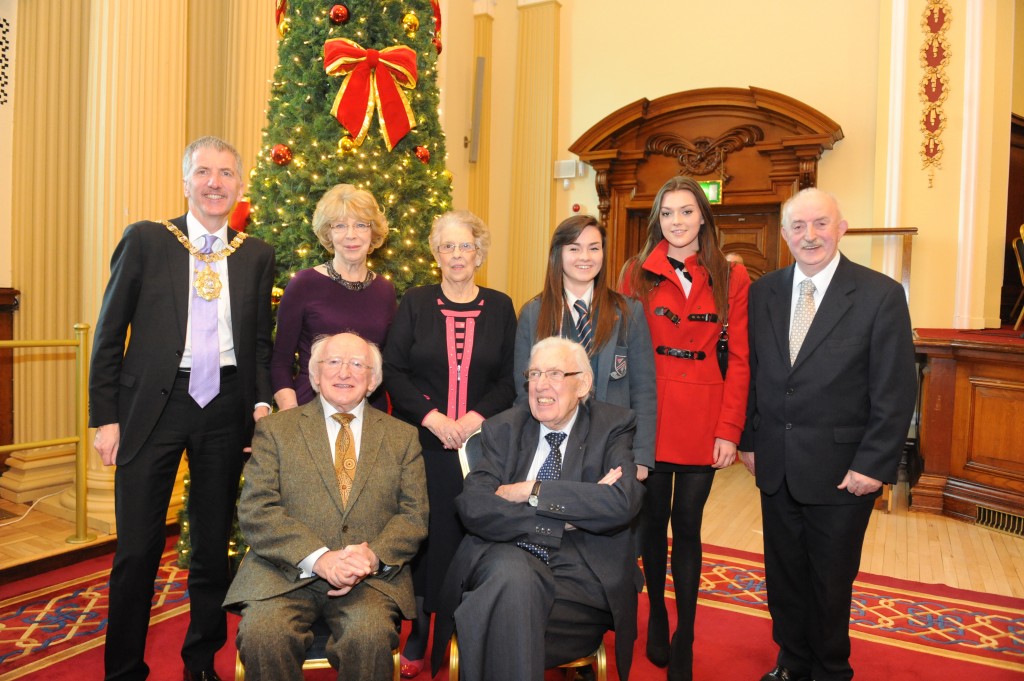
 The Ullans Academy: Helen Brooker (Chair), Jim Potts, Peter lavery, Andy Tyrie (Patron), Liam Logan, Ruairi O Bleine, Ian Adamson (President). Mrs Sabina Higgins, Brian Ervine, Jake Gallagher, President Higgins, John Laverty (Secretary), Lord Mayor Mairtín Ó Muilleoir 


Posted in Article | Comments Off on Feast of Columbanus 1

The Pictish Nation: 11 – Chapter 5 (Cont’d)

The Picts did not excel in architecture. Almost all their erections were circular. In districts like Sutherland, where the face of the land has been little changed by agriculture, the sites of Pictish villages may still be seen. Groups of hut-circles with adjacent groups of burial-cairns occupy sunny slopes on the sides of valleys, or comfortable situations on plateaux where once there were clearings in the original forest. It is evident from remains that exist that the machair, or plain-land by the sea, and the flat stretches by the rivers were also occupied by these villages, although the modern road-boards and cultivators have within recent years competed in removing the last traces of them. The Pict evidently built on the principle that here we have no continuing city. His dwelling was of the simplest. His finished hut was like a hollow cone, the apex being slightly open to draw away the smoke. This cone-like structure was made with the trunks of forest trees and thatched with branches, reeds, or heather. The heavy ends of the trunks were firmly bedded at the desired angle in a thick circular retaining wall, the remains of which are known to-day as a ‘hut circle.’ The doorway was made through this retaining wall and faced invariably towards the south. Frequently it was defended by massive stone outworks which concealed a short angular passage with one or even two guardrooms. Sometimes huts contained underground chambers with a tunnelled exit into the open beyond the circle of the hut-wall. The sides of these chambers and of the passage were built up with irregular-shaped stones; and all, roofed over with heavy flat undressed stones. Inclosures with wide entrances, as if for cattle, oblong in shape, square in a few instances, are found in or near the hut villages.

The Pictish towns and villages were situated on some naturally strong site, or close to a broch.Called also Caer (Cathair), Dün, Tor, and Caisteal. To different brochs within the single parish of Kildonnan these names are applied. From S. Ninian’s time, the first Churches were planted near these strong places, which reminds us how old the proximity of Church and Castle is. Some of the Pictish settlements were within earthen ramparts still clearly defined. A Pictish broch was constructed by raising two massive concentric walls tied together by long stones winding round the outer circumference of the inner wall and ascending gradually to the top, forming steps to the summit for the defenders or watchers. There was no opening in the outer wall except one low and narrow doorway leading, through a narrow passage easily blocked and indented with guard-chambers, into the circular area within the inner wall. The structure was roofless. Chambers on the ground level were opened out in the inner wall and entered from the interior. Windows also opened through the inner wall, letting in light from the interior to the stairways between the walls. Very often these brochs were accessible by only one narrow footway. They are believed to have been places of refuge for women and children and their defenders, in time of sudden attack. Although some brocks had wells others had none, and these could not have sustained long sieges. Weapons and implements of stone, bronze, and iron have been found in the brocks, as well as women’s ornaments, combs, bone hair-pins, and bone needles threaded by the side of the eye. Built hearths have been uncovered in the inner area; and, in one case, bones broken for the sake of marrow, were found beside two grease-stained stones that had served as hammer and anvil.

Some have thought that the Picts learned the art of broch-buildingfrom the Phoenician traders and slave-raiders who visited the coasts; because structures nearly akin in type have been found in Sardinia and North Africa. Towers resembling them in many features have been noted as part of the remarkable buildings at the Phoenician gold-workings at Zimbabwe. Whatever the origin of the brocks they agree with the Pictish preference for circular buildings. In what is now the mainland and islands of northern Scotland we see them arranged in such relation to one another that fire signals lighted on the summit of one would convey information to another, and so to every brock over an extensive area. The site of one of the best known brochs bears a Celtic name meaning Rock of the signal-fire. When the Vikings came to the locality of this broch they found it necessary to erect a fort to watch it, and, in the old Icelandic, continued the name, calling their stronghold, ‘Town of the signal-fire.’

The Churches of the Picts were at first constructed of oak-logs on stone foundations. One of the native colloquial names for them was Datrteach, the oak-house, and among the Celts this name came in time to mean prayer-house or Church. The Churches were apparently rectangular and for a long time represented an innovation upon the circular building favoured by the Picts. In storm-swept districts like the north coast of Caithness, where wood was scarce, the whole Church appears to have been of stone, roofed with logs and heather-thatch, as was the case into the early Roman Catholic period. The high Round Towers associated with rectangular Pictish Churches emphasize the Pictish partiality for circular building. They were used as watchtowers to anticipate foreign raiders ; ecclesiastical valuables and manuscripts were carried into them in time of danger. The only entrance was at a considerable height from the ground, and was reached by a ladder which was hoisted inside and thedoor locked, while the enemy continued to lurk about. The doorway could be defended with missiles from above, and the tower was proof against fire laid to it. Examples of these Pictish towers are seen at S. Cainnech’s, Kilkenny, at Abernethy, Brechin, and Deerness, the headland of the Daire, or Oak- Church.

Venerable Bede is responsible, through misinterpreting his information, for the impression that stone buildings were unknown to the Britons and Picts until S. Ninian built Candida Casa. This of course is incorrect, because wherever the Imperial Roman colonists settled, or the legions formed permanent camps, stone buildings were erected, before the date of Candida Casa. The Picts in their many successful raids were only too familiar with these buildings and with their contents. Archaeologists have shown that after the Romans departed the Picts occupied the Roman structures, although they do not appear to have imitated them, except in the construction of a few of their churches.

The Picts, like many other fighting nations who gave their enemies a bad time, were wantonly libelled by their foes. Roman historians of the minor order accepted the slanders of the mercenaries, and stated that the Picts were cannibals, and that they offered human sacrifices. They allege that their women submitted to polyandry. The Gaidheals called the Picts ‘savage’ and ‘cruel.’ The Angles spoke of them as ‘vile.’ There is not a word in the story of the dealings of the Pictish missionaries with their converts which indicates that these charges were true, or that the Picts were worse than their unscrupulous assailants. Domestic infelicities with which S. Comgall, S. Kentigern and others were called upon to deal, indicate that a woman’s unfaithfulness to her own husband was regarded as a serious breach of the tribal as well as of the moral law. The wives of kings, chiefs, and commoners are always represented as living in family with their own husbands.

Certain historians have professed to see confirmation of the charge of polyandry in the peculiar law regulating the Pictish sovereignty, by which a sovereign’s brother, or his sister’s son, or, in certain circumstances, his elder daughter’s son, was preferred before the sovereign’s son. These historians have failed to make clear that the Pictish sovereign acceded from the royal race after election and approval by the petty kings and chiefs of Pictland. The story that the Gaidheals supplied wives from time to time for the Pictish kings so that their children only might claim the throne of Pictland is a stupid fable promulgated by the Gaidheals to justify the accession of Kenneth Mac Alpin and the continuation in line of his dynasty to the Pictish sovereignty; an accession which the Picts considered illegal, because won by treachery; and a continuation which they disputed and which was only maintained by force of the Gaidhealic soldiery when the Picts had been weakened by repeated Viking
onslaughts.

Mr. Andrew Lang regarded succession in the direct line of the father as a sign of superior civilization. It may have been so ; but it had serious practical disadvantages when a nation depended on unity and strong leadershipAlthough the system of Pictish succession offers no room for the moral reflections of some historians; its practical advantages should be noted. It bound those chiefs who used their votes in favour of the sovereign to support him on the throne, a very important result among a people organized in clans any one of which was sometimes more powerful than the clan of the successful nominee. Again, the election of a grown-up member of the ruling caste to the supreme power always saved the Picts from the rule of a minor, with a consequent regency and the intrigues and abuses connected therewith. The succession of a minor or incompetent king, apart from the will of the people, simply because he, or she, was nearest heir in direct line from a royal father was the cause of some of the greatest woes that befell Pictland after it came under the rule of the Scotic dynasties. Science, forethought, and adaptation to the needs of a nation of clans, were all in the Pictish system of succession; in spite of the fact that certain historians have been able to see only signs of moral laxity and want of moral progress.

Posted in Article | Comments Off on The Pictish Nation: 11 – Chapter 5 (Cont’d)