Last Lakota code talker Clarence Wolf Guts dies at 86

I would like to thank Bruce Bock for informing us that the last Lakota code talker Clarence Wolf Guts has died at 86.
When the towers of the World Trade Center fell on Sept. 11, 2001, Clarence Wolf Guts asked his son to call the U.S. Department of Defense to see if the country needed his code talking abilities to find Osama Bin Laden.

Wolf Guts was in his late 70s at the time, so his son, Don Doyle, did not make the call, but said the request personified his father’s love of country.

“He still wanted to help. He was trying to still be patriotic,” Doyle said.

Wolf Guts, 86, the last surviving Oglala Lakota code talker, died Wednesday afternoon at the South Dakota State Veterans Home in Hot Springs.

A Native American code talker from World War II, Wolf Guts helped defeat Axis forces by transmitting strategic military messages in his native language, which the Japanese and Germans couldn’t translate.

“He’s the last surviving code talker from the whole (Lakota) nation. It’s going to be a little like the passing of an era,” Doyle said.

The 450 Navajo code talkers were the most famous group of Native American soldiers to radio messages from the battlefields, but 15 other tribes used their languages to aid the Allied efforts in World War II. Wolf Guts was one of 11 Lakota, Nakota and Dakota Native American code talkers from South Dakota. Wolf Guts, of Wamblee, enlisted in the U.S. Army on June 17, 1942, at age 18. While in basic training, a general asked Wolf Guts if he spoke Sioux. He explained the three dialects to the general and said he spoke Lakota. Wolf Guts helped develop a phonetic alphabet based on Lakota that was later used to develop a Lakota code.

He and three other Sioux code talkers joined the Pacific campaign; Wolf Guts’ primary job was transmitting coded messages from a general to his chief of staff in the field.

Pfc. Wolf Guts was honorably discharged on Jan. 13, 1946, but the horrors of war followed him home and he turned to alcohol to forget, Doyle said.

“He tried to keep it all inside,” Doyle said.

About a decade ago, Wolf Guts started to share his experiences as a code talker with his son and the public.

Doyle said his father’s deeply religious way of life was also a part of the stories. He always thanked God for bringing him home.

With the sharing of his story came recognition of his service and honors, including national acknowledgement through the Code Talkers Recognition Act of 2008 championed by senators Tim Johnson, D-S.D., and John Thune, R-S.D.

Both senators honored Wolf Guts efforts and offered their sympathies on Thursday night.

“I am deeply saddened to hear about the passing of Clarence Wolf Guts. He and his fellow Code Talkers have had a lasting impact on the course of history and helped lead the Allies to success during World War II. He will be greatly missed, but his contributions to our state and nation will live on,” said Johnson.

“Clarence Wolf Guts was an American hero; he was courageous and self-sacrificing. I have a great deal of respect for Clarence and for the extraordinary contributions Mr. Wolf Guts made to our country. The efforts of the Lakota Code Talkers saved the lives of many soldiers, and for too long went unrecognized. Kimberley and I wish to express our sympathy to his family during this difficult time,” Thune said.

Doyle said his father was humbled by the recognition, but was proud of his service during the war. Wolf Guts’ desire to help others continued throughout his life well after the war ended.

“He considered himself just a man, nobody important. A man that tried to make life better for his family and his people. To me that is his legacy, to be able to help people,” Doyle said. “To him, that was being warrior.”See more

Photo: Last Lakota code talker Clarence Wolf Guts dies at 86<br /><br /><br />
When the towers of the World Trade Center fell on Sept. 11, 2001, Clarence Wolf Guts asked his son to call the U.S. Department of Defense to see if the country needed his code talking abilities to find Osama Bin Laden.</p><br /><br />
<p>Wolf Guts was in his late 70s at the time, so his son, Don Doyle, did not make the call, but said the request personified his father's love of country.</p><br /><br />
<p>"He still wanted to help. He was trying to still be patriotic," Doyle said.</p><br /><br />
<p>Wolf Guts, 86, the last surviving Oglala Lakota code talker, died Wednesday afternoon at the South Dakota State Veterans Home in Hot Springs.</p><br /><br />
<p>A Native American code talker from World War II, Wolf Guts helped defeat Axis forces by transmitting strategic military messages in his native language, which the Japanese and Germans couldn't translate.</p><br /><br />
<p>"He's the last surviving code talker from the whole (Lakota) nation. It's going to be a little like the passing of an era," Doyle said.</p><br /><br />
<p>The 450 Navajo code talkers were the most famous group of Native American soldiers to radio messages from the battlefields, but 15 other tribes used their languages to aid the Allied efforts in World War II. Wolf Guts was one of 11 Lakota, Nakota and Dakota Native American code talkers from South Dakota. Wolf Guts, of Wamblee, enlisted in the U.S. Army on June 17, 1942, at age 18. While in basic training, a general asked Wolf Guts if he spoke Sioux. He explained the three dialects to the general and said he spoke Lakota. Wolf Guts helped develop a phonetic alphabet based on Lakota that was later used to develop a Lakota code.</p><br /><br />
<p>He and three other Sioux code talkers joined the Pacific campaign; Wolf Guts' primary job was transmitting coded messages from a general to his chief of staff in the field.</p><br /><br />
<p>Pfc. Wolf Guts was honorably discharged on Jan. 13, 1946, but the horrors of war followed him home and he turned to alcohol to forget, Doyle said.</p><br /><br />
<p>"He tried to keep it all inside," Doyle said.</p><br /><br />
<p>About a decade ago, Wolf Guts started to share his experiences as a code talker with his son and the public.</p><br /><br />
<p>Doyle said his father's deeply religious way of life was also a part of the stories. He always thanked God for bringing him home.</p><br /><br />
<p>With the sharing of his story came recognition of his service and honors, including national acknowledgement through the Code Talkers Recognition Act of 2008 championed by senators Tim Johnson, D-S.D., and John Thune, R-S.D.</p><br /><br />
<p>Both senators honored Wolf Guts efforts and offered their sympathies on Thursday night.</p><br /><br />
<p>"I am deeply saddened to hear about the passing of Clarence Wolf Guts. He and his fellow Code Talkers have had a lasting impact on the course of history and helped lead the Allies to success during World War II.  He will be greatly missed, but his contributions to our state and nation will live on," said Johnson.</p><br /><br />
<p>"Clarence Wolf Guts was an American hero; he was courageous and self-sacrificing. I have a great deal of respect for Clarence and for the extraordinary contributions Mr. Wolf Guts made to our country. The efforts of the Lakota Code Talkers saved the lives of many soldiers, and for too long went unrecognized. Kimberley and I wish to express our sympathy to his family during this difficult time," Thune said.</p><br /><br />
<p>Doyle said his father was humbled by the recognition, but was proud of his service during the war. Wolf Guts' desire to help others continued throughout his life well after the war ended.</p><br /><br />
<p>"He considered himself just a man, nobody important. A man that tried to make life better for his family and his people. To me that is his legacy, to be able to help people," Doyle said. "To him, that was being warrior."
 Here is a prayer I learned while living among this brave and noble people
 
Lakota (Oglala Sioux)

 
Ho Tunkasila Wakan Tanka
Oyate oyasin unsiwicalapo na owicakiyapo
Nahan waci wicasi na waci winyan wopila tanka
Nahan oyate oyasin canku luta ognamani owicakiyapo
Lecel wacin ho hecel lena, oyate kin nipi kte.
Mitakuye Oyasin
 
 Wasicu(English)
 

Grandfather Great Spirit
Have pity on and help all the People
Many Thanks for the Performers, male and female,
Help all the People to walk the Red Road of Peace
This I ask so that the People will prosper
You are all my relatives

Posted in Article | Comments Off on Last Lakota code talker Clarence Wolf Guts dies at 86

The Pictish Nation:10 – Chapter 5

HOW THE PICTS LIVED

A STORY used to be current at a southern university of a student, fresh from the works of a certain historian, who declared that Pictland of Alba was a ‘ land of lakes and shallow estuaries where the people lived in crannogs.’ In Pictland certain fishing communities did live in crannogs amid the shallow waters of lakes and estuaries ; and artificial islands, planned with much engineering skill, were constructed as defendable habitations in the same areas; but the majority of the Picts had no special affection for the marshes where ague and rheumatism prevailed. The Picts, considered as a whole, were a pastoral people as is indicated by the wide range of the name Kerones, shepherds. These pastoral folk owned three precious possessions — their dog, their flocks, and their pasture. The Celtic names for these enter into the three expressions of intense love which still survive in colloquial speech. Mynghu* (S. Kentigern’s pet name), my dear one, means, literally, my dog ; m’eüdail, my kind one, means my little cattle; m’ullie, my treasure or my precious one, means my pasture.

The Picts supplemented their pastoral work by agriculture and hunting. Stone querns,the hand-mill for grinding corn still used in Eastern countries, have been recovered from hut-circles, lake-dwellings, brochs, and even from the earth-houses and caves. These querns are constructed with wonderful mechanical balance. The upper stone revolves sunwise with perfect smoothness ; but jams if revolved in the opposite direction, just as the shaped, Pictish, stone-weapons and implements, when laid on a smooth surface, can be spun sunwise successfully; but if turned contrary to the sun they wobble and refuse to revolve. Indeed, this is a test of the  genuineness of Pictish stone weapons and implements; and the most skilled modern forgers have not yet discovered the secret of this feature.

* Mochu in Gaelic. Myn is the British form of the pronoun mo, and
among the Britons and Picts gh took the place of ch, giving the form Mungo.

The Picts were enthusiastic sportsmen. On foot they hunted the deer and wild cattle with dogs and weapons. They fought the wolves in their dens. They knew the best salmon-pools in rivers; and in banks on which they watched for their prey the flint heads of their fish-spears are frequently found embedded. They were acquainted with the fishing net, and could make fish-traps of woven willow- wands which they set at the head of streamy parts of rivers. They marked the haunts of doran, the otter, whom other Celts called the ‘fish-hound.’ The number of Pictish names signifying Otters’ Bank or Otters’ Burn indicate how carefully the Picts followed the ways of this fisher ; doubtless because they knew his habit of leaving an acceptable salmon on the bank minus his favourite mouthful. In the kitchen-middens of the brochs remains of nearly all our common animals, birds, and fishes are found, together with the remains of creatures now extinct. In a grave within the area of S. Ninian’s Churchyard, Sutherland, were found, along with human bones, a flint implement and part of a palmated antler of one of the larger, extinct, deer. That the Picts were prouder of their prowess in the chase than in battle may be inferred from their carved stones which oftener show fights with beasts than with men. Their beasts of burden were the horse and the ox. For transport they used a two-wheeled cart of which a sketch has survived on one of their incised stones.

The Picts were acquainted with the working of iron and bronze. Charcoal and slag-heaps have been discovered deep in the peat at the sites of primitive iron-furnaces. Flint weapons and implements continued in use among the Picts long after they had learned to work metals. A perfectly constructed bronze swivel, which various modern artificers could imitate but badly, was found in Sutherland on the gravel, beneath the peat, beside a flint hide-scraper and a flint spearhead. The smith ranked almost as a noble among the Picts as among other Celts. His professional name is linked with many Pictish place-names. The capital of one of the principalities of Pictlandwas called ‘The Smith’s Mount.’ Dr.Carmichael’s Barra Gowan or Beregonium, capital of the Western Picts before the coining of the Dalriad Gaidheals. This worker could be called on to make any metal article from a sword or spade to a golden torque for a lady, a chief, or a poet. One of the Pictish saints had learned the smith’s craft, and one of his ‘miracles’ was the making of charcoal from reeds for the forge fire. He was brazing the plates of a Celtic handbell, and probably ‘miracle’ was the popular description of some special flux which he had discovered for uniting the metals. The remains of wood-charcoal heaps have been found in the W«»« of brochs near the excavated fire-places; although, a mile or so away, there was an outcrop of coal on the sea-beach.

The Picts were exceedingly fond of the precious metals, which they worked into torques, brooches, and other ornaments of simple but artistic designs. Amulets of pebble and serpentine, and necklaces of shale have been recovered from Pictish burial-cairns. Bronze armlets were used by men to reinforce the biceps in a thrust blow from the hand, or in a lightning sword-stroke.

The Picts knew the use of the potter’s wheel. Food-vessels as well as urns associated with the dead have been found on the sites of dwellings and in graves. The pottery is usually of a heavy type, due more to the coarse nature of the clay and inferior kilns than to want of skill on the part of the potter; because the latter frequently attempted to atone for coarse material by skilful and symmetrical ornamentation. The genuine ‘ Barvas pottery’ of comparatively recent times is primitive compared with some of the food- vessels and urns dug up on the west coast, and dating back more than a thousand years earlier. Fragments of Samian ware, found in forts and brochs, point back to Mediterranean and Gaulish traders, or to the Pictish raids into the Imperial Roman colony in Britain. Recently, while a foundation was being dug in what was formerly part of Caithness, an early Greek coin was found four feet from the surface beside encisted burials in an ancient Pictish burial-ground. If it were not for Ptolemy’s Geography and certain references of early ecclesiastical writers, we would forget that Mediterranean and Gaulish merchants visited Pictland.

Spinning, weaving, and dyeing were practised by the Picts. The carding-comb, which also may have been a dressing-comb, is theleast mysterious of the symbols carved on the stones of Pictland. Although the Pictish warriors, according to Latin and Greek authors, loved to expose the cruits or figures tattooed upon their bodies, and so fought with the minimum of clothing, knowing the benefit of laying aside every weight; they also knew how to clothe themselves comfortably, and even gaily, in time of peace. The Picts of Alba do not appear to have differed from the Picts of Ireland, who came to the battle-ground clothed, but they divested themselves of their garments before entering the fight. A king of the Gaidheals when entering a battle refused to wear a short cape although it had been given to him by S. Columba, and to this was ascribed his defeat. The Pictish clerics, although they denied themselves all luxuries,  wore woollen garments of native make. We learn of an undergarment, apparently a long shirt, reaching below the knees, and of an outer garment reaching equally far down, and having wide sleeves and a capacious hood. The colour was apparently the native shade known as ‘moorag! The Picts could also weave vegetable fibres. Part of what appeared to be a woman’s skirt made of coarse fibrous material was unearthed in Sutherland from a deep bed of dry peat which had acted as a preservative.

The Picts understood the dressing and curing of pelts. The flint flaying-knife, the flint hide-scraper, and the stone for smoothing the inside ofthe hide are common relics in Pictland. Fleece and fur furnished clothing, and hides and skins were spread out to sleep on within the huts. Slaves and furs, secured apparently by raids, are understood to have been the attractions which brought the trading ships of Marseilles to Pictland from before the time of Christ. The traders of this port sent an expedition to Pictland before the Christian era, which sailed as far as the Orkneys.There was also considerable intercourse between the Celts of northern Gaul and the Celts of Pictland, until the ‘migrations of the barbarians’ in the fifth century interrupted communications. The Britons and Picts have not been regarded as sea-going folk for the extraordinary reason that many of the nautical terms in modern Scottish Gaelic are of Scandinavian origin. As a matter of historical fact, when the ships of Caesar met the fleet of the Britons, the British ships were larger and of better build; S.Ninian’s Candida Casa in the early fifth century possessed a fleet which sailed on regular voyages; and there was sea-borne traffic between the Picts of Ireland and the Britons and the Picts of Alba. The Picts organized warlike expeditions by sea; and even the Gaidheals, in spite of the Scandinavian terms in Gaelic, were no mean sailors. The Irish Gaidheals organized a raid by sea on the island of Islay while it was still Pictish; and the Gaidheals of Scottish Dalriada in the sixth century sent their battle-fleet from Argyll in the direction of the Pictish Orkneys.

Posted in Article | Comments Off on The Pictish Nation:10 – Chapter 5

The Pictish Nation: 8 – Chapter 4 ( Cont’d)

The Viking invasions laid the Pictish colleges of Ireland and Scotland in ashes. Pictish libraries were burned.or their contents were scattered and mostly lost. The scholars who escaped massacre fled to the Continent, some of them to the Pictish communities already securely established there. At a few places in Pictland of Alba (Scotland), units of the scattered forces of the Pictish Church managed to survive; but they represented remnants doomed to ultimate decay. Their controlling and supplying monasteries, both in Ireland and in their own land, were ‘burned,’ as the Annalists put it. Bangor, the mother of Churches, was left desolate. When the Church was, in course of time, revived there, and at other centres, it was a new Church, Gaidhealic not Pictish, Roman not Celtic.

The Vikings paralysed Pictish power, and shattered Pictish organization in Church and State. The Picts fell a comparatively easy prey to the Vikings; because, while they fought the Vikings on their front, they were assailed in the rear by Gaidheals; and both in I reland and in Scotland the Gaidheals never relaxed thejr pressure on their possible lines of retreat from the easily accessible and much devastated East Coasts of both countries. As the Viking deluge subsided, it became plain that the Gaidheals would possess the future. They had been able to keep their government, their organization, and some elements of culture; because their lines of retreat to inaccessible mountains and quiet islands had remained open. The Gaidheals possessed also either  power or opportunity of absorbing the Vikings which was not given to the Pict. In Shetland, Orkney, and Caithness, the Viking absorbed the Pict, putting it broadly; but in the Southern Hebrides and in North-western Ireland the Gaidheal absorbed the Viking.

The resurrection of Celtic power from the grave of Viking barbarism was a Gaidhealic resurrection. Everywhere in the Celtic territories of Great Britain, except among the remnant of Britons penned up in Wales, Gaidhealic lords or Gaidhealic ecclesiastics began to dominate. The Picts gradually ceased to exist as a separate people and became merged among the other Celts. They lost most of their ancestral lands in Alba, sometimes by force under the excuse of exacting tribute for the sovereign, sometimes by the high hand of the Gaidhealic provincial rulers, sometimes by intermarriage with Gaidheals. After a.d. 842, in Alba, their clan-organizations, their system of monarchy, their Church organization, and their central monastic communities began to disappear or to change by degrees as each new Gaidhealic king stepped to the throne.

 In A.D.851 the Gaidhealic clerics forsook lona, which like the Pictish monasteries had been repeatedly desolated by Vikings, and tried to centre themselves at Dunkeld within the borders of the old Pictish kingdom. Each succeeding half-century sees their tentacles seizing the ancient Pictish Church-centres one by one. First it is Abernethy, then St. Andrews, by and by Brechin, and later Deer. Mortlach was left to itself, but new centres were fixed at Birnay and Aberdeen. The Gaidhealic propaganda was persistent but slow, in spite of special missions conducted at refractory Pictish centres like Dornoch by such men as S. Dubthac, a much-lauded saint of the Gaidheals.who came from the Gaidhealicized Church of Armagh to establish a mission at Tain in Ross about the beginning of the eleventh century. Before the Gaidheals had completed the control of the religious and educational centres of Pictland, the Roman Church, under political influence, threatened to undo much of their work by sending into the Highlands Norman or Anglo-Saxon prelates. This policy reanimated the few scattered details of the ancient Pictish Church that survived in odd places;but the Roman Churchmen soon saw their error, and took up the Gaidheals anew, sending to the Highlands, as far as possible, only those who could speak what they called ‘Irish.’

The result of these carefully calculated efforts was that if the Picts did not consent to be Gaidhealicized, they were left outside education and power, and tended to become hewers of wood and drawers of water to the Gaidhealic and, later, to the Saxon incomers. The Gaidheals thus controlled education and the care of the literature of past and present. This Gaidhealic control of power and education, which continued slowly to extend from a.d. 842 onwards, is the reason why what remained of Pictish literature after the Vikings, has come down to us through Gaidhealic editors. They were the most unscrupulous editors that, perhaps, the world has known. Everything was altered in favour of their own interests and their own race. There is one document, one of the Fragments of the Pictish Chronicle and typical of many, where ‘ Scoti ‘ is substituted for ‘ Picti.’  The Gaidheals were overweeningly vain, and loved to exalt the age and exploits of their race to the Anglo-Saxons, who had emerged from barbarism before their eyes. It helped their political and ecclesiastical claims too. For this reason they represented themselves as older than the Picts or Britons, or any other Celts. They did not hesitate to garble versions of the Pictish Chronicle in their own favour, apart from the corruptions due to Gaidhealic orthography. They traced the origin of the Gaidheals to the Greeks, the Hebrews, and the Egyptians, and repudiated a half-hearted romancer who was content to start the race from the Trojans.

Although two Picts and a scholar of the Britons had educated and trained S. Columba, the greatest ecclesiastic of the Gaidheals, the Gaidhealic writers regularly refer to the Picts as ‘ravenous,’ ‘savage,’ or ‘barbarous,’ descriptions hailed by many historical writers down to Mr. Andrew Lang. Although the
Gaidhealic writers annex S. Patrick in face of the  historical truth that their forefathers spurned him they have verylittle to sayabout S. Ninian, whose community at Candida Casa sent out many of the most successful missionaries to Ireland. If the world depended on Gaidhealic writers, men would believe that the Picts, S.Comgall the Great and S. Cainnech, had been humble followers and dependents of S. Columba the Gaidheal. With similar historical recklessness the historical S.Servanus in a version of the fabulized Life, with all its extravagances,  printed by Skene, Chronicles of Picts and Scots, p. 412,is lifted away from his true period and associated with S. Adamnan, a romanized Gaidheal.

That there was a Pictish literature in Alba (Scotland) before the Vikings is beyond doubt. The evidence is too strong even for cynical historical writers. That some of this literature survives to the present time in Gaidhealic versions  which wait the critical analyses of some competent Celtic scholar is apparent. The. Pictish Chronicle at least had a Pictish original. The confusing efforts of the Gaidhealic copyists to render Pictish proper names is evidence of that, apart from other
considerations.

One of our oldest native Latin hymns is the work of a Pictish author. It was written by Mugent,the Ab, a successor of S. Ninian in the presidency of the Brito-Pictish monastery at Candida Casa (Whithorn). In passing, let us not forget that Latin was a living tongue to the early Picts, S. Ninian’s flock heard the Roman legions drilled in the Imperial tongue; traded with them in the regimental market in Latin; actually, as we know from remains, helped the Roman colonists to erect headstones on their family graves, graven with Latin inscriptions; and when the Imperial armies  were retreating, said ‘Good-bye’ to them in their own Latin speech, colder than Celtic. It was, therefore, not merely ecclesiastical fashion that moved Mugent to write his dignified prayer in the Latin, so restraining to the deeply-moved Celt. Mugent’s prayer is usually called Mugent’ s Hymn, sometimes it is referred to by the opening words, ‘Parce, Domine, parce populo Tuo quern redimisti.’ It is a remarkable devotional appeal. It dates from the first years of the sixth century. Incidentally we learn from the ancient scholiast’s preface to the ‘Parce, Domine,’ concerning the schools which at this early period were at Candida Casa for young men and women, other  than those who intended the Church. Two of these pupils are named, Talmag, a Pict, and Drusticc, daughter of Drust, sovereign of Pictland of Alba died A.D.510) . The schools for laity and clerics imply a literature: and Drusticc indicates that there was a Library at Candida Casa; because, as a bribe to gain a certain end, she offers to one of the masters, S. Finbar, ‘all the books which Mugent has.’

This is S. Finbar of Maghbile and Dornoch who continued S. Ninian’s mission-work in what is now Ayrshire, and theEast and North of Scotland. We know from his Life that he was a lover of manuscripts and very jealous of thosewhich he possessed. He made his own manuscript copy of the Gospels, the Psalter, and other parts of Holy Scripture. The Scholiast in the Kalendar of Angus states that he brought the first complete manuscript of the Gospel’ over to Ireland, when he returned from Pictland. The Kalendar of Cashel goes further and states that he brought the manuscript of the Mosaic Law and the complete Gospel into Ireland. The uniqueness, in Ireland, of S. Finbar’s Gospel is confirmed by the account of how it was stolen for a time by strategy in order that S. Fintan might have a copy of it. S. Columba, while a pupil of S. Finbar, also secretly copied this same Gospel or Psalter with disastrous consequences; because a royal demand that he should give up the copy to S. Fiiibar helped to bring on the sanguinary battle of Cul Dreimhne. The early Gaidheals called this version ‘S. Martin’s Gospel,’ indicating clearly that S. Ninian had brought the manuscript from S. Martin’s community at Tours to Candida Casa, and that through S. Finbar it came into use in Ireland. TheGaidhealic fabulists of a later period invented a story that Columcille went to Tours, opened S. Martin’s grave, and took from it tlie actual manuscript which S. Martin used.

The mention of the School at Candida Casa brings to mind the Schools founded, later, in the sixth century and after, throughout Pictland of Alba (Scotland) by missionaries from the Britons; and also by S. Moluag and other Picts from Ireland. The names of these schools remain attached to the sites until the present time. Wherever in Scotland the names ‘Bangor,’ ‘Banchory,’ or ‘Banagher’ survive, we have the locality of one of the schools that was attached to a community of Pictish or British Clerics. It is safe to assume that these schools were not conducted without the aid of native literature. One feature of the Bangors was that the Psalms were learned and sung with artistic care.

Another Pictish manuscript which long survived in Ireland was the famous ‘Glas Cainic written by S. Cainnech of Achadh-Bo and St. Andrews. It was, apparently,a manuscript of the Gospels with expositions. S.Cainnech’s powers as an expositor were so widely admitted that even S.Columba’s admiration was freely given to him.The Picts had their bards as well as the other Celts. One of their widely known compositions was the Brito-Pictish historical romance, Llallogan. Llallogan ‘ was his pet name. He is Myrdinn, otherwise ‘ Merlinus Caledonicus.’ The characters are historical, but they are brought together without regard to their correct places intime. Vortigern,the leader of the Brito-Pictish confederation, Llallogan the bard,S. Kentigern the Briton and missionary to the Picts, all appear together. Historically, Llallogan was the twin-brother of Gwendydd and kinsman of Urien Rheged of the Strathclyde Britons. His life was a weird one. He went mad after he had gazed on the horrible slaughter of the Brito-Pictish hosts at the close of a battle which had been instigated by his own perfervid verses. Demented he fled to the wilds, lived in the recesses of the woods like a wild beast among wild beasts, and fed on the roots and herbs of the forests. It happened on a day when S. Kentigern was in his retreat in the woods near Glasgow that he encountered this wild creature. After hearing the madman’s story of his life the Saint gave him his blessing, and the outcast came to himself, and was re-admitted to Christian fellowship.

Joceline in the twelfth century was acquainted with some version of this story, because he refers to Llallogan as ‘homo fatuus,’ who was kept by the Kingof the Britons. Walter Bower had also a version of this romance before him in the fifteenth century, and he quotes the main part of the story, Incidentally he indicates that the acquisitive Gaidhealic editor hadnot disappeared in his time; because not only is the British name Gaidhealicized to ‘Lailocen,’ but he candidly avows that some people regarded the bard as a ‘wonderful prophet of the Scots’ (Gaidheals). How little of the Gaidheal was about Llallogan can be seen from the Avellanau in the verses ascribed to him, where his friends and the localities named are British and Pictish.

Ah me  Gwendydd shuns me, loves me not!
The chiefs of Rhydderch hate me.
After Gwenddolen no princes honour me
Although at Ard’eryd I wore the golden torques.

Long used to solitude, no demons fright me now;
Not at the dragon presence do I quake
Of the lord Gwenddolen, and all his clan
Who have sown death within the woods of Celyddon.

Gwenddolen ap Ceidian, who, along with Saxon allies and S. Columba’s friend, King Aedhan ‘the False, “fought against Rhydderch the Briton” and were defeated at Ard’eryd, c. 573.

A fragment of another purely Pictish poem has come down to us through Gaidhealic hands. It is known by the opening lines:

‘Iniu feras Bruide cath
Imforba a shenathar’

(To-day Bruide fights in battle *
For the land of his ancestor).

* The Battle of Dunnichen (‘Nechtansmere’), 20th May A.D. 686.

This poem was written in Pictland of Alba, A.D. 686, by Riaghuil, titular Abbot of Bangor in Ulster. Riaghuil had fled for safety to Pictland of Alba; because the Gaidheals of the race of Niall had invaded the kingdoms of the Irish Picts. The Gaidheals burned Dungal the Pictish King, Suibhne, thePictish lord of Kianachta,Glengiven, and captured the great border-fortress of Dun Ceithern. They then wasted the Pictish kingdoms with fire and sword. Apparently the clerics of Bangor and the other religious houses of S. Comgall took flight for a time to the daughter-churches of Bangor in Pictland of Alba. Riaghuil was hospitably received by Brude Mac Bilé, the Sovereign of Pictland of Alba (Scotland). He repaid Brude by becoming his laureate and intercessor, and in this surviving fragment champions him in verse against Egfrid the Anglian invader.

This is not a history of Pictish literature. That subject still awaits the competent Celtic scholar who can divest himself of Gaidhealic and Anglo-Saxon prejudices. Enough has been written to show that the PictishChurchmen did not minister to a people without a literature; and also to show  hat the Picts did not derive their love and practice of literature from the Gaidheals. On the contrary it is apparent that the Gaidheals were taught and schooled by Britons and Picts. S. Columba, the greatest of the Gaidheals, was instructed by Pictish and British masters.

Posted in Article | Comments Off on The Pictish Nation: 8 – Chapter 4 ( Cont’d)

The Pictish Nation: 7 – Chapter 4

THE LITERATURE OF THE  PICTS

 
‘No scrap of Pictish literature ever existed.’ Such was the ill-founded decision of an accepted Scottish historian. Yet in the Irish Nennius reference is made to the Books of the Picts, ‘ As it is written in the Books of the Cruitneach. ‘ It was an audacious deliverance to make to a generation which had seen the literary treasures of Europe greatly enriched by the manuscripts from the libraries of the famous Celtic monasteries founded, one at Bobbio in Lombardy by S. Columbanus, (bom A.D. 543. His first instructor was S. Sinell, who had been a pupil of Finnian of Clonard, who was educated in Britain. S. Sinell’s cell was on Cluain Innis, Loch Erne) the other at St. Gall in Switzerland by S. Gall.(bom A.D.545. In an old MS. from the St. Gall library his father’s name is given as ‘Kethernac Mac Unnchun.’ His own name means Stranger. ‘Kethem’ was the name of one of the early Pictish heroes. Dr. Reeves states that he was of the race of Ir, progenitor of one branch of the Irish Picts. Ir was a sovereign of Ireland). Both founders were Pictish scholars educated by S.Comgall the Great at Bangor in Ulster, the chief centre of learning among the Irish Picts. Both were born in the ancient territories of the northern Irish Picts in the north of Leinster, S. Gall in the north of Louth on the Ulster border; and S. Columbanus, also on the border-land, in the district lying between Louth and southern Loch Erne. S. Columbanus surveyed the locality about Lake Constance within the two years of his wanderings after his banishment from Luxeuil, A.D.610; and there he left S. Gall to settle. S. Columbanus then made his way into Lombardy, and in A.D.612 he settled at Bobbio in the Apennines.

The catalogues of the libraries of Bobbio and St. Gall have been published. (The Catalogue of Bobbio, by Muratori and Peyron. For St. Gall see Ferdinand Keller’s  Bilder und Schriftszüge in den Irischen Manuskripten.The tenth-century catalogue used by the students at Bobbio has been reproduced; and the catalogue of St. Gall, compiled there for the convenience of readers in the ninth century, is still accessible. In the ninth century St. Gall possessed five hundred and thirty-three volumes; and in the tenth century Bobbio contained seven hundred. From the Bobbio collection came the Antiphonary of Bangor. It contains prayers, canticles, hymns, especially an alphabetical Hymn in honour of S. Comgall, the founder of Bangor, and rules as to the order of prayer. The MS. is now in the Ambrosian Library at Milan. It was edited in 1893 by Dr. Warren. It is a purely Pictish ‘Liber Officialis’; and it enables us to have an idea of the service which S. Moluag introduced from Bangor among the Picts of Alba, and to realize that the same order of worship was followed in Alba that was followed at Bangor, and at its daughter-houses at Luxeuil, Bobbio, and St. Gall. Bobbio naturally possessed the manuscript of the Gospels which, as we know from his Life, S. Columbanus carried with him wherever he went. It bore the inscription ‘Ut traditum fuit illud erat idem liber quem Beatus Columbanus Abbas in pera secum ferre consuevat”. 

In the University library at Turin are fragments of a Commentary on S. Mark’s Gospel with notes in Celtic. In the Ambrosian Library at Milan is a complete Commentary on the Psalms, also with Celtic notes. Both works belonged to Bobbio; and both are ascribed to S. Columbanus. The latter is regarded as the ‘Commentary on the Psalter catalogued in the tenth century as part of the Bobbio collection. To this library founded in a Pictish monastery we owe the only surviving Canon of the New Testament, the famous Muratorian Fragment. Among its manuscripts, as fragments in the Imperial Library at Vienna indicate, confirming the old catalogue, were most of the Apostolic Epistles, texts of Aristotle, Demosthenes, Cicero, Virgil, Horace, Juvenal, Martial, and many other Greek and Latin authors. These texts were copiously annotated, often in Celtic. The library of St. Gall was more than once pillaged by scholars who entered it as borrowers and left it thieves. A certain Poggio of Florence, who was interested in the works of Cicero arrived at St. Gall in 1416 with two confederates, and on his departure to Constance took with him two cart-loads of priceless manuscripts which included texts of Cicero, Quintilian, Lucretius, Priscian, the unfinished Argonautica of C. V. Flaccus, and other writings. These manuscripts were taken to Italy ultimately. An ‘Oecumenical’ Council receives
much blame for these thefts.

To this library of a monastery founded by a Pictish scholar came secretaries from the most Catholic Council of Constance (A.D. I414-I418) to borrow books which would reinforce any inspiration or knowledge that this despised Synod presumed to possess. One sign of knowledge in the borrowers was that they knew something of the value of the manuscripts; because they never returned them. It is not out of harmony with other acts of this Council that the members apparently sought authority for their doings in the works of pagan orators and poets while they left excellent copies of the Gospels and Epistles unconsulted.Europe owes to St. Gall the Dresden Codex Boernerianus which has S. Paul’s Epistles in Greek; various Fragments of the Gospels; a palmpsest of Virgil; a thirteenth-century Nibelungenlied; and certain books with unread glosses in Celtic, together with the ‘iron-bound book’ ascribed to S. Gall himself There was also at St. Gall what from old descriptions appears to have been another copy of the Antiphonary of Bangor (From a reference by Notker Balbulus). Of the thirty volumes written in Celtic script, which were in the library of St. Gall in the ninth century, according to the surviving catalogue of that period, only one volume remained twenty-five years ago.

Continental scholars are generally very wary in referring to the Celtic glosses in the manuscripts that belonged to Bobbio and St. Gall. They are usually satisfied to call the language ‘Celtic’; but some British writers have boldly pronounced it “Goidelic”; although they candidly admit that it is often difficult to interpret, except through known Brittonic words and orthography. Gaidhealic scholars doubtless wandered to the Continent of Europe as well as Picts, especially after the Vikings began their ravages; but the organized missions from Bangor and the communities of the Britons in the sixth century, which founded Luxeuil, Bobbio, St. Gall, and other Celtic monasteries in the European uplands, were led and staffed by men who were born Picts, or Britons, educated at Pictish or British monasteries, who spoke a Pictish or Brittonic dialect of Celtic when they did not speak Latin or Greek. Many writers have followed the Gaidheals in assuming that the continental designation ‘ Scot ‘ signified a Gaidhealic Celt; but from early times on the Continent ‘Scot’ was applied to a native of ‘Scotia,’ that is Ireland, without consideration as to whether he belonged to the Pictish or Gaidhealic branch of the Celts.

Among others, Columbanus was called a Scot on the Continent, and he spoke of himself as a native of ‘Scotia,’ i.e. Ireland. No scholar has yet applied himself seriously to the Continental Celtic writings for the purpose of separating what is Pictish or British dialect from what is Gaidhealic dialect. In like manner no scholar has yet attacked the Celtic manuscripts of Britain and Ireland for the purpose of separating the literature which originated among the Picts of Alba or Ireland from the literature which originated among the Gaidheals. After the deluge of Viking barbarism had subsided in the Pictish territories of Alba and Ireland, the Gaidheals gradually served themselves heirs to Pictish lands and heritages; and, when they had secured control of education, served themselves heirs to Pictish literature. The memory of Pictish scholars like Cainnech and Columbanus was revived; but in a Gaidhealic atmosphere. S. Comgall, the greatest Pictish Abbot, was represented as a protege of S. Columba the Gaidheal. The motive for the Gaidhealic usurpation of all Celtic greatness that had preceded the rise of the Gaidheals was at first political, and was also designed in view of the Pictish properties. The romanized Church of the Gaidheals, too, saw and seized its own opportunity of forwarding its own claims to primacy, and to the property of the old Celtic Church. It exalted the Gaidhealic claims into a system, and applied it everywhere without scruple. In Ireland the old Pictish territory of Armagh was represented as having been Gaidhealic from all time.

When the inventions of the Irish Churchmen were exhausted Latin Churchmen were brought from England to rewrite the Lives of the old Celtic Churchmen, in the professed interests of elegant Latin and orthodoxy; but, really, to ground the claims of the new Church.The saints of the ancient Pictish Church are put into the background to show up the figure of an unhistorical S. Patrick. Although the Gaidheals and their king Laeghaire were hostile to the historical S. Patrick and the king died an ‘obstinate pagan’; the S. Patrick of fable is represented as rising into power through the favour of the Gaidheals of the race of Niall who in course of time became the patrons and protectors of Armagh, the seat of the primacy. The ‘obstinate pagan,’ Laeghaire, is also passed through history as S.Patrick’s convert.Joceline of Furness and others. Joceline re-wrote the Life of Kentigern from a Celtic original. At the request of Thomas of Armagh, John de Courcy, and others, he re-wrote the Life of S. Patrick. He gave both Lives abundance of Roman colouring. John de Courcy had a political purpose in getting the Life of Patrick garbled ; just as the purpose of Thomas was ecclesiastical. Again, the historical S.Bridget, who belonged to the Pictish district of Louth, is transformed into the slave of a Gaidhealic bard, and exalted to later ages as the ‘Mary of the Gaidheal.’ Other pre-Gaidhealic saints and heroes are treated in similar fashion. Many fragments of history, poems, and stories now presented to the world as Gaidhealic literature can be detected by internal as well as external evidence as having been altered from their original form. They are merely Gaidhealic versions, bearing traces of the Gaidhealic editor, of works composed where Pictish was the dialect of Celtic in general use. In various Gaidhealic vocabularies, many words marked ‘early Irish’ and ‘old Irish’ are word-forms current among the Picts.

As an example of a Gaidhealic version of a work originally written in a different dialect of Celtic there survives the lorica called Feth-Fiadha, ‘Cry of the Deer,’ S. Patrick’s well-known Celtic hymn. There are various editions; but one often figures as a specimen of ‘Gaidhealic literature.’ The matter may be little changed from the original; but the form is certainly much changed. The author, S. Patrick, was a Briton, his dialect was Brittonic, his historical work was performed in the territories of the northern and southern Irish Picts where his Britonic dialect would be understood. The pagan Gaidheals were, as we have seen, hostile to him, and did not allow him to do more than touch the fringes of their clan settlements. Once, he visited their king after the Gaidheals had begun to wedge themselves in between the Picts of the north and south in Ireland. He and his disciples, who were Britons and Picts, approached, chanting this hymn. In the strange dialect it was so unintelligible to the Gaidheals, that it sounded with no more meaning than the ‘Cry of the Deer’ on the hill-slope, so they expressed it, and thus the lorica received its popular name.

Another work frequently represented as a ‘ Gaelic composition ‘ is the metrical memoir of S.Patrick known as the ‘Hymn, ‘ascribed to S. Fiacor Flag of Sleibhte in Leinster. The work is partly Celtic and partly Latin with extensive Scholia. If S. Fiac really composed the work, and if the surviving manuscript is ‘Gaelic,’ then it is  really a version; because S. Fiac lived and laboured in Leinster among the Manapian Picts and the Brigantes who were Britons. It is safe to assumethathewroteforhisown clerics and people in their own dialect of Celtic, and not for their enemies the Gaidheals, who had little interest in Patrick while he lived, and only took up his name many long years after S. Fiac’s time, when the romanized Gaidheals were seeking to centre the primacy in Armagh ; and when they required a saintly founder who could more easily be set up as in communion with Rome, and as of ‘ Catholic’ ways than any of the Pictish or Gaidhealic Saints. The Picts of Leinster (where S. Fiac laboured) had even more reason to keep clear of the Gaidheals than the Picts of Ulster; because the Picts of the north-east sought only to keep their lands against the covetous Gaidheals, when at the end of long intervals they came out for an increase of territory ; but the Picts of Leinster required to contend with the yearly fever of blood-lust which seized the Gaidhealic Nialls of the Midlands, who tried to wedge them apart from their kin in the north-east under the excuse of collecting the notorious  Boromhe.The Gaidheals wished the Picts to bribe them with this payment to let them alone, but the Picts steadily refused. It was not hymns about Patrick that the Gaidheals took from Leinster in S. Fiac’s time, or long after, but tribute, when they were able to collect it.

The authenticity of S. Fiac’s ‘Hymn’ has been doubted becauseof the reference in it to the desolation of Tara, the old capital. That reference, on the contrary, might be a sign of genuineness; because, in the eyes of a Pict, Tara was desolated when the Gaidheals took it and hoisted their flag there early in the fifth century, long before it was cursed, and made desolate after the death of King Diarmait, the Gaidheal, A.D.565. The correct criticism of the Fiac manuscript is, that if S. Fiac was the author of the hymn, the manuscript is a Gaidhealic version of a Pictish work which was written by a Pict for Picts in the Pictish dialect of Celtic. Once more, therefore, we may have an item of Pictish literature ; but it has come to us through a Gaidhealic editor, like many another Pictish work, Joceline of Furness and others. Joceline re-wrote the Life of Kentigern from a Celtic original. At the request of Thomas of Armagh, John de Courcy, and others, he re-wrote the Life of S. Patrick. He gave both Lives abundance of Roman colouring. John de Courcy had a political purpose in getting the Life of Patrick garbled ; just as the purpose of Thomas was ecclesiastical. It is asked why Pictish compositions have come down to us through Gaidhealic hands. The answer is, that the turn of historical events towards the close of the first millennium gave the Gaidheals the hegemony of the Celts in Ireland and Scotland, and the control of education and literature.

Posted in Article | Comments Off on The Pictish Nation: 7 – Chapter 4

The Soldier – Jake Gallagher at Bell’s

The Soldier 

In Holywood,  in County Down

Close to the heart of this little town,

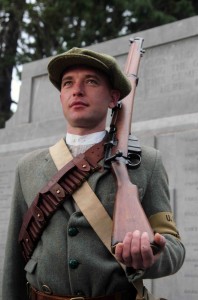
On granite plinth a soldier stands,

Symbol of all who died for us

In Ulster’s fields or far off lands.

Bayonet and rifle still in hand,

Stepping bravely forth he joins

That self-less band,

Whose names here cast in bronze,

Will live forever.


No questions asked,

No wondering why,

A nation called its youth to die.

No holding back, excuses made,

But purest gallantry displayed.

The sacrifice so freely made,

Made for you and made for me,

Made that our lives might be free,

From hatred, strife and tyranny.


So we gather each November,

Bow our heads as we remember.

Stand in ranks in silence there,

United in that silent prayer.

And in token of our debt,

That we must never once forget,

The hymns are sung,

The lines are said,

The Last Post requiem is played.

The wreaths of poppies,

Deep blood red,

With gentle reverence are laid,

In memory of these glorious dead.


The Unionist people of Northern Ireland have their distinctive culture, rooted deep in their sense of belonging to the land in which they live and under pinned by their belief in freedom of speech, worship, assembly, and conscience. That they see themselves as British first and last should surprise no one. 

Remembrance Sunday is part of that culture and heritage and affords us an opportunity to honour those who gave their tomorrows so we could have those freedoms we enjoy today. We attend the service on Remembrance Sunday not to glorify War but to Honour those who made the supreme sacrifice in the fight against all the enemies of Freedom. 

Our membership of the United Kingdom means that we are inheritors of a wonderful democratic tradition and our actions and thinking are shaped by a definition of those freedoms that are an intrinsic dimension of the British constitution and identity. 

We have a special affinity with the Scots, not just because of close cultural and social ties or even our physical proximity to Scotland, but because we believe that many Scots, like ourselves, are descended from those whom  History tells us occupied this north east corner of Ireland in ancient times. 

We have no resentment of those in the Republic who chose to secede from the United Kingdom and wish only to share our island home in a peaceful relationship. We have perceived the events of the past forty years as a determined attack on our freedom and identity and as an attempt to force us into a united Ireland against our will. 

In the eyes of many British/Unionist people there were no injustices in Northern Ireland which could have justified Republicans launching such a  campaign of indiscriminate terror, death and destruction on the people of the province.. How do you justify an indiscriminate armed struggle against your neighbours? 

Voting in Stormont and Westminster elections has always been on the basis of an equal franchise.  A democratic “one man one vote” process was always available to redress perceived wrongs and injustices.. Even when inequalities and  anomalies in local council elections had been redressed  by 1972 the IRA continued its vicious sectarian campaign. The response of loyalist paramilitaries was equally horrific and impossible for law abiding democratic people to justify.  

We suffered terribly as a result on all sides. It is time now to work patiently in cooperation to create a better future for us all on this island which we share. No mandate can justify violence. We must learn to share this space in peace, respecting each other’s culture and traditions equally. Irish Nationalists and British Nationalists must learn to live in peace and work for a common prosperity characterised by equality of opportunity.. 

The events of recent months and years have given us all hope for the future. In recent years it has been exciting to see the people of the Republic of Ireland and northern Nationalists come to appreciate how much we have in common, particularly the recognition that our shared past included an amazing blood sacrifice in the Great War, made in the defense of freedom.

 I am sure that in future years  on the eleventh of November all the people of Ireland will join in remembrance of those who fought together in past wars against our common enemies.

Posted in Article | Comments Off on The Soldier – Jake Gallagher at Bell’s

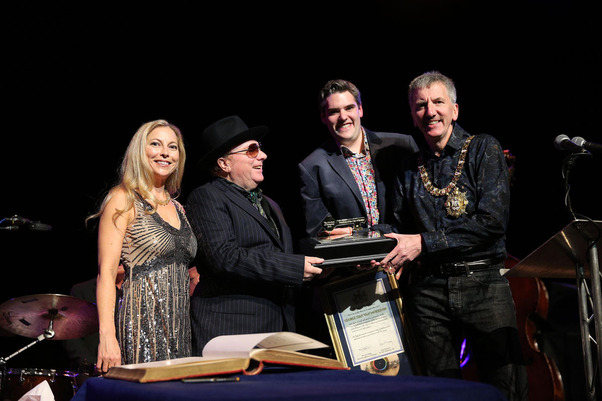
Van – Freedom of the City of Belfast


VanMorrison
Posted in Article | Comments Off on Van – Freedom of the City of Belfast

News Coverage: Annual Armistice Day Commemorations at Glasnevin Cemetery, Dublin

1.       National Broadcast – RTE

2.       International Broadcast (BBC 1 and BBC Newsline UK)

3.       4 Irish Independent –  National Print and Online – Ireland’s largest selling print paper on Online site

4.       1 Irish Times

5.       2 other print 

1.    RTE Radio 1 Drive Time.

A great piece reporting from Iveagh house. Interviews with George McCullough, Finbar Furey, teacher Nora Kielty and author Jamie Broughan

The piece starts at 1:55:30  and finishes at 2:01:00

 http://www.rte.ie/radio/utils/radioplayer/rteradioweb.html#!rii=9%3A10219892%3A0%3A%3A 

2.    UVF Exhibition in Dublin

BBC 1, BBC Newsline, 11-Nov-2013

…the Republic was opened in the visitor centre at Glasnevin cemetery. Rozlyn Small – Unionist Centenary Committee Jimmy Deenihan – Irish …

http://www.bbc.co.uk/news/uk-northern-ireland-24898648

Also BBC Newsline – Cannot Download Link – only available in the UK.  On Kantar 

3.    The Belfast Telegraph

Rare unionist artefacts go on show.  

Personal items of the first prime minister of Northern Ireland, rare artefacts and military memorabilia have gone on show in the Republic of Ireland for the first time. 

http://www.belfasttelegraph.co.uk/news/local-national/northern-ireland/rare-unionist-artefacts-go-on-show-29744727.html 

4.    https://t1.gstatic.com/images?q=tbn:ANd9GcTOffYoBlZoyQtcRoYQthZP_OypmgQr9KoSKBs3q5bZzU92yZs7dMgN2wQ

Home Rule exhibition in Dublin symbol of length of road travelled, says Deenihan

Irish Times – ‎12 hours ago‎

Opening The Third Home Rule Crisis,the Unionist Response, the Minister said the Decade of Centenaries project was to build understanding of the context surrounding events, including the first World War, the 1916 Rising, the workers’ rights movement and 


5.    https://t1.gstatic.com/images?q=tbn:ANd9GcT8XCl35TAQZ7PI1Tg-iuesJq3E1MC8D3SNhkNXvACUYn6pbfIIIXymyye6

Rare military memorabilia goes on show for time in Republic

Irish Independent – ‎7 hours ago‎

Entitled Third Home Rule Crisis – The Unionist Response, the event focuses on the unionist reaction to events during 1912-1913, particularly the Ulster Covenant and formation of the UVF. Unionist politicians Jim Shannon and Tom Elliot attended the launch 


6.    https://t0.gstatic.com/images?q=tbn:ANd9GcQcPYjZ-lAyKkxkMDncTSH5wdKsE5tGn5V1F2dcNfrIqo7zxsVlCJIOnJk

Cross-Border tribute to war dead signifies era of peace

Irish Independent – ‎11 hours ago‎

The ceremony was preceded by the opening of an exhibition at the cemetery’s museum titled the ‘Third Home Rule Crisis – The Unionist Response’ which features artefacts and documents on Unionism in Ireland between 1912 and 1914. The exhibition was  

7.    The Irish Sun pg 24

First PM’s rare show

Items belonging to the first prime Minster of Northern Ireland have gone on show in the Republic for the first time. 

8.    The Irish Mirror pg 6

Pupil’s book for Great war

A Group of students have published a book based on a ballad from WW1 

9.    The Irish Independent Online

Four Dublin teenagers launch first book by Jason Kennedy. A video report from outside Iveagh House yesterday.

http://www.independent.ie/irish-news/education/four-dublin-teenagers-launch-first-book-29744250.html

10. The Guardian

http://www.theguardian.com/world/gallery/2013/nov/11/10-photo-highlights-of-the-day


Posted in Article | Comments Off on News Coverage: Annual Armistice Day Commemorations at Glasnevin Cemetery, Dublin

Annual Armistice Day Commemorations at Glasnevin Cemetery, Dublin

Unionist Centenary Committee in partnership with Glasnevin Trust  

Annual Armistice Day Commemorations

Monday, November 11th 2013 

at Glasnevin Cemetery 

commencing at 1.30pm with the launch of the exhibition by

Jimmy Deenihan TD, Minister of Arts, Culture and the Gaeltacht

“Third Home Rule Bill 1912-1914, The Unionist Response”  

in the Prospect Gallery, Glasnevin Museum  

followed by a wreath laying ceremony at the

Commonwealth War Graves Commission Cenotaph

at 2.15pm 

followed by a lecture 

Ireland and the First World War: The Challenges of Commemoration“ 

By Dr. Edward Madigan

at 3.15pm 

in the Milestone Gallery, Glasnevin Museum 

Light refreshments will be served following the lecture,

courtesy of the Unionist Centenary Committee

Personal items of the first prime minister of Northern Ireland, rare artefacts and military memorabilia have gone on show in the Republic of Ireland for the first time.

Collections from the James Craig Trust, historic uniforms worn by the Ulster Volunteer Force (UVF) and literature were part of an exhibition launched on Armistice Day at the Glasnevin Museum in Dublin.

Entitled Third Home Rule Crisis – The Unionist Response, the event focuses on the unionist reaction to events during 1912-1913, particularly the Ulster Covenant and formation of the UVF.


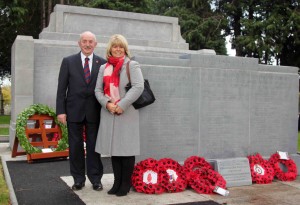
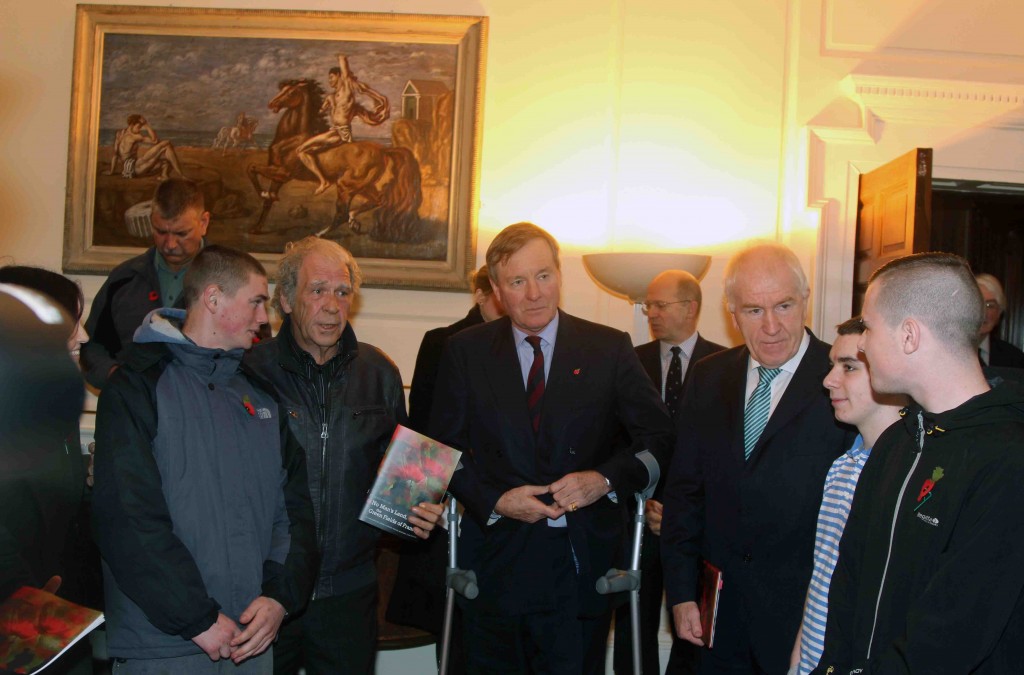
Unionist politicians Jim Shannon and Tom Elliot attended the launch and a wreath-laying ceremony at the Commonwealth War Graves Commission Cenotaph at Glasnevin cemetery. I attended as founder chairman of both the UCC and  the Somme Association along with the Somme Association’s Director Carol Walker.Earlier, a Remembrance Day service was held in St. Ann’s Church and The Green Fields of France, a historical book produced by four pupils of St. Paul’s School, Finglas, was published.

Jimmy Deenihan, Minister for Arts, Heritage and the Gaeltacht, said the exhibition was a symbol of the length of the road travelled since those tumultuous days.

“Within a very short time of the founding of the opposed Volunteer movements in Ireland, the men who had joined the Ulster Volunteers were fighting and dying in the World War just as those were who had joined the Irish Volunteers – founded 100 years ago next week,” Mr Deenihan said.

“It is deeply saddening to think of the many thousands of lives lost in the World War.

“As our commemorative programme continues, I hope that the Unionist Centenary Council (UCC) will bring forward further accounts of their community experience and the next chapters of their history.

“It is right that the men of the 36th (Ulster) Division should be remembered throughout Ireland with the same respect that is due to the 10th and 16th (Irish) Divisions.”

Organisers said the exhibition – organised by the UCC with support from the Department of Foreign Affairs Reconciliation Fund – gives an insight into the thinking of Unionists from Ulster, Munster, Leinster and Connacht and tell the history of the Signing of the Ulster Covenant, the Ulster Volunteers and lesser-known Unionist organisations such as the Loyal Dublin Volunteers.

It features the Covenant signed by James Craig, his military memorabilia and items from his home Craigavon House, such as Christmas ornaments and tableware. Weaponry, uniforms, badges and Unionist propaganda material from the time will also be on display from private collectors.

The UCC was created to oversee the decade of centenaries between 2012/21.

The committee has been given unprecedented access to material of major historical significance relating to this period in Ireland’s history, including descendants of James Craig, who was pivotal to political and social developments of the time and later became Northern Ireland’s first prime minister.

The majority of artefacts contained in the exhibition will never have been on view to the public before in the Republic of Ireland.

The exhibition will run until November 24, when a second event focusing on the Irish Volunteers will open.


David Stitt of the Ulster Defence Union, fellow member of the UCC, also attended.


Posted in Article | Comments Off on Annual Armistice Day Commemorations at Glasnevin Cemetery, Dublin

The Pictish Nation: 6 – Chapter 3 (Concluded)

Disert is from the Latin deserta, waste-places; but the meaning was enlarged. There is a recorded Church of S. Ninian at ‘Disert’ in Moray, believed  to be at Dyke. The place is no longer known by its first name. Disert, originally, meant any solitary place where the cleric might retire for a short time from the community for meditation and devotion. S. Martin had his Casa some miles away from Poictiers; and his cave on the Cher, well outside Tours; S. Ninian had his cave on the seashore some distance from the “Magnum Monasterium” at Candida Casa.  This usage was even applied to the Cuculla or Hooded Garment which covered the Cleric. Sometimes it was called Capa, sometimes Casula. The hood of the Capa was the only head-covering of the Celtic Clerics; and it was used only in cold or storm. Those who seek an explanation of the unexplained word Cap should note this. Those, also, who wish a further example of how initial C was avoided in Pictland, should note the word ‘ Hap’ still applied there to any garment like the ancient Capa or Cuculla which was a wrap for the day and a blanket for the night.

S. Servanus had his cave at Dysart in Fife; S. Kentigern retired ‘ad deserta loca” where his dwelling was a cave; S. Finbar and S. Comgall had retreats in the ‘Holy Wood’; S. Cainnech had a solitude on an island in a loch. In these solitary places these leaders of men meditated on God and rejoiced in Nature. They made friends with the wild creatures around them; the wild swans came to S. Comgall at his call; S. Kentigern had a wolf and a stag for companions; and S.Cainnech was followed by a hind.  n their monastic organizations the Picts and Britons left room for the anchoret as well as the cenobite. The Irish Christians at a later period recognized Diserts especially intended for men who had no external interests, religious or otherwise,who had imprisoned themselves ar Dia, ‘ for God,’ that is, for continued devotional exercises. The Irish also, in the late period, used Dithreabh, Wilderness, for Disert. Disert is still in use in Pictland, but only in secular place-names.

Bachall (Brit. bagl) from Latin baculum, was the pastoral staff of an Ab or bishop. When sent by a messenger who was the bearer of a verbal order from the Ab; the staff was a sign that the order had been authorized. The pastoral staves of SS. Moluag and Fillan are still preserved. The staff of S. Donnan the Great vanished at Auchterless Church at the Reformation. Certain lands at Kilmun went with the custody of S. Mund’s staff; and the property called ‘ Bachul’ in Lismore is still held by the hereditary keepers of S.Moluag’s staff. After the period of the Celtic Church the Bachalls of the saints were venerated as relics, used in healing the sick, and, to bring victory, were carried in front of the fighting-men as they marched into battle, which explains why the ‘Bachul’ of S. Moluag was in the custody of the standard-bearer of the lords of Lorn.

Cathair is a name associated with the sites of many cities and muinntirs in the territories of the Britons and Picts. Etymologists insist that it represents two words (i) Cathair (Brit. Caer, Latin Castrum), a fort; seen in ‘Caerleon,’ Fortified camp of the Legions; and in “CaerPheris”the thirteenth -century Dun-Fres (Dumfries), Fort of the Frisians. (2) Cathair ( Welsh Cadair, Latin Cathedra), a chair, particularly a bishop’s Cathedra or Chair. If the etymologists are right; mediaeval Latin translators of Celtic documents would be wrong ; because they call early monastic settlements ‘cities,’ not seats, and indicate, what is correct, that as a rule they were fortified. ‘Car-Budde’ near Forfar, for example, is known to be ‘Castrum Boethii,’ *Fort of S. Buidhe; not Chair of S. Buidhe. It was a gift from Nectan, the Sovereign of Pictland. Joceline writes ‘ad Cathures ‘ in the sense of ‘ad castra,’ that is, to the place that became known as the camp of S. Kentigern’s community, the first name of the city of Glasgow. 

On the other hand, there are places in Pictland connected with the early Celtic missionaries called ‘Suidhe,’ a seat, and an alternative name among the people is ‘Cathair’ The Suidhe- Donnan in Sutherland, for example, is a deeply concave rock, associated with the fieldpreaching of S. Donnan the Great. Apart from the fact that it was one of S. Donnan’s preaching-places ; the tradition is that at the Suidhe Donnan he ‘judged ‘ the people. In Ireland the Suidhe is frequently associated with some Brehon or Lawgiver. It is also called “Cathair” and it is in a protected position. These stones called Cathair or Suidhe are not all associated with saints, the best known is the Lia Fail now in Westminster. ‘Cathair,’ if equivalent to Suidhe, appears in Pictland to have the simple sense of the original Greek kathédra, a seat. There seems, however, to have been but one word ‘ Cathair’ which in course of time took a secondary meaning, designating not the fort but the seat protected by the fort. In neither sense was ‘Cathair’ an episcopal word. It was used in Pictland centuries before the introduction of the monarchic or diocesan bishop with his official ‘cathedra’ It was not the Chair of the bishop, but the Chair of the Ab which was the seat of authority in Pictland for many long centuries. The writers who interpreted Cathair, when linked to a saint’s name, as referring to his ‘city’ rather than to an episcopal chair were conforming to historical truth.

Bangor. In Pictland this name takes the forms Bangor, Banchory, Banagher. Among the Britons are ‘Bangor Padarn”* ‘Bangor y Ty Gwyn ar Dav’ and many others. Among the Irish are The ‘Bangor  of S. Comgall, ‘Lis-Banagher” and Church of ‘Ross Bennchuir,’ besides many others. One Irish writer refers to ‘Benncair Britonum,’that is, Bangor of the Britons. Also, among the Britons were the famous ‘Cor Tewdws” destroyed in the fifth century during a raid from the Irish coast and restored by S.Illtyd (died A. D. 512.) and, besides others, ‘Cor Tathan which originated in the beginning of the sixth century, and sometimes called Bangor Tathan.^ Associated with many of the Bangors among the Britons were the houses bearing the name ‘Ty Gwyn,’ that is, White House, a name already noticed at S. Ninian’s Candida Casa, Whithorn.

Legends have been invented, and etymological analyses applied to explain ‘Bangor ‘as a topographical name. The results have been amazing. The name has been discussedat length in this work in Connection with S. Comgall’s labours. It is sufficient to state here that ‘ Bangor ‘ was the name of an organization or institution. All the features  of a ‘Bangor’ were present in S. Martin’s Magnum Monasterium, and in the daughter-house at * Padarn ap Pedredin. This place is now Llanpadarn Var in Cardiganshire.

Candida Casa, namely, the monastic community with means for training and discipline; a Church; Schools for the training of outsiders not intending the Church. Only in two features did the Bangors improve on S. Martin’s or S. Ninian’s establishments; the communities were more numerous, and the Laus perennis, the continuous course of Divine praise, was more perfectly celebrated by huge choirs, which were divided into large groups  who took regular turns of the duty and sang with a refinement not possible when S. Martin was organizing his choir out of the raw converts in Gaul. So far as dates can be compared, they are in favour of the view that the name ‘Bangor’ was carried from the Britons to Ireland along with the perfected organization of the Laus ferennis,which was a feature of S. Comgall’s Rangor,  by men educated among the Britons like S. Finian of Clonard and others who were Britons by birth as well as education. Columbanus also made it a feature of the daughter-house at Luxeuil.At Bangor Illtyd each group numbered one hundred, according to the Triads. Just as the monasticism of S. Martin in Gaul was for a long time regarded with disfavour by certain authorities in the Western Church, so in the Eastern Church the cenobiteswhogave themselves to the celebration of Lausperennis were regarded as a sect and were called ‘Acoimetae’ Their great centre in the East was at Constantinople, in the famous Studion founded c. A.D. 460.

The following names are Celtic, most of them are Pictish or Brito-Pictish.

Andat or Annat meant a Church whose staff ministered to outlying congregations,or a Church which provided ministerial supply to other smaller Churches when required. The word has been happily translated, Mother-Church. ‘Andat’ is still the name of the site of a Church at Methlick in Aberdeenshire founded by S. Ninian on his northern mission. The name alone indicates the antiquity of this place. ‘Andat’ and ‘Annat’ are found throughout Pictland, and mostly at sites dating from before the Roman Catholic period. In Ireland one oftheChurches*founded there by the earliest British missionaries was called ‘Ando6it.” Afters. 727, when veneration of ‘Relics’ began among the Irish Celts under Roman influence, the relics were enshrined at the Andat or Mother-Church. Relics were not venerated in the Church of Pictland until it had been overtaken by Roman influence in the eighth century. The original meaning of ‘Relig’ in Ireland was Cemetery.

Nemhidh is a name that came to be applied to a place rendered sacred by the existence of a Church or other sacred institution. It is, however, The Church of a certain Earnan regarded (c. 800) as one of S. Patrick’s disciples, a pre-Christian name, and is one of the oldest names in Pictland. It was originally applied to a sanctuary in a grove. The people pronounce it ‘Nevie and Navie. Professor Watson equates it with the Gaulish Nemeton, and quotes Zeuss, l de sacris silvarum quae nimidias vacant’* The Indo-European root of the word is seen in the name of the famous Nemivt the Alban mount in Italy, the ‘sanctuary of Diana Nemorensis or Diana of the wood.’ The wood where S. Comgall and S. Finbar had their ‘ retreats,’ now Holywood, was called ‘Nemus sacrum’ There is a parish Nevay in Forfarshire, and the name is frequent in Pictland.

Dair, genitive darach, means Oak. It is the original of the place-names Deer, Darra, and ‘Tear,’ the Caithness pronunciation of a Church founded from and named after Deer. Z^zV came to mean Oak-grove, as we know from the place where the Celtic fort of Derry originally stood. ‘Derteack 1 and ‘Deartaighe’ meant Oak-house, and also an oak-built prayer-house. Drostan, the anchoret of the heights of Brechin, was known as ‘Drostan Dairthaighe?\ that is, Drostan of the Oak-house cell.

Gomrie, Comrie, and in Ireland ‘Innis-Coimrighi! S. Maelrubha’s, Abercrossan (Applecross), is ‘Combrick* Maelrubha. Irish has also ‘Comairche! Modern Gaelic is Comraich. The Comraich was the defined area around the Church where the shedder-of-blood could claim the protection of the Church and fair trial. It was the Pictish ‘City of Refuge,’ and restricted the range of the blood-feud. If a refugee reached the comraich of a daughter-Church; he could claim the intervention of the Ab of the Mother-Church however distant he might be; and this ensured trial away from local prejudices. An Irish ruler’s son slew a man who had claimed sanctuary at the Church of one of S. Columba’s monks, for which act S. Columba organized armed hostility*against him. This was the battle of Cutl-Feadha, organized by S. Columba against Colman mac Diarmid because Cuimin, son of the latter, slew Baedan mac Ninnidh

Garth, seen in ‘Girth-Cross,’ Kingarth, and other names, is the Scandinavian rendering of Comraich. Garth originally meant an inclosure. ‘ Girth-cross ‘f is one of the Cross-marked stones that marked the boundaries of the Comraich.

Llan is a Britonic word. It originally meant a place marked off and inclosed, then it came to mean the fortified inclosure of the Church, and  as finally applied to the Church itself. Llan is seen in Lamlash, the Church of S. Mo-Lias; in Lumphanan (Llan-Fhinan) the Church of Finan;in Lhanbride, Church of Brite. This name has nothing to do with S. Brigit. The two latter names, referring to a certain Finan and a certain Brite”, are in the area of Pictland worked by the British missionaries. The first name, Lamlash, is in the old territory of the Britons.

Lis (Brittonic llys, Breton Us) also originally meant an inclosure with a rampart. It afterwards came to be applied to the Church- inclosure, and in modern times to a garden. In Ireland/^ means a fortification. The name is seen in S. Moluag’s ‘Lismore’ and in many minor places throughout Pictland. The ramparts of S. Donnan’s Us at the Church of Auchterless used to be visible. The fortifying ditch and wall can still be seen at some of the early Church-sites in Pictland where they have not been disturbed. The sites of the Churches founded by S. Ninian on his northern mission at Dunottar, Navidale, and Wick Head were on sea-washed cliffs protected on the land side by ditches or natural ravines and approachable only by narrow footways. S. Ninian’s ‘ Tempul’ in the Great Glen at Glenurquhart was inclosed in the ‘Lis-ant-Rinianl S. Ninian’s inclosure.

Dabhach seen in ‘Doch-Fin,’ S. Finbar’s Davach at Dornoch, and in ‘Doch-Moluag,’ S. Moluag’s Davach, was a measure of land in Pictland.Wherever it is used with a Celtic saint’s name it indicates the old benefices and endowments of the Pictish Church.

Examples of secular names drawn from Pictish speech are

Pit as a prefix. Originally it meant Portion or share. From ‘share of land,’ it came to mean homestead and town. Pen, Head. Seen in Caer-pen-tiilach now ‘ Kirkintilloch.’ Tulach is Gaelic duplicate oipen.Dol, in Pictland as in Britanny, is Flat-ground on a higher plane than the mackairor plain-land.Oykel and Ochil, High. The Pictish pronunciation of the original word is indicated in the xella’ of the early Greek geographers. Rhos is Moor. Pefr is Clear (applied to water) Preas (-fhreas) is Bush. Cardenn is a Thicket. Gwydd is a Wood, seen in ‘ Keith.’ Gwaneg is a Wave of sea or loch, seen in ‘ Fannich.’ Pawr (-fhawr) is Pasture, seen in Bal-four;. Dr. Macbain stated that Stokes, Zimmer, and Giiterbock regarded this word as an early borrowing from Latin. The early nomenclature of monasticism, with which the Celts of Gaul were familiar, was mostly fromGreek and slightly from Chaldaic and Coptic. The Latin Church was at first opposed to monasticism.

It is not clear how inital Latin C was articulated; but the Gaidhealic scribes reproduced as ‘ Circ ‘ and ‘ Ciric ‘ the names which in Pictland were pronounced ‘Grig,’ for example, ‘ ” Ecdes-Grig 1 in Kincardine; and ‘Me Giric ‘ and ‘ Mai- Girc ‘ in the Book of Deer.

Posted in Article | Comments Off on The Pictish Nation: 6 – Chapter 3 (Concluded)

The Pictish Nation: 5 – Chapter 3 (Cont’d)

                                                                                                                                                                                                                                                                                                                                                                                                                                                                                                                                                                                                                                 Beyond what has been stated, some ancient names in our present-day speech witness to the to the differences between Gaidhealic and Pictish; and show the Brittonic (Old British) character of the latter tongue. For example, the name of S. Maelrubha of Abercrossan, a Pict, means Red Cleric. In the districts of Pictland where he laboured the tradi tional pronunciation of his name, still used, is ‘Malruf,’ ‘Maruf” or ‘Marüve.’ The b in his name is clearly aspirated. Among the descendants of the Gaidhealic Colonists in the West, however, his name is spelt Maolruadha. It has the same meaning; and in colloquial Gaelic has frequently been translated Sagart Ruadh, ‘Red Priest.’ The Gaidhealic form is seen in the west country names, ‘Kil-Molruy,’ ‘Kil-Marow,’ and ‘Kil-Maree.’ The important point is that the name gives us the Pictish rubh and the Gaidhealic ruadh, both meaning red.

Again the Landnamabók of Iceland informs us of certain place-names “Papeya” and “Papyli” The places so designated were occupied by Clerics called ‘Pápas’ before the Scandinavians went to Iceland. Dicuil, the Irish geographer, knew of these Clerics being in Iceland about A.D. 725. But the names are in everyday use among ourselves designating Papa Stour in Shetland, Papa Westra in Orkney, Pab-Ei in the outer Hebrides; and other places. ‘Pápa’ came into the childspeech of Greece with Phrygian nurses, took the form papas and needless to state meant father,’ or later, ‘grandfather.’ The Greek-speaking Christians applied the name to ministers of the Church, regarded as ‘fathers’ of their congregations. It came into Gaul on the lips of various bodies of Christian, Greek-speaking exiles, not to mention traders and professional men.

Having been already applied to monks in Greek-speaking districts, the name was naturally transferred to S.Martin and other presidents of Celtic monastic communities who were imitating the Greek-speaking monks. The president of the monastic community generally spoke ofthe members as his ‘children’ or ‘family,’ or to use the Celtic word,  his ‘muinntir” a name which still survives at S.Martin’s establishment at Tours, in ‘Marmoutier’ or Mormuinntir, that is ‘Magnum Monasterium” or Great Monastery. Kaor, Papa of Hermopolis, is the writer of a letter preserved in Papyrus 417, British Museum, dated c. A.D.350.

“Papa” found its way to the daughter ‘Magnum Monasterium’ in Galloway with S. Martin’s disciples, Ninian the Briton and his followers. It is a word that no Gaidheal ever popularized; because no Gaidheal could easily pronounce it. In fact the Gaidheals rejected it, and adopted the Syriac “Ab” the title of the presiding monk in certain communities of the East. On the other hand, ‘Papa with its p-sounds is such a word as Britons and Picts would welcome. It occurs in early documents, in the Epistle wrongly attributed to Cumine of Hy, and is applied to S. Patrick, a Briton. The survival of the name in Iceland goes to confirm Joceline’s statement that S. Kentigern sent his missionaries ‘towards Iceland.’ The use of the word at all by the Picts and Britons reveals to any one who knows the early history of the Church in Gaul that their missionaries had been in touch with S. Martin’s monasticism and its nomenclature among the Celts of Gaul while the Roman Church was still looking askance at monasticism, and while the Bishop of Rome had little influence among the Gallic bishops.

Although monasticism and its nomenclature were brought to Gaul from Greek-speaking centres the name Papa disappeared and Ab or Abbas took its place there and elsewhere in the West as soon as the Bishop of Rome won control; because with clever humility he had chosen Papa as his own particular title, rejecting Patriarchês or other names equally grand. Papa survived only in places where it had been firmly rooted in the speech of the people before the influence of Rome overtook it, as on the coasts of Pictland; or throughout the Eastern Church where the influence of Rome was never felt, and where it still designates the humbler clergy.

Other borrowed words seen in the place-names of the Picts are:

Cill (English Kil-),dative of Ceall (Early Irish Cell), from Latin Cella, a cell. The name now means Church. Originally it was attached to the founder’s name. The cell of the Ab was the centreof the monastic settlement, and close by stood the Church of the community. The great Pictish monastery of Bangor was a town of detached cells within a guarded rampart. The missionaries from Bangor and other centres of the Irish Picts introduced the detached bee-hive cell into Pictland, just as S. Columba, the Gaidheal, introduced it into Dalriada according to the examples which all had seen at Clonard and Glasnevin. It is worth noting, in this connection, that S. Columba’s teacher at Clonard was educated among the Britons, and that his teacher at Glasnevin was an Irish Pict. ‘Cill was not applied originally to Churches founded by missionaries from the Britons; Llan was common. Among the Picts and Gaidheals the Church frequently grew out of the Cell; among the Britons the Church and Cell were contemporaneous. S. Ninian’s Cell was Casa, a hut; because it was an effort to keep true to the type of Bothy at which S. Martin introduced and began to organize monasticism in Gaul, on the farm which S. Hilary gave to him for his great experiment. Here S.Martin began in the ‘ Logo-Tigiac’  or White Hut (The place is now Liguge, Poitiers), which was the original of Candida Casa.

Gregory of Tours and Fortunatus preserve the name as ‘Loco-ciacum ‘ and ‘ Logotegiacum’ and ‘ Logotigiacum. ‘ Longnon gives ‘ ‘ Loco-diacus”  of which there is a variant ‘ Lucoteiac- The latter part of the name is clearly  the diminutive of the Celtic Tigh ( Teach) or Ty, a House. The root of the first part of the name is seen in the Greek prefix leuko- which means Brightwhite; and in the ancient Celtic prefix Leuce (Leucetios, God of Lightning). The Celtic root also survives in the personal name ‘Luag-‘ which Angus the Culdee paraphrases as ‘clear and brilliant ‘ ; or in ‘ Cat-luan, ‘ Light of Battle.
It is seen also in the current Gaelic word luachair (rush), the light-maker. The whole name means literally Bright-white Hut, and is correctly translated by ‘ Candida Casa. ‘ Compare with the last part of the name ‘Moguntiacum,’ House of the god Mogun, the ancient name of Mainz. Kentigern’s settlement, showing that in his time the ‘little houses’ were maintained. In an old Irish manuscript, ‘ Botha is the name applied to the cells at Glasnevin. Both- was also used in Pictland of Alba.

Eaglais, formerly eclais (Brit, eglwys], is the Greek ekklesia, Assembly or Church. It occurs throughout Pictland, and, when associated with the Ancient Church-foundations, is attached to the ecclesiastical founder’s name. It is seen in such names as Eccles-Machan, West Lothian; in ‘ Egglis,’ the short name recorded in the early twelfth century for the ancient Eccles-Ninian, now S. Ninian’s near Stirling; in Eccles-Grig,Kincardineshire; and in Egilshay, Church-island, Orkney.

Tempul (Brit, tempel] is a name that abounds in Pictland; and, indeed, wherever Celts were settled. It came to mean Church. In the preface to the Hymn of Mugent, who was one of S. Ninian’s successors and presided at Candida Casa at the end of the fifth century and the beginning of the sixth, the scholiast calls the Church at Candida Casa ‘templum.’ The Church-site which S. Ninian on his northern mission marked off at Glen Urquhart,and where his Church stood for centuries, is still called “Tempul” Notwithstanding the later use of ‘ Tempul ‘ and its application to the Church at Candida Casa, there is evidence that in Pictland the name was not restricted to buildings but sometimes was used in its original sense of a place marked off and enclosed for a sacred purpose. The name had been, apparently, first applied in Pictland to the sacred enclosures of the heathen Picts; and, afterwards, bestowed upon the Christian Churches erected there. When Ailred, doubtless following the Old Life, relates concerning S. Ninian’s northern mission ‘temples are cast down and Churches erected,’ he means no more than that the templum proper, the inclosed space,  was broken into by the Christian pioneer, and the ceremonial standing stones laid flat.

Seipeal (Ir. Sepel), Chapel, is an interesting name. It has been applied in Pictland, in the vernacular, to the most ancient Church-sites, foundations not dedications, where there has been nothing but dry-built stone foundations time out of mind, and  perhaps adisused Churchyard. Thus we have in the north of Scotland, where ancient names have been little displaced, such examples as Sepel- Ninian, Sepel-Finbar, Sepel-Drostan,Sepel-Donnan, and the like. Yet the philologists declare that Sepel, because of the initial S which is articulated as Sh, was imported from English after the tenth century when extra apses with an altar came to be added to the main structures and were called ‘Chapels.’ The Gaidheals, for example, had no need to borrow from English; because they took their word Caibeal, Chapel, direct from the Latin Capella and it is seen in such a name as Portincaple, Port of the Chapel, reproduced in the fourteenth century as ‘Portkebbil’ Manifestly the initial Sh- sound in Sepel was due, not to English, but to the influence of a tongue which disliked simple initial S as much as initial C.

Both the Britons and Picts had these dislikes,hence in Pictland there still survives in the native pronunciation of place-names sepel for capellashantor for cantor, a choirmaster; ‘shant ‘ for sanct, and even ‘Skanonry’ for Canonry, the place where Canons resided. There is a further indication that “sepel” a chapel, was used by the Celts long before its application in the tenth century to extra apses The name goes back to the period of the true capella, that is, little capa or covering. The true ‘chaplain’ was the minister who dispensed the sacraments under the capella, which was an extemporized canopy of thatch-work raised over the held Communion-table of a minister accompany-
ing the Christian legions of the Emperor, or of a pioneer missionary sealing his converts.

As Ailred, with the Old Life before him, states that S.Ninian in his northern mission through Pictland joined his converts ‘to the body of Believers, by faith, by confession, and by the Sacraments, ‘ the Capella would be a feature of his field-services ; and it is only natural that the dry-stone building with heather-thatched roof which succeeded it as a permanent shelter for the Holy Table, should continue to possess the name Sepel, Capella, or Chapel. In the early Celtic Church ‘Capella’ ‘and ‘Casula’ became interchangeable names, apparently because of the thatch-work covering common to both;  for, of course, while the Casula had walls, the early Capella was supported on poles.

Posted in Article | Comments Off on The Pictish Nation: 5 – Chapter 3 (Cont’d)