The Pictish Nation: 5 – Chapter 3

THE LANGUAGE OF THE PICTS

It is desirable to think of the speech which the Picts used, the speech in which Christianity was taught to them. All the scholars who have a practical acquaintance with the topographical names of Pictland are now agreed that the speech of the Picts was a dialect of Celtic, that it differed considerably from Scottish Gaelic and other Celtic dialects of the Gaidhealic group; but, on the other hand, that it agreed closely with the Celtic speech of the Britons, now represented by Welsh. Professor Watson puts it thus:* ‘ Linguistic evidence goes to show that the Pictish language was Celtic, and belonged to the Cymric branch represented now by Welsh and Breton, and until recent times by Cornish.’ As stated by Dr. Macbain f the main difference between Pictish, or other Britonic  tongues, and the dialects of the Gaidhealic group is that Aryan q, when labialized by association with u or w, making qu, becomes in Pictish, or other Britonic speech, a simple p; but in the Gaidhealic dialects it becomes c, qu, or k. The standing illustration is the word for the number ‘five,’ which in Welsh is pump, in Cornish pymp, in Breton pemp, in Gaulish pempe; but in Scottish Gaelic it is coig in Manx queig, and in Irish cuig

Venerable Bede stated that besides Latin there were four ‘languages’ in Britain, namely, English, British, Scottish, and Pictish. Bede was quite untravelled* and his work shows that he had little personal knowledge of the Celts, and was not in a position to distinguish between a dialect and a language. Nevertheless, he has been much relied on by those who, as Dr. Macbain expressed it, with ‘wasted ingenuity’ theorized that Pictish was non- Aryan and pre-Celtic.

We have seen that the ‘Cruitin'(Pict) and the Briton were one in name; it would have been contrary to expectation if they had differed in speech otherwise than dialectically. Nevertheless, however similar the dialects of the British tribes, including the Picts, were at the time of the Roman occupation; it is well not to forget that between the days of the Roman colony and the eighth century, when Bede wrote, the speech of the conquered Britons would, owing to the influence of the Gaulish Legions and Latin culture, diverge markedly from the speech of the unconquered Britons or Picts which for a long time was preserved from foreign influences.

On the other hand, the expulsion of the Brigantes to the north of Antonine’s Wall, A.D. 139, before the legions of Lollius Urbicus, would only intensify the Britonic nature of Pictish speech. These Brigantes were the most numerous and powerful people among the Britons. They occupied the country from the H umber and Mersey line to the Firth of Forth, that is, all the ground that became the province “Maxima Caesariensis” and the eastern half of Valentia and with their relatives the Manapian Picts they also occupied the south-eastern coasts of Ireland. Pausanias tells us that the Brigantes were deprived of their lands.* Julius Capitolinus adds to this that they were expelled from the province by Lollius, thatis, driven with the Otadinoi north of the Forth and Clyde line, behind the new Wall which the Roman general had made; and, as we have already noticed, penned up in Pictland among the southern Vakomagoi and the Vernikones making a mixture of peoples that unite and emerge later as Miathi, Midlanders, out of whom, still later, emerge the Verturtones or Men of Fortrenn. The expulsion of these Brigantes, not to mention the Otadinoi from their far-stretching territories, and their withdrawal behind the Wall before the Roman drive must have turned Pictland into a ‘ Congested District’ for the first time in history. This event must also have increased the Britonic characteristics of the Picts, if that were possible, and accentuated the Brittonic features of Pictish speech to an extent that ought to have enlightened the sceptics who doubted the close original affinity of the Cruitin (Pict) and the Briton.

The close affinity between the speech of Pict and Briton is further indicated in the ease and speed with which the British Christians occupied the mission-fields of Pictland. Hardly had S. Ninian, a Briton, completed the foundation of Candida Casa in Galloway as a centre of the Christian religion when he set out with a number of his community to found Churches, and to place ministers all along the east coast of Pictland. f From the then border-town of Glasgow the line of his Churches extended to S. Ninian’s Isle in Shetland. Ailred, who drew his facts about Ninian from the Old Life, states that thesaint taught the Picts ‘the truth of the Gospel and the purity of the Christian faith, God working with him and “confirming the Word with signs following. “‘J There is not the slightest hint that either S. Ninian or his helpers had the least difficulty with the language. Even Bede lays stressonS. Ninian’s preaching^ as the means by which he converted the Picts of the East coast.

In the beginning of the sixth century S. Finbar (Uinniau) of Maghbile (Movilla) and Dornoch, a pupil at Candida Casa but an Irish Pict by birth, took up and * between A. D. 400 and 432 continued S. Ninian’s work in Sutherland, Ross, and elsewhere. He, of course, would have no difficulty with the Pictish tongue.

About the same time S. Drostan, another Briton, established a missionary-base at Deer in the lowlands of Aberdeenshire, from which he worked with the members of his community and strengthened the Faith in Buchan and Caithness.

Later, in the same century, S. Kentigern, another Briton, with his base at Glasgow, led a mission to the uplands of Aberdeenshire, and sent members of his community ‘towards the Orkneys.’f Joceline, his biographer, who also drewhis facts from an old Celtic Life, emphasizes the effect of his preaching, ‘the Lord working with him, and giving power to the voice of his preaching.’ Again, there is no suggestion that preaching to the Picts was other than easy to a Briton.

About the same time that S. Kentigern was in the Pictish mission-field S. Comgall the Great, J another Irish Pict, friend of S. Finbar and neighbour to him, was teaching the Western Picts; S. Cainnech of Achadh-Bo, also a Pict, was teaching the Picts of Fife; and S. Moluag, yet another Pict, a relative of S. Comgall, was joining up his missionary community at Lismore in Argyll with his other community at Rosemarkie in Ross, and linking this in turn to the missionary-communities of the Britons in Aberdeenshire. Here, once more, we have no sign that the Britons were divided from the Picts by any difficulties of language.

The first outstanding Celtic ecclesiastic who appears in history as having difficulties with the speech of Pictland was a Gaidheal; and he, none other than S. Columba of Hy. He stands in history, written too by a Gaidheal, to confirm all that philologists and historians have discovered in the way of indicating that the speech of Pictland though closely akin to the speech of the Britons was decidedly different from the Celtic dialect spoken by the Gaidheals or Scots.

Thrice we hear of S. Columba depending on interpreters in his conversations with the Picts. When he went to Brude Mac Maelchon to seek Permission to settle in Hy, or lona, for his work among the Gaidhealic colonists, he required to attach himself to the company of two Picts, S.Comgall the Great and S. Cainnech.

Posted in Article | Comments Off on The Pictish Nation: 5 – Chapter 3

Cork Branch Western Front Association ‘Evening of Remembrance’

Patrick Lynch has asked me to contact you regarding our Association’s planned event on Friday the 8th November. This event is ‘An Evening of Remembrance’ to remember the approximately 4000 fallen of the Great War who were from the City & County of Cork.  This is the second year that we have produced this event, and last year’s evening was a great success.  The format of the evening will be approximately 1.45 hours in duration, and tells the story of the Cork War Dead through Music, Song and Story.  Music is being provided free of charge by the Cork Barrack Street Band, which has been in existence since 1837, and indeed lost a number of their number during the Great War.  Singing on the night will be a young and upcoming Cork Soprano, Niamh O’Sullivan.

The story element of the evening contains stories covering the major engagement and campaigns of the War, from Mons, Etreux, Aubers Ridge, Gallipoli, Jutland, The Somme, 3rd Ypres through into 1918. the event is being supported by the Lord Mayor of Cork City , Cllr Catherine Clancy, and the Mayor of County Cork Cllr Noel O’Connor, as well as other military and civil dignitaries. All proceeds from the event are in aid of the Cork Penny Dinner’s charity, and were chosen as they provided assistance to many returned soldiers who had fallen on hard times. the event is being held at the Triskel Art Centre in the Beautiful Christchurch venue.

The Cork Branch of the Western front Association is very active in the community and host numerous open days for the public to come and explore their family history  of the Great War.  We are relatively new to the scheme having been in existence for only three years. However the Association as a whole has been around since 1980 and has branches in the USA & Canada, Australia & New Zealand, the UK, France, Belgium and of course Ireland.  in the past thee years since we were established in Cork, two further branches have been established  in Dublin and Belfast. Today  the Association  is recognised as the premier organisation for study, learning and research into all aspects of the Great War and numbered among its presidents and trustees are a number of distinguished academics and military historians and civic dignitaries.  It is completely non-political and has over 6,000 members.

Kindest regards

Mr Ross Glennon
Vice Chairman & Public relations Officer
Cork Branch, The Western Front Association.
www.westernfrontassociation.com
Facebook: Cork Branch Western Front Association. 
 

Posted in Article | Comments Off on Cork Branch Western Front Association ‘Evening of Remembrance’

The Pictish Nation: 4 – Chapter 2

PICTLAND OF ALBA

Albion is the name of Britain preserved by the Greek writers; probably it was taken down from the early shipmasters of the Mediterranean. Ptolemy’s spelling (c. 127) is Alouton, due, very likely, to a copyist’s error. Pliny also gives the name as Albion. The early literary Irish use the forms Alba and Alban, and ultimately apply the name to what is now Scotland, that being the part of Britain with which they had most traffic.

When the Vikings (c. 800) landed on the northern part of Britain they called the country ‘ Pictland.’ This is exactly the name which is applied to that part of the country in the Annals of Ulster (c 866) in the Celtic form “Cruitintuath” where Cruitin stands for Pict, and tuath  for land or nation.

Cruithne, a Pict, comes to us in the spelling of the C-using Gaidheals. It was the name which the Gaidheals of northern Ireland applied to the Picts of Ulster. Adamnan, Abbot of lona, also a Gaidheal, latinizes it into “Cruithnii”  and uses it in referring to the same people.

This short excursus among national names brings us round in a circle to the point from which Britons spelt ‘Cruitin (Pict) as Priten and Pryden. This the Teutonic Angles transformed into Briton. Therefore, Cruithne or Cruitin, on the one hand, and Priten (or Briton) on the other, are one and the
same name, meaning Pict, and taken from two different Celtic dialects.

An early Greek name for the British Isles is Pretanikai Nesoi. This is based on the native name for Britain, ” Ynys Prydain” which means, literally, Picts’ Island. Britain takes its name from the Picts \and the use of this name stamps  the fact in every literature throughout the world.

It is manifest to any patient inquirer that, so  far as Britain is concerned, the Picts who submitted to Imperial Rome, and who took on something of Roman manners and Roman culture, came, through Latin usage, to have the name ‘Britons’ reserved for themselves alone; whereas the Picts who had spurned Roman power and culture, and who had retired, independent, north of the Wall of Antonine, came, through the influence of Gaidhealic writers, to be distinguished as ‘Cruithini” or ‘Cruithnii.’

After the Roman general, Lollius Urbicus, had driven the powerful Pictish tribe known as the Brigantes beyond the Wall of Antonine(c 139) this wall became the southern boundary of Pictland. From this frontier-line, stretching between the Firths of Forth and Clyde, Pictland extended northwards to the remotest island of Shetland; and the Hebrides, outer and inner, were included in the country.

This was the territorial extent of Pictland when S. Ninian led his mission along the whole east coast, and crossed the sea as far as Shetland between 400 and 432 A.D. This also represents the territory over which Brude Mac Maelchon, the Sovereign of Pictland, reigned at his capital in Inverness from 554 to 584 A.D. Cantyre with its colony of Gaidheals or Scots was at this time within the lordship of Mac Maelchon; because A.D. 5 60 this sovereign had expelled many of the encroaching Gaidheals from South Argyll, had shut up a remnant in Cantyre, and after slaying their righ, or king, Gabhran, in battle, had left their new chief with the title of a mere tributary “toiseach” or military magistrate.

It was into the Pictish dominions thus defined,and to this sovereign, Brude Mac Maelchon, that, A.D. 563, SS. Comgall and Cainnech, the Pictish ecclesiastical leaders, introduced S. Columba the Gaidheal, outcast  from the Gaidheals of Ireland who had turned to the Dispersed amongthe Picts of Argyll. Columba was discreetly angry at the broken state of his race-brothers, the colonists in Cantyre; but he restrained him self enough to crave from Brude, the Sovereign, an island in the West, where he could dispense the consolations of Religion to the children of the  captivity who wept among the Isles to the moan of the Atlantic; and where, afar from the supervision of the monarch, he could exercise warily his aggressive diplomatic genius to restore freedom and progress to the conquered Gaidheals.

In the Irish additions to the Historia Britonum the mainland of the Picts is described as ‘ Ochrichat co Foirciu that is, from Caithness to the Forth. Within this stretch of territory Ptolemy of Alexandria places ten tribes or provinces. The Epidioi, Horsemen, inhabited Epidium, Cantyre and South Argyll. The Kerones, Shepherds, occupied the whole West Coast from about Loch Linnhe to Cape Wrath. The Kornavioi people are represented by the present county of Caithness. The Lougoi occupied the arable coast-land of Sutherland between the Ord of Caithness and the Dornoch Firth. A large, chambered burial-cairn on the left bank of the Ilidh within a quarter of a mile of Helmsdale is still called Carn-Lougie. The Smertai, the Quick-people, lived in the interiors of Sutherland and north Ross. One of their surviving burial-cairns is situated on the bank of the eastern Carron, and still bears the name Cam Smeirt.  The Dekantai dwelt on the fertile coastlands that extend from the Dornoch Firth to Moray. The Taezali were on the coasts of Banff and Aberdeen. The Vernikones, or Vernikomes, occupied the plains by the sea, from Kincardine, through Forfar and across the Tay into Fife. As V in Ptolemaic names sometimes represents Celtic Mk I as well as Fk and it is possible that the variant Vernikones contains the antecedent of ‘ Mearns. ‘ Throughout the eastern half of the Pictish midlands from the Tay to Moray were the  Vakomacoi and throughout the western half were the Kaledonioi, whose capital was Dunkeld.

On the east coast, south of the Forth, were the Otadinoi and still farther south, occupying the country from sea to sea, were the Brigantes. When about A.D. 139 Lollius Urbicus, general of Antoninus Pius, drove the Brigantes and the Otadinoi north of the Roman Wall, there was a fusion of
tribes, and new names appear in the South. From Xiphiline’s summary of Dion Cassius we learn that during the campaign of the Emperor Septimius Severus ( A.D. 211) the two chief tribes of southern Pictland were the Miathi* Midlanders, and the Kaledonioi. The Miathi appear out of the fusion of the unyielding Brigantes with the Otadinoi in the southern territories of the Vakomagoi and Vernikones and they were still surviving as a distinct Pictish clan in the sixth century.

In a reference by Ammianus  to the tragic campaign of the Roman general Fullofaudes, A. D. 365, the Kaledonioi are called ‘ Dicalydones,’ and the fused tribes between the Roman Wall and the Tay are roughly summed up as ‘ Verturiones, that is, Men of Fortrenn (Earn), whose centres were at Dun(d) Earn, Forteviot, and Scone. Beyond these mainland tribes were the Picts of Orkney, the Orkades of Ptolemy and Innis hOrk of the Picts; and, also, the Picts of Sketis (Skye) and of Dumna (Lewis).

Some time before the ninth century the Picts were organized into seven provinces. From an early Gaidhealic pen we learn that these  were ‘Cait, Ce, Cirigh, Fibh, Fidach, Fotla, Fortrenn. ‘  Cait is Caithness proper, that is, including Sutherland. Cirigh is the later Magh-Chircin, the name of the plain along the coasts of Forfar and Kincardine; and ‘Mearns’ is regarded as a surviving corruption of this compound name. Fotla is the later Ath-Fodla, now Atholl. Fib is Fife; and Fortrenn. kingdom of the fused tribes between  Forth and Tay, whose centres were as just stated.

These provinces were governed by chiefs or petty kings; but all were ruled by one ‘high-king’ or sovereign elected from the previous king’s brothers, whom failing, from the sons of the previous king’s sister; and, if these failed, from the sons of the daughters of the previous king. The elected sovereign reigned from the capital of his own clan.

These particulars show that the Picts were not the unorganized hordes of many histories. On the contrary, they were carefully organized as distinct clans in separate provinces enjoying local government under a chief whose rule was patriarchal; and all the clans with their chiefs were federated under one supreme government directed by the sovereign. The Draoidhean, who were seers and orators, were also counsellors of the sovereign; and the clan-chiefs formed the Executive throughout the realm. The people were homogeneous, and united by a true national spirit; because not only did they repel the advance of Imperial Rome as one man; but also the attempted encroachment of the Gaidheals led by Gabhran Mac Domongairt A.D. 560, and under the Pictish sovereign Angus I. Mac Fergus they almost shattered the power of the Gaidheals or Scots.

The effective occupation of all Pictland by the Picts is confirmed by many place-names conferred either by the Gaidheals or Vikings, and still in use. For example, in Shetland there are Pettidale, Picts’ valley; Pettwater, Picts’ Water; Pettgarthsfell, Hill of the Picts’ Walled I nclosure, or Town. At Orkney, the PtttlancFs Fiord is the Firth of Pictland, the ‘ Pentland Firth ‘of common speech. In Stoer on the north-west of Sutherland there is Clais nan Cruitneach, Hollow or Ditch of the Picts, referring either to a boundary between them and Gaidhealic settlers, or to the cuttings from which they dug their fuel. In Abercrossan (‘Applecross’) in Ross, where the Pictish saint Maelrubha established his community of clerics, there is Airigh nan Cruitneachd, that is, The Summer-pasture among the hills, whither the Picts led their cattle and where they sojourned in shielings to make the cheeses for the winter stores. In Kintail, also in Ross, there is Carnan Cruitneacht, that is, The Cairns of the Picts, the reference being to the Cairns in which they buried their dead. doubtless, this name reaches back to the Karnonakai, a section of the Kerones, who in Ptolemy’s time inhabited this very locality. In Moray the Abbots of Kinloss Abbey possessed a thirteenth century charter containing the bounding description, ‘ad rune Pictorum,’ which is explained as Picts’ Fields. Rune is still used colloquially in Moray as ‘Run? meaning a border-stretch of field, or path. In Aberdeenshire, at Turriff, the stretch of land between the haugh and the heights on which the old Pictish Church of S.Comgan stands is Cruithen-righe, that is, Pasture-stretch of the Picts. In Lochaber, Inverness-shire, is Cruithneachan, that is, Picts’ places.

Wherever foreigners crept into Pictland they bore unconscious testimony, in the names which they conferred, to the hold which the Picts had and kept of their own country.

* Latinized as Pictavia, and the people’s name as Picti or Pictones.
There was also Pictland of Erin, namely the east-coast districts of Ireland.
The Gaidheals called these districts Crich-na-Crutihne, that is, Bounds
of the Picts. Cf. Reeves, V. S. Columba, p. 94, note h.

t Whiteland. \ Not tuath meaning north, as Dr. Skene states.

V.S.C. lib. Leap. vii.

* See Place-names of Ross, p. xlvi, where Dr. Watson equates ‘Rune’
with Gaelic Raon, a field, or road,
t The later Celtic form is ruighe.

* Y. Cymmrodor, ix. 179.
t Keltic Researches, E. W. B. Nicholson, pp. 25, 173.

* Conall, Gabhran’s successor, is so termed by the authorities on which
the Four Masters drew.

t S. Columba was exiled from Ireland after 561, the year of the battle
of Cul-Dreimhnc which he provoked.

* ‘ Woe to the Picts to whom he will go East,
He knew the thing that is,
It gave him no pleasure that a Gaidheal
Should reign in the East under the Picts.’

The explanation of S. Columba’s mission in the Prophecy of S, Berchan.
\ This name not only indicates Ptolemy’s accuracy; but the P in the
name indicates one of the distinctive features of the Pictish dialect of Celtic.
Professor Kuno Meyer discovered the form of this name used by the Gaidh-
eals, namely Echidium.

\ The best authorities regard Kreones, A’arini, KarnSnes^ and Karndn-
akais& copyists’ variants of this name.

The writer considers that, as the KarnSnakaivizxz. flanked on both sides
by KeroneS) Karndnakiws, merely a sectional name for a part of the Kerones
who were distinguished by their prominent burial Karns, Celtic Cam.
At the present time ‘ Cclrnan Cruithneachd* is a place-name in the locality
of the Karntinakai.

* With this name Dr. Watson compares the Gaulish Ro-Smcrta, Deep-
thinking.

t Discovered by Dr. Watson in the parish of Kincardine, Ross-shire.

\ As in Ptolemy’s ‘ Farar,’ which is an attempt to render the Celtic
accusative for the sea.

As in Ptolemy’s Vir-, which is an attempt to’render.the Celtic Fhar- t
over, in the sense of towering over, or projecting over.

|| Compare Ptolemy’s Tarvt- with the old British Taru, Cornish Tarow
which he was striving to represent; and also the first part of his ‘ Vol-sas’
with its Celtic antecedent Oil- in the hybrid, Ullapool. Ullapool is in the
safe anchorage of Loch-Broom, which is believed to be Ptolemy’s ‘ Volsas
sinus.’ Loch-Broom agrees better with Ptolemy’s data than Loch-Alsh,
and the charting of the anchorage of Loch-Broom would be a greater testi-
monial to the Massilian sailors than the charting of treacherous Loch-Alsh
with its incessant squalls and want of sea-room.

In a reference by Ammianus \ to the tragic cam-
paign of the Roman general Fullofaudes, A. D. 365,
the Kaledonioi are called ‘ Dicalydones,’ and the
fused tribes between the Roman Wall and the
Tay are roughly summed up as ‘ Verturionesj\

* Thename occurs in the midlands of the Irish Picts, now Meath. The
word is the Britonic medd, central point; and the Irish med, later meidh.
An old spelling of Meath, in Ireland, is ‘ Midhi.’

f When Aedhan, King of the Gaidheals of Dalriada, fought against them .

t Ammianus Marcellinus, xxvii. 8. i.

Corrected by Rhys from Vecturiones. Initial Fhere equals F

* The islands are put out of true position by Ptolemy’s data.
\ Represented in the Book ofBallymote as the ‘ Sons ofCruithne. ‘

J These names are all in the genitive case.

* The Varangians and the Viking Jerusalem-pilgrims called Constant-
inople the Big Garth.


Posted in Article | Comments Off on The Pictish Nation: 4 – Chapter 2

The Pictish Nation: 3 – Chapter 1

THE PICTISH CHURCH

The Church of the Picts originated from the great mission conducted along the east coast of Alba(Pictland) by S. Ninian,a Briton, during some period between the years 400 and 432 A,D. While a native ministry was being reared,the ministry of the Church thus founded was supplied from the muinntirs , or religious communities of the Celtic Britons who lived south of the Wall of Antonine; and,also from the religious communities of the Irish Pcts (Cruithnii) ,particularly from the overflowing community of the Picts of Ulster at Bangor where S. Comgall the Great ruled as Abbot. It continued to be  the sole Church of the Picts of Alba until A.D. 842 when Kenneth Mac Alpin, king of the Gaidheals,* or Scots t of Dalriada, seated himself on the throne of the Picts in Fortrenn( Kingdom of Earn), and assumed the sovereignty. By this act, the Kingship of the Gaidhealic colony of Dalriada became merged in the High-kingship J of Pictland. The Gaidheals, or Scots, had a Church of their own, founded at Hy (lona) A.D. 563 by S. Columba, a Gaidheal. Clerics of this Church naturally followed their king and his court into his new realm; and we possess a record of their presence there, in Fortrenn,*about a century after Kenneth Mac Alpin’s time, trying to adjust their claims with the interests of the clerics of the native Pictish Church. Although, in name, Kenneth united the two dominions of Gaidheal and Pict at once, he did not unite the two peoples, or the two Churches.

Union of the peoples and Churches was a gradual process which continued through centuries. It was effected, district by district, sometimes by absorption on the part of the Picts, sometimes by suppression and penetration on the part of the Scotic dynasty. For example, the people in the districts once ruled by the Pictish mormaors of Moray withheld recognition from the Gaidheals until compelled by the terrors of the sword; and the old native Church was still represented at St. Andrews in the tenth century. \ Again, the ancient Pictish Churches at Deer| and Turriff were not taken over by Gaidheals until the early part of the twelfth century, after the Roman episcopate had been organized with the help of the Ceanmor group of Scottish kings. Although the Gaidhealic intrusionists had the countenance of theCrown, they required some sort of title with which to soothe the local sentiment before entering into possession of these old native establishments. They were equal to the situation, however, here as elsewhere, and proceeded to edit in their own interest the history of the origin of Deer, subordinating S. Drostan, the founder, to their own Saint Columba, thus creating what is known as’ The Legend of Deer’*

Although they could use Columba’s name to influence the Celtic sentiment of local officials, they show nevertheless that, by that time, this Saint had been deposed from his once high place in the esteem of Gaidhealic ecclesiastics; because in the memorandum of a genuine dedication of property made after the Gaidhealic intrusion was complete, ‘ Petir Abstoil? that is Peter the Apostle, is added to ‘Columcille and Drostan’ and takes precedence of both, f We thus learn that the Gaidheals who took possession of Deer in the twelfth century had already been romanized. Farther north, in the diocese of Caithness, the clerics who represented the very ancient Pictish foundation of S. Finbar, at Dornoch | continued to survive into the early thirteenth century in spite of and apart from Gilbert Murray, the fourth prelate but the first Gaidhealic bishop who had been able to secure a footing in that part of the diocese. The community of S. Finbar worked undisturbed; but Saint Gilbert* Cf. The Book of Deer. required to import a colony of Murrays to insure his security.

These are merely three widely separated examples of survivals of the ancient Pictish Church, indicating the long period that elapsed before the churchmen of the Gaidheals gained effective control of the congregations that gathered affectionately to the sacred centres of the ancient native Church. Incidentally, we learn that the Celts of Scotland have never been for long without a dissenting minority somewhere. Most interesting, however, it is to note that altogether, apart from isolated survivals later than the reigns of Kenneth Mac Alpin and King Giric or Grig (c. 889), the Church anciently founded by S.Ninian, the Briton, flourished as the sole Church of the Pictish people for four hundred and seventy years (c. 420-^. 890), that is, roughly, one hundred and ninety years longer than the period in Dalriada of the Church of the Gaidheals, or Scots, founded by S. Columba (563-^. 842), and two hundred and five years longer than the period of the mixed Church of Alba (c. 842-1107) which was partially romanized, and recognized by the Scotic dynasty of Pictish sovereigns; and, roughly, twenty years longer than the period in Scotland of the organized and conformed Roman Catholic Church of the Scots (i 109-1560), and, roughly, nearly one hundred and thirteen years longer, to date, than the period of the Reformed Church in Scotland.

* Gaidheal (modern Gael) is the name owned by the Q-using Celts. At the beginning of the sixth century they occupy the West, the Upper Midlands, and the North-west of Ireland. They were descendants of Cairbre Righfada, and claim to have migrated northward by the west coast from Munster. Their north-eastward pressure drove the Picts to the eastern sea-fringe in Ulster. The Gaidheals of the North and Upper Midlands were the race of Niall; those on the West the race of Brian; the Gaidheals who emigrated to Scotland and founded the colony of Dalriada (Argyll) were the race of Ere ; and related to the Nialls.

t This name occurs in Claudian (fourth century) referring to certain Irish Allies of the Picts of Alba. Continental Latin-speaking people applied the name to all natives of Ireland. S. Columbanus and S. Gall, although both were Picts, are ‘ Scots ‘ to the people on the Continent. The Vikings (c. 800) restrict the name ‘ Scot ‘ to the Gaidheals of Dalriada and the name Pict to the Picts of Alba. In the Leabhar na h- Uidhre the Gaidheals of Scotland are Albanaich men of Alba. After the tenth century, Latin writers begin to restrict the name ‘ Scot ‘ to the Gaidheals of Scotland; and ultimately these Gaidheals monopolized this name entirely.

\ At first the Gaidhealic kings followed Kenneth’s example and were styled ‘ rex Pictorum ‘ ; but in A. D. 900 there is a sudden change, and they begin to be styled ‘ rex Alban,’ which was a return to the pretentious title which the Annalists dropped after the disastrous defeat of the Gaidhcals by Brude Mac Maelchon in 560. Righ Alban was then changed to Righ Dalriada. When the style of ‘ rex Alban ‘ was revived after 900 we find that it began to be translated ‘ King of Scotland ‘ and also ‘ King of Scots.’

* Chronicles of the Picts and Scots, Skene, p. 9.

t C. 906 attempts were made apparently by Cellach, first Roman bishop at St. Andrews under the Scotic kings, to bring the clerics of the Pictish Church into communion with the new Gaidhealic clerics.

J In Buchan ; founded by S. Drostan, a Briton, and dealt with later.

Also in Buchan; founded by S. Comgan, a fugitive Pictish prince
from Erin.

* Cf. The Book of Deer.

t See Entry iii. fol. 4, first side, Book of Deer.

\ Now the county town of Sutherland.


Posted in Article | Comments Off on The Pictish Nation: 3 – Chapter 1

The Pictish Nation: 2 – Preface

“A HISTORY of the Nation and Church of the Picts is centuries overdue. Others have contemplated the task; but they shrank from it almost as soon as they began to enter the maze of deliberately corrupted versions of ancient manuscripts, of spurious memoranda introduced into ancient documents, of alleged donations to Gaidheals or Scots of what had been Pictish property, and of fabulous claims to great antiquity made for pretended missions of the Church of Rome to the Britons, the Picts, and the Scots. To these the late Dr. Wm. F. Skene referred when he stated, in spite of his regard for the Scotic ecclesiastics, that ‘ the fictitious antiquity’ given by Roman ecclesiastics to the settlement of the Scots is accompanied by ‘a supposed introduction of Christianity, by Roman agents, equally devoid of historic foundation.’

Several mediaeval fabricators of early history are now known and have been exposed. The late Bishop Forbes timidly drew attention to the fabulists employed by the prelates of Armagh, York, and Glasgow, in the interests of their Sees and the claims of their Churches to antiquity and primacy. These fabulists were sometimes more honest under one employer than under another. When Joceline wrote up the Life of S. Patrick for Armagh, he was much less scrupulous than when he elaborated the ancient Life of S. Kentigern; because in the latter instance he retained much that is valuable from the original which was before him.  

Consequently, in writing an Introduction to the History of the Nation and Church of the Picts, the research and patience have at times been exacting. It has not only been necessary, where possible, to get back to ungarbled original sources, or fragments of sources; but, where these have perished, to collect and to compare versions drawn up from motives not often historical, and then by critical examination, and elimination of what might turn out to be mutually destructive, or unconfirmed, to get close up to what had been before the author of the version.

Although, for example, there is more than one version of the original Pictish Chronicle-, it is not difficult for an equipped and experienced student to isolate what now remains of the original, or at least of the oldest versions, and even to tell the dialects of Celtic in which the latter were written. The mediaeval hands that wrote introduction or added information to this Chronicle have not always revealed their actual identity like the York copyist of the most valuable of the manuscripts, Robert de Popilton; but it is nearly always possible to tell where they wrote, with what motive they wrote, and to identify the source or sources of their additions, when they had any.

In connection with the critical examination and comparison of documents, and the identification of places, referred to under their ancient names, the author is indebted to many correspondents and librarians both at home and abroad. The history of the Pictish Nation and Church does not provide a mere pastime for antiquaries. It has a modern interest and value, especially to a world which in these past years has been compelled to contrast the spirit of the Teutons with the soul of the Celtic eoples, and to ask the explanation of the moral gulf between. Men have learned in these latter days that Culture and Civilization devoted to materialistic ideals, though wearing Christianity hypocritically as a mask, may suddenly plunge back into primaeval savagery. The appreciation of the Celtic soul is more likely to grow than to wane, because it has a natural affinity for the spiritual and moral ideals of decent men and women.

The Picts cherished Culture and Civilization as means to attain moral ideals. They believed in the Fatherhood of God and the brotherhood of men, and strove that personal and communal righteousness should be recognized as necessities of life and progress. The memories of the heroic Pictish Christian leaders proclaim to the modern Church that it is false to Christ, if it does not take pains to secure that His Spirit pervades human life and governs human action. Put another way, neither sincerity of assent to theological dogmas nor abject submission to alleged apostolic traditions cantake the place of individual conformity to the moral standard of life set up by Jesus Christ in Himself as the abiding rule for all mankind. A study of the Pictish Church cannot but have a rousing effect on the modern Church with its materialistic ideals of success; calling it back from the idolatry of Mammon, and from theological to ethical and evangelical standards.

At the time when the Picts ceased to continue as an undiluted people, independent, organized, under their own native sovereigns, they were no effete and decadent nation. They were the same indomitable soldiers that their fathers had been when freedom, home, and country were assailed. They knew that their ancestors had thwarted and baffled the legions of Imperial Rome, and had swept them behind the Wall of Antonine which remained a standing monument to their triumph. They remembered ‘ Dun-Nechtain,’ and how their fathers had smashed the last great army which the first Teutons sent into Pictland that they might complete the conquest of Britain, and how they had left but a handful of fugitives to reach the safe side of the same Wall of Antonine. That liberty and the maintenance of their own nation were still Pictish ideals in the eighth century is seen in the way that the Pictish people arose to throw back into the sea the second Teuton inrush, known as the Viking invasions. If they failed, it was through no cowardice.”

Reverend Scott’s book is available to download on

Posted in Article | Comments Off on The Pictish Nation: 2 – Preface

The Pictish Nation: 1

With his deep interest in archaeology , Edward Carson orientated towards the Pictish origins of the British people, while, as an Ulster Scot,  James Craig wrote about Dalriada…As a boy my father bought for me The Pictish Nation, its people and its Church by Archibald B. Scott published in September 1918 by T. N. Foulis of Edinburgh and London, Boston, Australasia, Cape Colony and Toronto.  It was printed in Scotland by R & R Clarke Limited of Edinburgh.  The author dedicated his book to his father and mother and to the memory of his youngest brother who died, in 1916, of wounds inflicted in action and sleeps in France with other comrades of the 1st Cameron Highlanders.This wonderful book was my introduction to the Picts. 

Rev Scott had not spent the years of his ministry in the heart of ancient Pictland in vain.  He produced a careful and minute study of the annals of the Pictish nation and church and gave us a picture of what the Picts achieved that was much valued by all who were interested in early church history.  The ancient and accepted authorities were examined with great skill and much fresh light was thrown upon the history of this branch of the British church.  But most interesting was the chapter dealing with the conflict between Picts and Vikings and the exposure of Teutonic methods in the eighth century.    It shows how permanent are the characteristics of a people.  Not for many years had such a notable bit of original historical work come from a Scottish manse. 

In Chapter 4, The Literature of the Picts, Rev Scott wrote: “No scrap of Pictish literature ever existed”  Such was the ill-founded decision of an accepted Scottish historian. Yet in the Irish Nennius reference is made to the Books of the Picts. “As it is written in the Books of the Cruitneach”  It was an audacious deliverance to make to a generation which had seen the literary treasures of Europe greatly enriched by the manuscripts from the libraries of the famous Celtic monasteries founded, one at  Bobbio by S.Columbanus, the other at St Gall in Switzerland by S.Gall.  Both founders were Pictish scholars educated by S. Comgall the Great at Bangor in Ulster, the chief centre of learning among the Irish Picts. 

The Rev Scott goes on to say that S. Gall was born about 545 AD in the ancient territories of the northern Irish Picts, in the north of modern Leinster and more specifically in the north of Louth on the modern Ulster Border.  Louth of course is in modern Leinster but in ancient Ulster.  He says that in an old manuscript from the St Gall library his father’s name was given as Kethernac MacUnnchun.  His own name meant “Stranger”.  Kethern was the name of one of the early Pictish heroes and Dr Reeves  states that he was the race of Ir, progenitor of one branch of the Irish Picts.  Ir was the sovereign of Ireland. Although we are now told not to use the term Irish Pict, though Cardinal O’Fiaich himself used it, I am happy to use the term Cruthin for both the inhabitants of Ulster and of North Britain. 

As far as the nickname Gall or stranger is concerned it probably derives from the old continental Celtic tribe the Volcae a name which as Wolch and later Wälsch meant “stranger” or “foreigner” to their German neighbours, whose Anglo-Saxon descendants applied the derivative Wealas to the Britons in general.  Those in Strathclyde were once called Straecled Wealas and Ptolemy’s Cornovii had migrated to south-west Britain, where they were known as Corn WealasWalh can be found in Old High German walhisk  meaning “Roman”, in Old English wilisc meaning “Romano-British” and in Old Norse as valskr  meaning “French”.Thus the term was used by the ancient Germanic peoples to describe inhabitants of the former Roman Empire who were largely romanised and spoke Celtic and later Latin languages. resulting in Welsche in Eary New High German and Modern German as the exonym for all Romanic speakers. In Ireland we have the personal names Welsh, Walsh and Wallace…

 And of course the Volcae Tectosages  became the “foolish Galatians” of the New Testament.

Posted in Article | Comments Off on The Pictish Nation: 1

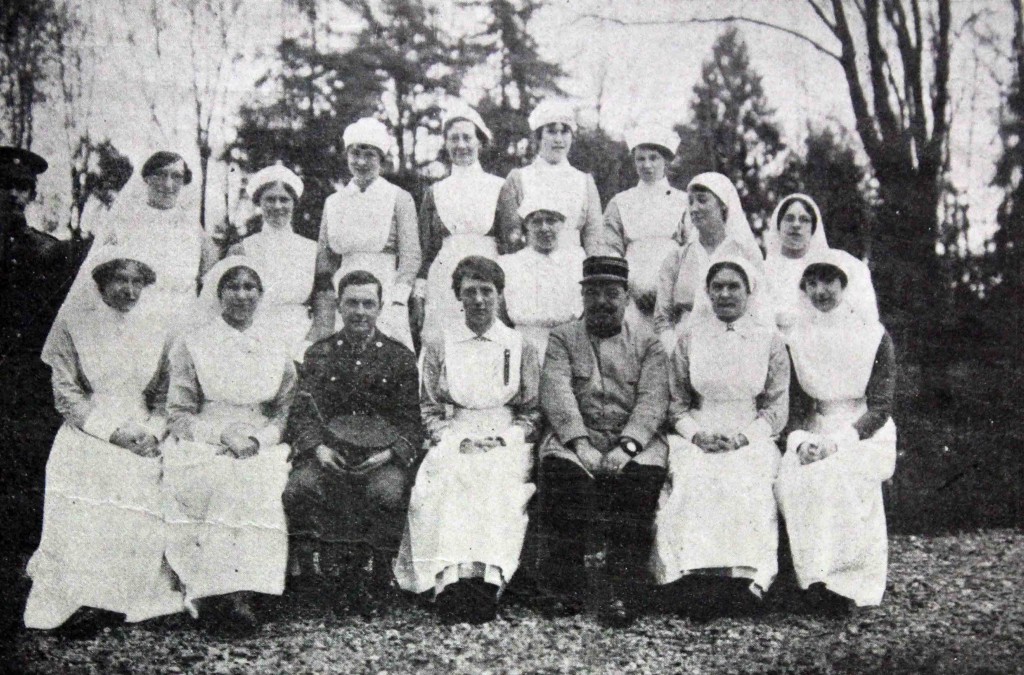
Staff of the Ulster Volunteer Hospital in France 1916

Posted in Article | Comments Off on Staff of the Ulster Volunteer Hospital in France 1916

Drogheda Remembers

Drogheda 2013 11 02

Posted in Article | Comments Off on Drogheda Remembers

Van at Blues Fest

BluesFest

Posted in Article | Comments Off on Van at Blues Fest

Lest We Forget: Book Launch

A memorial which was forced to remain low-key during the Troubles is now being commemorated with a history detailing its 50 years in existence. 

The Northern Ireland War Memorial was opened by the Queen Mother on October 29, 1963, as a permanent reminder of the bloodshed endured during the two world wars and the German Blitz.

I attended the launch tonight with my mother-in-law Marie Carson of the book describing the history behind the unorthodox memorial, as well as details of how the Second World War affected the Province.

It was authored by Catherine Charley, daughter of our former treasurer at the Somme Association, Lt-Colonel Robin Charley, and John Mc Millan, Professor Emeritus of Graphic Design at the University of Ulster, who also designed the War Memorial Museum itself.

In the wake of the Second World War, the Royal British Legion and the government agreed that Belfast should have some kind of permanent commemoration, but that it would not be simply a statue or a sculpture.

Instead, it was decided it would take the form of a new building on council land at 9 to 13 Waring Street, at the southern edge of what is now the Cathedral Quarter.

The previous commercial premises at the site had been flattened by the Luftwaffe, and the new five-storey building included, among other things, office space for charities and organisations linked to the Armed Forces as well as a social hall for former soldiers to congregate.

But within years of opening, a different kind of conflict had engulfed the Province.

“Unfortunately because of the Troubles, starting in the late 1960s, it never really got used properly for that social club purpose,” said Catherine. “Because obviously it wouldn’t have been wise to have met in the middle of Belfast, all of these ex-services people.”

Asked if it was ever attacked, she said: “Not that I’m aware of. It was quite low-key during the Troubles.”

Its existence had been something of a “secret” she said, and although it had become better-known since the start of the peace process part of the reason for the book was that it would simply “let people know it’s there”.

In 2007, the old building itself was sold and the memorial moved to much smaller premises in Talbot Street, where it is today.

The building also houses Armed Forces organisations including the Legion, and has a gallery and exhibits.

Inside, there are artefacts such as ration books and gas masks, as well as statues, friezes and a record of those who died in the Belfast Blitz – a list she put at roughly 1,000.

The memorial got accredited museum status only last month from the Arts Council of England, meaning it can now borrow exhibits from other official museums. The certificate of accreditation was also handed over yesterday.

The 110-page history, titled Lest We Forget, can be purchased from the memorial itself for £10.

Posted in Article | Comments Off on Lest We Forget: Book Launch