Archives
- April 2018
- March 2018
- November 2017
- October 2017
- September 2017
- July 2017
- June 2017
- May 2017
- April 2017
- January 2017
- October 2016
- September 2016
- August 2016
- July 2016
- June 2016
- May 2016
- April 2016
- March 2016
- February 2016
- November 2015
- October 2015
- September 2015
- August 2015
- July 2015
- June 2015
- May 2015
- April 2015
- March 2015
- February 2015
- January 2015
- December 2014
- November 2014
- October 2014
- September 2014
- August 2014
- July 2014
- June 2014
- May 2014
- April 2014
- March 2014
- February 2014
- January 2014
- December 2013
- November 2013
- October 2013
- September 2013
- August 2013
- July 2013
- June 2013
- May 2013
- April 2013
- March 2013
- February 2013
- January 2013
- December 2012
- November 2012
- October 2012
- September 2012
- August 2012
- July 2012
- June 2012
- May 2012
- April 2012
- March 2012
- February 2012
- January 2012
- December 2011
- November 2011
- October 2011
- September 2011
- August 2011
- July 2011
- June 2011
- May 2011
- April 2011
- March 2011
- February 2011
- January 2011
- December 2010
- November 2010
- October 2010
- September 2010
- August 2010
- July 2010
- June 2010
- May 2010
- April 2010
- March 2010
- February 2010
- January 2010
- November 2009
- October 2009
- September 2009
- July 2009
- March 2009
- September 2008
- June 2008
- May 2008
- February 2008
- September 2007
- May 2002
- November 2001
- June 2001
- April 2001
- August 2000
- February 1998
- January 1997
- July 1996
- November 1995
- April 1995
- March 1994
- July 1992
- September 1991
- June 1990
- September 1986
- May 1983
- April 1983
St Patrick and the Snakes: Robert Wigod
I am an independent academic from America. I am conducting research in the field of Neolithic iconography. In other words, I interpret ancient art.
I am working on deciphering the iconography of Cornwall, England & Wales, Ireland, the Isle of Man and Scotland. My work requires that I consult with experts in the field on St. Patrick’s life and mission in establishing the Christian church.
My work is focusing on the prospects that early Brittonic iconography was a form of written language, not art. I am forming the opinion that the ‘myth’ of St. Patrick driving all the snakes from Ireland is a characterization of true events.
I am working multiple hypotheses in my research, though I can conclude already the ‘myth’ of St. Patrick is no myth at all rather a conflict which arose over the forms of iconography in use in St. Patrick’s day.
In the era when both the Christian narrative and the extant Brittonic narrative formed a marriage of traditions and values and Christianity was adopted as a moral authority the iconography of the age clashed with the Christian narrative of Satan. As we all know the Christian narrative describes Satan as a dragon, a demon, a serpent.
It appears to me that the use of eels as a ”familiar” symbolizing ranks of pre-Caesarean leadership clashed with Christian characterizations of evil, causing concern amongst Christianity’s early leaders. Many throughout Cornwall, England & Wales, Ireland, the Isle of Man and Scotland were against abandoning their aboriginal form of writing, though the majority agreed the new phonetic language was more powerful.
While conducting field work in the United Kingdom in 2011 I confirmed that Brittonic Iconography is in fact a form of language and am planning an expedition to Ireland to complete my research next year. Although I am only two thirds complete in my field work I am confident I have identified St. Patrick’s Miracle was based in fact though obscured by legend.
It appears St. Patrick’s Miracle was in keeping brothers from coming to blows in the debate over whether to retain the aboriginal iconographic language of the British Isles or adopt a written language based on phonetics, which was not possible without adopting the Roman alphabet. St. Patrick was able to convince the Nobility of Ireland that the iconographic language which was replete with animal familiars, with dragons and serpents employed to signify ranks of Nobility, would prove to be a liability in the European community which was adapting Christianity and the Roman alphabet.
One can well imagine the reluctance of the kindreds of Cornwall, England & Wales, Ireland, the Isle of Man and Scotland to adopt the iconography of the Tyrant that had invaded and occupied parts of their dominion for nearly 400 years. Attempts were made to develop a phonetic language endemic to the British Isles, of which Ogam is one. We can all agree there was no use fighting the roman alphabet, for intertia had established the roman alphabet as the conventional form of writing throughout Europe and the early Christian leaders were advocating inclusion in the New Covenant rather than isolation in a written language which would bias others in Christendom against the Brythons.
My belief that the ‘myth’ of St. Patrick refers to a real event is based on a few factors: first the prevalence of the tradition itself reinforces the notion a real event involving St. Patrick occurred.
Secondly, the tradition will have originated within St. Patrick’s lifetime and, deferring to the reverence paid to the clergy of the early Christian Church, I doubt very much if the events were fabrications.
Thirdly, Ireland has no snakes because the geography of Ireland was either under an ice sheet until around 20,000 BC or so cold that cold blooded reptiles can not have survived the extreme conditions. The same is true of England & Wales and Scotland, though the English Channel is an intermittent body of water which, in geophysical scales of time, is periodically inundated or dry.
Between 20,000 BC and 12,500 BC the English Channel did not exist and England and Scotland were contiguous to the European continent. In 12,500 BC, when the world’s oceans were as much as 36 meters lower, was nearly connected to Scotland by an isthmus which formed between Scotland and the Irish coast a little ways north of Belfast. In that age the Isthmus of Ireland, as I will be calling it, was not complete, rather it featured a narrow straights much like the Straights of Menai which separates the Isle of Angelsey and Wales today.
In other words snakes can have crossed from Europe to England and Scotland, though not to Ireland. In conclusion, there never were any real snakes for St. Patrick to drive out of Ireland. St. Patrick converted the Irish to Christianity and convinced the Nobility and Bards of Ireland to abandon iconography which would clash was certain to prejudice other Christians against the Brythons.
In a narrative which is foundational, St. Patrick drove the eels from Ireland. Legend merely recalls he drove the serpents from Ireland.
I am to publish my findings in a book, likely to be published before 2020, and am in need of experts in the life and mission of St. Patrick to be as comprehensive as possible.
I expect your organization will know of the foremost scholars of the early church in Ireland, of the life of St. Patrick, and where possible, in ancient Irish Lore. Please refer me to any of your colleagues who you think may help.
Kind Regards,
Robert Wigod
1644 West Alabama St. Apt 8
Houston, Texas 77006
823-800-2434
Posted in Article
Comments Off on St Patrick and the Snakes: Robert Wigod
Revisiting A Letter From Ulster and other news – Brian Desmond Hurst : Northern Ireland’s Greatest Film Director : Allan Esler Smith
I wanted to share something to celebrate the 1st Anniversary of Peter Robinson and Martin McGuinness opening the magnificent Hurst Sound Stage at Titanic Studios in October 2012. The previous news on this event is here http://www.briandesmondhurst.org/hurststudios.html
Having just secured the consent of the BFI National Film Archive I can now put ‘Revisiting A Letter From Ulster’ on youtube. We screened this a few years back at Queens Film Theatre and at the Aspects Arts Festival and the short 15 minute documentary takes you back to when the first of 300,000 US troops came to Northern Ireland in 1942. There are some lovely then and now scenes of Tynan Abbey, Carrickfergus, Derry/Londonderry, Strabane, Bellarena, Cultra and St Marys in Belfast. The ‘stars’ are men from the US 34th ‘Red Bull’ Division who, at the time, were not to know what lay ahead of them at Anzio.
I don’t have any ‘marketing machine’ so just rely on folk to take and interest and pass this on to anyone who they think might be interested. So see what you can do and you never know… we may get a few more views or even some likes/comments.
http://www.youtube.com/watch?v=rOi4vxcivgc
If you are interested my youtube channel (allan esler smith) also contains some work we have done on Brian’s Arnhem epic Theirs is the Glory (something much bigger is happening next year on the 70th anniversary of the battle and more on this next year).
I also hope to stream Brian’s Riders to The Sea (1935) on my youtube channel before the end of the year– I think it’s an awesome piece as the mother copes with losing her sons to the sea and this film deserves a wider audience. I am also trying to locate though a network of film buffs in the USA a full copy of Irish Hearts (1934) (US release Norah O’Neale) which the academics tell me is probably Ireland’s first feature length talkie and, hopefully, in time for its 80th anniversary next year. At the moment the only copy that the Irish Film Institute and we have is partial and I do want to know how it ends!! So if you or any contacts have ideas on how we can find this please let me know. Ohh and then there’s the publication of Brian’s memoirs as well… so plenty to keep us busy.
Finally if you have not hear the RTE Radio 1 documentary An Irishman Chained to the Truth (we couldn’t use the title The Life of Brian for some strange reason…) which we did in 2011 it can be heard again here:
Best wishes
Allan
Administrator of the Brian Desmond Hurst Estate
www.allaneslersmith.com
Posted in Article
Comments Off on Revisiting A Letter From Ulster and other news – Brian Desmond Hurst : Northern Ireland’s Greatest Film Director : Allan Esler Smith
The Cruthin of Ulaidh
http://hal_macgregor.tripod.com/gregor/IrishPicts.html
My friend Ruairí Ó Bléine writes: “This site is most interesting and informative. I have seen two items that need correction. The word “Uladh” is the genitive of “Ulaidh”. For example we say Cúige Uladh – the province of Ulster, but Ulaidh Abú – Hurrah for Ulster. The other problem is that Firbolg is already in the plural and does not need to have an “s” added for Fir is Men and Bolg is a version of Belgae.”
Posted in Article
Comments Off on The Cruthin of Ulaidh
Belfast English and Ulster Scots
Today at our Beakfast meeting of the famous Ullans Academy promoting Common Identity, our chair Helen Brooker introduced Prof Alison Henry, School of Linguistics, University of Ulster, and Fearghal McKinney MLA, invited by myself, and Dr Ofrit Leviatan, Lecturer, Department of Government, Harvard University, Cambridge Massachusetts, USA, invited by Sammy Douglas MLA. Prof Henry wished to talk about some ideas she had about using study of local Belfast English to improve educational performance in deprived areas in Belfast, particularly among Working Class Protestants.
In the eighteenth century Belfast was a small town on the West Bank of the River Lagan; on the East Bank lay the neighbouring small town of Ballymacarret. By 1821, the population of Belfast was still only 37,000, but by 1861 it had more than trebled to 121,000. By the end of the century the population was 350,000 and in 1951 it had risen to 443,000. After that, the city population began to decline and that of adjacent areas began to rise.
The rapid rise in population in the second half of the nineteenth century was due firstly to the influx of rural people after the Great Potato Famine of the 1840s, but chiefly to the rise of the linen and shipbuilding industries. The growth of Belfast as an industrial city seems to have been rather later than the growth of similar cities on the British mainland and its relatively recent growth is evident in its language.
Academics distinguish three language areas in Ulster – the Ulster-Scots area (which is mainly along the northern and eastern coastal areas but which also extends into central areas of County Donegal), the Ulster-English area( which consists of central, southern and south-western Ulster) and the Ulster-Gaelic area of Donegal and scattered areas of Northern Ireland including Belfast. In the Ulster-Scots areas there are a great many rural speakers who speak a variety of Scots rather than of English, and in its strongest forms it is almost indistinguishable from the Scottish language of western and central Scotland. The Scots character of these Ulster language varieties is most apparent in the pronunciation of common words such as night, stone, soft, die, down, as nicht, stane, saft, dee, doon, and so forth. Ulster-Scots is a stigmatised language of low status. The development of a literary form “Ullans” has been hampered by an academic indifference or outright hostility and by anti-Unionist prejudice.
The areas to the north and south-east of Belfast are Scots and it can therefore be suggested that the Scots area in east-Ulster was at one time continuous, running from south-east Down, northward through the Belfast area and linking up with Antrim Scots. Academics usually argue that the growth of Belfast has brought about an intrusion of Ulster English into what was formally a Scots area. It is true, of course, that Belfast does not have the broad Scots word forms we have discussed above (nicht, saft, doon, etc) and that immigration to Belfast has been largely from the Ulster-English area. However, it would be a mistake to believe that Belfast speech has no Scots features, for it is very much a mixed language form. It is also true that there is a strong similarity between Belfast English and that of the several towns of the Lagan Valley to the southwest of Belfast. But within the city there is some difference between east and west Belfast and the Lagan Valley speech is similar to west Belfast rather than the east. The east of the city has a language that has something in common with the rural varieties of north Down which are, of course, Ulster-Scots in type, while the Lagan Valley is more English.
In 1860, Belfast was quite a small city with its population of 121,000. We know to some extent what the language was like then as a result of a small book by David Patterson, The Provincialism’s of Belfast Pointed Out and Corrected. Patterson’s aim was to correct some of the broader pronunciations of the city as well as some of the word forms and uses of grammar, but in order to do this he had to describe these usages. Thus the main value of the book is not its recommendations to correct the English but the information it gives us about Belfast speech in 1860. Patterson describes pronunciation very clearly and it is apparent that there have been changes since 1860. Words he wished to correct such as ‘deef’, (deaf) and ‘rideekilis’, (ridiculous) were actually of Ulster-Scots origin. One of the first features that outsiders notice about Belfast speech is the use of ‘aw’ for the ‘a’ sound as in ‘haun’, ‘maun’, ‘bawd’, for hand, man and bad. This occurred with the spread of Ulster-Scots from north Down into east Belfast and then into the west of the city, through the Shankill.
Language is a living thing. Patterson’s attempt to “correct” the Belfast speech towards the standard were not successful. The people of Belfast, particularly of the Shankill Road did not want to correct their speech and those who go to elocutionists for social reasons today are still in a small minority. Belfast English is, in fact, a distinctive form of English, which should be promoted, rather than changed. One of its distinctive features is the use of the double negative, such as ‘I didn’t do nothing’ instead of ‘I didn’t do anything’. There is nothing inherently wrong with this, since the same features occur in Spanish. Belfast English should indeed be cherished and conserved.
There is, of course, also in Belfast a revival of interest in the Gaelic language. The variety used in Irish Medium schools is essentially Donegal Gaelic, which is a variety of Ulster Gaelic. The original Gaelic spoken in the Belfast area would have been east Ulster Gaelic which is now obsolete but had characteristics similar to that of the island of Islay, north of Rathlin in the southern Hebrides. Belfast Gaelic is presently developing independently of Donegal Gaelic itself. Originating in language classes held in Her Majesty’s Prisons it is presently known by its detractors as Jailic rather that Gaelic. Belfast Gaelic is heavily influenced by English. Ulster Gaelic as a whole shows many differences with that of the standard Irish developed by de Valera in Dublin, which was based on the Gaelic of Munster and Connaught and largely ignored that of Ulster .
Many people often ask if the communities of Belfast can be defined by their language. For the moment we must draw the conclusion that there is as yet no persuasive evidence to show that they can. The differences that do exist are mainly regional. There is of course the difference between east and west Belfast, east Belfast having more Ulster-Scots words and phrases. There may be some difference in the pronunciation of the names of the letters of the alphabet, especially ‘h’. It is true that in Belfast most Catholics pronounce this letter name as ‘haitch’ and most Protestants as ‘aitch’. This, however, has absolutely nothing to do with language as such, the preferences are a result of two separate school systems. Most Catholic school children are taught to pronounce the names of letters in a traditional way that is probably influenced by the letter names in the Gaelic language; Protestant children and any Catholic children who attend State schools learn the normal British pronunciations, however, as the schools become more and more integrated such differences are fast disappearing.
Acknowledgements: This article is based on the work of James Milroy, former Senior Lecturer in English at the Queen’s University of Belfast, 1981
Posted in Article
Comments Off on Belfast English and Ulster Scots
Tennessee Resolution of Restoration – Daphne Swilling
Hello My friend!
It has been a while since we connected. I am sending you something that I think you would be interested in. This year is the 175 anniversary of the Trail of Tears. We have written a resolution that we are presenting to our Tennessee Assembly to address this wounded history of Tennessee. It is always a delight to hear from you,Ian!!
Don’t give up on me on my return to my beloved Ireland.It will happen!!!
Your Hillbilly Friend, Daphne Swilling
Tennessee Resolution of Restoration
October 2, 2013
Whereas, the great State of Tennessee has a proud and successful heritage of playing significant roles in the recorded history of the United States of America.
Whereas, the first independent democratically governed communities in the United States were four settlements located in what is now East Tennessee, one of which was known as the Watauga Settlement.
Whereas, reconciliation has occurred between the descendants of these settlements through the passage in Carter County of Resolution 516 on April 19th, 2010, and subsequently accepted by members of the Cherokee Nation on April 24,2010.
Whereas, we, the citizens of Tennessee, acknowledge the significant role that the Native American people have played in allowing the birth of American freedom to first take root with tribal approval in East Tennessee, such as the efforts of Nancy Ward who saved the lives of many at the French Lick settlement in which our petition for statehood would emerge. Because of her diplomatic role, Nancy saved the lives of many Cherokees by preventing further bloodshed of her tribe.
Whereas, in subsequent years prior to 1830, relationships with all Native American tribes deteriorated dramatically, leading up to the tragedy of the forced removal of the native people and subsequent confiscation of their homes and lands through the passage of the Removal Act of 1830.
Whereas, Tennessee has a duel role in both the passage of the Removal Act by President Andrew Jackson, and its historic opposition through the efforts of House of Representative member, David Crockett, representing the 9th District in Tennessee.
Whereas,on this the 175th anniversary of the Trail of Tears, the State of Tennessee, wishing to both acknowledge this tragedy and renounce any role it may have played in what is a stain on our collective histories
Now therefore be it resolved, we, the citizens of the State of Tennessee, stand with our Statesman, David Crockett, on a national level in acknowledging the tragedy of this act that took place in defiance of the Supreme Court ruling by Chief Justice John Marshall in Worcester vs. Georgia.
We, the citizens of the Volunteer State, following the example of David Crockett, offered up our lives in the ultimate sacrifice in defense of life, liberty and the pursuit of happiness of all people. The global battlefields are stained with the blood of many Tennesseans.
We, the citizens of the Tennessee, wish to close this chapter in our collective history so that our past does not cast a shadow over our future. Tennesseans stand against acts of injustice perpetrated against any people group regardless of race, gender or religion. Therefore, we offer our sincere regret to all Native American groups who were tragically and unjustly confined and removed from their lands by our participation in the Removal Act of 1830 and the subsequent death march known as the Trail of Tears. Greed and prejudice have no part of play in the future of Tennessee. We stand today as David Crockett stood, prepared to lay down our lives in defense of freedom for all people in this great nation.
Posted in Article
Comments Off on Tennessee Resolution of Restoration – Daphne Swilling
The Dalaradia Organisation
The Dalaradia community organisation was formed in County Antrim several years ago as a way of engaging working class loyalists in the peace process. Although key members were involved in enabling the peace process to occur and in facilitating decommissioning, many members and associates had not bought into the process and saw no benefits to their community.
The first official representation of Dalaradia was in 2011 at Belfast City Hall when the chairman of the group was co-opted on to the (Grand) Ulster Centenary Committee, of which I myself was founder chairman, to organise the forthcoming decade of events. This has involved the highly successful Balmoral Review and the Centenary of the founding of the original UVF at Craigavon House and the West Belfast UVF at Fernhill House. Key members of Dalaradia were previously involved in founding the Loyalist Commission after the loyalist feud, meeting with all loyalists, MLAs, Clergy and Secretaries of State.
In 2011, members of Dalaradia went on a week-long trip to the Somme on an inter-community basis to try to give everyone involved a deeper understanding of this key period of history. Individuals who took part in that project have remained in touch. Although the Somme was paramount in their minds, they were eager to engage with people from across the board within a Common Identity logic to move towards a shared future. Thus I have accompanied them both to Crew Hill, Glenavy, to see the site of the inauguration stone of the Kings of Ulster and, in liaison with Brian Ervine, who has a particular interest in the area, came with them on a Caledonian “Scottish” Dalriada Residential, which was inter-community, to Argyll in September 2013.
Similarly, the group, who meet at the Hubb on the Shore Road, North Belfast, have recently visited the Bogside Bloody Sunday Museum, the Orange Museum and Derry’s walls. The Hubb is the last Second World War Civil Defence Hall left in Northern Ireland and was preserved mainly due to the fundraising efforts of local community worker, Jim Crothers.
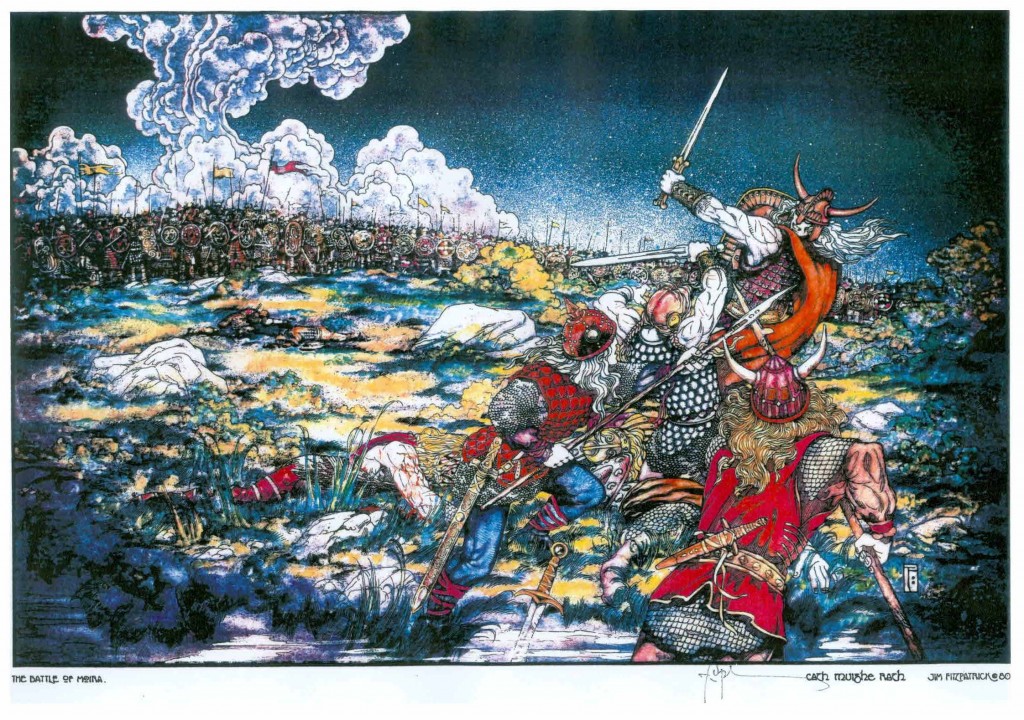
Dalaradia (Dál nAraidi in Gaelic)— which should not be confused with Dál Riata, Latinised as Dalriada –was a kingdom of the Cruthin ( Cruithni in Gaelic ) in the north-east of Ireland in the first and early second millennia. The lands of Dalaradia appear to correspond with the Robogdii of Ptolemy’s Geographia, a region shared with Dál Riata. Fiachu Araide was their eponymous founder. It was centred on the northern shores of Lough Neagh in southern Antrim and included modern Belfast. Its kings contended with the Dál Fiatach of North Down for the high-kingship of Ulster for some centuries. One of their greatest kings was Congal Clane, who died at the Battle of Moira in 637. Belfast first enters history at the Battle of Bel Feirste in 667 between the Ulidians of Dal Fiatach and the Cruthin, where Cathasach, son of Laircine, son of Congal Clane, was slain. This was an attempt by the Ulidians to encroach on the Cruthin territory of Trian Congail. the “third of Congal”, which encompassed territory on both sides of the Lagan, corresponding more or less to Upper and Lower Clandeboye, including modern Belfast. Cathasach was Congal’s grandson. The battle was the first mention of Belfast in Irish history.
Its members see Dalaradia as a broadly Ulster-Scots body open to all aspects of our culture relating to all who share our land. They have moved beyond the two traditions’ frame, developing strong links with the Polish community who have become an integral part of the ever-broadening tapestry of Northern Ireland society. They are also determined to learn from other people’s experience of divided societies. Thus, in 2012 the chairman was one of a small group of senior loyalists who visited Israel to study the conflict there, engaging with Israelis, Palestinians, universities and Kibbutz, military and UN personnel. They will also facilitate the formation of a Dal Fiatach Group in North Down, complimenting their own group as well as the Kingdom of Dalriada group in North Antrim, linked to the Ullans Centre in Ballymoney, County Antrim.
Posted in Article
Comments Off on The Dalaradia Organisation
Northern Ireland’s Lost Opportunity – Tony Novosel
Tony Novacel was our guest at this morning’s meeting of the Academy of Common Identity (Ullans) along with the chairman of the Dalaradia group. Here he talks about his latest book.
“When I finished writing Northern Ireland’s Lost Opportunity, I hoped it would begin a serious reappraisal of loyalism and move us away from what Graham Spencer calls, “the standard one-dimensional representation of loyalism that so dominates the media and popular imagination” as well as open the door for other researchers to walk through. I never anticipated that its release would coincide with the crisis that has developed in Northern Ireland over the flying of the British flag at City Hall nor have as much relevance to present day events on the ground in Northern Ireland. What is particularly relevant to this study of loyalism and today’s problems is the re-enactment of the all too familiar play that is Northern Ireland’s history.
In this play, the established Unionist parties warn about a real or perceived threat to Northern Ireland’s place in the UK from Republicanism/Nationalism and that it is necessary to prepare to defend Ulster and/or their British identity. The Protestant working class, a class that has benefited little from its relationship to Unionism and the old Unionist state, suffers from poverty, social deprivation, and alienation, then takes its actions to the street to fight for their flag and culture. Then once the “troubles” are over the politicians sort everything out and the working class goes back to its way of life with little to show for its loyalty. This occurred in the 1920s, 1930s, 1960s, and throughout the period of the “Troubles.”
In a subplot of these plays, we witness the emergence of a political leadership from within the working class, which while believing it is necessary to fight for Ulster, also believes that the working class needs its own political voice, a voice that focuses on social issues as well as the border. This voice is much more conciliatory and moderate in terms of relations with the nationalist population and in fact, calls for an inclusive society that is social democratic in nature. This occurred in the 1930s, the 1970s, the 1980s and in the present era. However, the forces of reaction coming from within unionism and in some cases loyalism itself usually drown out this voice blunting any progress for the Protestant working class and the working class as a whole in Northern Ireland. As David Adams argues,
there is always room for the voices that are opposed and are moving to the right, but there is very little room for the moderate voice, which tends to get stymied. If you are preaching a harder message, you will always find an audience and an acceptance.
In the present crisis in Northern Ireland, this play has begun once again, this time over the flying the flag at City Hall. In the prologue, the SDLP and Sinn Fein, who, for their own reasons, wanted to take the flag down permanently, accepted a compromise deal brokered by the Alliance Party, which allowed the Union Jack to fly on 17 designated days at Belfast City Hall.
In Act One, the DUP and the UUP, instead of accepting the vote in City Hall and working politically to overturn that decision, chose to print 40,000 leaflets targeting the Alliance Party, its members and its offices. Then, performing its part in this play, many within the Protestant working class, enraged by this decision, for over six weeks now have been on the streets to protest the City Councils’ decision and to defend the flag as part of their culture and identity. Appeals, from political leaders from within loyalism, in this case people such as Jackie McDonald and Billy Hutchinson, for people to work politically to overturn the decision, have largely been ignored. As Adams put it above, and as I found in my research, and as we see today, those who have thought little about politics, let alone progressive politics, have gotten the ear of the people, brought them onto the streets, and kept them there, while those with a political vision have been relatively sidelined.
Examples of this retrograde thinking have appeared in various social media, in particular on Facebook. One post called for the expulsion of the Irish from Ulster and another for a “new Troubles.” Other posts complain that the government does not listen to them and the police are not theirs anymore, going so far as to call the police the “PSNIRA.” Consequently, they argue that the demonstrations are necessary to force the government, “SF/IRA” and the other parties to negotiate over the flag with the “PUL people.” At the same time, the crowds and their leaders lack an awareness of the political and practical impact of their actions, as was clearly illustrated on 11 January when a crowd prevented an elderly man from visiting his terminally ill wife near Whiteabbey and a doctor from getting through to a patient.
If these comments and actions represent the thinking of those on the streets it begs the question of where the conscious and progressive political leadership is in these demonstrations and riots or will come from. If there is none, then who will represent the PUL if/when there are talks and negotiations? Will it be the DUP and the UUP again in the guise of the Unionist forum? Will it be those on the streets or writing the posts cited above? Where is a political programme or plan of action that goes beyond returning the flag or reinforcing their identity once the demonstrations are over? Without positive answers to these questions the Protestant working class will most likely find itself, once again, gaining little if anything because it has rejected or ignored the progressive political leadership emerging from its own community. (Note: There is evidence that this tide may be turning now and people are looking to act in a political manner, but it is too early to tell.)
In the second act, Unionism then steps back and proceeds to criticize those who, with its encouragement had converged on Alliance offices, threatened the Alliance members, and taken over the streets of Northern Ireland to get the flag back. They then attempt to take back control of the situation from those on the street.
In the final act, as illustrated above, the Protestant working class having no political programme or progressive political leadership, no clear idea of itself, and what it really hopes to gain, other than returning the flag and stopping Sinn Fein, finds itself in the same position as it was before the crisis.
So, if the script runs true to form, what we are witnessing once more is the play in which the Protestant working class comes on to the streets, in this case, to get the parties to negotiate the return of the flag. And if by chance, the protests lead to serious talks the politicians will take over once more and the Protestant working class will return to a life where the really important issues of political, economic, and social marginalization, along with educational underachievement and social deprivation will continue to exist and may even be worse.
Even more damaging to the working class is the fact, just as my research has shown, is that unless something within the community itself changes dramatically, it will remain without a coherent and forward thinking political leadership and will be at the mercy of those who, as one of my interviewees said, “do not have our best interests at heart.” Consequently, if the Protestant working class does not begin to engage constructively with politics and more importantly with its progressive political leadership, then it will once more find itself adrift and returning to, as Gusty Spence put it in his 12 July 1975 speech in Long Kesh, the “domestic serfdom” that it had endured for fifty years.”
Tony Novosel is a senior lecturer in History at the University of Pittsburgh. He is involved in ‘common history’ projects in Belfast. He is the author of Northern Ireland’s Lost Opportunity: The Frustrated Promise of Political Loyalism (Pluto, 2013).
|
Unique in-depth investigation into working-class Loyalism in Northern Ireland as represented by the UVF and RHC and their political allies. “Novosel’s study of the UVF and its attempts to develop a politicised loyalism challenges the standard one-dimensional representation of loyalism that so dominates the media and popular imagination.” – Graham Spencer, author of The State of Loyalism in Northern Ireland
|
Posted in Article
Comments Off on Northern Ireland’s Lost Opportunity – Tony Novosel
Ode to the Somme
|
|||
Ode to the Somme
On the sacred day of 1st July every year, we commemorate the sacrifice of our loved ones who died for freedom. We do not seek to glorify war but rather to see that it does not happen again.
To the people of France we say:-
“People of France, mother of nations, we thank you for your generosity and kindness to these our children who rest now in peace in the most beautiful gardens on earth. We pray that their sacrifice will not be in vain and that there will be no more war and that the peoples of Europe will walk together in mutual forgiveness, understanding and respect until the end of the world”.
Au people de France nous disons:-
“Peuple de France, mére des nations, nous vous remercions de votre générosité pour nos enfants qui reposent en paix dans les jardins les plus beaux du monde. Nous prions pour que leur sacrifice n’ait pas été vain, pour qu’il n’y ait plus de guerre, et pour que les peuples d’Europe puissent marcher ensemble et se pardonner, se comprendre et se respecter mutuellement jusqu à la fin des temps”.
Zu den Franzosen sagen wir:-
Bevölkerung von Frankreich, Mutter von Nationen, wir danken Ihnen für Ihre Grosszügigkeit und Freundlichkeit für unsere Kinder, die in diesen schönen Gärten in Frieden ruhen. Wir beten, dass das Opfer unserer Kinder nicht umsonst gewesen ist und dass es zu keinem weiteren Krieg mehr kommen wird, dass die Völker Europas in Vergebung, Verständnis und Respekt miteinander in die Zukunft gehen können.
To the sons of Ulster and Soldiers of Ireland we say:-
“Sons of Ulster, Soldiers of Ireland do not be anxious. The war is over – both here and in you beloved Ireland. The Western Front is no more and Ireland at last is at peace with herself and with her people. We will always remember you, so long as the sun shines and the rain falls and the wind blows and the great river Somme runs gently to the sea”.
Innui, deir muid le fir Uladh agus le fir na hÉireann:-
“A Fheara Uladh agus a Shaighdiúirí na hÉireann, ná biodh imni oraibh. Tá an Cogadh thart – ní amháin san áit seo, ach in bhur dtír dhílis féin in Éirinn. Níl an Fronta Thiar ann níos mó, agus, so deireadh, tá tír na hÉireann faoi shíocháin léi féin agus len a pobal. Ach chomh fada is a shoilsíonn an ghrian, agus a thiteann an fhearthainn, agus a shéideann an ghaoth, agus chomh fada is a théann abhainn mhór an Somme go caoin chun na farraige, bedh cuimhne againn araibh go deo”.
And in honour of the brave American and Canadian soldiers who also fought here, I speak in Lakota (Oglala Sioux), the Hymn of the Warriors
Ho Tunkasila Wakan Tanka
Oyate oyasin unsiwicalapo na owicakiyapo
Nahan waci wicasi na waci winyan wopila tanka
Nahan oyate oyasin canku luta ognamani owicakiyapo
Lecel wacin ho hecel lena, oyate kin nipi kte.
Mitakuye Oyasin
Which in Wasicu(English) is
Grandfather Great Spirit, Almighty God,
Have pity on and help all the People
Many Thanks for the Performers, male and female,
Help all the People to walk the Red Road of Peace
This I ask so that the People will prosper
You are all my relatives
Posted in Article
Comments Off on Ode to the Somme