Aspects: Irish Literature Festival – North Down Museum

prices 

Bangor 400: A Celebration  of Bangor in poetry and prose.

Novelists, historians, saints and scholars have been writing about Bangor for centuries. Now the man behind the creation of Aspects twenty-two years ago, Kenneth Irvine, has recruited some of our top local asctors to present a special one-off selections of readings to celebrate the 400th annuversary of the granting of Bangor’s Royal Charter. Excerpts of the writings of Columbanus, Bernard of Clairvaux, Michael Longley, Derk Mahon, Moyra Donaldson, Colin Bateman, Gerald Dawe and Ian Adamson are brought to life by a cast of talented local thespians

Posted in Article | Comments Off on Aspects: Irish Literature Festival – North Down Museum

Open Grand Prix – EI Sports

Posted in Article | Comments Off on Open Grand Prix – EI Sports

Ulster Day Centenary Parade – Formation of the West Belfast UVF

Posted in Article | Comments Off on Ulster Day Centenary Parade – Formation of the West Belfast UVF

Lord Mayor of Belfast’s Installation Dinner

The Lord Mayor, Councillor Máirtín Ó Muilleoir and Belfast City Council request the pleasure of the company of


Dr Ian Adamson OBE and Mrs Helen Brooker
at a Dinner in Belfast City Hall
Saturday 28 September 2013
7pm for 7.30pm


Dress: Lounge suit
 

Please reply by Wednesday 18 September to rsvp@belfastcity.gov.uk informing of any special dietary or disability access requirements.

The Lord Mayor’s Office
Telephone: 028 9050 0503

This invitation is non-transferable.

Ba mhór ag an Ard-Mhéara, an Comhairleoir Máirtín Ó Muilleoir agus Comhairle Cathrach Bhéal Feirste túDr Ian Adamson OBE and Mrs Helen Brookera bheith i láthair ag dinnéar i Halla Cathrach Bhéal Feirste
Dé Sathairn 28 Meán Fómhair 2013
7in do 7.30in

Feisteas: Gnáthchulaith 

Freagair le do thoil fán Chéadaoin 18 Meán Fómhair chuig rsvp@belfastcity.gov.uk ag inse dúinn fá aon sainriachtanas cothaithe nó slí isteach do dhaoine le míchumas.

Oifig an Ard-Mhéara
Guthán: 028 9050 0503


Inis ainm aoi s’agat le do thoil d’Oifig an Ard-Mhéara chomh luath agus is féidir.


Tá an cuireadh seo neamh-inaistrithe.

                                         Running Order                                         

6.30pm

Guests begin to arrive 

6.30pm-7.25pm

Open Arts Choir performing in Grand Marble Entrance Hall. 

6.30pm-7.25pm

Drinks reception in Rotunda. 

7.25pm-7.35pm

Dr Sinead Morrissey introduced by Geraldine Hughes, to recite poem on raised area in front of the Earl Of Belfast statue in Rotunda.

7.35pm

Announcement inviting guests to move into The Great Hall. 

7.35pm-8.00pm

CELTUS traditional musicians performing in The Great Hallduring the seating of guests.

8.00pm

Geraldine Hughes announced into The Great Hall and takes position at centre podium.

8.00pm-8.05pm

Geraldine asks guests to be upstanding for the new Mayor.Lord Mayor enters The Great Hall to pre-chosen playback.

8.05pm-8.10pm

Geraldine invites Michael Longley to podium to recite poem. 

8.10pm-8.20pm

Geraldine thanks Michael Longley and welcomes Joby Fox and his band to perform ‘Belfast’.

8.20pm-8.25pm

Geraldine invites Dr Ian Adamson OBE to podium to recite Somme oration.

8.25pm-8.30pm

Geraldine invites each Chaplain to recite ‘The Belfast Prayer’ from their tables.

8.30pm

Geraldine thanks Chaplains and announces ‘Dinner Is Served’. 

8.30pm-9.45pm

‘ArtsEkta’,  ‘Methodist College Harpists’ and ‘Quire’  perform during dinner.

9.45pm

Geraldine welcomes Mayor for speech during after dinner coffee.

9.45pm-10.00pm

Lord Mayor’s Speech

10.00pm-10.05pm

Geraldine thanks everyone and says Goodnight. 

10.05pm-Finish

Van Morrison ‘Astral Weeks’ playing in background during departure. 


Posted in Article | Comments Off on Lord Mayor of Belfast’s Installation Dinner

Columbanus: Patron Saint of Bikers

Today I accompanied our Chair of the Academy of Common Identity (Ullans) Helen Brooker to see Ken Perry, Principal of Dundonald High School. We had met him at a Community Event organised by the Ballybeen Men’s Motivation Group and was introduced to him by our Patron Andy Tyrie. We were meeting him to inform him about our Feast of Columbanus Event in Belfast City Hall on 21st November 2013..It turned out Ken was an enthusiastic Biker and knew the McBride brothers from Whitespots, Conlig where my friend Gladys Harvey nee Kearney lived…Whites Pots, of course, means Lead Mines in Ulster Scots.

I told him of my nepnew Kevin Beegle who works for Harley Davidson in Seattle and my travels to their headquarters in Milwaukie, which I have visited twice with the famous Irish Fest.

He was delighted to discover that Columbanus is the Patron Saint of Motorcycles and Bikers. Here is their Prayer

Bikers Patron saint & Prayer of Blessing Prayer of BlessingMay God bless you and keep you safe on this machine.
May you meet encounter the risen Lord in your travels, in the freedom of the open road, the fellowship of other bikers and in each person you meet.
May the Lord be with you at home and on the road.
May He accompany you when you start on your many journeys.
May He fill your life abundantly with his many blessings.
May He keep all your riding safe.
May His mercy, grace and love shine upon your every road. 

Patron Saint

 St Columbanus is the official saint of bikers. He was born in 540 AD and  died in 615 AD. He had various qualities that seemed to make him fit the bill.

He appealed to both Christians and Pagans.

He was born in Ireland in Lenster so he was  big hearted and friendly. A ruggedly handsome chap by all accounts.

Like many male bikers he was  irresistible to women. Jonas his saintly historian wrote that  Columbanus left home because he was constantly pestered by  a beautiful woman

He was most famous for his miracle. Not the  five loaves and two fishes, but the two fishes and loads of beer. He  found some hungry and thirsty monks one day and multiplied two fish  and a little beer into an almighty knees up.

He didnt ride a bike; he would have we are sure, but the trouble was they weren’t invented at that time.

If he had ridden a bike scholars agree it  would probably have been something Italian like a Laverda or a  Ducati even a Guzzi . You see he founded his monastery in Bobbio  northern Italy and his bones lie there to this day, not far from  the Monza racetrack, so beloved by my friend Eddie Irvine, himself a biker

The church got it right for once! A patron  saint of bikers would have to be attractive, irresistible,  interested in beer and exotic north Italian products. So, St  Columbanus really fits the bill!!


St. Columbanus. Window of the crypt of the Bobbio Abbey


Posted in Article | Comments Off on Columbanus: Patron Saint of Bikers

Máirtin Ó Muilleoir backs city hall Poppy Appeal lights plan

The Royal British Legion requested city hall be lit red for the launch of the Poppy Appeal The Royal British Legion requested city hall be lit red for the launch of the Poppy Appeal

Belfast’s Sinn Féin Lord Mayor is to back a Royal British Legion request to have the city hall bathed in red light for the launch of the Poppy Appeal.

First citizen Máirtin Ó Muilleoir said he agreed to the request in the interests of “building peace”.

The move will be voted on later at a council committee meeting.

The building’s recently-installed lighting means it can be illuminated with various colours on designated occasions.

If the strategic policy and resources committee votes in favour, the red lights will be switched on on 24 October.

The DUP’s Gavin Robinson, Mr Ó Muilleoir’s predecessor as lord mayor, is the chair of this committee.

If the proposal is agreed without discussion, it is likely to be passed by a full council meeting on 1 October.

‘Common ground’

Mr Ó Muilleoir said he had been involved in discussions with the British Legion for six months before he became lord mayor.

“Their aim is the same as mine, to remember the dead of the great war, and the carnage and destruction that destroyed the cream of our manhood across this nation,” he said.

“It’s a request they made. It goes to the main committee today.

“My discussions with the British Legion and the Somme Association are continuing. We are looking at all these things in a bid to find common ground.”

Lyn Palmer, the British Legion’s NI district community fundraiser, said: “The decision has not been confirmed by city hall yet, but obviously if they are able to facilitate us in this way the Legion will be delighted.”

The city council has previously agreed to a number of requests to light up the building for special occasions.

Mr Ó Muilleoir has said that he will not be wearing a poppy.

He was asked on BBC Radio Ulster’s Talkback programme if he would be tempted to wear a poppy for his great grandfather, who served in the British Army and died training soldiers in WW1. He was given a military funeral on the Falls Road in west Belfast in 1916.

“No. I suppose as an Irish republican I’m not alone in the fact I have relatives who died in the Great War and obviously many relatives of other republicans who served in the British Army after that and I hope that we can show respect for the dead without having to wear a poppy,” Mr Ó Muilleoir said.

“I know that it’s something that I won’t do, that I’m not able to do and therefore I need to say that in a way which is respectful.

“We need to set out some of the parameters and what I’m saying to those who want to unite our people around remembrance (is) ‘well what else can we do? What else can we do that maybe helps to heal the hurt over remembrance and brings our people together?’

“So I suppose that makes it even…it’s a bigger challenge because we need to make sure that what we don’t do is we don’t insult each other in how we remember the dead.”

Posted in Article | Comments Off on Máirtin Ó Muilleoir backs city hall Poppy Appeal lights plan

The Confusion of Henry McDonald

Writing in the local newspaper the Belfast Telegraph on Friday 21st September 2013, Henry McDonald wrote of an Ulster Defense Association mural on nationality at Freedom Corner on the Lower Newtownards Road, Belfast:

Analysing the responses of the Protestant working class to the Belfast Telegraph/LucidTalk poll, specifically on the nationality question, you wonder how much has changed since that UDA mural went up.

In the 1970s, the UDA employed obscure academics and ransacked Ulster mythology to come up with the notion of a separate Ulster nation and people – the “Cruithin” – in pursuit of a home-grown anti-Irish/gaelic nationalism. The difference in the 21st century is that the public disorder of the past 10 months has convinced the most socially and politically alienated segment of the urban Protestant population that the only way is pure and simply British.

This represents poor scholarship, and it smacks of lazy journalism and political motivation, since he uses the term “obscure” academics and tells us that “Ulster Mythology” was “ransacked”, in pursuit of an “anti-Irish” nationalism, which is untrue. Nor can he apparently distinguish between nationality and nationalism. He also prefers the  semi-Gaelic term “Cruithin” which he seems to put in inverted commas to infer that they were an invented people, which speaks volumes. Cruthin, of course, represents in English the modern Gaelic Cruithne for Pretani or British, so it is difficult to work out where this confused commentator is coming from or going to here. Like that of Peter Shirlow at Queen’s University, Belfast his work is indicative of an insidious attempt to undermine British history and culture in our universities and the wider world.

The Cruthin, of course, are a historically attested people in Ireland, who occupied large parts of the modern counties of Down, Antrim, Londonderry and Donegal in the early medieval period and anciently the whole country. Their name in Middle Irish is Cruithnig or Cruithni; Modern Irish: Cruithne .Their ruling dynasties included the Dal nAraidi (Dalaradia) in southern Antrim, the Ui Echach Cobo (Iveagh) in western Down and the Cenél Conaill in Donegal. Early sources preserve a distinction between the Cruthin and the Ulaid, who gave their name to the kingdom  of Ulster, although the Dál nAraide claimed in their genealogies to be na fir Ulaid, “the true Ulaid”. The Loigis, who gave their name to County Laois in Leinster, and the Sogain of Connacht are also claimed as Cruthin in early Irish genealogies.

Variations of the name include Cruthen, CrutheniCruthini populi, Cruthne, Cruthni, and Cruithini as well as Cruthin and Cruithne. It is generally accepted that this is derived from Qritani or Qriteni, which is the Old Gaelic version of the Old British Pretani or Priteni. From the latter came Britanni, the Roman name for those now called the Britons or British. Early Irish writers used the name Cruthin to refer to both the north-eastern Irish group and to the Picts of Scotland. Likewise, the Scottish Gaelic word for a Pict is Cruithen or Cruithneach, and for Pictland is Cruithentúath. It therefore obvious that the Cruthin and Picts were the same people or were in some way closely linked. Professor T.F. O’Rahilly describes them as, “the earliest inhabitants of these islands to whom a name can be assigned”. It is therefore obvious that Cruthin was a name used to refer to all the Britons who were not conquered by the Romans – those who lived outside Roman Brittania, north of Hadrian’s and then the Antonine Walls.
 
Posted in Article | Comments Off on The Confusion of Henry McDonald

The Return of the British Kings 5: Elizabeth II

This year Queen Elizabeth II celebrated the 61st year of her accession to the British throne, making her one of the longest reigning monarchs in British history and the longest serving since the death of Queen Victoria, her great, great grandmother in 1901. In the early 19th century, with fear of revolution and counter-revolution, there was also the knowledge that the monarchical system was well entrenched throughout most of the world, as was evident in the funeral cortège of King Edward VII. But the First World War was to change all that. Monarchies and empires were to fall like ninepins, to be replaced by the ghastly 20th Century dictatorships of Hitler, Stalin and Pol Pot. If Verdun and the Somme were the price of victory, Auschwitz and Dachau were the price of defeat. The Royal Family saved us from all that.

In the 21st century, although constitutional monarchies continue to exist in Europe and Asia, there has been a steady if gentle decline in their significance and they seem to have less and less relevance to young people. Nowadays, demands of the monarchy are not measured in the mystery and magic of history and heritage, but in best value and media hype over family problems. Gone are the days of Arthur and the Knights of the Round Table. Few are there left to stand with Cuchulainn against the mighty Maeve and fight the Morrigan. Few weep for Deirdre and the Sons of Usna. Few follow Finn and the Fianna or hear the poems of the great Oisin. These heroes are nothing if they have not the romance of royalty. The very idea of a republican form of government would have been repugnant to their Old Irish system of law.

Princess Elizabeth, the elder daughter of the Duke and Duchess of York (later GeorgeVI and Queen Elizabeth), was born at 2.40am on 21st April 1926 at 17 Bruton Street, the London home of her mother’s parents, the Earl and Countess of Strathmore. The Princess was brought up at the family home at 145 Piccadilly and Royal Lodge, Windsor Great Park. It was at the latter that she had her own small house, called in the ancient British tongue Y Bwthyn Bach (The Little Cottage) which was presented to her by the people of Wales in 1932 and installed at Windsor in December that year.

The family moved into Buckingham Palace on 15th February 1937 and Princess Elizabeth attended the coronation of her parents as King George VI and Queen Elizabeth at Westminster Abbey on 12th May. She enjoyed a happy childhood with loving parents who gave her every opportunity to mix and make friends with other children of her own age. In 1939 she met her third cousin Prince Philip of Greece and by 1944, when she was just eighteen, it was clear that she was in love with him. Following the War, her engagement was announced on 10th July 1947 and her wedding was celebrated at Westminster Abbey on 20th November that year.

On the death of her father her coronation took place on 2nd June 1953 at Westminster Abbey, signifying the hopes of a new Elizabethan age. Against the wishes of her cabinet she insisted that her coronation be televised so that as many as possible should be able to observe the ceremony and from the time of her accession she has worked assiduously at her many constitutional duties.The Queen has been very fortunate during her reign to have been spared the constitutional crisis that so marked the reign of her grandfather King George V.

Speaking on the occasion of her Silver Jubilee on 4th May 1977 she said of nationalist aspirations “I number Kings and Queens of England and of Scotland and Princes of Wales among my ancestors and so I can readily understand these aspirations. But I cannot forget that I was crowned Queen of the United Kingdom of Great Britain and Northern Ireland. Perhaps this Jubilee is a time to remind ourselves of the benefits which union has conferred, at home and in our international dealings on the inhabitants of all parts of the United Kingdom.”

The Queen has done much to insure that the monarchy has adapted to social change, while remaining a strong force for continuity and stability. She has sought to modernise the monarchy and render it more informal, while at the same time preserving its dignity and its roots in tradition, based as it is on the ancient Brytenwalda, ruler of all Britain and its islands including Ireland and accepted in early, medieval and modern times by the scholar priests of the Vatican.So it is not inevitable that the institution must be dumbed down or made to disappear altogether. There remains much scope for our sovereign to play a significant role in filling the gap left by a modern political system which responds generally to the needs and wishes of a majority of voters while remaining insensitive to the needs of others, particularly ethnic minorities and disadvantaged groups.

There is an acknowledged role for a monarch who can encourage, advise and council with legitimate authority to counteract the excesses of a majoritarian government. Inevitably, the precise role of The Queen in advising her ministers will not be known for some time. Yet consider The Queen in 1976 when she encouraged James Callaghan, as Foreign Secretary, to take an initiative to solve the Rhodesian Problem, or 10 years later when she gave a subtle rebuke to Margaret Thatcher who continued to oppose sanctions against South Africa over apartheid, or the Prince’s Trust which has done so much to help the deprived and alienated youth of our country in a way that the political process never could.

The year 2013 still sees a monarchy held in high esteem throughout the world, imbued with the established wisdom of an ancient civilisation; a monarchy which is the embodiment of the culture and heritage of Great Britain (Albion) and Little Britain (Ireland); a monarchy whose Ulster Scots origins lie deeply in the heartlands of Ireland’s most ancient kingdoms, the hill of Tara, the Ulster realms of Dalriada and Dal Fiatach, and the Cruthin Kingdom of Dalaradia, as well as those of England, Scotland and Wales; an enduring symbol of the shared inheritance and common identity of all the peoples of these British islands, the ancient Isles of the Pretani.

The ancient British ritual centre of Tara is of immense significance. The pre-Celtic Cruthin King of Tara, Congal Clane (Cháech or One-Eye), overking of Ulster and Scotland was one of the Queen’s ancestors. Known to us through the Seventh Century Old Irish Law-Tract on Bee-Keeping Bechbretha, which stated Congal was King of Tara until a bee-sting in his eye put him from his kingship, he was killed at the watershed Battle of Moira in 637AD. So when the Queen visited the Republic of Ireland in May 2011 she was coming home and, as Chairman of the Somme Association, I was honoured to be introduced to her there.
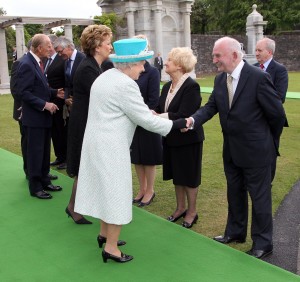
Winnie Duff has written that the Queen’s grandson Prince William’s ancestors have very strong Ulster connections, and he  has one of the most illustrious family trees in History, with much of the Ulster and English aristocracy included in the Spencer family tree, the Scottish in Bowes Lyons, and the whole continent’s in the Mountbattens. Not only is he descended from Stuarts and Tudors, but O’Neill and McAlpine, even Sarsfield and Schomberg.  Although for generations they tended to marry European Royals, most of the British input to the Royal Genes is via the Queen Mother and Princess Diana, whose mother was from a Cork family, her grandmother from County Tyrone.

Posted in Article | Comments Off on The Return of the British Kings 5: Elizabeth II

The Return of the British Kings 4: The Macnaghtens, last of the Caledonian Cruthin (Pictish) Kings, and Robert Quigg VC.

The Macnaghtens (MacNaughtons or MacNachtens ) are descended from the eighth century Caledonian Cruthin or Pictish King Nechtan.The earliest reference to the MacNaghtens is in connection with great Pictish Rulers of Moray. The name ‘Nechten’ which means “pure” or “clear” was popular in the Pictish royal line. The originator of the clan is believed to have been “Nechtan Mor” who lived in the 10th Century.

By the time of the Renaissance, the Mcnaghtens had developed four distinct branches, or “septs,” each recognized by the Crown with its own coat of arms. The senior line, Macnaghten of Argyll, is assumed to descend from Sir Gilchrist MacNaughtan, who was granted land in Argyll in the early 13th century by Alexander III, King of Scotland. Parchments from 1247 and 1267 bearing the seal of Sir Gilchrist MacNaughtan are among the oldest existing charters in Scotland. They took up residence on an island in Loch Awe called Fraoch Eilean, which name they used as a battle cry. Also in this century the sept MacNaught broke away from the main clan and moved to Galloway and Ayrshire although they kept a strong connection with the main clan for protection.

During the 14th Century the Macnaghtens were opposed to Robert the Bruce and his claim to the throne of Scotland; however, he did eventually become King Robert I of Scotland. As a result, the Macnaghtens forfeited many of their lands. Clan Macnaghten also fought against Robert the Bruce at the Battle of Dalrigh in 1306. The fortunes of the clan were restored, however, when King David II of Scotland granted them lands in Lewis. The MacNaughts were on Robert the Bruce’s side because they lived in part of his lands.

In the sixteenth century during the Anglo-Scottish Wars the Clan Macnaghten led by Chief Alistair Macnaghten, who was knighted by King James IV of Scotland and fought at the Battle of Flodden Field in 1513. However the Chief was killed during the course of the battle. The MacNaghtens did not put their faith in the Stewarts and opted more for the freedom that the presbyterian church offered.

In the 17th century during the Civil War Chief John MacNaghten and his clan were Royalist supporters. The MacNaghtens had a strong force and joined King James VII’s general the Viscount Dundee and is said to have taken a leading part when the Clan Macnaghten were victorious at the Battle of Killiecrankie in 1689. By this point the MacNaughts had a lot of septs such as MacKnight (which is the direct translation of the name into English), MacNeight, MacNett, MacNitt and MacNutt.

The Macnaghtens were one of the families brought in by the McDonnells of the Glens of Antrim. Black John Macnaghten (known locally as Shane Dhubh) became The Earl of Antrim’s Chief agent. Black John was buried in the family burial ground at Bonamargy Friary near Ballycastle, County Antrim The MacNaughts were also moved to Ulster and Roy McNett gave me my first job on a building site in Fort Wayne, Indiana.

The Ulster Volunteer Force members, who volunteered to join the British Army in 1914, formed the bulk of the 36th (Ulster) Division . Thousands of its members volunteered for active service. One such volunteer was Robert Quigg. In September 1914, he enlisted in the 12th Battalion of the Royal Irish Rifles (Mid-Antrim Volunteers). His service number was 12/18645. He held the rank of Rifleman. His Platoon Officer was Harry Macnaghten, the heir to the Macnaghten Estate at Dunderave. Sometime earlier, Robert had worked on Dunderave Estate; he had first become familiar with Harry Macnaghten while employed there.

Robert Quigg was awarded the Victoria Cross for his “Most Conspicuous Bravery” at the Battle of the Somme, 1 July 1916. Prior to the major offensive, his unit had been placed in the French village of Hamell, located on the north bank of the River Ancre. On 1 July, the Mid-Antrim Volunteers were ordered to advanced through the defenses towards the heavily defended German lines. During the advance, they encountered fierce resistance from heavy machine-gun and shell fire. Quigg’s platoon made three advances during the day, only to be beaten back on each occasion by German fire. The final evening assault left many hundreds of the 12th Battalion lying dead and wounded in “no man’s land”.

In the early hours of the next morning, it was reported that Lieutenant Harry Macnaghten, the platoon commander was missing; Robert Quigg volunteered to go out into “no man’s land” to try and locate him. He went out seven times to search for the missing officer, without success. On each occasion, he came under machine gun fire, but he managed to return with a wounded colleague. It was reported that, on one of his forays, he crawled within yards of the German position in order to rescue a wounded soldier, whom he dragged back on a waterproof groundsheet. After seven hours of trying, exhaustion got the better of him; Robert had to rest from his efforts. The body of Lieutenant Harry Macnaghten was never recovered.

On 8 January 1917, Robert received his Victoria Cross from King George V, at York Cottage, Sandringham.Queen Mary was also in attendance. Upon his return to Bushmills, the people of the town and district turned out in force to welcome him home, including the Macnaghten household. Lady Macnaghten presented him with a gold watch in recognition of his bravery in attempting to find and rescue her son, Lieutenant Harry Macnaghten. Robert reached the rank of seargeant before retiring from the army in 1926 (after he was badly injured in an accident). Later, in 1953, two years before he died, he met the newly crowned Queen Elizabeth II. Robert Quigg died on 14 May 1955 at Ballycastle, County Antrim. He was buried in Billy Parish Churchyard, with full military honours. His statue now stands in Bushmills town centre.

The Russians also presented Robert Quigg with the Medal of the Order of St George (Fourth Class), the highest award of the Russian Empire. The First and Second classes were only given on the personal decree of the Emperor. The Third and Fourth classes were only awarded by the approval of the Georgevsky Council, a group of St George Knights. The Third Class was for senior officers, and the Fourth Class was the highest award of the Russian Empire for non-senior officers. His Victoria Cross and Order of St. George (fourth class) are on display at the Royal Ulster Rifles Museum, Waring Street, Belfast.


Posted in Article | Comments Off on The Return of the British Kings 4: The Macnaghtens, last of the Caledonian Cruthin (Pictish) Kings, and Robert Quigg VC.

The Return of the British Kings 3: William and Mary of Orange

The House of Stewart or Stuart, from whom William and Mary and our present Queen Elizabeth II are ultimately descended, had its origins  in Alan fitz Flaald (born 1070, died in 1114)  Alan was of the Breton or Old British nobility and held the feudal barony and castle of  Oswestry in Shropshire, from which the Wallace family also came. He was descended from the ancient British who had fled to Armorica in France under the pressure of the invading Anglo-Saxons in the 5th century AD, transferring the name Little Britain to that area rather than  Ireland. His duties as a “valiant and illustrious man” included supervision of the Welsh border. Alan was the son of Flaald, who was in turn a son  of an Alain, a crusader (in 1097) who was dapifer to the Ancient Diocese of Dol in Dol-de Bretagne. The area of Dol which is near Mont-St-Michel and has figured in the history of the Kingdom and then Duchy of Brittany since at least the rule of Nominoe. “Alan, dapifer” is found as a witness in 1086 to a charter relating to Mezuoit, a cell of St. Florent, near Dol.

Flaald and his son Alan had come to the favourable notice of King Henry I of England who, soon after his accession, invited Alan to England with other Breton friends, and gave him forfeited lands in Norfolk and Shropshire, including some which had previously belonged to Ernulf de Hesdin and Robert de Belleme. Robert had proved a threat to Henry in both the Wesh Marches and in Normandy, so the king was determined to insert reliable supporters to counterbalance or replace his network of supporters. Alan received more land as he proved his worth. A large portfolio of lands in Shropshire and around Peppering, near Arundel in Sussex, was taken from the holdings of Rainald de Bailleul, ancestor of the House of Balliol, who were later to provide a king of Scotland.

The FitzAlan family quickly established themselves as a prominent Anglo-Norman noble house, with some of its members serving as High Sheriff of Shropshire. It was the great-grandson of Alan named Walter FitzAlan  who became the first hereditary High Steward of Scotland, while his brother William’s family would go on to become Earls of Arundel.The name Stewart derives from the political position of office similar to a governor, known as a steward. It was originally adopted as the family surname by Walter Stewart, 3rd High Sreward of Scotland, who was the third member of the family to hold the position. Prior to this, family names were not used, but instead they had patronyms defined through the father; for example the first two High Stewards were known as FitzAlan and FitzWalter respectively.

The sixth High Steward of Scotland, Walter Stewart (1293–1326), married Marjorie, daughter of Robert the Bruce, and also played an important part in the Battle of Bannockburn gaining further favour. Their son Robert was heir to the House of Bruce, the Lordship of Cunningham and the Bruce lands of Bourtreehill; he eventually inherited the Scottish throne when his uncle David II died childless in 1371.During the 16th century the French spelling Stuart was adopted by Mary, Queen of Scots  when she was living in France. She sanctioned the change to ensure the correct pronunciation of the Scots version of the name Stewart, because retaining the letter ‘w’ would have made it difficult for French speakers, who usually render “w” as “v”. The spelling Stuart was also used by her second husband, Henry Stuart, Lord Darnley; he was the father of James VI and I , so the spelling Stuart for the British royal family officially derives from him. Both Mary, Queen of Scots, and Lord Darnley had strong claims on the English throne, through their mutual grandmother, Margaret Tudor.

In total, nine Stewart monarchs ruled just Scotland from 1371 until 1603. After this there was a Union of the Crowns  under James VI and I who had become the senior genealogical claimant to The Crown holdings of the  ancient British House of Tudor.. Thus there were six Stewart monarchs who ruled both England and Scotland as well as Ireland (although the later Stuart era was interrupted by an interregnum lasting from 1649–1660, as a result of the Wars of the Three Kingdoms). Additionally, at the foundation of the Kingdom of Great Britain after the  Acts of Union, which officially united England and Scotland politically, the first monarch was Anne, Queen of Great Britain. After her death, all the holdings passed to the House of Hanover, under the terms of the Act of Settlement (1701).

During the reign of the Stewarts, Scotland developed from a relatively poor and feudal country into a prosperous, fairly modern and centralised state. They ruled during a time in European history of transition from the Middle Ages to the Renaissance. Monarchs such as James IV were known for sponsoring exponents of the Northern Renaissance such as the poet Robert Henryson and others, the great Makars of the Scots language, which we have inherited as Ullans or Ulster-Scots. After the Stewarts gained control of all of Great Britain, the arts and sciences continued to develop; many of William Shakespeare’s best known plays were authored during the Jacobean era, as was the Authorised version of the Bible, while institutions such as the Royal Society and Royal Mail were established during the reign of Charles II, Uncle of both William and Mary. During the reign of William and Mary,  the National Debt was commenced, the Bank of England established, the modern system of finance instituted, ministerial responsibility recognised, the standing army transferred to the control of parliament, the liberty of the press secured, and the British Constitution established on a firm basis.


Principal members of the house of Stuart following the 1603 Union of the Crowns.

Posted in Article | Comments Off on The Return of the British Kings 3: William and Mary of Orange