The Return of the British Kings 2: Henry Tudor

Henry VII (Welsh: Harri Tudur; 28 January 1457 – 21 April 1509) was King of England and Lord of Ireland from his seizing the crown on 22 August 1485 until his death on 21 April 1509, as the first monarch of the House of Tudor.

Henry won the throne when his forces defeated Richard III at the Battle of Bosworth Field. He was the last king of England to win his throne on the field of battle. Henry cemented his claim by marrying Elizabeth of York, daughter of Edward IV and niece of Richard III. Henry was successful in restoring the power and stability of the English monarchy after the political upheavals of the civil wars known as the Wars of the Roses. He founded the Tudor dynasty and, after a reign of nearly 24 years, was peacefully succeeded by his son, Henry VIII.

Henry’s main claim to the English throne derived from his mother through the House of Beaufort. Henry’s mother, Lady Margaret Beaufort, was a great-granddaughter of John of Gaunt, Duke of Lancaster, fourth son of Edward III, and his third wife Katherine Swinford. Katherine was Gaunt’s mistress for about 25 years; when they married in 1396, they already had four children, including Henry’s great-grandfather John Beaufort. Thus Henry’s claim from an Anglo-Norman point of view was somewhat tenuous.


Groat of Henry VII

Gaunt’s nephew Richard II legitimised Gaunt’s children by Katherine Swynford by Letters Patent in 1397. In 1407, Henry IV, who was Gaunt’s son by his first wife, issued new Letters Patent confirming the legitimacy of his half-siblings, but also declaring them ineligible for the throne.[6] Henry IV’s action was of doubtful legality, as the Beauforts were previously legitimised by an Act of Parliament, but it further weakened Henry’s claim.

Nonetheless, by 1483 Henry was the senior male Lancastrian claimant remaining, after the deaths in battle or by murder or execution of Henry VI, his son Edward of Westminster, Prince of Wales, and the other Beaufort line of descent through Lady Margaret’s uncle, the 2nd Duke of Somerset.

But Henry also thought of himself as an ancient British King and attracted military support in Wales, thus safeguarding his army’s passage on its way to the Battle of Bosworth. He came from an old-established Anglesey family which claimed descent from Cadwaladr (in legend, the last ancient British king) and on occasion, Henry displayed the red dragon of Cadwaladr. He took it, as well as the standard of St George, on his procession through London after victory at Bosworth. A contemporary writer and Henry’s biographer, Bernard André, also made much of Henry’s Welsh descent.

Although, in reality, his hereditary connections to Welsh aristocracy were not just so strong, he was indeed descended by the paternal line, through several generations, from Ednyfed, the seneschal (steward) of Gwynedd and through this seneschal’s wife from Rhys ap Tewdwr, the King of Deheubarth in South Wales. His more immediate ancestor Tudur ap Goronwy had aristocratic land rights, but his sons, who were first cousins to Owain Glyndwr, sided with Owain in his revolt. One son was executed and the family land was forfeited. Another son, Henry’s great-grandfather, became a butler to the Bishop of Bangor. Owen Tudor, the son of the butler, like the children of other rebels, was provided for by Henry V, a circumstance which precipitated his access to Queen Catherine of Valois.

And so, to the bards of Wales, Henry was a candidate for Y Mab Darogan – “The Son of Prophecy” who would free the Welsh, last of the Britons to be anglicised, from English domination.

Posted in Article | Comments Off on The Return of the British Kings 2: Henry Tudor

Van Morrison – The Freedom of Belfast

statement background

Belfast is my home. It is where I first heard the music that influenced and inspired me, it is where I first performed and it is somewhere I have referred back to many times in my songwriting over the past fifty years.

I am delighted and honoured to receive the Freedom of the City and would like to thank all those who made it possible, the Lord Mayor, the Councillors and the people of Belfast.

vm signature small

Posted in Article | Comments Off on Van Morrison – The Freedom of Belfast

The Return of the British Kings 1: William Wallace

Sir William Wallace (Norman French:William le Waleys) died 23 August 1305) was a Scottish landowner and descendant of the ancient kings of Northwest Britain. He became one of the main leaders during the Wars of Scottish Independence.

Along with Andrew Moray, Wallace defeated an English army at the Battle of Stirling Bridge in 1297, and was Guardian of Scotland, serving until his defeat at the Battle of Falkirk in July 1298. In 1305, Wallace was captured in Robroyston near Glasgow and handed over to King Edward I of England, who had him hanged, drawn and quartered for high treason and crimes against English civilians.

Edward I had used Sir William Soulis to obtain Cruggleton from the Mac Cairills in 1282. William Wallace had assisted William Mac Cairill in recapturing Cruggleton, and he and Wallace wanted independence for Scotland from England. Mac Cairill accompanied Wallace to meet Robert the Bruce July 1st (August?), 1305 near Glasgow. With them was John Stewart of Ruskie who was to betray them. Mac Cairill (M’Kerlie) was asleep and was slain. Wallace awoke at the noise and resisted, but was captured.

Since his death, Wallace has obtained an iconic status far beyond his homeland. He is the protagonist of the 15th-century epic poem The Wallace, by Blind Harry. Wallace is also the subject of literary works by Sir Walter Scott and Jane Porter and of the 1995 Academy Award- winning epic film Braveheart.


Statue of Wallace at Edinburgh Castle

William Wallace was a member of the lesser nobility of Scotland but little is definitely known of his family history. Records show early members of the family as holding estates at Riccarton,Tarbolton, and Auchincruive in Kyle, and Stenton in Haddingtonshire. They were vassals of James Stewart, 5th High Steward of Scotland (himself decended from the ancient British kings of Brittany and an ancestor of William of Orange) as their lands fell within his territory. The traditional view regards William’s birthplace as Elderslie in Renfrewshire, and this is still the view of most historians, but there have been recent claims that he came from Ellerslie in Ayrshire. There is no contemporary evidence linking him with either location, although both areas had connections with the wider Wallace family.

The Wallace family first came to Scotland with a Norman family in the 11th century. King David was eager to extend the benefits of Norman influence and gave grants to the nobles of the south. Among them was Walter FitzAlan, who the Scottish king appointed his Steward in 1136. One of FitzAlan’s followers was Richard Wallace from Oswestry who came north to try and improve his fortunes. Oswestry is on the Welsh border and the name Wallace means “Welshman” in its broad sense, as of Old British descent from lands stretching from Strathclyde, Aeron (Ayrshire), Galloway, Cumbria, Lancashire, Wales, Cornwall and Brittany.  

Lord FitzAlan received from King David lands in Ayrshire and so it was here that his follower Richard Wallace settled. Richard Wallace was granted his own estate in Kyle, where it is claimed that his name Richard is still remembered in the placename of the village of Riccarton. While tradition claims Sir Malcolm Wallace of Elderslie as the father of three sons, Malcolm, John, and William Wallace, the seal of William Wallace, rediscovered in 1999, identifies William as the son of Alan Wallace of Ayrshire, who appears in the Ragman Roll of 1296 as “crown tenant of Ayrshire”. Dr. Fiona Watson in “A Report into Sir William Wallace’s connections with Ayrshire”, published in March 1999, reassesses the early life of William Wallace and concludes, “Sir William Wallace was a younger son of Alan Wallace, a crown tenant in Ayrshire”.

Posted in Article | Comments Off on The Return of the British Kings 1: William Wallace

The Boyds: Rebecca McCarl

 The story of the Boyds begins earlier with family in England.

Alan was the son of Flaald, and had a grant in Norfolk, England, 1101. He was Lord of Oswestry, 1105 10 and Viscount of Shropshire. He married Ameline daughter of Waryn the Bald, by Ameria, (grand)daughter of Roger Montgomery, Earl of Arundel.

Their sons:

William Fitzalan I, (Fitz means son of) was Lord of Oswestry and Viscount of Shropshire, 1126, Tante. He married Helen daughter of William Peverel.These are the Fitzalans of The House of Arundel in England.

Walter Fitzalan was Senescal of Scotland, his descendants became the Kings of the House of Stewart.

* Simon Fitzalan was said to be a younger brother of William and Walter, who followed Walter to Scotland. The 1161 charter of the Monastery of Paisley lists Simon, as “Simon frater,” “Walter filis,” “Alan Lapiferi,” and “Regis Sectiac.”

Simon Fitzalan, was from whom the Boyds descend.

Simon Fitzalan’s eldest son was Robert Boyd, called Robert, the Fair, because of his light hair coloring. The Celtic Gaelic word “Buidh” (yellow) is where the name Boyd comes from.

Robert Boyd (1st generation) had a son Robert Boyd (2nd generation), in 1262 in a charter given to Sir John Erskin he is called “Robertus de Boyd Miles”.

Robert Boyd (3rd generation) died about 1300. His son, Robert Boyd (4th generation) is the one who was with William Wallace and William Mac Cairill. Robert Boyd also was a supporter of Robert the Bruce. After the Battle of Bannockburn he was rewarded by Bruce gifts of the land of Kilmarnock, among others.

The oldest son of Sir Robert Boyd (4th generation) was Thomas Boyd (5th generation) in the line. Thomas Boyd’s son was also Thomas Boyd (6th generation) and was called “Dominus de Kilmarnock” (The first Lord Boyd).

Posted in Article | Comments Off on The Boyds: Rebecca McCarl

O Sons of Ulster (Ulster English / Northern Irish)

O Sons of Ulster
When will we see yer likes again
That fought and died for 
Our freedom at the Somme
And stood against them
The Kaiser’s armies
And sent them homeward
Tae think again…
 
O Caledonia
And all you folk from Old Strathclyde
Where Briton Wallace
At one time did abide
And stood against them
The Kaiser’s armies
And sent them homeward
Tae think again…
 
Them days are gone now
But we will aye remember them
And we can still rise now
The British nation again
And stood against them
The Kaiser’s armies
And sent them homeward
Tae think again
 
O Sons of Ulster
When will we see yer likes again
That fought and died for 
Our freedom at the Somme
And stood against them
The Kaiser’s armies
And sent them homeward
Tae think again…


Posted in Article | Comments Off on O Sons of Ulster (Ulster English / Northern Irish)

Ah Flooer o Scotlan (Ullans / Ulster-Scots)

Ah Flooer o Scotlan
Whan wull we see yer likes agane
That focht and deed fir
Yer wee bit hill an glen
An stud agin thaim
Prood Edward’s army
An sent thaim hameward
Tae think agane

The hills are bare noo
An autumn leaves lie thick an still
O’er lan that is loast noo
Which thae so dearly hould
An stud agin thaim
Prood Edward’s army
An sent thaim hameward
Tae think again

Thae days are bye noo

An in the past they maun remain
But we can still rise noo
The British nation agane
That stud agin thaim
Prood Edward’s army
An sent thaim hameward
Tae think agane

Ah Flooer o Scotlan
Whan wull we see yer likes agane
That focht and deed fir
Yer wee bit hill an glen
An stud agin thaim
Prood Edward’s army
An sent thaim hameward
Tae think agane

Posted in Article | Comments Off on Ah Flooer o Scotlan (Ullans / Ulster-Scots)

September 1913 – William Butler Yeats

SEPTEMBER 1913

by William Butler Yeats 

What need you, being come to sense,
But fumble in a greasy till
And add the ha’pence to the pence
And prayer to shivering prayer, until
You have dried the marrow from the bone;
For men were born to pray and save?,
Romantic Ireland’s dead and gone,

It’s with O’Leary in the grave.

Yet they were of a different kind,
The names that stilled your childish play,
They have gone about the world like wind,
But little time had they to pray
For whom the hangman’s rope was spun,
And what, God help us, could they save?
Romantic Ireland’s dead and gone,
It’s with O’Leary in the grave. 

Was it for this the wild geese spread
The grey wing upon every tide;
For this that all that blood was shed,
For this Edward Fitzgerald died,
And Robert Emmet and Wolfe Tone,
All that delirium of the brave?
Romantic Ireland’s dead and gone,
It’s with O’Leary in the grave.

Yet could we turn the years again,
And call those exiles as they were
In all their loneliness and pain,
You’d cry ‘Some woman’s yellow hair
Has maddened every mother’s son’:
They weighed so lightly what they gave.
But let them be, they’re dead and gone,
They’re with O’Leary in the grave.


Posted in Article | Comments Off on September 1913 – William Butler Yeats

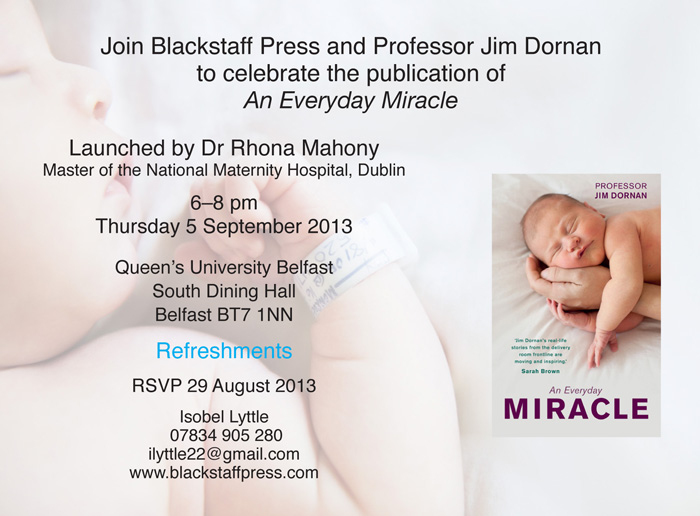
An Everyday Miracle: Professor Jim Dornan


Jim Dornan

Professor Jim Dornan is one of the world’s leading gynaecologists and obstetricians.
For almost forty years, he has cared for women, helping them through some of the most difficult, joyous and transformative events of their lives. Jim lives and continues to practice medicine in his hometown of Belfast.

He was in the year below David Trimble and me at Bangor Grammar School, where he is still remembered for his role as Lady Macbeth, and his son Jamie obviously takes after him. An Everyday Miracle is the compelling story of Jim’s career. I attended the launch at Queen’s University this evening and met Sir Nigel Hamilton former Head of the Northern Ireland Civil Service, now Chairman of TinyLife, of which Jim is President. 

TinyLife started out in 1988 as NIMBA (Northern Ireland Mother & Baby Appeal), the only premature and vulnerable baby charity in Northern Ireland dedicated to reducing illness, disability and death in babies born here.  Its first chairman, Eric Cairns was with us this evening. The charity was established by healthcare professionals and concerned parents in the Belfast area in response to the growing number of babies requiring special or intensive care at birth.

It actually started life as the Lord Mayor’s Mother and Baby Appeal , which I facilitated through the good offices of Councillor Fred Proctor of Belfast City Council on behalf of my incomparable colleagues Drs, now Professors, Henry Halliday and Garth McClure of the Royal Maternity Hospital, Belfast, who also established Community Paediatrics with me in Belfast.

Posted in Article | Comments Off on An Everyday Miracle: Professor Jim Dornan

Unique World War One Poster Collection to go Online

 http://www.inverclyde.gov.uk/news/2013/aug/unique-world-war-one-poster-collection-go-online/

  A unique collection of original WWI posters will be given a new lease of life thanks to a Heritage Lottery Fund (HLF) grant of £51,300. 

Around 300 posters were collected by Inverclyde Council’s McLean Museum during the First World War and immediately afterwards.

Assistant Curator Vincent Gillen said: “From 1914 the secretary of the museum Thomas Thomson had the foresight to write to the High Commissions and Embassies of the countries fighting against the Germans and their allies asking for examples of posters. He was sent recruitment adverts and propaganda posters from Britain, France and Ireland as well as material from America and Canada. Some are very rare and all of them are in near perfect condition as they were sent directly to the museum and have been safely stored away ever since. It really is a unique collection and one that I am sure will be very popular when it is available online.” 

The digital poster collection will be a key part of Scotland’s commemoration of next year’s centenary of the start of the Great War.

Inverclyde’s Communities Vice Convener Councillor James McColgan said: “Communities in Inverclyde like many parts of Scotland were torn apart by the events of the First World War. The country lost a generation in a little over four years and next year’s centenary commemorations give us the chance to remember the sacrifices made and how they shaped our country today.

This incredible collection shows the vast range of messages being promoted in the lead up and during the conflict from recruitment posters urging men to join up and promotional posters calling for people to help fund the fighting through war bonds. There is even a collection of rare German propaganda posters.

The artwork and message of these posters reflect a different time and by being able to make them available online we can share this fascinating glimpse into that conflict with generations to come.”

The project will digitise the collection of over 300 posters. A collection of local newspapers from that period is also set to be digitised. A blue heritage plaque will be placed at the site of the Greenock headquarters of the 1/5th Argyll and Sutherland Highlanders. Inverclyde was traditionally an important recruiting area for the regiment.

Colin McLean, Head of HLF Scotland, said “Saving our historic archives is important as they provide such a valuable resource for anyone wanting to explore their past. This First World War collection is bursting with images that give us clues about what life was like and how that has shaped us into what we are today.”

Workshops will be arranged and there’ll also be displays in Inverclyde’s McLean Museum in Greenock.

A play based on the letters sent back home from soldiers serving in the Battle of Gallipoli will be produced and performed in the museum and in local community centres. There will also be a leaflet produced and a special tour programme created of WWI graves.

As well as the large collection of posters, the online website will also include muster rolls and residents will also be able to upload their own memories and photographs to add to the collection.

Inverclyde Council’s McLean Museum is based in Greenock.

About the Heritage Lottery Fund

Using money raised through the National Lottery, the Heritage Lottery Fund (HLF) sustains and transforms a wide range of heritage for present and future generations to take part in, learn from and enjoy. From museums, parks and historic places to archaeology, natural environment and cultural traditions, we invest in every part of our diverse heritage. To date it has invested over £500 million in Scotland’s heritage. Website: www.hlf.org.uk

HLF support:

The McLean Museum and Art Gallery was awarded a grant of £51,300 to explore the First World War from an Inverclyde perspective.

HLF supported this exciting project as it will help the local community to learn about their heritage, recording oral histories, gathering archive material and creating a play based on letters sent during the war.

Heritage walks and graveyard tours will show the impact of the war in the area, and a new digital resource will make the material available to a wide audience. Memorial panels will be erected in each project area, celebrating Inverclyde’s role in the war, and the project will culminate in an exhibition in 2014.

The Heritage Lottery Fund has a range of funding programmes available for projects interested in exploring the legacy and impact of the Great War. 

A new programme First World War: Then and Now was recently launched offering grants from £3,000 – £10,000, while larger grants are available through other programmes. More information can be found at www.hlf.org.uk/firstworldwar

The Heritage Lottery Fund recently announced the first awards under the First World War programme www.hlf.org.uk/news/Pages/FirstWorldWarCentenaryOneYearToGo.aspx

Posted in Article | Comments Off on Unique World War One Poster Collection to go Online

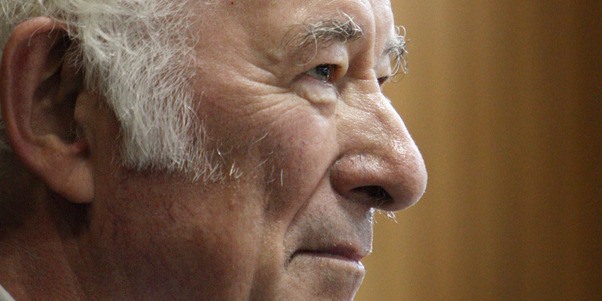
Seamus Heaney: 13th April 1939 – 30th August 2013


Blog of Belfast’s Lord Mayor, Máirtín Ó Muilleoir
Follow Máirtín on Twitter and LinkedIn


seamus_heaney


In the week that we lost our greatest scribe Séamus Heaney, Belfast came together as one family to mourn his passing and celebrate his life with an uplifting night of poetry, music, and craic at the Lyric Theatre.

Full marks to Stephen Douds of the Lyric who put the evening together in a heartbeat, exactly the type of generous and spontaneous response to grief which enriches us all. And with the Lyric team full-out with their plans to bring the stupendous Brendan at the Chelsea to New York next week, the city salutes them for making space for Séamus. 

I had the great honour of reading the harrowing lament An Chéad Mháirt den Fhómhar during the evening of celebration for all that Séamus Heaney gifted Ireland and the world and while that poem about a father losing his son is, perhaps, angrier than the occasion merited it is also a tremendously moving poem by another people’s poet, Séamus Ó Dónaill of the Rosses — 200 years back. 

We will pay our own homage to hope and history at City Hall on Monday when we open a book of condolence for Séamus Heaney, with the consent of all parties. 

If you don’t make it to City Hall to sign the book of condolences, I do hope you’ll make it to our Belfast Diversity Day on Sunday 29 where we will raise a glass to all the different cultures, cuisines, colours, musics, and peoples of Belfast. Our festivities will take place the day after my installation dinner and will mark our thanks to the city for all it has given us with a special nod to the migrants to Belfast and the ethnic minorities who are building Belfast. 

The day will end with a blessing by our eight wonderful chaplains. I’ve been invited to spend time with them all in the weeks ahead and this morning had the good fortune to spend some time meditating and listening to my Buddhist chaplain Ryushin Paul Haller at the Black Mountain Zen Centre. As regular readers will know, I don’t do enough listening and rarely pause. You can take it, therefore, that both were good for my soul. 

r.gif
bl.gif b.gif br.gif

Seamus was buried today in Bellaghy, County Londonderry, close to where he was born. His friends  were there to bid him farewell.

Posted in Article | Comments Off on Seamus Heaney: 13th April 1939 – 30th August 2013