Van at Slieve Donard Hotel


Posted in Article | Comments Off on Van at Slieve Donard Hotel

….and in other news from 1913

Belfast Accent Confuses Judge

The Manchester Guardian has reported that a newly installed Resident Magistrate in Belfast has struggled with the local accents. He was hearing a case in which a man was accused of assaulting his wife. The Magistrate asked the wife what had happened. She replied, ‘He hit me over the head wi’ the matta’. The Magistrate failed to understand what this object was, and was informed that the woman meant a motto. Still perplexed, the Magistrate was told by the witness, ‘Ach, don’t you know, it’s thon wee thing wi’ a frame round it, and “God Bless This House” in the middle’.


Great Scientist Honoured in Belfast

The Earl of Shaftesbury has unveiled a memorial statue honouring the life of Lord Kelvin, the scientist and mathematician. The statue, which stands thirteen feet high, is the work of Mr Bruce-Joy RHA, and will stand at the entrance of the Botanic Gardens in Belfast.


Irish athletes beat Scots

At an athletics meeting in Belfast, Ireland has beaten Scotland seven events to four. The outstanding performance was by F.R. Shaw, the well known cricketer, who won the sprint in a time that equalled the Irish record. It has been seven years since Belfast hosted this prestigious event, and a good crowd was in attendance.


Population Increasing Despite Emigration

Figures released today, covering the year 1912, show that Ireland’s population is growing. Overall there was an increase in population of 1,162 people, and the lowest death rate was recorded since 1862. The declining death rate was assisted by a fall in deaths due to tuberculosis and by the lowest infant mortality rate since records began.

Last year there were 23,283 marriages of which 16,557 were Roman Catholic, 3,494 Church of Ireland, 13 Jewish and 9 from the Society of Friends. 407 of the men who married, and 1,485 women were minors at the time of their wedding. Of the 101,035 births, 51,700 were boys and 49,335 girls. The highest birth rates were recorded in Dublin and Belfast, while the lowest were in Counties Wicklow and Roscommon. Death rates were highest in Counties Limerick, Monaghan and Armagh, and lowest in Galway, Mayo and Kerry. 29,344 people emigrated, with the majority, 11,352 leaving from Ulster.


Car for Crippled Children Attacked in Belfast

Today was the annual outing for crippled children to Mountstewart, the home of the Marquis of Londonderry. However, when one of the cars that had conveyed the children back to their homes in West Belfast was driving down Leeson Street, just off the Falls Road, it was attacked. The car was set upon by a group of men and they pulled off three Union flags that were decorating the car. The men also tried to attack the driver and two passengers, an entertainer who had been at the party and one of the crippled children. Fortunately the driver was able to speed off, and no one was hurt. According to the Belfast Telegraph, the ‘incident has caused much indignation in Belfast’.


Telephone Cable for crossing The Irish Sea Completed

The city section of telephone cable that will link the GPO with Holyhead has now been completed. The cable, which will cross underwater from Holyhead to Howth, has now been run all the way to the GPO in the heart of the city. From there, the lines go on to the south of the country and to the Belfast. All customers will, once the undersea lines have been completed, find it far easier to make calls to Britain with an increase in sound quality. The completed undersea lines will replace those between Port Mora and Donaghadee that were laid in 1893.


Belfast Shipworkers Threaten Strike

While English and Scottish shipworkers vote on whether to strike over the issue of advanced wages, the men in Belfast are refusing to even ballot. The hardline approach has been rejected by employers who claim that one of the workers demands, an eight hour day, will make the Belfast yards uncompetitive. The employers’ spokesman stated that ‘already several jobs that could have been filled at home have gone abroad’.


New Scheme for Treatment of Tuberculosis Unveiled

The Belfast Corporation adopted a new scheme today aimed at tackling the high incidence of tuberculosis in the city. The Corporation will take over the Abbey Sanatorium which will allow 465 beds to be made available to tuberculosis patients. Half of the cost of the scheme would be funded by the government under the terms of the Home Rule Bill, which the majority of the Corporation are opposed to.


Posted in Article | Comments Off on ….and in other news from 1913

Major arms find in Dublin: 7 June 1913

Major arms find in Dublin

500 rifles intercepted on way to Ulster

Published: 7 June 1913

A large consignment of rifles, thought to have been bound for Ulster, has been seized by customs officials at Dublin Port. The arms were concealed in packing cases in a furniture van and were addressed to Lord Farnham in Co. Cavan. Lord Farnham, who is strongly identified with anti-Home Rule agitation, has said that he knows ‘absolutely nothing’ about the matter.

The rifles are thought to have been of Italian manufacture and may have been used during the recent Italian-Turkish war around Tripoli.

Customs officials, acting on a tip-off, discovered the rifles upon the arrival of the City of Dublin Company’s steamship, Kerry. The officials had stationed themselves along the dock at the North Wall in Dublin Port to watch the discharge of cargo from the ship. The packing cases full of rifles were quickly found and were seized.

The find in Dublin comes just three days after a similar find in Belfast. Custom officials in that city impounded twelve cases of rifles and bayonets that had landed early on Tuesday, brought by a steamship from Manchester.

The rifles had been disguised in cases designated as ‘electrical plant’, but it is thought that the authorities at Belfast Port had been tipped-off by telegram as to the true nature of the contents. The full consignment has been estimated to contain at least 500 rifles.

Although there are suggestions that the importation of the rifles was a stunt designed to frighten away support for Home Rule by implying that civil war in Ireland was increasingly likely, the government is reported to take a grave view of the latest turn of events.

Police in Britain and in Ireland are now seeking to investigate the origins of both consignments.

Preparations for military opposition to Home Rule in 1913 pre-dated the June importation of arms. A Minute from Chief Secretary’s Office refers to allegations that an ex-school teacher from Kilrea in Londonderry was raising funds prepare unionists to defend themselves against ‘the rule of Rome and the priests’. Dated 16 January 1913 (National Archives UK, CO 904/28).

A memorandum from 1911 sets out legal position regarding the importation of arms into Ireland. It states that the legality of supply or keeping of arms ‘must depend in each case on all the circumstances’ (National Archives UK, CO 904/28).

Preparations for military resistance to Home Rule were a feature of Unionist opposition to each of the three Home Rule Bills. There is an extract from a listing of Persons taking part in Drilling at Rich Hill Demesne, in the Portadown district, on 2 June 1886 (National Archives UK, CO 904/28).

The unlawful assembly of more than 500 persons at Rich Hill Demesne in June 1886 for the purpose of ‘being trained or drilled to the practice of military exercise movements’ was subsequently addressed at the Petty Sessions in Co. Armagh (National Archives UK, CO 904/28).


Posted in Article | Comments Off on Major arms find in Dublin: 7 June 1913

Cultural divisions in Northern Ireland – Myth or Reality.

“Cultural divisions in Northern Ireland – Myth or Reality” are notes for a Radio Interview I gave in Paris at 10.30 am on Friday 29th April 1983 .It also formed the basis of a talk given there to 23 Young people from the Farset Youth Project, under the leadership of Jackie Hewitt, Ann Brown and Fred Proctor

Culture is total range of activities and ideas of a group of people with shared traditions which are transmitted and reinforced by members of the group. 

I was born in Bangor and reared in Conlig a village between Bangor and Newtownards.  From the hills of Conlig you can see Galloway on a clear day.  I was descended from the Sloans of Kinelarty through my two grandmothers who were sisters.  One grandfather Robert Kerr from Lanarkshire in Scotland was a devotee of James Keir Hardie and fought for the flame of idealism, and working for socialism and the unemployed.  I travelled extensively in my youth through the Highlands of Scotland with my grandfather, to the Isle of Skye were I was taught the legend of Cuchulainn, to Stornoway on the Isle of Lewis and to Galloway where he taught me about the Covenanters, whom he loved.

I learned that Catholic and Protestant Gaelic speakers on the Scottish Highlands and Islands were in the majority Protestant.  The first book printed in Irish Gaelic was the Book of Common Order commonly called John Knox’s Liturgy, published in Edinburgh in 1567 for the use of Presbyterians.  Scottish Gaelic was not a literary language until the early 17th Century.  Old British was displaced in Ireland by Gaelic just as English Literature displaced Gaelic.  When Gaelic was planted on the British mainland its verbal system was on along the lines of the old British language.  Scottish Gaelic was to preserve archaic features now lost in Irish Gaelic.

The division of Ulster Gaelic from that of the rest of Ireland developed well before the arrival of English in the 17th century and there was an increasing influence of Scottish Gaelic on Ulster.  TF O’Rahilly in 1932 outlined the features which distinguished the two languages and regarded the position of word stress as the most important of these. The southern language of Gaelic stretches from south County Meath running through West Meath to Longford in Co Galway.  This is more than homogenous than the Ulster dialects. Modern Irish Gaelic was basically developed from Munster and Connaught dialects.

In 1770 Ulster Lallans was used by Rhyming Weaver poets until about 1870.  My ancestor Edward Sloan of Conlig was one of these.  Allan Ramsay was a member of the Easy Club along with the Jacobite leader Dr Archibald Pitcairn and had strong Jacobite sympathies following the 1715 rising.  During the occupation of Edinburgh in 1745 he was a highly respected figure but probably disapproved of Prince Charles Edward Stuart’s policy of invading England.  He supported the aims of the French moderate Cardinal Fleury who died shortly before the 1745 Rising was embarked on.

Ramsay lived to influence the Whig “Pacifiers” following defeat at Culloden Moor.  “The Gentle Shepherd” deals with the Restoration of the Stuarts following the Cromwellian interregnum. It contains Jenny an early advocate of Women’s Liberation.   He stands midway between the Scots renaissance poets Henryson, Gawain Douglas and Dunbar and the later Romantic group, of which Burns personifies the French Revolution, Scott is the product of imperial compromise and MacDiarmid adheres to the Russian Revolution.  At first Ramsay appears the least conspicuous but he is the still small voice between the two storms, right at the beginning of the Scottish Enlightenment.

In 555 AD Bangor Monastery was founded on Ulidian territory by Comgal and became the centre of literature both sacred and secular in the 6th and 7th Centuries.  The original Chronicles of Ireland and the poetry The Voyage of Bran were written there.  In the area the old traditions were preserved which were remoulded in to the Ulster Gaelic masterpiece “The Tain”.  The Bangor Antiphonary in Latin is an important relic of the Bangor monks.  The peregrinations of Columbanus and Gall are well known in the re-evangelisation of Europe.

In 637 Congal, Prince of the ancient British Cruthin attempted to regain the soverainty of the whole North  with help of mainland British allies but was defeated and killed at the Battle of Moira in 637 AD.  Samuel Ferguson the Unionist Post has said that this was the greatest battle ever fought within the bounds of Ireland.

In Conlig  I learned from my Grandmothers the story of Archibald Wilson, the Carpenter of Conlig, who was hanged for his part in the United Irish rebellion on 26th  June 1798.   On his grave slab is the poem:

Morn not dear friends, tho’ I’m no more,

Tho’ I was martyred your eyes before

I am not dead but do sleep here.

Yet once more I will appear. 


That is when time will be no more

When thel be judged who falsely swore

And them that judged will judged will be

Whether just or onjust then thel see.


Purpere, dear friends, for that grate day

When death dis sumances you away.

I will await you all with due care

In Heaven with joy to meet you there.

History is primarily a record of human relationship with a vast network of variation in the manner of its evolution.  Now is the time to widen its perspective beyond the religious and political divide.  People do not change their minds rather their horizons are widened.  We begin to comprehend that what we thought was the whole of reality is but a small part and that a representation.  Nobody can claim to own reality just as nobody can legitimately claim that theirs is the only view of history.

Posted in Article | Comments Off on Cultural divisions in Northern Ireland – Myth or Reality.

Van at Stornoway


Heb Celt Festival

Posted in Article | Comments Off on Van at Stornoway

Van at Larmer Tree Festival

Larmer Tree Festival


Posted in Article | Comments Off on Van at Larmer Tree Festival

Nelson’s Last Speech

Speech by Nelson McCausland MLA in the Northern Ireland Assembly on Tuesday 16th July 2013, speaking on the DUP motion regarding the Parardes Commission ruling which blocked, for the first time, the ‘Ligoniel Lodges’ return parade up Crumlin Road on 12th July:
 
Mr McCausland:
“The first Orange lodge in Ballysillan was formed in 1865 and the first Orange hall was built at Ballysillan in 1868. For almost 150 years, Orange lodges have paraded on the Crumlin Road because it is the main road into the centre of Belfast. Now, after 150 years, the Parades Commission has de facto banned the Orange brethren from returning along the Crumlin Road as part of their annual Twelfth parade.

Throughout the years, that road was a shared road, and, even today, it has on that contended section a major health centre at Everton, a public library, shops, a car wash and an ambulance station; all of these. The shopkeepers are happy to take money from Protestants and Roman Catholics. Nobody asks when you go in to check in your book whether you are a Protestant or a Roman Catholic, but republicans and nationalists in Ardoyne have sought to sectarianise the road and to claim it as their preserve. Year after year, there has been republican violence emanating from Ardoyne, and in response to that, the Parades Commission has through the years placed more and more restrictions on the parades, especially the return parade. It has pandered to republican and nationalist bigotry, it has pandered to the intolerance of the republicans and the SDLP and, especially after last year, it has pandered to dissident republican violence.

Last year, dissident republicans rioted and burned vehicles, while a republican gunman attempted to murder police officers, and then this year, the return parade was banned. Once again, the Parades Commission sends out a very clear message: the Parades Commission rewards violence. That is irresponsible and immoral, and Peter Osborne, Brian Kennaway and the other members of the commission should hang their heads in shame. Previous commissions were bad, but this commission is the worst ever. This determination was not only an attack on the Orange Order, it was an attack on the entire Protestant community in Ballysillan. It has caused deep hurt, and it has damaged community relations.

Of course violence is wrong, and on Sunday afternoon, along with party colleagues, I visited the homes of local people, many of them elderly, who had been affected in various ways by the violence. Indeed, our party colleague Nigel Dodds suffered directly on Friday night, but it is hard to convince others to refrain from violence when they can say to you, “Violence pays”. Moreover, although republican violence and the Parades Commission stopped the parade, violence will not get it back. The way forward is by the removal of the Parades Commission. Northern Ireland needs a new start, a new structure and a new system for the issue of parades; that is a priority. The Parades Commission is not an impartial body, rather it has been thoroughly partisan and punitive. Republicans have opposed Orange parades, and they have been aided and abetted by the Parades Commission.

The commission was a product of direct rule from Westminster and was imposed in Northern Ireland at a time when Sinn Féin was ramping up its campaign against the Orange Order, with parades being disrupted, the order being demonised and Orange halls being attacked. Today, the violence against the Orange Order and Orange parades in north Belfast comes from dissident republicans, but they learned their trade from Sinn Féin.

Forty years ago, on 2 March 1973, an Orangeman by the name of George Walmsley left Ligoniel Orange hall for the last time to go to his home in Glenbank Drive. George was a quiet man who had served in the merchant navy. He lived at home with his parents, his father had died just a week earlier, and he was going home earlier that night to make sure that his mother, an elderly woman, was in good form. He worked as a foreman for the Belfast Corporation and he lived at home with his parents. As he left the hall, Provisional IRA gunmen shot him dead and another Orangeman who was with him was shot nine times by the Provisional IRA but survived. It was a brutal murder, and a thoroughly decent man was murdered by sectarian killers.

The murder of George Walmsley was a brutal murder, and a thoroughly decent man was murdered by sectarian killers. No one has ever been made accountable for the murder, nor have there been any inquiries. How did the Parades Commission mark the 40th anniversary of his murder? They banned the Ligoniel lodges from going home.

We hear much of the talk around a shared future, but it seems that republicans in Ardoyne cannot even share a road with us. We hear much talk from republicans of an island of equals but, as George Orwell put it, some are more equal than others. If we are looking at the issue of apartheid in South Africa and all the rest, I would suggest to some of those here who are republicans and nationalists that if they are looking for issues of supremacy, they should look in the mirror.”

 
Posted in Article | Comments Off on Nelson’s Last Speech

National Day of Commemoration, Dublin


NewBelfast.com
 
Blog of Belfast’s Lord Mayor, Máirtín Ó Muilleoir
Follow Máirtín on Twitter and LinkedIn

ceremony


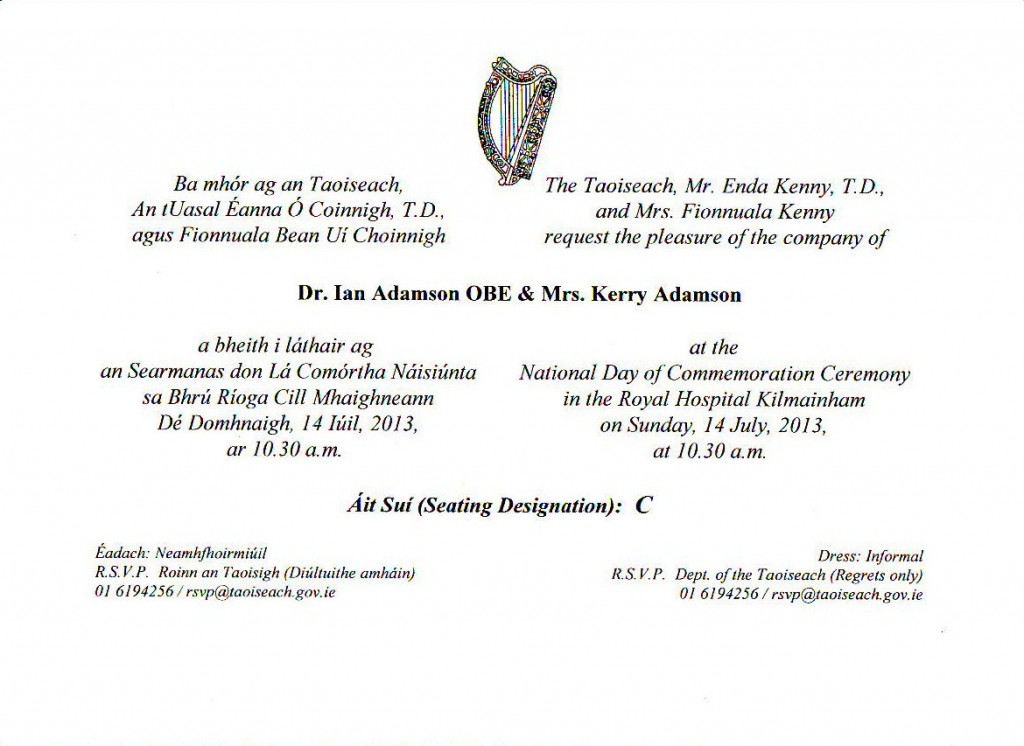
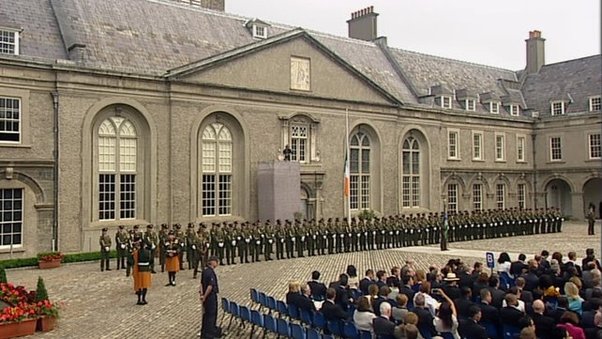
I was honoured to represent Belfast at the National Day of Commemoration in Dublin today.

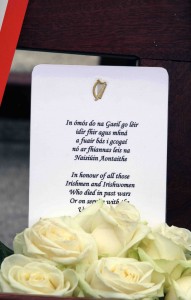
With representatives from across Ireland, it was an occasion which combined respect for the dead – “in honour of all those Irishmen and Irishwomen who died in past wars or on service with the United Nations” – with reconciliation among the living. 

And that spirit of peacemaking (among the guests were many unionist representatives including Ulster Unionist leader Mike Nesbitt and Ian Adamson, former Lord Mayor of Belfast) extended far beyond this island. 

Particularly poignant were the contributions from the main faiths in Ireland. We had prayers from the Muslim and Jewish communities as well as from the Christian congregations. I was especially taken by the Prayer of Intercession from the Rev Heather Morris, head of the Methodist Church in Ireland, which included this sentiment: “Grant us your grace, strength and courage that we might build peace in this generation.” 

And those traits are surely needed as we deal with the aftermath of a testing Twelfth.  It’s my hope that the second night of violence in North Belfast will be the last and that those Orange Order members opposed to the rulings of the Parades Commission will avoid actions which increase tension and exacerbate division. 

Over the Twelfth, we had around 550 parades. Only two were marred by violence. 

And I believe that with dialogue, we can reduce that figure to zero.

For those who doubt that fact, I would urge them to see the glass half-full. A decade ago, Derry was wrecked with violence on the Twelfth. This year the city hosted one of the biggest and most successful Orange parades. The starting point in that transformation was, of course, dialogue. 

Despite this week’s setback in Belfast, people of goodwill should ensure that dialogue between the Loyal Orders and residents groups continues. 

If that’s a bold ambition, it’s one shared by the Rev Rob Craig, Moderator of the Presbyterian Church in Ireland, who used these words at the Kilmainham gathering: “Are we bold enough Lord, to ask for your healing, for these people, for this nation, for all nations, for our world today.” 

All my attention wasn’t only on the home front this week though. On Tuesday, I made a 24-hour trip to Milan, to pick up a major award to mark Belfast’s hosting of the Giro d’Italia next May and to meet the city’s esteemed Mayor Giuliano Pisapia. You can read more about that visit here

Stay in touch at my website www.newbelfast.com.


Irish President Michael D Higgins reviews the Guard today at the National Day of Commemoration,, Dublin.

Photo: Irish President Michael D Higgins reviews the Guard today at the National Day of Commemoration,, Dublin.

r.gif
bl.gif b.gif br.gif
Posted in Article | Comments Off on National Day of Commemoration, Dublin

Annual Wreath Laying Ceremony at Islandbridge

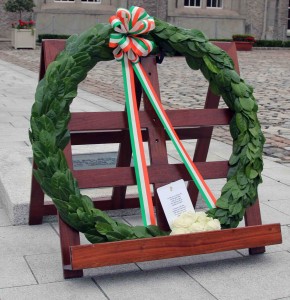
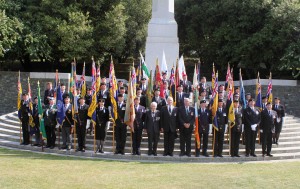
Today I attended, on the invitation of John Kennedy, the Annual Wreath Laying Ceremony at Islandbridge, hosted by the Royal British Legion Ireland on the Saturday nearest July 11th, prior to Ireland’s National Day of Commemoration.

The ceremony was open to the public.

Ceremony

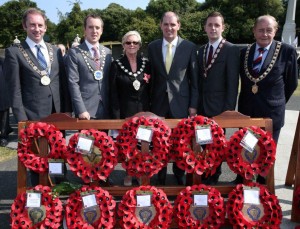
Minister of State at D/Taoiseach, Mr Paul Kehoe TD with participating Mayors at WW1 commemoration

The Islandbridge memorial garden has a fascinating history: Following a meeting of over one hundred representatives from all parts of Ireland, held in Dublin on 17th July 1919, it was agreed that there should be a permanent Memorial to commemorate all those Irish men and women killed in the First World War and a Memorial Committee was appointed to raise funds to further this aim.

A number of schemes were suggested including a Memorial centre-piece in Merrion Square but all were found to be impractical or inconsistent with legal obligations.

The matter had arrived at an impasse, until, in 1929, the Irish Government suggested that a memorial Park be laid out on a site known as Longmeadows on the banks of the Liffey.

The scheme embodied the idea of a public park, to be laid out at Government expense, which would include a Garden of Remembrance and War Memorial to be paid for from the funds of the Memorial Committee.

Construction of the linear parkway, about 60 hectares in extent stretching from Islandbridge to Chapelizod, began in 1931 and took about two years to complete. The Memorial Gardens were laid out between 1933 and 1939. The workforce for the project was formed of fifty percent of ex-British Army servicemen and fifty percent of ex-servicemen from the Irish National Army.

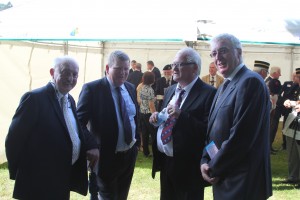
Myself, George McCullough, Philip Orr and John Green at Islandbridge


Posted in Article | Comments Off on Annual Wreath Laying Ceremony at Islandbridge

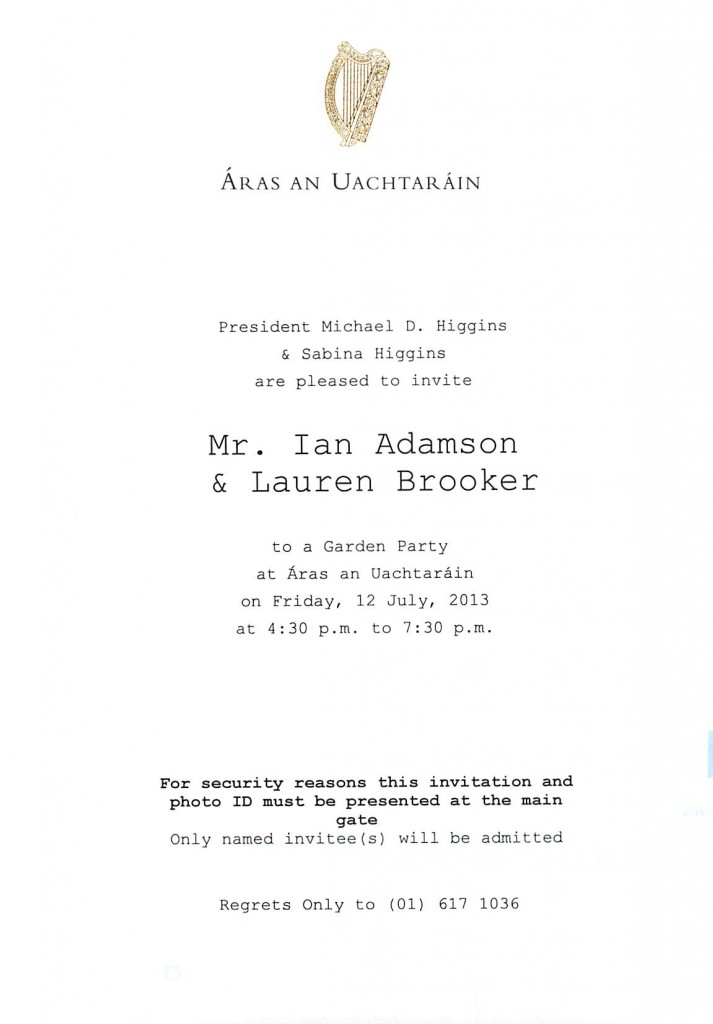
Garden Party at Aras an Uachtarain


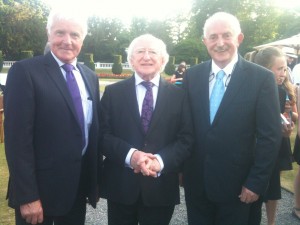
Jim Devenney (Ullans Academy), the President and myself

Posted in Article | Comments Off on Garden Party at Aras an Uachtarain