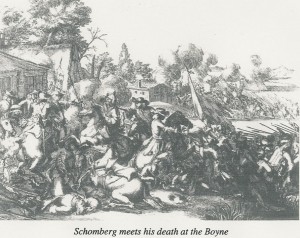
Frederick Hermann Schomberg, Marshal of France.

Frederick Hermann Schomberg was born at Heidelberg of a German father and English mother in the year 1615.  He became a Captain in the Scottish Guards of the French Army in 1652 and fought at the Battle of the Dunnes in 1658.  So great a soldier was he that although a Protestant he obtained a Marshal’s Baton in 1675.  The anti-Protestant legislation forced by Louis XIV of France in 1685 however, suppressed all the privileges granted by Henry IV and Louis XII to the Huguenots, inhibited the exercise of the Protestant religion, enjoined the banishment of all its ministers in fifteen days, held out rewards for converts, and prohibited keeping schools or bringing up children, in any but the Roman Catholic religion.  Dragoons were sent into Languedoc, Dauphiné, and Provence to enforce the Revocation of the Edict of Nantes, and it has been estimated that some half million Huguenots left France as a result.  They migrated mostly to the British Isles, Holland and Germany and brought with them their arts, industry and resentment.

Marshal Schomberg and the Marquis of Ruvigny, the hereditary leader of the French Protestants, signed a “Humble Petition on behalf of the Protestants of France” which they presented to Louis XIV.  Like Schomberg, Ruvigny was an eminent soldier who had served as French ambassador to England in the 1670s.  He eventually took refuge there in 1686 and lived at Greenwich until his death in 1689.

The petition stated that in the past few years Protestants had been refused admission to public office, and had also been dismissed from positions of authority in which they had served with honour and fidelity.  Within ten years at least 300 Protestant churches had been demolished.  Protestant children were often taken away from their homes.  They were only allowed one schoolmaster in each town, even when there were more than 200 children in the school.  As a result, Protestants had been forced to leave their homes and seek refuge abroad.  The petitioners suggested that the king had been distracted by war, and as a result, through neglect, the persecution of the Protestants had increased.  They pleaded for a return to the observance of the Edict of Nantes.  When this plea went unheeded, Schomberg retired to Portugal and initially settled at Brandenburg. 

On 5th November 1688, however, he landed at Torbay in England as second in command of the Williamite army.  In Ireland he led the Huguenot refugee cavalry regiment known as Schomberg’s French Horse, and commanded the Royal forces at the fateful Battle of the Boyne.

Schomberg had landed 10,000 men at Bangor (in County Down) on 13th August, 1689, and William and Mary had just been proclaimed in Belfast, through which James’s troops had recently marched.  This town became winter quarters in 1689 for the army which had been at Dundalk on duty.  Thomas Pottinger, the Governor, asserts that, at his own expense, he furnished a hospital and storehouse for the men  on their return to winter quarters, and here the sick were attended to during the early months of 1690, and prepared for the deadly conflict in which they were soon to be engaged on the banks of the Boyne.  The mortality of this GREAT hospital, as it is termed, is almost incredible. Dr Lawrence was dispatched from the camp to take charge of the sick, of whom, from November 1st, 1689, till May 1st, 1690, 3762 men died.  The townspeople seem also to have suffered greatly.  Ten or a dozen funerals of the residents passed through the streets in little more than an hour; yet at this time the town was only a cluster of thatched cabins.

Among those who accompanied Schomberg were Louis Chevalleau de Boisragon, Chevalier de la Chenaye whom he commissioned at Lisburn on 18th March 1689 and who traditionally served as a Cornet in Schomberg’s Horse, as a Lieutenant and according to family tradition as an Aide-de-Camp at the Battle of the Boyne.  Another close Huguenot friend who is also said to have acted as Aide-de-Camp to Schomberg was Major Henry Foubert.  Major Foubert was the son of Solomon Foubert, who ran the Royal Riding Academy in the Faubourg St Germain, Paris.  On 20th January 1679, however an Edict of Council had been passed against the Protestant Masters of the Academies in France.  Solomon Foubert left Paris as a result and settled in London where he established a similar institution in Sherwood Street, Piccadilly, which helped fill a major gap in English education.  Major Foubert entered the army in 1685.

On 1st July (11th July in modern calendars, but celebrated on 12th July) the two great armies of William and James met at the River Boyne where William defeated James’s troops. Schomberg’s son Meinhard, who had also served under the French and the Elector of Brandenberg, commanded the right wing of the Williamite forces.  At a moment when William’s troops were very hard pressed, however, and almost overpowered, Schomberg, who kept a strong body around him to act as an emergency including Major Foubert and Louis Chevalleau de Boisragon, dashed into the midst of the fight and turned the fortune of the day.  Sadly, however, he himself was hurried away amidst a party of James’s horse in full flight, and was killed by a discharge from his own men, who were not aware of his entanglement with the fugitives.  Riding to his aid Major Faubert dismounted to assist the great General when he had been fatally wounded and was himself badly wounded in the arm.  For his bravery he was promoted to the rank of Major and on his fathers death in 1696 he took over the management of the French Academy in London which was to have such an important effect on British civilisation.

Another who had followed Schomberg throughout Holland, England and Ireland was Jacques Abbadie.  Abbadie’s life is a good illustration of the wanderings of the Huguenot refugees after they left France.  Born near Pau, Béarn about 1654, Abbadie gained a Doctorate of Divinity at Sedan University and then went to Berlin where he was a minister for most of the 1680s.  Following the Battle of the Boyne he returned to London and became minister at the Savoy church.  This post he held when he wrote in praise of Queen Mary II, wife of William of Orange, who was a woman of outstandingly charitable disposition and a warm friend to the Huguenot refugees.  This work, together with his “Defence of the British Nation” won him the regard of William III and in 1699 he became Dean of Killaloe in Ireland.  He died in Marleybone, London in 1727.

Seldom have we seen such people since as the followers and friends of Frederick Hermann Schomberg, Marshal of France.

Posted in Article | Comments Off on Frederick Hermann Schomberg, Marshal of France.

Somme Memories 3

Special branch for Somme man

A fine sycamore towers in the front garden of a small house in the Donegal village of Gortahork.

People can’t remember a time when it wasn’t there.

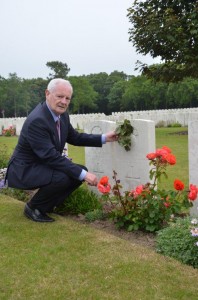
Before he travelled to France last weekend for the Battle of the Somme commemorations, Minister for the Gaeltacht Dinny McGinley heard the poignant story of this stately tree. Dinny was visiting his old friend Paddy McGowan (right), who told him about his uncle who left Gortahork in 1914 to join the British army. On the morning before he departed, 18-year-old John McGowan planted a sycamore sapling as a reminder to his family to keep him in their thoughts.

The young Donegal man was first sent to the Dardanelles, where he sustained a hand injury. After recuperating, he was transferred to the Somme, never to return home.

But the tree he planted now soars above the garden, 99 years after he planted it.

When Dinny told Paddy he would be representing the Government at the commemorations, his friend asked him to try and locate Uncle John’s final resting place. “Will you take a branch of the tree with you, and if you find him will you place it on his grave?”

Dinny was happy to oblige. Which is how it came to pass that the Minister of State travelled to France accompanied by the special branch.

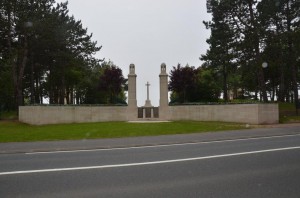
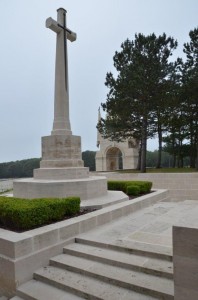
Last Sunday, in the company of Niall Leinster of the Somme Association, Dinny travelled north to Étaples Military Cemetery in Pas de Calais. There, after a little searching, they found the grave of “5169 Private J McGowan, Royal Munster Fusilier”. He died on August 2nd, 1916. Dinny described the emotional moment when he stood at the headstone.

“I said: ‘Hello John, I bring you greetings from your nephew Paddy, who is now 90 years of age. Even though he never knew you, he has fond memories of you through all the stories he heard down through the years. They never forgot you. Paddy told me to be sure and tell you that the tree you planted the morning before you left is in full bloom and covers more than half the garden. It’s one of the finest trees in all of Gortahork and the surrounding area. And I’m falling down on my two knees now and bringing you a branch of your own sycamore tree’.”

Then Dinny said a silent prayer and laid it by the headstone – John McGowan’s final bough. And he left the grave of Paddy’s uncle from Gortahork with these parting words: “Codladh sámh i measc na laoch go raibh agat a John.” (Sleep peacefully among the warriors, John)

THE IRISH TIMES

Miriam Lord

Saturday, 6 July, 2013.

Posted in Article | Comments Off on Somme Memories 3

All Party Parliamentary War Heritage Group

ALL PARTY PARLIAMENTARY WAR HERITAGE GROUP

MONDAY 8 JULY 2013      6.00 pm COMMITTEE ROOM 4

(MAIN COMMITTEE CORRIDOR)   HOUSE OF LORDS 

Minutes of the Meeting 

Apologies for absence:  

Lord Boswell,

Lord Eden,

Julian Lewis MP,

Ann McGuire MP,

Madeleine Moon MP,

Baroness Royall


Present: 

Lord Faulkner of Worcester (Chairman),

Lord Cope,

Jeffrey Donaldson MP,

Baroness Golding,

Lord Roper,

Lord Clark of Windermere,

Graham Evans MP,

Rob Flello MP,

Lord Watson,

Peter Doyle (Secretary)


In attendance: 

Frank Baldwin (Battlefields Trust),

Nathan Bennett (representing Ann Clwyd MP),

Peter Burley (Battlefields Trust),

Tony Cowan (BCMH), Lt Col.

Kingsley Donaldson (NI 100 Committee),

Hugh Hamilton (University Military Education Committee),

Colin Kerr (CWGC),

Maj-Gen. (retd) Mungo Melvin (BCMH),

Brig. (retd) T.N. O’Brien, Tony Smith (GBG),

David Tattersfield (WFA),

Colin Wagstaff (WFA),

Harvey Watson (Battlefields Trust),

Liz Woodfield (CWGC),

 Lord Faulkner opened the meeting by welcoming Mr Colin Kerr, the Finance

Director at the Commonwealth War Graves Commission (CWGC), and Ms Liz

Woodfield, Head of Information Systems at the CWGC, and to invite them to talk

about the activities of the CWGC in the coming centenary years of the Great War

(2014–2018). 

The CWGC and the Commemoration of the Great War Centenary: Mr Colin

Kerr and Ms Liz Woodfield (Commonweath War Graves Commission)

Mr Kerr opened the presentation. He explained that his talk would fall into four

sections, first discussing the large events that the CWGC would be involved with, and

the approaches taken by the Commission; secondly how to promote the work of the

CWGC during this period; thirdly, to talk about how success will be measured; and,

finally, to talk about UK, and what MPs could do to connect with local war graves in

their constituencies. 

The CWGC role is to look after Commonwealth war dead from both world

wars. The majority of the graves are from the First World War, some 60% of the total,

with 40% coming from the Second World War. The Commission also looks after

other graves, such as those from the Boer War in South Africa. 

Turning to the major events of Commemoration in 2014–2018, Mr Kerr

explained that this was the ambit of the Government, with a programme of events that

will focus on Mons (1914), Gallipoli (1915), Somme (1916), Jutland (1916),

Passchendaele (1917) and 100 Days (1918). These will be matched with others from

the Commonwealth countries, with Gallipoli (1915) a focus for Australia, Messines

(1917) for New Zealand, with the sinking of the SS Mendi in 1917 being a focus for

South Africa. The CWGC is involved with all of these, and is a participant in a

number of subgroups that are examining the activities associated with these events,

which are under the direction of the Department of Culture, Media and Sport

(DCMS). 

Though the CWGC is not the originator of the events, the majority have a

focus on sites that are managed by the Commission; and in view of this the CWGC

have had an opportunity to influence debate over the commemorations. Important

examples of this were the suggestion by the Commission of the suitability of St

Symphorien Cemetery at Mons, a joint British and German site, and of sites in

Denmark where men from the Battle of Jutland are buried. At present, the CWGC is

working to suggest a suitable site for consideration of the 1918 Battle of 100 Days.

Mr Kerr went on to explain that there is another level of commemoration, an

informal one. Events are being planned by the various regimental associations, and

though it is difficult to judge how many people might attend, many of these will be at

CWGC sites. For the Commission, working with the associations is important in order

to help facilitate such events and make them memorable and appropriate. Events

associated with the Battle of the Somme in particular are likely to be large and

complex – and though the Thiepval Memorial is truly monumental in scale, there are

at least 100 other monuments across the Somme battlefield that could receive visitors.

Moving to the promotion of the commemorations, Mr Kerr explained that the

CWGC would be working to ensure that the iconic sites – such as Thiepval, the

Menin Gate, The Helles Memorial (Gallipoli) and the Doiran Memorial (Salonika) are

in perfect condition. In all thirty such sites have been identified as being ‘iconic’. In

addition, a total of 500 sites worldwide have been selected for special attention. At

these sites, there will be a focus on the history of what happened there – this is

important as the men who served are now all gone, with no one to explain them.

There will be information panels at sites as far afield as Tsingtao (now Qingdao,

China) to the Falkland Islands. The panels will include pictures of the actual events

that took place at the site, and explanations will be in local languages as well as

English. Each panel will also include a QR (Quick Response) code that will connect

smart phones with files that will have the words of men who served and who are

commemorated at each site, using letters held by the Imperial War Museum (IWM).

The CWGC is also responding to public demand to hear about ‘famous people’ buried

at each site, though this is not necessarily in tune with the principles of the

Commission. 

The CWGC will also be developing six ‘Remembrance Trails’, which will

connect sites and events. The first will be ‘Mons to the Marne’, focusing on 1914;

there will be the ‘forgotten fronts of 1915’ as well as a consideration of the British

efforts at Gallipoli, and a trail to mark the first day of the Battle of the Somme in

1916. There will be links to hospitals and the British base at Etaples, and there will be

sites in the United Kingdom – important as there are some 13,000 separate sites in the

UK. The CWGC will use Google technology to link the sites and provide

geographical coordinates. 

Mr Kerr went on to discuss how success will be measured by the CWGC

during the commemoration period. For him, success will be about people visiting

sites. He acknowledged that CWGC sites look beautiful but reflected that this cannot

be enough of a measure if people do not come. For example, at one site in Suez the

last visitor was four years ago. He asked what is success – more numbers going

through each site, re-engaging, and perhaps even shifting perceptions. Mr Kerr’s

focus is not the main sites that already receive many visitors, but the smaller and less

well visited sites, and those in more remote places, such as Macedonia.

Turning to the United Kingdom, Mr Kerr explained that it was important to reevaluate

decisions that had been made in the past in order to abandon some sites.

There are some 300,000 men buried in the UK; unfortunately some now lie under

developments and car parks, a result of decisions made in the 1960s. Today, the

CWGC is committed to reopening access to all of its sites across the UK, even if these

are components of large, derelict or overgrown municipal cemeteries. Mr Kerr assured

the Group that these sites would be regularly ‘strimmed’ for weeds, and that the

CWGC component would become an oasis in an otherwise abandoned site, with an

access pathway maintained. It is the view of the CWGC that wherever possible these

sites should maintained for visitors, with 80% of derelict sites opened to visitors. He

also explained that the CWGC had gained permission to use its characteristic green

CWGC signs to indicate the presence of war graves in local cemeteries in the UK.

Ms Woodfield went on to explain the intention of the CWGC to map each

headstone within the United Kingdom, so that each would be more easily found.

Many are scattered and difficult to locate. In view of this, each site will be digitally

mapped, and it is envisaged that the project will be able to place visitors to within 40

cm of a headstone. The CWGC has just commenced a three-month trial of the

technology, and it is hoped that within the next few years the coordinates will be

available for each site. She explained that it should be possible to map war graves to

parliamentary constituencies, though it is not an easy task as there is no suitable

software available. Notwithstanding this, the CWGC would be able to supply MPs

with digital maps based on the Ordnance Survey that will map out the constituency

and add the location of wargraves. It is probable also that spreadsheets will be

provided with the cemetery name and address, together with GPS coordinates and

locations. In addition to these data it will be possible to supply the number of CWGC

headstones in a given cemetery. Ms Woodfield explained that though the constituency

mapping will be easy, developing the spreadsheets would be more difficult.

Fortunately, there are dedicated volunteers, and it is hoped to have this material

available by October. 

Mr Kerr went on to explain that within the United Kingdom, there are only

two large CWGC sites, at Brookwood and Lyness (Orkney). In big cities there are

often large blocks of CWGC graves within municipal cemeteries, but there are

scattered graves too. He then went on to suggest a number of activities that local MPs

could get involved with. 

Mr Kerr suggested that a good place to start with be with the local war

memorials. These are already used by primary schools, and there is the opportunity to

work with the names on the memorial and link them to sites across the world, or even

at home, sites where these men and women are buried or commemorated. This would

provide great opportunities for a fuller understanding of the impact of the war, with

each headstone representing a microcosm of the war. In Mr Kerr’s view,

remembrance does not have to start and stop with ‘Poppy Day’; we should try and

reclaim the local CWGC sites. 

Lord Faulkner thanked Mr Kerr and Ms Woodfield for their illuminating

contributions, and opened up the meeting for discussion. 

Lord Clark thanked Mr Kerr and Ms Woodfield for their encouraging presentation.

Making reference to the Government’s decision to send two pupils from each school

to the Western Front, Lord Clark considered the effect on the majority who would not

go. In his view, they should be included in local initiatives, but the loss of some of the

soldiers’ records during the Second World War might be inhibiting to students

wishing to follow up local stories. In his view, the County Records might be a

valuable source of documents, and it might therefore be worthwhile to contact them.

Lord Clark also commented that it would be a big task to alert people to the existence

of isolated graves in village cemeteries. Mr Kerr thanked Lord Clark for his

comments. He agreed that the schools’ visits had some problems, and expressed

surprise that the Government had not suggested exploiting twinning mechanisms

between communities and schools in Europe. 

Lord Cope explained that he is a Trustee of the War Memorials Trust (WMT). In his

view, it would be important to include the location of local war memorials on the

proposed constituency maps for MPs. However, he recognised that there would be

some difficulties. There are some 100,000 war memorials, with c. 60,000 are on a list

of UK inventory run by IWM. Unfortunately, due to the age of this inventory, it is not

interactive. A separate list is starting to be compiled by English Heritage and the

WMT, but at present this only records a tiny fraction of the total, just 3000 memorials.

Despite this Lord Cope explained that he was sure the WMT would be happy to help

the CWGC in supplying information to MPs. 

Lord Faulkner considered the issue of constituency maps, and expressed the view

that he would be happy, on behalf of the All Party Group, to ensure that the

information compiled by the CWGC was distributed to MPs. Ms Woodfield was

grateful for the offer of assistance. Jeffery Donaldson MP agreed that distribution of

constituency-based information would be a valuable contribution. 

Baroness Golding explained that she had sat as a representative of Government on

the CWGC. She remembered that UK graves are often very difficult to locate, and this

represented a significant problem. Mr Kerr agreed that cemetery access was an

important issue, and reiterated that CWGC was committed to ‘blazing a path’ through

overgrown sites to the site of the CWGC graves. He also noted that abandoned sites

will receive a green CWGC directional sign, and that the proposed GPS coding will

guide the people there. Baroness Golding asked also about the status of German war

graves in UK. Mr Kerr and Ms Woodfield explained that there is a huge German

national war cemetery in Cannock, and that other graves could be scattered. Whereas

the CWGC did not formerly record data relating to foreign nationals in their

cemeteries, this is now changing, and their details would be available online. Ms

Woodfield added that in addition to this new information, from next year, each

individual will have additional information from the original Graves Registration

Service records added to that already available online. This will be done with some

sensitivity and it is hoped that the project will be available by June 2014.

Lord Watson expressed his interest in obscure sites, and asked whether some of these

will be the ones to be highlighted. Mr Kerr confirmed that of the 500 sites selected,

some indeed would be the less commonly visited. Details will be on the CWGC

website. Lord Watson asked if there were any German sites within Germany. Mr

Kerr indicated that there were many WW2 sites in Germany under the care of the

CWGC, and some cemeteries with WW1 prisoner of war deaths. 

Graham Evans MP was familiar with the work of the CWGC, and makes a point of

visiting cemeteries when he can. His concerns lie with the awareness of communities

and schools. In his view, MPs have an important role here, and he recommends that

information should be provided that makes it easy for MPs to promote such

awareness. In his experience, there are local authority officers who are responsible for

memorials, and it is often valuable for MPs to connect with these authorities to share

information, especially as authorities could raise the awareness. Mr Evans was happy

to help promote sites to the 650 MPs. Lord Faulkner expressed his gratitude for the

offer of help. 

Jeffrey Donaldson MP took the chair, as there was a division in the Lords. He

invited the attendees to join the discussion. 

Frank Baldwin (Battlefields Trust) was concerned with getting people over to the

battlefield. He explained that the Heritage Lottery Fund has set up a fund to get

people over to the sites, but that this is not well known. Jeffrey Donaldson MP

thanked him for the information, which he would seek to include in the information to

be distributed to MPs. 

Major-General Mungo Melvin (BCMH) noted that some sites on the Western front

were still largely unvisited. In his view, there is a danger of being too narrowly

focussed in the commemoration of some events, and was happy to note that Scotland

and Ireland would have a focus on Loos (1915) and Messines (1917) respectively. He

was grateful, however, that the pivotal 100 Days battles of 1918 were included. Mr

Kerr agreed that some battles had a narrowly focussed public perception, with

interest in the Somme (1916) seemingly centred on its first day. 

Hugh Hamilton (Military Education Committee) suggested that smartphones store

geographical coordinates, and that volunteers’ gravesites would include site

orientation photo data using smartphones for example. Ms Woodfield was grateful

for the suggestion.


David Tattersfield (WFA) pledged the support of the 6,000 strong membership of

the Western Front Association in helping to propagate the CWGC’s work and

initiatives. Mr Kerr thanked Mr Tattersfield for his support. 

Lt-Colonel Kingsley Donaldson (NI 100 Committee) explained that he had

encountered a significant number of people who would be interested in volunteering

to assist with the commemorative events, but that they were unsure where to go. Mr

Kerr was aware that the concept of public volunteers, so successful during the

Olympics, was an important one. He noted that nearer the date, volunteers would be

needed, and that a database should be developed. 

Lord Faulkner, returning from the division, took the Chair and thanked Mr Kerr and

Ms Downfield for their interesting and though-provoking contributions. With no

further business he closed the meeting. 

The All Party Parliamentary War Heritage Group exists to promote and support the protection, conservation and interpretation of war graves, war memorials and battlefield sites. 

Chairman:         Lord Faulkner of Worcester

Vice-chairs:       Lord Cope, Nigel Dodds MP, Lord Roper, Baroness Golding,

Treasurer:          Jeffrey Donaldson MP
Posted in Article | Comments Off on All Party Parliamentary War Heritage Group

Andy Murray wins Wimbledon

Andy Murray won his first Wimbledon title and ended Britain’s 77-year wait for a men’s champion with a hard-fought victory over world number one Novak Djokovic.

The Scot, 26, converted his fourth championship point in a dramatic final game to win 6-4 7-5 6-4 and claim his second major title.

In an atmosphere reminiscent of his Olympic final win last summer, Murray was willed on by the majority of the 15,000 spectators on Centre Court, thousands watching on the nearby big screen and millions more around the country.

  • Wimbledon is Murray’s second Grand Slam title after he won the 2012 US Open
  • It is the 36th time a British man has won the Wimbledon singles title – more than any other nation
  • Fred Perry was the last British man to win Wimbledon, completing a hat-trick of wins in 1936
  • Harold Mahony was the only other Scotsman to win the Wimbledon singles title – in 1896
  • Murray is the most successful British man in terms of Grand Slam match wins with 113, ahead of Fred Perry on 106
  • Fred Perry won eight Grand Slam titles – three Wimbledons, three French Opens, one US Open and one Australian Open
  • Murray has reached seven Grand Slam finals, behind Fred Perry on 10


The final game was a battle in itself, with Murray seeing three match points slip by from 40-0 and fending off three Djokovic break points with some fearless hitting, before the Serb netted a backhand to end the contest.

After a gruelling three hours 10 minutes in searing temperatures, Murray had finally followed in the footsteps of Fred Perry’s 1936 win at the All England Club.

Perry used to leap over the net in celebration, but Britain’s new champion roared in delight before sinking to his knees on the turf.

Murray, who collected a first prize of £1.6m, then headed into the stands to celebrate with his family and support team, moments later parading the trophy around Centre Court.

Posted in Article | Comments Off on Andy Murray wins Wimbledon

Edmund and Kathleen’s Golden Wedding Anniversary Party

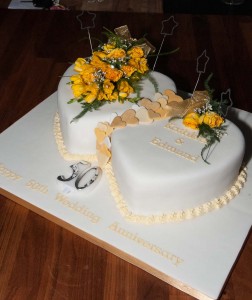
This was the 50th Wedding Anniversary Party of my oldest friends, Edmund (Big Ed) and Kathleen Irvine of Conlig, organised by Sonia, Megan and Edmund (Eddie)…

Posted in Article | Comments Off on Edmund and Kathleen’s Golden Wedding Anniversary Party

William Sloan–Behold a Son of Ulster marching towards the Somme 2

Helen’s Tower at Clandeboye contains a beautiful room in which are inscribed poems by Lady Helen Dufferin, Lord Alfred Tennyson and Rudyard Kipling, amongst others.

Tennyson’s reads:

 Helen’s Tower here I stand,

Dominant over sea and land.

Son’s love built me, and I hold

Mother’s love in letter’d gold.

Love is in and out of time,

I am mortal stone and lime.

Would my granite girth were strong

As either love, to last as long

I would wear my crown entire

To and thro’ the Doomsday fire,

And be found of angel eyes

In earth’s recurring Paradise. 


This poem is replicated in the Ulster Tower at Thiepval, only slightly altered to make it a fitting tribute to the Sons of Ulster and their comrades–in–arms, who fought and died in the First World War:

Helen’s Tower here I stand

Dominant over sea and land

Son’s love built me,and I hold

Ulster’s love in letter’d gold. 

The Somme Association has therefore through its “Battlelines” publication emphasised the literary attributes of those who fought and died in the First World War.  Amongst these were Professor Thomas Michael Kettle, Lieutenant of the 9th Battalion Royal Dublin Fusiliers, who died in September 1916 in the second phase of the Battle of the Somme, and Francis Ledwidge, who was killed in action in Flanders on 31st July 1917.  These two poets were specially remembered at our services that year.  Captain Lord Dunsany wrote “I gave my opinion that if Ledwidge had lived, this lover of all seasons in which the blackbird sings would have surpassed even Burns, and Ireland would lawfully have claimed, as she may do even yet, the greatest of the peasant singers”. 

But in September of that year we also remembered J R R Tolkien and his two groups of friends in the TSBS (Tea Club and Barrovian Society) and the Inklings, the latter of which included CS Lewis, from Belfast.  J R R Tolkien never forgot what he called the “animal horror of trench warfare”.  The sights which he experienced at the Somme, the images, sounds and the people he met stayed with him until his death in 1973.   But from that horror came the inspiration of his great works including “The Lord of the Rings”.  During the war J R R Tolkien enlisted in the 11th Lancashire Fusiliers as a Second Lieutenant.  Late on Sunday June 4th 1916 he set off for London and on to France where he was present at the Battle of the Somme. 

Tolkien’s Battalion disembarked in Amiens, the capital of the Somme area, and marched to a hamlet called Rubempré ten miles away.  Here they were billetted in those conditions of the Western Front to which they would soon become accustomed.  On Friday 30th June they moved near to the front line.  The great attack began early the next morning but the men of Tolkien’s Battalion were held in reserve.  They were to go into battle several days later when it was planned that the German line would have been smashed open and the allied troops would have penetrated deep into enemy territory. 

At 7.30 a.m. however on Saturday 1st July the troops of the British front line including of course the famous 36th (Ulster) Division went over the top, the latter from Thiepval Wood.  On the right flank were the 15th (Service Battalion) of the Lancashire Fusiliers, The 1st Salford Pals, known as”Gods Own”.  To the south were Tolkien’s friends Rob Gilson of the 3rd  Salford Pals, the 19th  (Service) Battalion of the Lancashire Fusiliers and at La Boisselle, Rob Gilson of the 11th  Suffolks. 

Soon the awful truth dawned that on the first day of battle 20,000 allied troops had been killed.  The 36th Ulster Division had suffered 5,500 casualties, the 1st Salford Pals had been almost completely wiped out, apart from those who joined the remnants of the 36th Ulster Division on the right flank, and Rob Gilson had been killed at La Boisselle, where the great mine had gone off in No Man’s Land.  Only the heroic Ulstermen had been able to penetrate the German lines, which generally had remained intact. 

On Thursday July 6th, the 11th Lancashire Fusiliers went into action, but only “A” Company was sent to the trenches and Tolkien remained at Bouzincourt with the remainder.  Finally on Friday 14th July “B” Company went into action.  Tolkien’s first day in action had been chosen by the allied commanders for a major offensive and his company was attached to the 7th Infantry Brigade for an attack on the ruined hamlet of Ovillers which was in German hands. 

The attack was unsuccessful and many of Tolkien’s Battalion were killed around him by machine gun fire.  Rob Gilson however of the 3rd Salford Pals had survived.  Day followed day in the same pattern; a rest period, back to the trenches, and  more attacks.  Tolkien was among those who were in the support at the storming of the Schwaben Redoubt, a massive fortification of German trenches, upon which Northern Ireland’s National War Memorial – the Ulster Tower – now stands. 

Sadly his other friend Geoffrey Bache Smith died at 3.00 on the morning of 3rd December 1916 , at Warlincourt, having been hit by fragments of a German shell which had been fired from 4 miles away in the dying days of the Somme. British losses continued to be severe and many more of Tolkien’s Battalion were killed.  On October 27th 1916 he was rescued from the Battle by pyrexia of unknown origin or as the soldiers simply called it “Trench Fever”, a highly infectious disease carried by lice.  By November 8th he remained ill and was put on a ship back to England. 

CS Lewis arrived at the front line trenches on his 19th birthday , 29th November 1917.  Lewis was also to suffer from trench fever at the beginning of February 1918.  He returned to the front on 28th February. The Germans launched their great Spring offensive on 21st March, utilising all the additional troops which had been withdrawn from the eastern front following the Russian Revolution.  During the first Battle of Arras from 21st to 28th March 1918, Lewis was in or near the front line and next saw action in the Battle of Hazebrouck from 12th till 15th April, when he was wounded by a British shell exploding behind him. The Medical Board described Lewis’ wounds thus “shell fragments caused three wounds in the left side of his chest, his left wrist and left leg” and on 25th May 1918 he arrived by stretcher in London. 

 The experiences of the First World War which drew Tolkien and Lewis together in Oxford to form that legendary friendship which culminated in the development of the group known as the Inklings when Lewis became in essence a replacement for both Gilson and Smith.  The first story which Tolkien put in paper was written during his convalescence in Great Haywood early in 1917.  This is the” Fall of Gondolin”, which deals with the assault of the last elvish stronghold by Morgoth, the prime power of evil and these are the elves who form the basis of the Silmarillion in the Lord of the Rings.  Discussing one of the principal characters in the Lord of the Rings, Tolkien wrote many years later “my Sam Gamgee is indeed is a reflection of the English soldier, of the privates and batmen I knew in the 1914 war and recognised as so far superior to myself.” 

And so although the Great War had ended over 90 years ago we have been left in the great works of Tolkien and Lewis that atmosphere of pre-battle tension and watchfulness, the plunge from peace to terrifying peril , the mass movement of thousands of men, the wonderful courage of ordinary people, and of love and comradeship, the battlefield now dominated by great machines and the air swept by airborne killers without ruth or pity . 

 On Monday 3rd November Dr Paisley, the Baroness and I went to see the story of the Salford Pals and the Irish regiments in the Imperial War Museum North in Manchester. Many are buried with their Ulster comrades in the Connaught Cemetery at Thiepval Wood. The Duke of Wellington described the Lancashire Fusiliers as the best and most distinguished of English regiments, just as he said the 27th of Foot (Inniskilling Fusiliers) had saved the centre of his line at Waterloo. 

 My grandfather Samuel fought with the Lancashire Fusiliers at Spion Kop in the Boer War. My great–grandfather Samuel met my great-grandmother Roseanne Gamble when he was stationed with them at Clandeboye and took her back to Bolton. Like the Inniskillings they dated back to the landing of William of Orange in England in1688. In the Seven Years War they had shattered the charge of the supposedly invincible French Cavalry at Minden. Their allies then were the Germans. It all goes to show how quickly things can change. 

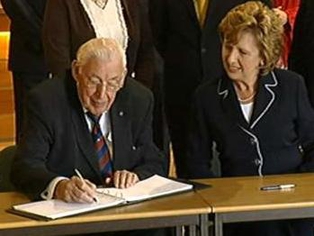
On Monday 10th September, 2007, at the Somme Heritage Centre, Dr Paisley as First Minister of Northern Ireland and the head of state of the Irish Republic, President Mary McAleese, shook hands for the first time – another symbolic milestone on Ireland’s road to reconciliation. As Dr Paisley’s Personal Physician and Advisor on History and Culture,  this gave me the greatest of pleasure, as it was the culmination of  my vow to my relatives that the deaths of William and his comrades would  not be in vain.

 On the occasion President Mc Aleese said:” It is an honour to be here at the opening of this exhibition commemorating the Battles of Guillemont and Ginchy, part of the heroic struggle of the Battle of the Somme fought over ninety years ago. Congratulations to Dr Ian Adamson, Carol Walker and all the members of the Somme Association for this labour of love which allows the stories of those who fought and died to be honoured and respected and better known by a new generation.

The meeting also led directly to the visit of Her Majesty The Queen to Islandbridge, Dublin on Wednesday 18th May, 2011. President Mc Aleese  further honoured us by presenting me , on behalf of our Association, to The Queen. I knew William would have been pleased.

Ian Paisley & Mary McAleese - Attending Somme function
 
Posted in Article | Comments Off on William Sloan–Behold a Son of Ulster marching towards the Somme 2

William Sloan-Behold a Son of Ulster marching towards the Somme 1

William Sloan was born in Newtownards, County Down, Ireland. He was the only  son of Anthony and Lizzie Sloan ( McCreedy) who lived in Roseneath Cottage, Main Street, Conlig, Co Down, near my father’s shop, at the corner of  the Tower Road. This  leads past Clandeboye Golf Club to Helen’s Tower .

The couple were married on 24th  August,1896  in Ballygilbert Presbyterian Church. Anthony, who worked as a general labourer, was the brother of my two grannies Martha and Isabella Sloan. He had two children William and Lillah..

William enlisted at Clandeboye, without his parent’s permission, and, like other young men from Conlig , came home already wearing his uniform. He served with the 11th Battalion Royal Irish Rifles in 108 Battalion of the 36th (Ulster) Division and he was killed in action on the first day of the Battle of the Somme (1st July,1916) aged only 19 years.

Initially William was posted as missing in action but his mother Lizzie never accepted that he was dead. Until the day she died on 24 January 1932 the front door of the cottage was left unlocked, day and night, just in case William came home. He has  no known grave and is commemorated in Conlig Presbyterian Church and on the Thiepval Memorial , France (Pier and face15A and 15B).

But the story does not end there. I delivered daily newspapers to his sister Lillah Hamilton in Roseneath Cottage as a boy. Lillah talked often of her brother and thought that I reminded her of him, for we looked alike and, of course, he was the cousin of both my grannies. And that is why I formed the Somme Association in 1990.

This grew essentially from a press conference held under the auspices of the then Lord Mayor Sammy Wilson and Lady Mayoress Rhonda Paisley on the 70th Anniversary of the Battle of the Somme, 1st July,1986, when a Somme Commemoration Committee was initiated.

Having grown up in sight of Helen’s Tower at Clandeboye, where the Belfast Brigade of the 36th Ulster Division had trained, and on which the Ulster Memorial Tower at Thiepval had been modelled, I proposed that museum complexes close to both towers could be built, that Thiepval Wood could be purchased and that Helen’s Tower could be opened up to the public under the auspices of the Dufferin family.

Dr Paisley explained his own position as a European MP and emphasised that this was a project to honour everyone who had fought at the Somme, both Unionist and  Nationalist, Catholic and Protestant. He would help the project to achieve its aims through the good offices of the European Parliament, the French Embassy and the Commonwealth War Graves Commission.

Dr Ian Paisley and myself at the Ulster Tower, Friday,12th September,1986.

And so, on 1st July, 1989, the Ulster Memorial Tower at Thiepval in France, the second Helen’s Tower, built by public subscription and completed in 1922, was re-dedicated under the auspices of our Farset Somme Project by HRH Princess Alice, Duchess of Gloucester. Hundreds of pilgrims from Ulster made the journey, among them veterans of the 36th (Ulster) Division and public representatives from throughout Northern Ireland.

We were delighted that HRH continued to be associated with our work by consenting to become the first  President of The Somme Association. On her death on 29th October, 2004, we were further privileged that her son Prince Richard would follow her in this role.

As founding Chairman of this Association, I have travelled to France and Belgium every year since to remember the ordinary soldiers from throughout Ireland who fought and died there. Prince Richard, Duke of Gloucester, has accompanied us many times, officiating at our ceremonies of Remembrance in both France and Gallipoli, and meeting with President Mary McAleese in Turkey. He also opened the Somme Heritage Centre at Whitespots, Conlig in 1994.

In commemorating the 90th anniversary of the end of the First World War in 2008, I was especially privileged to attend three Services of Remembrance in Belgium and France.  The first was on Sunday 29th June at Wytschaete 16th Irish Division Memorial in Belgium attended by my friends Rev. Dr Ian and Baroness Eileen Paisley.  Dr Paisley laid a wreath at the grave of Major Willie Redmond at Locre.  On Tuesday 1st July we attended the British and French Service at Thiepval Memorial led by the then Secretary of State, the Right Honourable Sean Woodward.

As Chairman of the Somme Association I then officiated at the Ulster Tower Service in memory of the 36th Ulster Division and their comrades in arms who had fought there at the Battle of the Somme.  On Sunday 7th September, 2008 the Association held a further service of remembrance at the 16th Irish Division Memorial at Guillemont in honour of the men who fought in that month at the Battles of Guillemont and Ginchy.  This service was attended by the Mayor of Derry, and dignitaries from throughout Northern Ireland.


Posted in Article | Comments Off on William Sloan-Behold a Son of Ulster marching towards the Somme 1

The 4th of July

For me American Idependence Day should make us reflect on the American Civil War which was a direct result of the War of Independence, on the retention of British North America, which became Canada, that model of modern Democracy, the destruction of the Indian Nations, and especially the Mohawks, the most loyal citizens of the Crown, who were driven from New York in thousands…But also the reunion of American and Canadian soldiers in both World Wars, who bought us our Freedom.
And today a book is launched to celebrate the life and work of that other First World War hero, Clive Staples Lewis, one of greatest Sons of Ulster who marched towards the Somme.


Posted in Article | Comments Off on The 4th of July

Thiepval Memorial


Casualty Record Detail

Each year on 1 July, the Thiepval Memorial becomes the focus of the beginning of the day’s commemorations to mark the opening of the Battle of the Somme. 

Designed by Sir Edwin Lutyens and built between 1928 and 1932, the panels on the memorial commemorate the names of the 72,000 Commonwealth servicemen who were killed between July and November 1916.

An archive photo shows the unveiling of the Thiepval Memorial on 1 August 1932.  Originally scheduled for 16 May 1932, the unveiling was postponed due to the death of French President Paul Doumer.

Country:France
Locality:Somme
Identified Casualties:72203
 

Location Information

The Thiepval Memorial will be found on the D73, next to the village of Thiepval, off the main Bapaume to Albert road (D929).

Each year we attend a major ceremony  held at the memorial on 1 July.

Visiting Information

From 8th July to the beginning of August Renovation work will be carried out at Thiepval Memorial by a company specializing in work at height (Alpine specialists) They will carry out a Biocidal wash and general repairs to the external fabric of the memorial. Major renovation works will start this summer 2013. Panels replacement will be commence this autumn.

The Panel numbers (or Pier and Face) quoted at the end of each entry relate to the panels dedicated to the Regiment served with. In some instances where a casualty is recorded as attached to another Regiment, his name may alternatively appear within their Regimental Panel (or Pier and Face). Please refer to the on-site Memorial Register Introduction to determine the alternative panel numbers (or Pier and Face) if you do not find the name within the quoted Panels (or Pier and Face). 

Historical Information

On 1 July 1916, supported by a French attack to the south, thirteen divisions of Commonwealth forces launched an offensive on a line from north of Gommecourt to Maricourt. Despite a preliminary bombardment lasting seven days, the German defences were barely touched and the attack met unexpectedly fierce resistance. Losses were catastrophic and with only minimal advances on the southern flank, apart from the advance of the 36th (Ulster) Division the initial attack was a failure. In the following weeks, huge resources of manpower and equipment were deployed in an attempt to exploit the modest successes of the first day. However, the German Army resisted tenaciously and repeated attacks and counter attacks meant a major battle for every village, copse and farmhouse gained. By the end of September, Guillemont and Guincy were captured by the 16th(Irish) Division and finally Thiepval.The village had been an original objective of 1 July. Attacks north and east continued throughout October and into November in increasingly difficult weather conditions. The Battle of the Somme finally ended on 18 November with the onset of winter.

In the spring of 1917, the German forces fell back to their newly prepared defences, the Hindenburg Line, and there were no further significant engagements in the Somme sector until the Germans mounted their major offensive in March 1918.

The Thiepval Memorial, the Memorial to the Missing of the Somme, bears the names of more than 72,000 officers and men of the United Kingdom and South African forces who died in the Somme sector before 20 March 1918 and have no known grave. Over 90% of those commemorated died between July and November 1916. The memorial also serves as an Anglo-French Battle Memorial in recognition of the joint nature of the 1916 offensive and a small cemetery containing equal numbers of Commonwealth and French graves lies at the foot of the memorial.

The memorial, designed by Sir Edwin Lutyens, was built between 1928 and 1932 and unveiled by the Prince of Wales, in the presence of the President of France, on 1 August 1932 (originally scheduled for 16 May but due to the death of French President Doumer the ceremony was postponed until August).

The dead of other Commonwealth countries, who died on the Somme and have no known graves, are commemorated on national memorials elsewhere.

Posted in Article | Comments Off on Thiepval Memorial

Somme Pilgrimage 2013: Day 5

Tuesday 2nd July

0830hrs                                   Breakfast in hotel

0930hrs                                   Depart for Calais and ferry crossing to Dover

1740hrs                                   Arrive London Gatwick for Flybe flight to Belfast BE974

1940hrs                                   Depart London Gatwick Airport for Belfast

2105hrs                                   (approx) Arrive Belfast City Airport


Posted in Article | Comments Off on Somme Pilgrimage 2013: Day 5