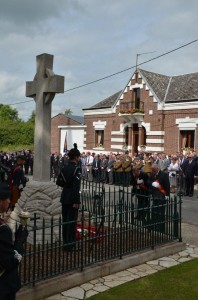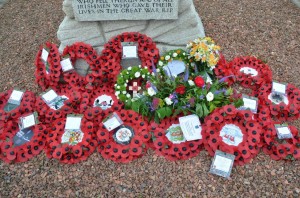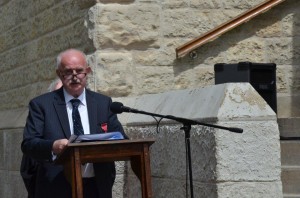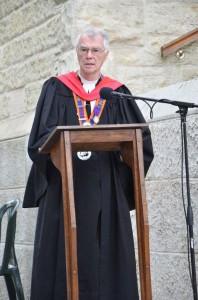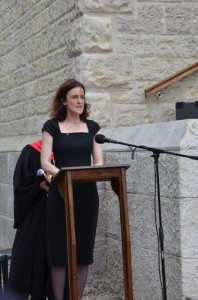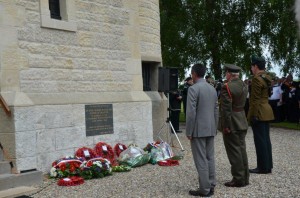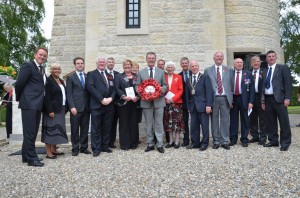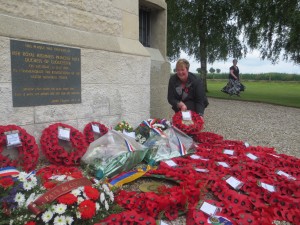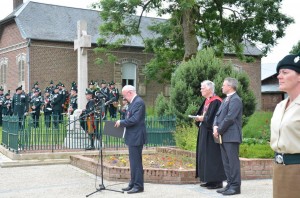
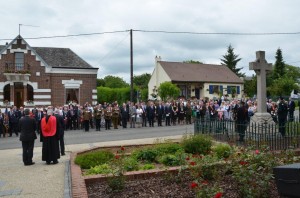
Somme Commemoration: Chairman’s Welcome, 16th (Irish) Division Memorial Cross, Guillemont, 1st July 2013

MONSIEUR LE MAIRE 

DE LA PART DE L’ASSOCIATION DE LA SOMME, JE TIENS À VOUS REMERCIER DE VOTRE ACCUEIL AUJOURD’HUI A GUILLEMONT AINSI QUE DE L’HOSPITALITÉ GENEREUSE QUE VOUS NOUS AVEZ OFFERTE. NOS AMIS FRANCAIS NOUS HONORENT TOUJOURS ET NOUS SOMMES CONSCIENTS DU FAIT QUE LES FILS D’ULSTER ET D’IRLANDE QUI REPOSENT EN PAIX ICI SONT DEVENUS PLUS QUE DES FILS D’ULSTER ET D’IRLANDE. CE SONT MAINTENANT DES FILS DE LA FRANCE. 

Here at Guillemont and neighbouring Ginchy, Redmond’s 16th (Irish) Division  lost heavily in the first ten days of September 1916 with casualties of 240 of its 435 officers and 4090 of 10410 other ranks among its infantry and engineer units. Two-thirds of these were wounded, another fifth missing, with the remaining 650 killed in action. Among the 9thDublin Fusillers were Private James Liddy of Amiens Street, a well known Dublin confectioner, as well as Ginchy’s best known casualty, Lieutenant Tom Kettle.

(A memorial to Tom Kettle by Francis W. Doyle-Jones stands in St. Stephen’s Green in Dublin.  It quotes lines from a sonnet he penned to his daughter shortly before his death (‘To My Daughter Betty’):

Know that we fools, now with the foolish dead,
Died not for the flag, nor King, nor Emperor,
But for a dream, born in a herdsman’s shed,
And for the secret Scripture of the poor.) 

On 31st July 1917, during the third battle of Ypres, Francis Ledwidge of the Royal Inniskilling Fusilliers was engaged in road making with many others when he was blown to bits with six other soldiers by a German shell. He had fought everywhere from Suvia Bay in the Dardanelles to Serbia to France and Belgium. But he was killed suddenly and almost by accident drinking tea with his friends. Born the son of an immigrant farm labourer in 1897, Ledwidge claimed the noble heritage of the dispossessed Irish peasantry. While he wrote ardently of nature and the pastoral grandeur of his native Boyne Valley, his short life – as a local political representative, an activist of the Irish Volunteers – was a passionate testimony on human rights. Although he is best known for his moving tribute to Thomas MacDonagh, Ledwidge himself was fighting in France during the 1916 rising. “I joined the British Army” he said, “because she stood between Ireland and an enemy to our civilisation, and I would not have her say that she defended us while we did nothing at home but pass resolutions.” 

The poetry of Francis Ledwidge evokes an Ireland of traditional nostalgia. But Seamus Heaney had said of Ledwidge that his fate was more complex and more modern, his moral courage alone gave him “membership in the company of the walking wounded, wherever they are to be found at any given time.” He was buried, No 5, in row B of the second plot in Artillery Wood Cemetery, about 3 miles North of Ypres in Belgium, and has joined the ranks of such fellow poets as Wilfrid Owen, Julian Grenfell, Rupert Brooke and Siegfried Sassoon. 

As a tribute to these fellow poets who fought and died in the Great War, known and unknown, let me read one of his last poems: 

After the War 

Now is the story over

Over the grief and pain

And down in the purple clover

The red lips meet again


But one in the dewy shadows

Waited through all the noon

And they told her out of the meadows

Someone was coming home


Some lips spoke of tomorrow

And someone of yesterday spoke

But O! the heart in sorrow

On the rocks of trouble broke


I longed for to sing delighted

And laugh with the newly gay

But a gloom on my soul alighted

And would not go away.

To the sons of Ulster and Soldiers of Ireland we say:-

“Sons of Ulster, Soldiers of Ireland do not be anxious. The war is over – both here and in your beloved Ireland. The Western Front is no more and Ireland at last is at peace with herself and with her people. We will always remember you, so long as the sun shines and the rain falls and the wind blows and the great river Somme runs gently to the sea”.

Innui, deir muid le fir Uladh agus le fir na hÉireann:-

“A Fheara Uladh agus a Shaighdiúirí na hÉireann, ná biodh imni oraibh. Tá an Cogadh thart – ní amháin san áit seo, ach in bhur dtír dhílis féin in Éirinn. Níl an Fronta Thiar ann níos mó, agus, so deireadh, tá tír na hÉireann faoi shíocháin léi féin agus len a pobal. Ach chomh fada is a shoilsíonn an ghrian, agus a thiteann an fhearthainn, agus a shéideann an ghaoth, agus chomh fada is a théann abhainn mhór an Somme go caoin chun na farraige, bedh cuimhne againn araibh go deo”. 


GUILLEMONT 1st JULY WREATH LAYING SEQUENCE
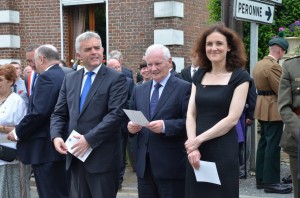
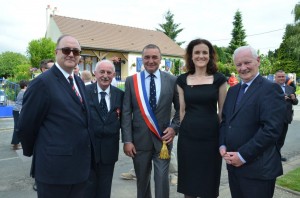
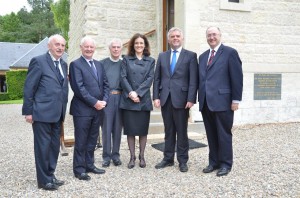
 SECRETARY OF STATE FOR NI, RT HON THERESA VILLIERS MP
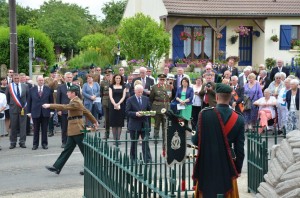
 DINNY McGINLEY TD, IRISH MINISTER OF STATE FOR IRISH GAELTACTH AFFAIRS
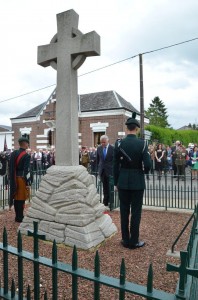
 JONATHAN BELL MLA ON BEHALF OF FIRST MINISTER FOR NI
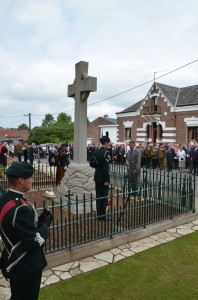
 MIKE NESBITT LEADER OF THE ULSTER UNIONIST PARTY


MAYOR OF GUILLEMONT AND MAYOR OF GINCHY
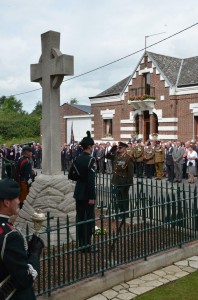
 BRIG GEN TOM BEHAN IRISH DEFENCE FORCE
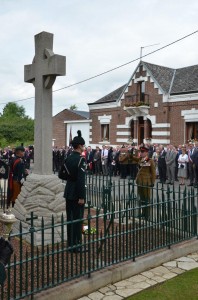
 BRIG RJ THOMSON COMD 38 (IRISH) BDE
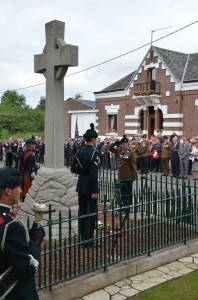
 MAJ G SEMPLE 2nd BATTALION THE ROYAL IRISH REGIMENT
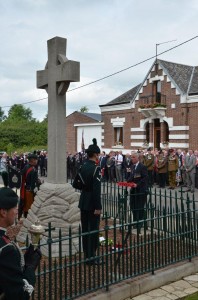
 LT COL (Retd) CHARLIE BENNETT SOMME ASSOCIATION


OTHER WREATHS WERE NOW LAID BY ORGANISATIONS LED BY REPRESNTATIVES OF LOCAL AUTHORITIES IN NORTHERN IRELAND
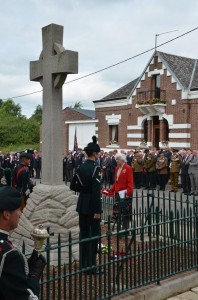
 

THE FINAL WREATH WAS LAID BY RANGER HASSARD AT THE FRENCH MEMORIAL
 

Posted in Article | Comments Off on Somme Commemoration: Chairman’s Welcome, 16th (Irish) Division Memorial Cross, Guillemont, 1st July 2013

Somme Commemoration: Chairman’s Welcome, Ulster Tower, Thiepval, 1st July 2013

Secretary of State for Northern Ireland Theresa Villiers, Minister of State Jonathan Bell, Irish Minister of State Dinny Mc Ginley, Distinguished Guests, My Lords, Ladies and Gentlemen, On behalf of the Somme Association could I welcome you to our annual Somme Commemoration ceremony.

On this day, 1st July 1916, 96 years ago, at the commencement of the Battle of the Somme, the men of the famous 36th (Ulster) Division advanced out of Thiepval Wood towards this point on the Schwaben Redoubt and on reaching here, passed into the pages of history, legend and high renown. This advance, when they sustained 5,500 casualties, under continuous fire, is for us the most memorable single episode of the First World War.

This memorial, erected on this sacred site by public subscription, raised in the North of Ireland, was modelled on Helen’s Tower at Clandeboye, near Bangor,where the 36th (Ulster) Division trained.

In Helen’s Tower at Clandeboye there is inscribed in letters of gold a poem by Alfred, Lord Tennyson, of which the first four lines have been slightly altered in the memorial room in this Ulster tower to serve as a fitting tribute to the sons of Ulster who fell here.

Helen’s Tower here I stand
Dominant over sea and land;
Son’s love built me, and I hold
Ulster’s love in lettered gold.

And so we have come with the Somme Association to visit Thiepval once more and to walk again in the gardens of Valhalla so lovingly cared for by the Commonwealth War Graves Commission. On this sacred day we commemorate the sacrifice of our loved ones who died for freedom. We do not seek to glorify war but rather to see that it does not happen again.

Monsieur le Secretaire d’Etat pour Irlande du Nord, Monsieur le  Ministre d’Etat d’Irlande du Nord Jonathan Bell, Monsieur le Ministre d’Etat irlandais Dinny McGinley, Monsieur le Prefet de la Somme et Peronne et toutes les autres personalites ici aujourdhui,
 
 En ce même jour, le premier juillet mille neuf cent seize, au début de la bataille de la Somme, les hommes de la fameuse trente-sixièmer sortirent du bois de Thiepval pour rejoindre ce point sur la Redoute de Schwaben, s’inscrivant ainsi dans les pages de l’histoire, de la légende et de la renommée. Cette avancée, sous un feu continu, qui leur coûta cinq mille cinq cent morts et blessés, est pour nous l’épisode le plus mémorable de la première Guerre Mondiale et représente une des démonstrations de courage les plus remarquables dans l’histoire de l’humanité. D’un courage tout aussi grand étaient les hommes de la seizième division irlandaise qui se battirent à Guillemont et Ginchy en septembre de la même année.
 
Ce mémorial, élevé sur ce site sacré grâce à une souscription dans le Nord de l’Ireland, a pris pour modèle la tour d’Hélène à Clandeboye, pres de Bangor, où s’entraîna la trente-sixiéme Division de l’Ulster.Sur la tour à Clandeboye est inscrite en lettres d’or un poème de Tennyson dont les quatre premiers vers ont été adaptés légèrement en hommage aux fils d’Ulster tombés ici. Ainsi peut-on lire à l’intérieur de cette Tour d’Ulster:
 
Me voici, la Tour d’Hélène
Qui domine terre et mer
Construite par l’amour d’un fils
J’abrite en lettres d’or l’amour d’Ulster.
 

En ce jour sacré nous commémorons le sacrifice de ces héros tombés pour la liberté. Nous ne cherchons pas seulement à les glorifier, mais à veiller à ce que un tel désastre ne se reproduise plus jamais.

To the people of France we say:-

“People of France, mother of nations, we thank you for your generosity and kindness to these our children who rest now in peace in the most beautiful gardens on earth. We pray that their sacrifice will not be in vain and that there will be no more war and that the peoples of Europe will walk together in mutual forgiveness, understanding and respect until the end of the world”.

Au people de France nous disons:-

“Peuple de France, mére des nations, nous vous remercions de votre générosité pour nos enfants qui reposent en paix dans les jardins les plus beaux du monde. Nous prions pour que leur sacrifice n’ait pas été vain, pour qu’il n’y ait plus de guerre, et pour que les peuples d’Europe puissent marcher ensemble et se pardonner, se comprendre et se respecter mutuellement jusqu à la fin des temps”.

Zu den Franzosen sagen wir:-

Bevölkerung von Frankreich, Mutter von Nationen, wir danken Ihnen für Ihre Grosszügigkeit und Freundlichkeit für unsere Kinder, die in diesen schönen Gärten in Frieden ruhen. Wir beten, dass das Opfer unserer Kinder nicht umsonst gewesen ist und dass es zu keinem weiteren Krieg mehr kommen wird, dass die Völker Europas in Vergebung, Verständnis und Respekt miteinander in die Zukunft gehen können.

To the sons of Ulster and Soldiers of Ireland we say:-

“Sons of Ulster, Soldiers of Ireland do not be anxious. The war is over – both here and in you beloved Ireland. The Western Front is no more and Ireland at last is at peace with herself and with her people. We will always remember you, so long as the sun shines and the rain falls and the wind blows and the great river Somme runs gently to the sea”.

Innui, deir muid le fir Uladh agus le fir na hÉireann:-

“A Fheara Uladh agus a Shaighdiúirí na hÉireann, ná biodh imni oraibh. Tá an Cogadh thart – ní amháin san áit seo, ach in bhur dtír dhílis féin in Éirinn. Níl an Fronta Thiar ann níos mó, agus, so deireadh, tá tír na hÉireann faoi shíocháin léi féin agus len a pobal. Ach chomh fada is a shoilsíonn an ghrian, agus a thiteann an fhearthainn, agus a shéideann an ghaoth, agus chomh fada is a théann abhainn mhór an Somme go caoin chun na farraige, bedh cuimhne againn araibh go deo”.

And in honour of the brave American and Canadian soldiers who also fought here, I speak in Lakota (Oglala Sioux), the Hymn of the Warriors

Ho Tunkasila Wakan Tanka
Oyate oyasin unsiwicalapo na owicakiyapo
Nahan waci wicasi na waci winyan wopila tanka
Nahan oyate oyasin canku luta ognamani owicakiyapo
Lecel wacin ho hecel lena, oyate kin nipi kte.
Mitakuye Oyasin

 Which in Wasicu(English) is 

Grandfather Great Spirit, Almighty God,

Have pity on and help all the People
Many Thanks for the Performers, male and female,
Help all the People to walk the Red Road of Peace
This I ask so that the People will prosper
You are all my relatives

The Somme Association would like to thank The Band of The Royal Irish Regiment(TA); The 2nd Battalion The Royal Irish Regiment;Rossen Platoon, 4th Battalion The Royal Welsh, (Clwyd AFC) and especially The Rev Martin Smyth.

Thank you..

Exhortation by  Secretary of State for Northern Ireland Rt Honorable Theresa Villiers MP

The Placing of Official Wreaths…Depots des Gerbes Officielles

SECRETARY OF STATE FOR NI RT HON THERESA VILLIERS MP

JONATHAN BELL MLA ON BEHALF OF FIRST MINISTER FOR NI

COL MURRAY-PLAYFAIR – MA BRITISH EMBASSY PARIS

DINNY McGINLEY TD IRISH MINISTER OF STATE FOR IRISH GAELTACHT AFFAIRS

SOUS PREFET – JOEL DUBREIL  (LA PREFET DE LA REGION PICARDE PREFET DE LA SOMME)

STEPHANE VRUNEL LE CONSEIL GENERAL DE LA SOMME

MIKE NESBITT LEADER OF THE ULSTER UNIONIST PARTY

MAYOR OF THIEPVAL

MAYOR OF GUILLEMONT

MAYOR OF GINCHY

BRIG RJ THOMSON COMD 38 (IRISH) BDE

a.    MAJ W NICHOLS 2nd BATTALION THE ROYAL IRISH REGIMENT

b.    BRIG GEN TOM BEHAN IRISH DEFENCE FORCE

c.     COL GILLES HEYRAUD La DELEGATION MILITAIRE DEPARTMENT  DE LA SOMME

JOHN CRISFORD NATIONAL CHAIRMAN RBL

MON JEAN-LUC FOURDINIER VICE PRESIDENT PAYS DU COQUELICOT

Lt COL (Retd) C BENNETT SOMME ASSOCIATION

MR BARRY MURPHY DIRECTOR COMMON WAR GRAVES COMMISSION 


During the final hymn there was an opportunity for organisations and individuals to place wreaths led by the Reprsentatives of the Local Authorities starting with Belfast as the Capital City and the other Local Authorities in alphabetical order


Photographs courtesy of Councillor Sandra Hunter and John Kennedy

Posted in Article | Comments Off on Somme Commemoration: Chairman’s Welcome, Ulster Tower, Thiepval, 1st July 2013

Somme Pilgrimage 2013: Day 4

Monday 1st July

0730hrs                                   Breakfast in hotel.

0900hrs                       Morning: Depart for Thiepval.

At 1100hrs Commonwealth Service of Remembrance at Thiepval Memorial to the Missing.  

Afternoon: A lunch will be served at the Ulster Memorial Tower for the Somme Association tour and invited guests.

1430hrs. Northern Ireland Service of Remembrance at the Ulster Memorial Tower followed by a Wreath laying Service at 16th (Irish) Division Memorial at Guillemont.  

Evening at leisure


Posted in Article | Comments Off on Somme Pilgrimage 2013: Day 4

Somme Pilgrimage 2013: Day 3

Sunday 30th June

0730hrs                                   Breakfast in hotel.

0830hrs                       Morning: Depart hotel for the Amiens area. Visits shall include the Australian Memorial at Villers Bretonneux.

Afternoon: Lunch at the Ulster Memorial Tower followed by the guided tour of Thiepval Wood. Other afternoon activities will include the Canadian Memorial at Newfoundland Parc and the South African Memorial at Delville Wood.

1830hrs                                   Arrive back at hotel.                            Evening at leisure


Posted in Article | Comments Off on Somme Pilgrimage 2013: Day 3

Somme Pilgrimage 2013: Day 2

Saturday 29th June

0800hrs                                   Breakfast in Hotel

0830hrs                                   Depart for full day’s tour intoBelgium.

Morning: Visits shall include; the 16th (Irish) Division Memorial, Spanbroekmolen Mine Crater, and Lone Tree Cemetery.

Afternoon: Lunch in Ypres, Tyne Cot Cemetery, Memorial and Visitor Centre, and Langemark German Cemetery. 

Return to Ypresfor dinner and Last Post Ceremony at the Menin Gate at 2000hrs.

22:00hrs                      (approx) Arrive back at hotel.             Evening at Leisure

Posted in Article | Comments Off on Somme Pilgrimage 2013: Day 2

Somme Pilgrimage 2013: Day 1

SOMME TOUR 2013

28TH June 2013 – 2nd July 2013

Itinerary


Friday 28th June

0815hrs                                   Check-in Belfast City Airport

1015hrs                                   Depart Belfast on Flybe flight No. BE965

1135hrs                                   Arrive at London Gatwick

                                    Depart Gatwick by Dhillon of London Coaches for Port of Dover.

                                    Arrive at Dover for ferry crossing to Calais

1900hrs                                   Arrive in France and journey on to the Hotel in Amiens.

                                                                                                Evening at leisure


Posted in Article | Comments Off on Somme Pilgrimage 2013: Day 1

Order of the Striped Tiger: Dr FWS O’ Neill

Order of the Striped Tiger (Fifth Class Neck Badge), in silver-gilt and enamels, 60mm, awarded to “Dr FWS O’ Neill”, in its original lacquer box.

“My grandfather FWS O’ Neill, went to Manchuria in 1897 as a missionary of the Irish Presbyterian Church, at the age 27.

In 1900 he could speak fluent Chinese and was not molested during the Boxer Rising, which aimed at expelling foreign influence.

“His house was wrecked but later a Chinese dictionary was returned to him. Again in 1904 he assumed Chinese dress (blue cotton), during the Russo-Japanese war.

At one stage he was condemned to death by the Russians. He had blue eyes and did not expect to pass as Chinese. 

“In 1917 he was attached by the YMCA to the Chinese Labour Corps in France and was awarded the Order of the Striped Tiger on his return to China.

“From 1928 to 1931 he lived through the taking over of Manchuria by the Japanese and was allowed to continue his work until 1941, when he and his wife were interned in Kobe.

They came home in 1942 in an exchange of diplomatic and religious prisoners.   “He died in 1952 at the age of 82.”

FWS O’Neill was based in Fakumen, a town of about 15,000 people among foothills about two days walk from Mukden, the chief city of Manchuria, and the same from the Mongolian (indeterminate) frontier.

“He toured an area about equal to Northern Ireland taking about a month on foot for each journey. As far as I know the school and church he established in Fakumen still exist and he is still remembered in the area.” 

Chinese order of the striped tiger
The Chinese order of the striped tiger 

>>>>>>>>>>>>>>>>>>>>>>>>>>>>>>>>>>>>>>>>>>>>>>>>>>>>>>>>>>>>>>>>>>>>>>>>>>>>>>>>>>>>>>>>>>>>>>>>>>>>>>>>>>>>>>>> 

Subject:  lunchtime lecture by Mark O’Neill on his book ‘Frederick: The Life of my Missionary Grandfather in Manchuria’ 

Lecture by Hong Kong-based academic and journalist, Mark O’Neill, in Iveagh House on Friday, 28 June at 12.30pm. 

Mark O’Neill’s book entitled ‘Frederick: The Life of my Missionary Grandfather in Manchuria’ is based on the experiences of his grandfather, a Presbyterian missionary in China, whose career spanned the first half of the 20th century. The book provides a snapshot of a pivotal period in Chinese history. Additionally, O’Neill will share many rare photographs from the book, extracted from the archives of the Presbyterian Church that capture life in one of the most remote corners of China.  Whilst in Iveagh House, Mark O’Neill will also be formally handing over to the Presbyterian Historical Society of Ireland an Order of the Striped Tiger Medal awarded to his Grandfather by the Chinese government for his work with the Chinese Labour Corps of 96,000 people who assisted the Allied Forces in France and Belgium from 1917 to 1919.

Posted in Article | Comments Off on Order of the Striped Tiger: Dr FWS O’ Neill

“Every Townland Earned its Name in Song: John Hewitt’s Ulster Scots Tradition”

At PRONI on Friday 28th June 2013

“Every Townland Earned its Name in Song: John Hewitt’s Ulster Scots Tradition”

About the Exhibition This exhibition explores Ulster poet, author, lecturer and broadcaster John Hewitt’s fascination with the poetry of the Rhyming Weavers and explores how the Scots vernacular became an integral part of poetry and local literature in Ulster.

The exhibition has been developed by Dr Kathryn White and Dr Frank Ferguson (University of Ulster) for the John Hewitt Society and will be on display at PRONI from 27th June – 9th July 2013.

The John Hewitt archive held by PRONI (Ref D3838) comprises over 7,000 documents and volumes. 

The Public Record Office of Northern Ireland (PRONI) requests the pleasure of DrIan Adamson’s company on Friday 28th June 2013 at 1pm. 

Light refreshments will be served. Please advise of any access, communication or dietary requirements which would aid your enjoyment of this event.

RSVP by Friday 21st June 2013

PRONI 2 Titanic Boulevard, Titanic Quarter, Belfast, BT3 9HQ

E-mail: proni@dcalni.gov.uk Telephone: (+ 44) 02890 534808)

Posted in Article | Comments Off on “Every Townland Earned its Name in Song: John Hewitt’s Ulster Scots Tradition”

The Ballybeen Men’s Motivation Group: Battles that shaped Ulster

Could I first thank my friend Andy Tyrie for inviting me to speak to your group tonight and to pay tribute to him for his work in promoting our Common Identity theme over many years. Forty years ago he brought me to see the Kempe stones, built by our ancestors thousands of years ago, before the Celts, the Anglo-Saxons, the Norse, the Danes and the Normans.
 
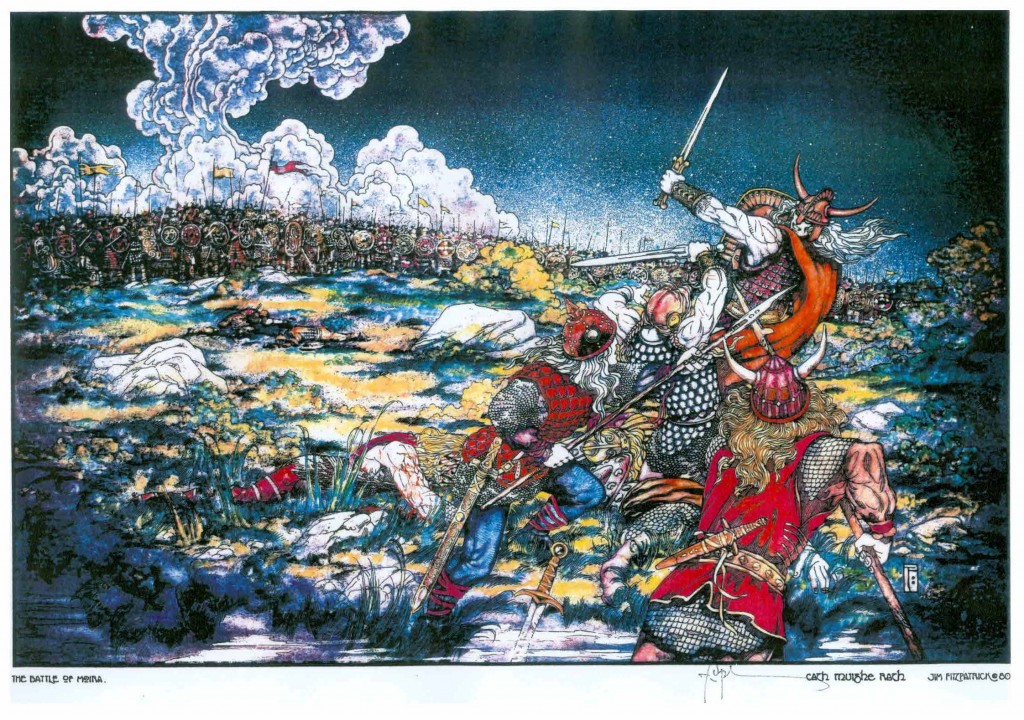
In 627 AD Congal Clane or “One Eye,” a Prince of the Cruthin, those ancient British people or Pretani  from whom we are descended, became the Over-King of Ulster. He had ruled in Tara until his blinding by bees put him from his kingship. The following year Congal slew the High King of the Ui Neill and in 629 he strengthened his claim to the whole of Ulster by killing the King of Dalriada who was an ally of the Ui Neill. This resulted in the Battle of Dunceithirnn in Londonderry later that year, when the north-western Gaels under their new High King, Domnall, son of Hugh, defeated Congal and crushed the Cruthin. Congal was forced to flee to Scotland where he succeeded in reversing the Dalriadan alliance with the Ui Neill.
 
 
On this day, 24th June, 637 AD, therefore was fought the famous Battle of Magh Rath (Moira) in County Down against Domnall, son of Hugh, by the allies of Ulster. Sadly, however, Congal was killed and Domnall Brecc (Freckled Donald), King of Dalriada, lost all his Ulster territories. In this way the Ui Neill consolidated their power in Ulster and the Cruthin further declined. One of the finest passages from the epic of the Belfast poet and antiquarian, Sir Samuel Ferguson, on Congal is the soliloquy of Ardan, the great friend of Congal, to his dead king following the battle.
 
“I stand alone,
Last wreck remaining of a power and order overthrown,
Much needing solace;
And, ah me!, not in the empty lore
Of bard or druid does my soul find peace or comfort more;
Nor in the bells or crooked staves nor sacrificial shows
Find I help my soul desires,
Or in the chants of those
Who claim our druids’ vacant place.
Alone and faint, I crave,
Oh, God, one ray of heavenly light to help me to the grave,
Such even as thou, dead Congal, hadst;
That so these eyes of mine
May look their last on earth and heaven with calmness such as thine.”
 
The grave of Congal Clane is unmarked today but surely his memory should be kept alive in Ulster for he was the last Cruthinic king to provide an effective opposition to the Gaels in the north of Ireland. Congal had fought above all others for the People of Cruthin. Bangor could only remain strong while the Cruthin remained strong and the complete defeat at the Battle of Moira signalled the inevitable decline of the Bangor monastery. Thus it was that the Cult of Patrick eventually moved from Connor in Dalaradia to Armagh. Abbot Comgall himself had once said that he also would pray only for the People of the Cruthin, his own people, but Comgall was no more. And gradually the Cruthin lost power and migrated to south-western Scotland where they became known as Kreenies
 

Set as Ulster is at the North Eastern corner of Ireland, facing Britain across a narrow sea and separated from the rest of Ireland by a zone of little hills known as Drumlins, marshland, lakes and mountains, the characteristics of her language and people have been moulded by movements, large and small, between the two islands since the dawn of human history.  The difference between Ulster and the rest of Ireland is one of the most deeply rooted, ancient, and from a literary point of view, most productive facts of early Irish History. Furthermore, Ulster’s bond with Scotland counterbalances her lax tie with the rest of Ireland.  To say, once more, that this applies only to modern times and to dialects of English would be to miscalculate grossly.  Here too the mould was fixed in ancient times and modern developments continue ancient associations.

We need but think of the ancient British Cruthin Kingdoms in both areas, of the Ulster-Scottish Kingdom of Dalriada from the last quarter of the 5th to the close of the 8th century, of the Scottish Kingdom founded under Gaelic leadership in 842, of Irish relations with the Kingdom of the Hebrides and Argyll from the 12th century, particularly the immigration of Hebridean soldiers (gallowglasses) from the 13th to the 16th century.  The Gaelic form of this word, Galloglaigh, (i.e. Gallagher) occurs as a family name in Northern Ireland. Another family name for them is “English” Gallowglasses would later become the mainly Catholic Dutch Blue Guards of William of Orange and the Swiss Guards of the Papacy.

There was a constant coming and going between North East Ireland and Western Scotland.  The Glens of Antrim were in the hands of Scottish Macdonalds by1400, and for the next two hundred years Gaelic-speaking Scots came in large numbers.  The 17th century immigration of a numerous Scots element need not to be considered outside the preceding series.  It has brought for example Presbyterian Scots with names as familiar on this side as McMenemin and Kennedy, who must be considered rather in the light of homing birds. 

Now we turn to the famous battle which bought thousands of now Lowland Scots back to Ulster, the Battle of the Boyne. The Boyne has been described as one of the decisive battles of the western world, for it signalled to Europe defeat for the French and the Jacobites — but it was not the final victory of the War. Neither was it a battle altogether characterised by the direction of the professional soldier but a magnificent drama portraying the personalities of the two kings each of whom caused problems for his own most able generals.
 
For if Sarsfield was betrayed by the cowardice of James, so Schomberg was dismayed by the almost foolhardy courage of William, who must have been familiar with the exploits of that earlier Guillaume d’Orange (William of Orange) , so prominent in the Old French Chansons de Geste (Songs of Heroic Deeds) of the 12th and 13th Centuries. The Prince of Orange’s own legendary bravery was linked to a strong, yet tolerant, religious conviction and a warm attachment to the Protestant faith, which sprang from earnest thought and attention. He possessed great military genius and soundness of judgement. At the Boyne his tactics were proved to have been correct. Yet, if the battle was won by William, the pursuit was not.
 
The losses on both sides had been less than on any field of battle of equal importance and celebrity — fifteen hundred Jacobites and five hundred Williamites. Among the latter were Schomberg, the master soldier, and Walker of Derry, the heart and soul of his people. William’s physical infirmities, his wound in the early part of the battle and the fatigue he had endured exhorting his men, had made him incapable of further progress. The King could not do everything, but what was not done by him was not done at all. And so the French and Jacobites escaped to fight another day.
 

From October 1690 until May 1691 no military operation on a large scale was attempted in the Kingdom of Ireland. During that winter and the following spring the island was divided almost equally between the contending parties. The whole of Ulster, the greater part of Leinster, and about one third of Munster were now controlled by the Williamites; the whole of Connaught, the greater part of Munster and two or three counties of Leinster were still held by the Jacobites.

Continuous guerrilla activity persisted, however, along the rough line of demarcation. In the spring of 1691, James’s Lord Lieutenant, Tyrconnell, returned to Ireland, followed by the distinguished French general Saint Ruth, who was commissioned as Commander-in-Chief of the Jacobite army. Saint Ruth was a man of great courage and resolution but his name was synonymous with the merciless suppression and torture of the Protestants of France, including those of the district of Orange in the South, of which William was Prince.

The Marquess of Ruvigny, hereditary leader of the French Protestants, and elder brother of that brave Caillemot who had fallen at the Boyne, now joined the Dutch general Ginkell, who was strengthening the Williamite army at Mullingar. Ginkell first took Ballymore where he was joined by the Danish auxiliaries under the command of the Duke of Wurtemburg, and then the strategic town of Athlone.

Thus was the stage set for one of the fiercest battles of that age or any other. Determined to stake everything in a final showdown St Ruth pitched his camp about thirty miles from Athlone on the road to Galway. He waited for Ginkell on the slope of a hill almost surrounded by red bog, chosen with great judgement near the ruined castle of Aughrim.

Soon after 6 o’clock on the morning of 12 July, 1691, the Williamite army moved slowly towards the Jacobite positions. Delay was caused, however, by a thick fog which hung until noon and only later in the afternoon did the two armies confront each other.

The Jacobite army of twenty-five thousand men had further protected themselves with a breastwork constructed without difficulty. The Williamites, numbering under twenty thousand, advanced over treacherous and uneven ground, sinking deep in mud at every step. The Jacobites defended the breastwork with great resolution for two hours so that, as evening was fast closing in, Ginkell began to consider a retreat. St Ruth was jubilant and pressed his advantage.

However, Ruvigny and Mackay, with the Huguenot and British Cavalry, succeeded in bypassing the bog at a place where only two horsemen could ride abreast. There they laid hurdles on the soft ground to create a broader and safer path and, as reinforcements rapidly joined them, the flank of the Jacobite army was soon turned. St Ruth was rushing to the rescue when a cannonball took off his head. He was carried in secret from the field and, without direction, the Jacobites faltered. The Williamite infantry returned to their frontal attack with rugged determination and soon the breastwork was carried. The Jacobites retreated fighting bravely from enclosure to enclosure until finally they broke and fled.

This time there was no William to restrain the soldiers. Only four hundred prisoners were taken and not less than seven thousand Jacobites were killed, a greater number of men in proportion to those engaged than in any other battle of that time. Of the victors six hundred were killed, and about a thousand were wounded. If the night had not been moonless and visibility reduced by a misty rain, which allowed Sarsfield to cover the retreat, scarcely a Jacobite would have escaped alive.

Waiting in the wings with his own army was a remarkable character named Balldearg O’Donnell.  He had arrived from Spain shortly after the Battle of the Boyne claiming to be a lineal descendant of the ancient “Gaelic” Cruthin kings of Tyrconnell in Ulster.  He also claimed to be the O’Donnell ‘with a red mark’ (ball dearg) who, according to ancient prophecy, was destined to lead his followers to victory.  Many ordinary Ulster Catholics had flocked to his standard, causing great hostility on the part of Tyrconnell who saw him as a threat to his own earldom.

Balldearg thus remained aloof from the Battle of Aughrim.  He proceeded to join the standard of William with 1200 men on 9th September, 1691, and marched to assist in the reduction of the Jacobite town of Sligo.  This garrison surrendered on 16th September, 1691, on condition that they were conveyed to Limerick.  Balldearg remained loyal to William and later entered his service in Flanders, with those of his men who elected to follow him.

The Battle of the Somme in 1916 has been celebrated by Ulster Protestants as an essential part of their heritage.  Yet the sacrifice of young lives in the battlefields of France during the First World War were in reality a uniquely intercommunity one with Protestants, and Catholics, Northerners and Southerners, fighting and dying side by side. There are memorials to the young men from Donegal, Monaghan and Cavan in churches throughout those counties. Furthermore the famous Finner Camp has had a very special place in the commercial, social and historic fabric of south Donegal since it was established in l890.

The valour displayed by the 36th Ulster Division is legendary but the price paid was high.  They had lost over 5,500 officers and men. The Inniskillings lost more than any British Regiment of the line has ever lost in a single day.  Of the 15th Royal Irish Rifles only 70 men answered their names on that night of the 1st July.  The dead accounted for half of the casualties. And Ulster, in this Divisional  context included Donegal, Monaghan and Cavan.

The battle dragged on until November. In September it was the turn of the 16th Irish Division to show their gallantry.  This division included 5 Ulster battalions and also the 6th Battalion, the Connaught Rangers, which included 600 Ulster men recruited mainly from West Belfast.  The 16th Irish Division is most predominately identified the assaults on the villages of Guillemont and Guinchy.  Lieutenant- Colonel W Shooter wrote: “The conditions in which the Irishmen had to advance were appalling.  The whole of this area was the scene of complete desolation and odious mud.  Movement over the ground in such conditions required a supreme effort, apart altogether from the fierce hurricane of machine gun and artillery fire which the enemy brought to fear in the advancing troops.  Nevertheless the advancing Fusiliers and Riflemen hacked their way forward with great determination and traditional Irish dash.  In spite of the most severe casualties they drove the Germans from their positions inflicting heavy loss on the defenders and taking many prisoners.”

The Great War saw the sacrifice of a whole generation of Europe’s young men led like lambs to the slaughter by politicians and generals.  Nevertheless the War provided proof that Ulster men of all persuasions could unite in the face of adversity.  One veteran of the Ulster division Tommy Jordan witnessed such mutual aid even while in the trenches. 

“I remember too we were in a village close to the men of the 16th Irish Division and a lot of Australians.  This Australian, a great fellow but very overbearing,… anyway something happened.  There was a row between some of our people and these Australians.   HHow the Irish brigade got word of it nobody knew but down they came and beat up the Australians.  Now I saw fellows arm- in- arm afterwards.  Fellows of the 11th Enniskillings with their orange and purple badges and the other fellas with their great big green badges on their arm.”

Yet, in a sense the Battle of the Somme signifies the rebirth of the Ulster Nation.The Battle became Northern Ireland. We are a very fortunate people in Ulster. The marvellous diversity of both Irish and British culture has been accorded to us.  We should all be proud of what we are.Through the chair of our Ullans Academy, Helen Brooker, my colleague in Pretani Associates, we, and here I include our Secretary John Laverty and our Treasurer Jim Potts, who are with us tonight, are developing the vision of Common Identity promoted over the years by our Patron Andy Tyrie, to take us at last beyond the religious divide.

Posted in Article | Comments Off on The Ballybeen Men’s Motivation Group: Battles that shaped Ulster

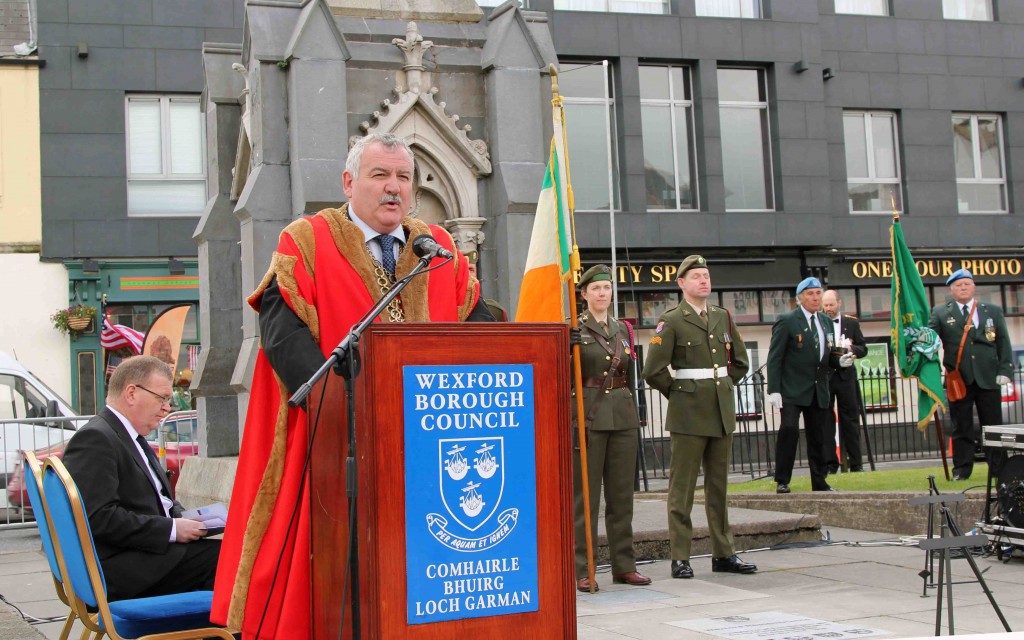
Wexford Borough Council and The Royal British Legion of Wexford ECUMENICAL DEDICATION CEREMONY OF REMEMBRANCE AND WREATHLAYING

Wexford Borough Council and The Royal British Legion of Wexford

ECUMENICAL DEDICATION CEREMONY OF REMEMBRANCE AND WREATHLAYING

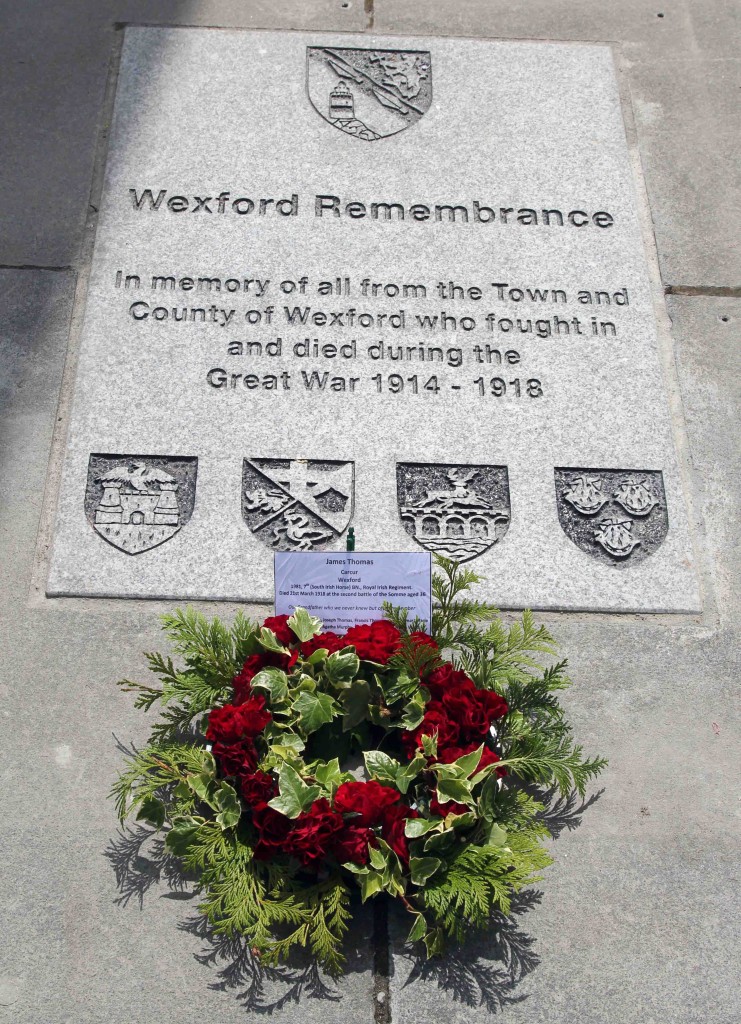
To the sacred memory of all Wexfordmen who sacrificed their lives in defence of freedom 1914 -1918 

Redmond Square, Wexford 23rd June 2013

OFFICIATING CLERGY Rev. Fr. James Fegan; Rev. Arthur Minnion

MUSIC BY Anthony Nolan

Pipers from New Ross Pipe Band, Éanna McKenna and Michael Londra 

ORDER OF SERVICE

PARADE OF STANDARDS

************

WELCOMING ADDRESS

His Worship the Mayor of Wexford

Councillor Jim Allen

(Please Stand)

************

THE BIDDING PRAYER

Rev. Fr. James Fegan

Rev. Arthur Minnion

We are here in the presence of God: To remember with thanksgiving and

sorrow those whose lives, in world wars and conflicts past and present, have

been given and taken away in the cause of justice and freedom:

To pray for all who in bereavement, disability and pain, continue to suffer the

consequences of fighting and terror, and to commit ourselves, young and old

to work in penitence and faith for reconciliation between the nations of our

troubled world so that, under God, people of every race and creed may be at

peace.

These thoughts and prayers we offer now in the words that Jesus taught us:

ALL

Our Father, who art in Heaven, hallowed be Thy name;

Thy kingdom come, Thy will be done, on earth as it is in Heaven.

Give us this day our daily bread, and forgive us our trespasses,

As we forgive those who trespass against us.

And lead us not into temptation, but deliver us from evil.

For Thine is the Kingdom, the Power and the Glory,

For ever and ever – Amen.

“O LORD MY GOD, HOW GREAT THOU ART”

O Lord my God, when I in awesome wonder

Consider all the works Thy hand hath made,

I see the stars, I hear the mighty thunder,

Thy power throughout the universe displayed!

Chorus:

Then sings my soul, my Saviour God, to Thee:

How great Thou art, how great Thou art!

Then sings my soul, my Saviour God, to Thee:

How great Thou art! How great Thou art!

When through the woods and forest glades I wander,

and hear the birds sing sweetly in the trees,

When I look down from lofty mountain grandeur

and hear the brook and feel the gentle breeze;

Chorus

And when I think that God, His Son not sparing,

sent Him to die I scarce can take it in

That on the cross, my burden gladly bearing,

He bled and died to take away my sin;

Chorus

(Swedish Folk Song “O Store Gud” Translated by Stuart K Hine 1899)

(Please Sit)

************

THE LESSON

Brendan Howlin T.D.

Minister for Public Expenditure and Reform

“Jesus said; this is my commandment: love one another, as I have loved you.

There is no greater love than this; that a man should lay down his life for his

friends; you are my friends, if you do what I command you, I call you servants

no longer; a servant does not know what his master is about. I have called you

my friends, because I have disclosed to you everything that I heard from my

Father. You did not choose me: I chose you. I appointed you to go on and bear

fruit, fruit that shall last: so that the Father may give you all that you ask in my

name. This is my commandment to you: Love one another.”


(St. John-Chap 15 – Verses 12 to 17)


(Please Stand)


“CHRIST BE BESIDE ME”

(St. Patrick’s Breastplate)

Christ be beside me, Christ be before me,

Christ be behind me King of my heart;

Christ be within me, Christ be below me,

Christ be above me never to part.

Christ on my right hand, Christ on my left hand,

Christ all around me, shield in my strife;

Christ in my sleeping, Christ in my sitting,

Christ in my rising, light of my life.

Christ be beside me, Christ be before me,

Christ be behind me King of my heart;

Christ be within me, Christ be below me,

Christ be above me never to part.


Ancient Irish Text Attributed to St. Patrick-Translated by Mary Byrne (1880-1931)


Adapted by Rev J Quinn SJ-Traditional Irish Melody


PRAYERS

Rev. Fr. James Fegan

Rev. Arthur Minnion


Let us pray for all who suffer as a result of conflict and ask that God may give us peace: 

For the service of men and women who have died in the violence of war, each one remembered by and known to God: May God give peace –

God give peace.

For those who love them in death as in life, offering the distress of our grief

and the sadness of our loss: May God give peace –

God give peace.

For all members of Armed Forces, whether peace keeping or peace making

who are in danger this day, remembering families, friends and all who pray

for their safe return: May God give peace –

God give peace.

For civilians whose lives are disfigured by war or terror, calling to mind in

penitence the anger and hatreds of humanity: May God give peace –

God give peace.

For peace-makers and peace-keepers, who seek to keep this world secure

and free: May God give peace –

God give peace.

For all who bear the burden and privilege of leadership whether political,

military or religious; asking that they be blessed with gifs of wisdom and

resolve in the search for reconciliation and peace: May God give peace –

God give peace.

O God of truth and justice, we hold before you those whose memory we

cherish and those whose names we will never know. Help us to lift our eyes

above the torment of this broken world and grant us the grace to pray for

those who wish us harm. As we honour the past, may we put our faith in

your future; for you are the source of life and hope.

Amen.

************

THE ACT OF REMEMBRANCE

Rev. Fr. James Fegan

Rev. Arthur Minnion

Teach us Good Lord to serve Thee as Thou deservest; to give and not to

count the cost, to fight and not to heed the wounds; to toil and not to seek

for rest; to labour and not to seek reward, save that of knowing we do Thy

will; through Jesus Christ our Lord. Amen.

(Please sit)

************

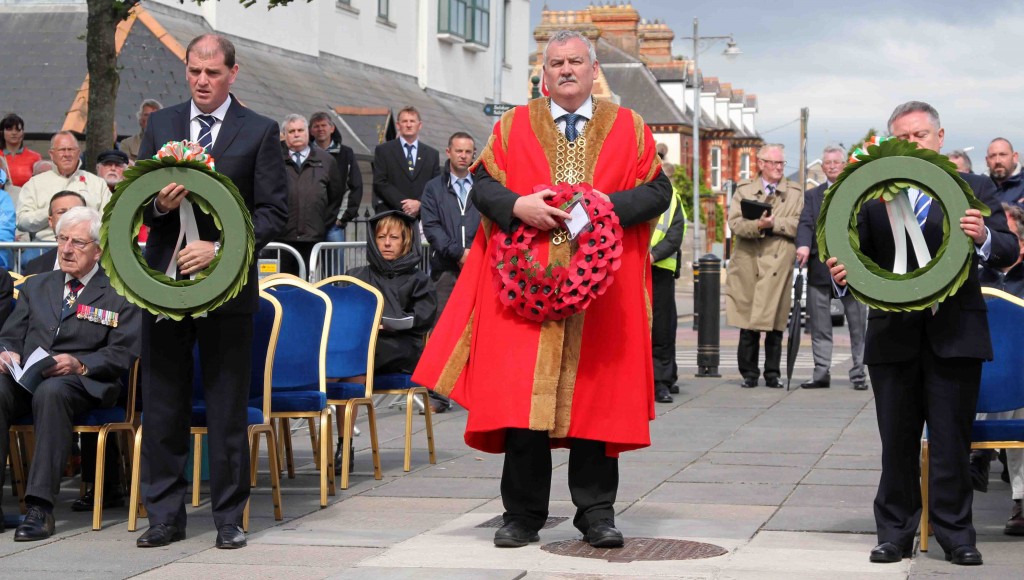
THE WREATH LAYING CEREMONY  

Wexford Sunday June 23rd 2013


Memorial plaque dedicated to men of Wexford lost in WW1 

And wreaths laid by

Mayor of Wexford, Jim Allen,

Minister for Public Expenditure and Reform,  Brendan Howlin TD (Lab) and

Minister of State at D/Taoiseach (Chief Whip) and at D/Defence, Mr Paul Kehoe TD (FG).

=============================================================

***********

LAMENT

Posted in Article | Comments Off on Wexford Borough Council and The Royal British Legion of Wexford ECUMENICAL DEDICATION CEREMONY OF REMEMBRANCE AND WREATHLAYING