Sarah Leech Summer School

 4 BRIGS Literary Group 

presents

The Sarah Leech Summer School

Friday, 21st June – Sunday, 22 June 2013

Inishowen Gateway Hotel, Buncrana, Co Donegal

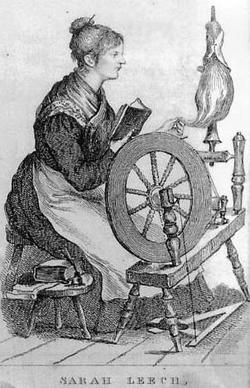
Sarah Leech (1809 – c. 1830) 
 picture

The daughter of a linen weaver, Sarah was born near Raphoe, County Donegal, and is one of the few published women writers in the Ulster-Scots tradition of that era. Beyond the biographical account contained in her only published collection, Poems on Various Subjects (1828), very little more is known about her. Her staunch unionism and Protestantism are evidenced by poems such as ‘The Brunswick Clubs’ and ‘Progress of the Reformation’. ‘On the Killing of a Mouse in Harvest’ compares very favourably with Burns’ ‘To a Mouse’. Sarah’s ‘weaver poetry’ is genuinely impressive and unfortunately undervalued.

Further reading: Celine McGlynn & Pauline Holland, Sarah Leech: The Ulster-Scots Poetess of Raphoe, Co. Donegal.

« More Famous Ulster-Scots  

Sarah Leech Summer School, Co Donegal

The inaugural Sarah Leech Summer School takes place on the coming Summer Solstice weekend: Fri 21 June – Sun 23 June, 2013.

Full programme of events below;

The Sarah Leech Summer School: Friday, 21 June – Sunday, 23 June 2013.

The Sarah Leech summer school is about more that Literature. It is about a place in Ireland that has functioned as a pluralist society for the past four centuries, a place which offers a role model in cultural pluralism that can serve as a touchstone for the future. This summer school presents these unique elements through poetry, prose, drama, and song, of the Donegal area and the hinterland of Northern Ireland. The heart and soul of a people are in the voice of their Literature, and through this we can build lasting bridges between Ireland’s post-plantation communities and cultures.

Based in the Laggan Valley, with its accompaniment of cultural kinship connections stretching for miles along the shores of the Foyle, Swilly and the Finn, this area has created a melting-pot of English, Irish and Ulster Scots, where these three language groups are still regularly heard in the same streets and the same houses. Ulster Scots is generally associated with the Presbyterian churches, Irish with the Roman Catholic Church, and English with the Church of Ireland.

Many of our planned summer schools, and printed or reprinted publications, conform to that pattern, but not all. All these communities now speak English, which is the language of the Irish Diaspora of all creeds – much of predominantly catholic west Donegal. People learned Ulster Scots, rather than English, while working in the fields of East Donegal’s Laggan. The ever shifting borders between language areas, the restlessness and the transmutations, have generated some of Ireland’s finest Literature in all three languages. 

Event will begin: Friday, 21st June, 7.30pm-9:00pm:

Opening Ceremony:

Welcome to Donegal by Dinny McGinley, TD, Minister of State for the Gaeltacht

Welcome to Summer School by Jim Millar, Representative from the Ulster Scots Agency.

Introduction to the School and Summer and programme of events by Mr Jim Devenney, Chairman of the 4 BRIGS Literary Group.

Guest speaker Dr Ian Adamson OBE, President of the Ullans Academy.

Entertainment from Letterkenny Caledonian Pipe Band.

Close of evening at 9:00pm.


Saturday, 22 June at 10am

Opening Ceremony: guest speaker Dr Ian Adamson OBE, President of the Ullans Academy.

Avisual presentation of Sarah Leech, her poetical works by Dr Pauline Holland.

Guest Panel: Liam Logan with key note speakers discussing: “The impact of the Scottish Plantation”.

An open discussion on: “Conversion of Cultures.” 

Exhibits running all day long for visitors not taking part in workshops:

Exhibition of paintings from “The Treasure Each Voice book”- 400 years  of Anglo-Irish, Irish and Ulster Scots Literature from Stranorlar.

Exhibition and Sale of Rare and Antiquarian Books.

Exhibition and Sale of “Coats of Arms”.

Exhibitit of Genealogy.

Exhibition on Ulster Scots writings and Sale of books.

Report by Celine McGlynn…. The First Sarah Leech Summer School organised by the 4 Brigs Literary Group at the Inishowen Gateway Hotel, Buncrana, was history in the making. “Itʼs groundbreaking and itʼs pushing the boundaries. “Sarah Leech, was the only female weaver poet of the early 17th Century. We are extremely fortunate that the weaver poets recorded their life events in their native tongue,” said Jim Devenney, Chairman, 4 Brigs Literary Group.

Jim Millar, Ulster Scots Agency, who helped fund the summer school made the opening speech. “The agency was delighted to be able to make a contribution to what I think will be the start of something very significant and hopefully onglasting. This isnʼt just about poetry. Itʼs about a lot of other things. I look forward to hearing much more about Sarah Leech and indeed about the 4 Brigs Literary Group.”

Dr Ian Adamson, OBE, who is fluent in fourteen languages was the keynote speaker at the Summer School. In a wide-ranging talk on Ulster Scots culture and heritage, he spoke of the influence of his grandmothers, Irish folklore, history and culture. “What is culture? Culture is the total range of activities and ideas of a group of people with shared traditions which is transmitted and reinforced by members of that group. That is our culture.

“Donegal is a special place. It does have this interlinkage between the Ulster Scots language, the English language and Ulster Gaelic. We never had any feelings of animosity that you often find within the context of Northern Ireland. We never ever had that, ever in our lives,” he said.

Dinny McGinley, TD, welcomed the initiative: ”We have an opportunity of celebrating the contribution of Ulster Scots to Ireland, to Ulster, to Donegal and to the world,” he said.

The Letterkenny Caledonian Pipe Band entertained the audience on the opening night.

On Saturday, Short Story, Poetry and Songwriting Workshops were facilitated by Kathryn Daily, Liam Campbell and Patricia Morris respectively.

A visual presentation of Sarah Leech and her poetical works by Dr Pauline Holland explained the poet’s thought processes, her dissatisfaction with her public image and examined a number of her poems.

Dr John Mouldon, Liam Logan, BBC, Dr Ian Adamson and Jim Devenney, contributed to the Guest Panel discussion ʻThe Impact of the Scottish Plantation and Subsequent Conversion of Culturesʼ on Saturday.

Sundayʼs bus tour took in early historical sites and settlements in the Laggan and told the story of the flax industry. Also included was a visit to the Stewartsʼ homesteads and a viaduct they constructed across the Swilly.

“It sits there now in its sombre silence where the tide ebbs and flows,” said Jim Devenney.

The tour finished with a trip to Glenveagh featuring the Sollas Dancers from Bready.

House of Books, Ballybofey, had an extensive collection of rare and antiquarian books on display for the duration of the Summer School.

Also on display was the Treasure Each Voice Exhibition by the Fiach Art Circle.


Posted in Article | Comments Off on Sarah Leech Summer School

Francis Makemie Plaque

The Ulster History Circle, the Ulster-Scots Agency and Ramelton Presbyterian Church request the pleasure of Dr Ian Adamson OBE at the unveiling of a blue plaque of FRANCIS MAKEMIE by Dinny McGinley TD, Minister of State for the Gaeltacht at The Old Meeting House, Back Lane, Ramelton, County Donegal 

on Friday 21 June 2013 at 2:30 p.m.

Refreshments afterwards in the Makemie Hall (beside the Presbyterian Church)

RSVP to Patrick Devlin: Email: pdevlinz@btinternet.com

Tel: 07530067256

The Old Meetinghouse, Ramelton
Pat Crowley
 

Views of the Old Meetinghouse, Ramelton
Clare McCahill
Founded about 1610 by Sir William Stewart on the site of an earlier castle and settlement, on the western fringes of the Ulster Plantation, Ramelton reflects the Presbyterian character of its past. Although they make up a relatively small proportion of the inhabitants, Presbyterians still constitute two sturdy congregations.
 

Francis Makemie (c.1658 – 1708):
Cleric, Presbyterian

Francis Makemie was born in Ramelton, County Donegal, Ireland, in 1658. In February 1676, he enrolled in the University of Glasgow. He was ordained in Northern Ireland in 1682 by the Presbytery of Laggan at the call for a minister/missionary by Col. William Stevens from Rehobeth, Maryland. Makemie came to the American colonies and traveled in North Carolina, Maryland, Virginia and New England.

In 1683, Makemie established four Presbyterian congregations, located in Rehobeth, Snow Hill, Princess Anne (Manokin Church) and Salisbury (Wicomico), Maryland. Since Makemie was under the Presbytery of Laggan’s direction, these churches often are claimed to be the first Presbyterian churches in America.

There were earlier churches established on Long Island under the Dutch colony’s jurisdiction during the 1640s. These churches were founded by Presbyterian and Congregationalist ministers and members. Many became Presbyterian in reputation and were finally organized into the Presbytery of New York in 1716.

In 1687, Francis Makemie purchased land in Accomack County, Virginia, which is on the Eastern Shore. He engaged in shipping and trade to make a living, while traveling to the small congregations of Presbyterians. William Anderson, a successfull businessman and landowner, helped Makemie become established. Francis married Anderson’s daughter, Naomi, around 1685. They had two daughters, Anne (circa 1697) and Elizabeth (circa 1700). Elizabeth died before her father, while Anne outlived him and was married three times.

In late Fall 1696 and early 1697, Makemie was in Barbadoes preaching.

On October 5, 1699, Makemie appeared at the Accomac County court to request a license to preach and hold religious meetings in Virginia as a Presbyterian at his houses in Pocomoke and Onancock. Previously, he had preached and organized churches in Maryland and Delaware, as well as holding services in Virginia. The official church in Virginia was the (Episcopal) Church of England. Passage of the Act of Toleration by the English Parliament in 1689 gave new rights to religious dissenters, allowing them to register their meeting houses and license their ministers to preach. In 1699, Makemie got the Virginia legislature to accord similar freedom in the Commonwealth. The court gave him a license on October 15, 1699.

In 1706, Makemie helped bring together Presbyterians ministers and elders to establish the Presbytery of Philadelphia. This was the official birth of American Presbyterianism. Makemie was elected the first moderator of the Presbytery.

While traveling in January 1707, Makemie was arrested by Lord Cornbury (aka Edward Hyde), the Colonial Governor of New York, for preaching without a license. Though Anglicanism was the official religion, there were many dissenters who preached different doctrine, including Puritans, Quakers, and Presbyterians on Long Island. Makemie had a license to preach as a dissenter in Virginia, Maryland and Barbadoes. After spending 6 weeks in jail, Makemie was aquitted in June 1707. His defense was based on the English Toleration Act of 1689. Though he was found innocent, he was ordered to pay the very expensive cost of his prosecution. This case is considered a landmark case in favor of religious freedom in America. It caused the New York legislature to enact legislation to prevent such prosecution again in the future.

Francis died in the Summer of 1708. He was buried on his farm on the Eastern shore.


Posted in Article | Comments Off on Francis Makemie Plaque

Herdenking Eerste Wereldoorlog in België via partnerschap tussen federale overheid en deelstaten, ook internationaal; Commémoration de la Première Guerre mondiale en Belgique : un partenariat entre autorités fédérales et entités fédérées, également sur le plan international

Persmededeling van de FOD Buitenlandse Zaken, Buitenlandse Handel en Ontwikkelingssamenwerking


Herdenking Eerste Wereldoorlog in België via partnerschap tussen federale overheid en deelstaten, ook internationaal


Op minder dan een jaar voor de herdenking van de Eerste Wereldoorlog in België organiseerde het Belgische coördinatiecomité voor de herdenking van de Eerste Wereldoorlog (dat uit vertegenwoordigers van de federale overheid, de gemeenschappen en de gewesten is samengesteld) vandaag een tweede briefing voor de ambassades in Brussel. De samenkomst had twee doelen: mensen voor de herdenking mobiliseren en een overzicht geven van de initiatieven die de overheden in België plannen. 

De Eerste Wereldoorlog heeft de geschiedenis ingrijpend veranderd. België speelde door het verzet van zijn soldaten, maar ook door de offers van de burgers een centrale rol in dit wereldconflict. 

Bovenop de herdenking is het de bedoeling van het Belgische coördinatiecomité om een boodschap van vrede en solidariteit te blijven uitdragen. Zo blijft de herinnering levendig, ook voor de nieuwe generaties. 

Tijdens de bijeenkomst vandaag werd de organisatie van de herdenking in België uit de doeken gedaan. Daarna werd toelichting gegeven over de drie plechtigheden met internationale uitstraling, die de federale regering zal organiseren. De herdenking op 4 augustus 2014 in Luik stelt het verzet tegen de invasie van België en de gruweldaden tegen de bevolking centraal. De herdenking op 28 oktober in Ieper en Nieuwpoort draait rond de vastberadenheid om voor de onafhankelijkheid van het laatste stuk niet-bezet België te vechten. Ook de onderwaterzetting van de IJzervlakte wordt daarbij herdacht. Voorts zal plechtige hulde worden gebracht aan de Koning-Soldaat Albert I. De herdenking op 11 november 2018 in Brussel gaat over het einde van de oorlog, de terugkeer van vrede en democratie en de heropbouw. 

De Duitstalige gemeenschap, het Brussels gewest, de Franse gemeenschap, het Waals gewest en de Vlaamse gemeenschap stelden elk hun initiatieven en activiteiten voor, rond onderwijs, cultuur, onroerend erfgoed, toerisme, wetenschap en kunst. 

Het Belgische coördinatiecomité zal zijn steun geven en deelnemen aan bepaalde internationale herdenkingsplechtigheden van gebeurtenissen die tekenend waren voor dit eerste conflict op wereldschaal. 

De verschillende overheden in België staan samen in voor de voorbereidingen van de herdenking van de Eerste Wereldoorlog. De samenwerking gebeurt via het Belgische coördinatiecomité, dat regelmatig vergadert. 

Al deze info is terug te vinden op de volgende websites:

www.be14-18.be – Herdenking van de Eerste Wereldoorlog op federaal vlak

www.2014-18.be – Herdenking van de Eerste Wereldoorlog in Vlaanderen

www.commemorer14-18.be – Herdenking van de Eerste Wereldoorlog in de Federatie Wallonië-Brussel en Wallonië

www.2014-18brussels.be – Commémoration de la Première guerre mondiale en Région de Bruxelles-Capitale


Communiqué de presse du SPF Affaires étrangères, Commerce extérieur et Coopération au Développement


Commémoration de la Première Guerre mondiale en Belgique : un partenariat entre autorités fédérales et entités fédérées, également sur le plan international


A moins d’un an de la Commémoration de la Première Guerre mondiale en Belgique, le Comité de coordination belge à la Commémoration de la Première Guerre mondiale, composé de représentants des autorités fédérales, des Communautés et des Régions, a organisé ce mardi 18 juin à l’attention des ambassades bilatérales à Bruxelles un deuxième briefing visant à mobiliser les énergies en vue de cette commémoration et faire le point sur les initiatives développées par chacun. 

La Première Guerre mondiale a bouleversé l’Histoire. La Belgique a joué un rôle central dans ce premier conflit mondial, par la résistance de ses soldats mais également par les sacrifices subis par sa population civile. 

Au-delà de la commémoration proprement dite, l’intention du Comité de Coordination belge est, pour le temps présent et l’avenir, de délivrer un message de paix et de solidarité. Le devoir de mémoire est ainsi assuré, également en direction des jeunes nouvelles générations. 

Après une présentation de l’organisation interne de la Belgique en vue de la Commémoration, les trois Cérémonies à dimension internationale, organisées par le gouvernement fédéral, ont été évoquées : la commémoration, le 4 août 2014 à Liège, de la résistance à l’invasion de la Belgique et des violences subies par la population civile; le 28 octobre à Ypres et Nieuport, de la volonté de garantir à tout prix l’indépendance d’une partie du territoire belge, et de l’inondation de la plaine de l’Yser. Un hommage solennel sera également rendu au Roi Albert Ier, le Roi-Chevalier ; le 11 novembre 2018 à Bruxelles, de la fin de la guerre, du retour à la paix et à la démocratie et de la reconstruction 

La Communauté germanophone, la Région de Bruxelles-Capitale, la Communauté française, la Région wallonne et la Communauté flamande ont ensuite présenté leurs activités et initiatives spécifiques dans des domaines variés, tels l’enseignement, la culture, le patrimoine, le tourisme, les sciences et arts. 

Le Comité de coordination belge apportera son soutien et participera à des cérémonies commémoratives d’envergure internationale, liées aux événements marquants de ce premier conflit mondial. 

Les autorités belges fédérales et fédérées assument ensemble la préparation de la Commémoration de la Première Guerre Mondiale. Le Comité de coordination belge se réunit régulièrement pour favoriser la coopération en la matière. 

Toutes les informations sont disponibles sur les sites suivants 

www.be14-18.be – Commémoration de la première guerre au Fédéral

www.commemorer14-18.be – Commémoration de la Première Guerre en Fédération Wallonie-Bruxelles et en Wallonie

www.2014-18.be – Commémoration de la Première Guerre mondiale en Flandre

www.2014-18brussels.be  – Commémoration de la Première Guerre mondiale en Région de Bruxelles-Capitale


Michel Malherbe, woordvoerder/porte-parole

michel.malherbe@diplobel.fed.be / +32 477 403212

Joren Vandeweyer, adjunct-woordvoerder/porte-parole adjoint

joren.vandeweyer@diplobel.fed.be / +32 473 730594


Web: www.diplomatie.belgium.be

Twitter: MFABelgiumMedia

Facebook: diplomatie.belgium

 
Posted in Article | Comments Off on Herdenking Eerste Wereldoorlog in België via partnerschap tussen federale overheid en deelstaten, ook internationaal; Commémoration de la Première Guerre mondiale en Belgique : un partenariat entre autorités fédérales et entités fédérées, également sur le plan international

The Venniconian Kingdoms: Part 7

The Battle of the Somme in 1916 has been celebrated by Ulster Protestants as an essential part of their heritage.  Yet the sacrifice of young lives in the battlefields of France during the First World War were in reality a uniquely intercommunity one with Protestants, and Catholics, Northerners and Southerners, fighting and dying side by side. There are memorials to the young men from Donegal in churches throughout the county. Furthermore the famous Finner Camp has had a very special place in the commercial, social and historic fabric of south Donegal since it was established in l890.

The valour displayed by the 36th Ulster Division is legendary but the price paid was high.  They had lost over 5,500 officers and men. The Inniskillings lost more than any British Regiment of the line has ever lost in a single day.  Of the 15th Royal Irish Rifles only 70 men answered their names on that night of the 1st July.  The dead accounted for half of the casualties. And Ulster, in this Divisional  context included Donegal, Monaghan and Cavan.

The battle dragged on until November. In September it was the turn of the 16th Irish Division to show their gallantry.  This division included 5 Ulster battalions and also the 6th Battalion, the Connaught Rangers, which included 600 Ulster men recruited mainly from West Belfast.  The 16th Irish Division is most predominately identified the assaults on the villages of Guillemont and Guinchy.  Lieutenant- Colonel W Shooter wrote: “The conditions in which the Irishmen had to advance were appalling.  The whole of this area was the scene of complete desolation and odious mud.  Movement over the ground in such conditions required a supreme effort, apart altogether from the fierce hurricane of machine gun and artillery fire which the enemy brought to fear in the advancing troops.  Nevertheless the advancing Fusiliers and Riflemen hacked their way forward with great determination and traditional Irish dash.  In spite of the most severe casualties they drove the Germans from their positions inflicting heavy loss on the defenders and taking many prisoners.”

The Great War saw the sacrifice of a whole generation of Europe’s young men led like lambs to the slaughter by politicians and generals.  Nevertheless the War provided proof that Ulster men of all persuasions could unite in the face of adversity.  One veteran of the Ulster division Tommy Jordan witnessed such mutual aid even while in the trenches. 

“I remember too we were in a village close to the men of the 16th Irish Division and a lot of Australians.  This Australian, a great fellow but very overbearing,… anyway something happened.  There was a row between some of our people and these Australians.   HHow the Irish brigade got word of it nobody knew but down they came and beat up the Australians.  Now I saw fellows arm- in- arm afterwards.  Fellows of the 11thEnniskillings with their orange and purple badges and the other fellas with their great big green badges on their arm.”

We are a very fortunate people in Ulster. And especially here in Donegal. The marvellous diversity of both Irish and British culture has been accorded to us.  We should all be proud of what we are.

Concluded

Posted in Article | Comments Off on The Venniconian Kingdoms: Part 7

Reflecting on a decade of War and Revolution in Ireland 1912-1923: the Cause of Labour

President Higgins keynote speaker at second 1912-1923 conference 

Principal speakers at the 2013 History Conference 

Left to Right: Professor Ralph Darlington, Dr Michael Murphy, President of Ireland Michael D Higgins, Mrs Sabina Higgins, Professor Karen Hunt, and Mr Padraig Yeates.

The President of Ireland, Michael D. Higgins, was the keynote speaker at the second in the series of all-island 1912-1923 conferences organised by Universities Ireland in Dublin’s Liberty Hall on 15th June.


http://www.universitiesireland.ie/wp-content/uploads/programme-cover.jpg 

The conference was entitled ‘1912-1923: Reflecting on a decade of War and Revolution – The Cause of Labour’ and was attended by 150 people.

Among the other speakers and session chairs were

the General Secretary of the TUC, Frances O’Grady; Professor Ralph Darlington of the University of Salford;

Professor Karen Hunt of Keele University; the author of Lockout:Dublin 1913, Padraig Yeates;

the General Secretary of the ICTU, David Begg; and the general president of SIPTU, Jack O’Connor.

Podcasts from the conference:

http://www.universitiesireland.ie/wp-content/plugins/wpaudio-mp3-player/wpaudio-play.pngMr Padraig Yeates:

Download

0:00

1913 – Did the wrong side win?

Download

0:00

The Dublin Lock-Out in Context

Download

0:00

Solidarity in the age of austerity

Download

0:00

The Dublin tenement as a window on the Dublin poor in 1913

Download

0:00

Helena Malony: a revolutionary life

Download

0:00

The many stories of Dora Montefiore and the Dublin Lockout

Download

0:00

Perceptions of the police during the decade of revolution

Download

0:00

Larkinism and the Lockout

Download

0:00

Belfast – Brave beginnings and a carnival of reaction

Download

0:00

Larkin and the Lockout

Download

0:00

William Martin Murphy and the Lockout

Download

0:00

, Head of Special Projects, National Archives of Ireland

Posted in Article | Comments Off on Reflecting on a decade of War and Revolution in Ireland 1912-1923: the Cause of Labour

The Venniconian Kingdoms: Part 6

The American War of Independence struck a sympathetic chord in Ulster.  Many thousands of Ulster people had emigrated to America and some were in the forefront of the Revolution.  However when France declared its support for the Colonists, Volunteer Companies were formed to counter any possibility of a French invasion of Ireland.  Ulster at that time was the cradle of progressive ideas in Ireland. “May the northern lights ever illuminate the Irish nation” became a popular toast. 

Many of the volunteers were politically-conscious and democratically minded.  They used the strength of the Volunteer Movement to press for radical reform, including a demand for legislative independence.  Although the Volunteers were Protestants, the Belfast Companies called vociferously for Catholic emancipation and resolved that: “We invite to our ranks persons of every religious persuasion”.  Indeed the Belfast Companies not only raised half the building costs of St Mary’s Chapel and St Patrick’s Catholic Church in Donegall Street but on the day of its opening in 1784 paraded in full dress and marched to attend the Mass, which according to the Belfast Newsletter, was also attended by great numbers of the other Protestant inhabitants.

Father O’Donnell published a letter of thanks from the Catholics of Belfast to the Volunteers “for their generosity in enabling them to erect a handsome edifice for the celebration of divine worship.  They know not in what adequate terms to express their feelings and were excited by the attendance and so respectable a protestant audience on Sunday last at the opening of the House- the impression of which mark of regard is never to be effaced”.

A few years later, in 1789, the Siege of Derry centenary commemorations showed, as A T Q Stewart pointed out, how the celebration of the historic event could not have developed in a more natural way, allowing all the townspeople to take civic pride in it.  An early nineteenth Century account describes how the day’s celebrations culminated.   The Derry Corporation, the Clergy, the Officers of the Navy and Army, the gentlemen from the country, Volunteers, Scholars and Apprentices sat down to a plain but plentiful dinner in the Town Hall.  Religious dissentions in particular seemed to be buried in oblivion.  Roman Catholics vied with Protestants in expressing their sense of the blessing secured to them by the event which they were commemorating.

At the beginning of the 19th century during the Napoleonic Wars, the demand for timber for sailing ships could not be met from the traditional source of the Baltic States due to a blockade by Napoleon’s navy. Emigration through the ports of Moville and Derry was to British North America, where timber was plentiful, rather than the new United States. Due to technological changes in linen production, cottage-based weavers and their impoverished families were left with no option but to migrate to the Maritime Provinces of what is now Canada. 

This immigration started about 1815 following the battle of Waterloo and it is thought that 80% of passengers landed in Canada, with perhaps half of that total going on to the United States.  By 1871 they made up 24.3% of Canada’s population, with 35% of the population of Ontario and New Brunswick being of Irish origin.

In this pre-famine period of genuinely mass immigration (1815-45) in both the United States(400,000) and Canada (450,000), protestant Irish migrants continued to significantly outnumber catholic Irish. As a consequence in 1871 60% of the Irish in Ontario, Quebec, Nova Scotia and New Brunswick were protestant.  Furthermore they were rural settlers, in contrast to the United States where the Irish immigrant’s principal role was to service the industrial revolution. 

With the failure of the Potato crop in 1845 thousands upon thousands of desperate and diseased men, women and children from every corner of Ireland sought escape by boarding ships bound for America.  And it is this period (1845-50) that has received the most attention. There is still a tendency to see the Great Famine as the prime cause of the Irish Diaspora, when in reality heavy emigration from Ireland began well before the Famine and continued well after it.

To be continued


Posted in Article | Comments Off on The Venniconian Kingdoms: Part 6

The Venniconian Kingdoms: Part 5

The inhabitants of our Island are renowned for their gift of storytelling, for the lyrical construction of their daily talk, and for their unique literary achievements.  This fondness  for the “word” is deeply rooted within the population.  The ancient poets, who preserved the old traditions of the people, carried considerable status within the community.  As Francis Byrne said “There can be little doubt that the influence which they exerted so effectively for over a thousand years was rooted in ancient belief in the power of the word”. 

The varieties of English spoken in Ireland have their origins in the Elizabethan period.  This period was one of the most vibrant of the English language and included Shakespeare and his contemporaries. The “English” that the Irish adopted and adapted still preserves some seventeenth century peculiarities, pronunciation, vocabulary and grammar.  It is far closer to that rich heritage than the English of modern Britain. 

Hiberno-English has both northern and southern versions, due to the dialect differences in the original Gaelic of the two areas.  The persuasive influence of Gaelic upon our pronunciation, vocabulary, grammar and idiom is still quite evident in daily speech. “He is in bed with the leg, so he is; he is after writing;  there is a great buying on the cows the day; it’s mad in the head you are; it was dead she was;  she has a definite cold on her, so she has”.  Many of these turns of phrases arise from the literal translational of the Gaelic.

Gaelic may have been the ultimate loser in the language battle but it has found ways of making English in its own image.  Gaelic heritage also survives in Ulster.  Place and personal names, e.g. Shankill and Craig.  In fact there are more of these names of Gaelic derivation in Ulster than anywhere else in Ireland.

Northern Hiberno-English was also considerably influenced by the introduction of Scottish dialects.  Indeed much of the distinctive vocabulary of the North is of Scottish origin including such Ullans words as scunder (sicken), thole (endure), byre, corn, dander (stroll), lift (steal) and mind (remember).  English, Gaelic and Scottish dialects have all attributed significantly to the shared heritage of the Ulster people particularly in Donegal , where all three languages may be heard in the home.  As Estyn Evans said of the Protestant Northerners “They’ve inherited a material culture and idiom that has a stamp of this country on it and I like to think of a very paradoxical figure, an Orangeman from the Bannside waving a British flag and pouring scorn on the English man because he can’t get his tongue round a good Gaelic place name like Ahoghill.”

Nowhere was the blending of our Scottish Heritage with our Irish heritage more significant than in Ulster’s contribution to the birth of America.  Severe economic pressure, increased rent demands from absentee English Landlords and Government discrimination against Presbyterians as well as Catholics led, from 1717 to a great migration from Ulster to America.  By the time America declared Independence a quarter of a million Ulster people had emigrated there and were estimated to have composed 15% of the population.  Because of their dual ancestry these Ulster folk were to be become known as the Scotch Irish.  They had a profound impact on their new homeland.

It has been said that the Scotch Irish made three contributions to Colonial America.  They settled a frontier, they founded the Kirk and they built the school.  It was they more than any other group who created the first western frontier. The Reverend Francis Makemie (1658–1708) was born into the Ulster Scots community in Ramelton, County Donegal. He went on to become a clergyman and was ordained by the Presbytery of the Laggan, in West Ulster, in 1682. At the call of Colonel William Stevens, an Episcopalian from Rehobeth, Maryland, he was sent as a missionary to America, arriving in Maryland in 1683. He is considered to be the founder of Presbyterianism in the United States of America.

To the Ulster Scotch much largely go the credit of being the first pioneers west of the Appalachians in opening up the Mississippi valley.  Not only were they predominantly among the pioneers-the mother of the first white child born west of the Rockies was Catherine O’Hare from Rathfriland, but they carried with them an important part of their cultural heritage, their music.  Whatever their influence in terms of cabin and barn styles, field lay-out, town planning and so on, it  seems likely that the greatest and most lasting contribution of the Scotch Irish was music.

However one may define their particular religious and ethnic identity musically they should be considered Ulstermen for they brought with them the mixture of Scottish and Irish tunes which is still characteristic of large parts of old Ulster. From the Hillbilly music of the Appalachian Billy Boys or followers of King William, which became Bluegrass, to the Soul music of the Gaelic singers of Donegal and the Hebrides, which became Rhythm and Blues, we have reached the heavens in the transcendental music of Van Morrison

To be continued

Posted in Article | Comments Off on The Venniconian Kingdoms: Part 5

The Venniconian Kingdoms: Part 4

One of the great religious figures was Columba (Colum Cille), born at Gartan , Donegal on 7th December, 521, and claimed to have been a prince of the Northern Ui Neill, his father a great-grandson of Niall of the Nine Hostages.  Columba studied under St Finnian of Movilla where he was ordained deacon and according to the Annals of Ulster founded Derry in 545, although this was more probably effected by his relative Fiachra mac Ciaráin, who died in 620.  Columba became a close friend of Comgall’s even though the political and ethnic rivalries between their respective kinsmen must at times have sorely tested their shared Christianity.

As JT Fowler wrote: “it is no marvel then if Columba, leading spirit in the great clan of the Northern Ui Neill, incited his kinsmen to fight about matters which would be felt most keenly as closely touching their tribal honour.  But at the same time such a man as he may very well have been, one can on reflection, consider that his enthusiasm and energies would have been more worthily bestowed in missionary work than in maintaining the dignity of his clan”.

Whatever the reasons for his departure from Ireland the history of the Church was to be so much the richer, for the community in which he founded on the small island of Iona, close to the coast of Argyle , was destined to be the cultural apotheosis of Scotland. Here some scholars believe the magnificent book of Kells was executed.

The traditional understanding of the history of the Donegal Kingdoms maintained that at some time in the late fifth century the sons of Niall of the Nine hostages, Cairpre,  Conaill,  Enda and Eogan had launched an invasion into that territory from Tara, having defeated and conquered the indigenous people, or at least the rulers of those people. The four brothers were said to have divided out the territory of Donegal between them and each then established a kingdom that subsequently bore his name.  In one form or another these kingdoms were believed to have lasted for all of the early medieval period.

Collectively these kingdoms were never linked but are known to us now as the Northern Ui Neill, who went on to conquer the rest of western and central Ulster. Two of the kingdoms, Cenel Conaill and Cenel nEogan, were said to be the most dominant and for about three centuries after their establishment, the kingship of the whole territory was shared between them.  In addition, when each of their kings was ascendant, they respectively claimed provenance of the prestigious kingship of Tara, which seems to have had some sort of overriding national influence. The ancient principality of Tír Eogain’s inheritance included the whole of the present counties of Tyrone and Londonderry, and the four baronies  West Inishowen, East Inishowen, Raphoe North and Raphoe South in County Donegal.

As we now know, however, that story is a later propagandistic fiction, rather than a summary of what actually happened.  Almost certainly it was given its classical form by and on behalf of the Cenel nEogan, almost certainly during the reign in the mid eighth century of their powerful and ambitious king, Aed Allan, who died in the 743. Whatever his actual victories and political successes, they were underlined by a set of deliberately created fictional historical texts which reported to give him and his ancestors a more glorious past than they had actually enjoyed.  The same texts projected his dynasty back to the dawn of history and created a new political relationship with the neighbouring kingdoms.  Whatever the initial reaction to them, these political fictions were plausible enough to endure and have been ultimately accepted as history by most commentators over the past thirteen hundred years. Aed’s pseudo-historians were probably led by the Armagh Bishop Congus, who exploited the opportunity provided by the alliance with the King to advance the case for the supremacy of his own church.  Congus died in 750.

There appears to be no evidence that any of the rulers of the Venniconian Kingdoms of Donegal were related by blood to Niall of the Nine Hostages or to the Ui Neill.  On the other hand it seems that there is evidence that Cenel Conaill were a Cruthin people associated in some way with the Ui Echach Coba and other east Ulster peoples.  The Cenel nEogain, on the other hand, may well have had connections with the Dal Fiatach of maritime Down.  The remarkable fact in all this is that of the groups said to have belonged to the Northern Ui Neill, Cenel Cairpre may have been the only genuine decendants of Niall of the Nine Hostages to have invaded South Donegal in the sixth century.  And whatever evidence we have for the mid sixth century seems to show that it was the Cenel Conaill, rather than the Cenel nEogain, who were dominant among the Donegal Kingdoms at that time.

Conall Gulban , perhaps as Conall  Cernach of the Ulster Cycle, is the figure most closely related to the ancestry of the Cenell Conaill. Whether he existed or not as an actual person, his name demonstrates a powerful political reality of some sort, in that he was definitely  the ancestor of the fully historically attested Cruthin people of Ui Echach Coba of County Down, the Conaille Muirthemne of north Louth, the Sil nAedo of County Meath, and the Clann Cholmain of County Westmeath. The rise to power of what was said to have been Conall Gulban’s immediate descendants is equally something of a mystery. And among those descendants was our Colum Cille, the founder of the Monastery in Iona, where ironically in an Irish context the practice of keeping Annals and therefore  the study of history seems to have originated.

 We know almost nothing genuinely historical about Colum Cille’s early clerical life prior to his departure for Iona.  On one occasion Adamnan writes that “this blessed boy’s foster- father a man of admirable life, the priest Cruithnechan” was apparently responsible for the child ColumCille  In view of the identification above that the saint’s people, the Cenell Conaill, possibly belonged  to the Cruthin, the priest’s  name, which is diminuative of that, may be very significant indeed.

Posted in Article | Comments Off on The Venniconian Kingdoms: Part 4

The Venniconian Kingdoms: Part 3

In 398 AD St Ninian had established the first Christian Church in what is now Scotland at Canada Casa now Whithorn in Galloway.  Although little is known about this great Christian saint of the Novantes or the earliest history of his foundation, it is clear that in the fifth and sixth centuries Canada Casa was an important centre of evangelism to both Britain and the northern part of Ireland. Here was to come St Enda, the founder of Irish monasticism.

 For the Irish however the main credit for the introduction of Christianity to Ireland belongs to Saint Patrick.   Yet despite Patrick’s pre-eminent place in the history of the Irish Church we do not know just how much of this story is historically accurate.  Ironically the only first hand accounts of Patrick come from two works which he reputedly wrote himself, the Confession and the Epistle to Coroticus.  The reference to his arrival in the Annals cannot be taken as necessarily factual either, as it is now believed that the Annals only became contemporary in the later part of the sixth century and when fifth century entries were therefore backdated.  The question of Palladius and his mission give still  more uncertainty with some scholars proposing that the idea that there could have been two Patricks.  Francis Byrne suggested that we may suspect that some of the seventh century traditions originally refered to Palladius and have been transferred, whether deliberately or as a result of genuine confusion, to the figure of Patrick.

Douglas Hyde  wrote “In the early development of rhyme, their masterly treatment of sound and in their absolutely unique and marvellous system of verse-form,the Irish have created for themselves a place alone and apart in the history of European Literatures”.  It was the scribes of the early Church who would help commit the customs and legends of the populace to writing.  Proinsias Mac Cana believed it was the cultural dynamic regionating from the monasteries centred around Bangor that made this area of Ulster “the cradle of written Irish Literature”.

The great masterpiece of great Irish saga literature is Tain Bo Cuailgne, “The Cattle-Raid of Cooley” This tells of the invasion of Ulster by the combined armies of the rest of Ireland headed by Queen Maeve.  The story is traditionally though to refer to the first few centuries AD, and although it wasn’t written down until the 8th century, it is still the earliest vernacular epic in Western European literature.

The hero of the Tain is the Ulster Warrior Cuchulainn, who for much of the story singlehandedly defends his homeland against his enemies.  His death is equally dramatic, tying himself to a pillar stone so that he might die standing as he finally vanquished by his foes.  The richness of the Ulster sagas and the legend of Cuchulainn are now an intrical part of the heritage of the people of Ulster and indeed of Ireland.

The Common Christianity that lies at the basis of much of our tradition is centred amongst such as Columba of Iona and Aidan of Lindisfarne. But In 555 AD at Bangor Co Down, Comgall of the CruthIn had founded a Monastery which has given the largest number  of names to Irish religious history- Columbanus, Gall, Moluag or Molua, Maelrubha, Dungal, Malachy,  to name but a few.  As for Comgall, such was his reputation for piety and learning that multitudes flocked to his school from the most distant parts:   It is well established that not less than 3000 students and teachers were under his care at one time, including many of the most honourable in the land.  The evangelistic seal of Comgall was preeminent – down to the landing place at the reef of rocks he led many a band of his disciples who were to embark on their frail coracles to spread the gospel in European Countries. And it was his disciples who provided the unique European legacy, especially for France, Germany, Switzerland, Austria and Italy. 

One of these disciples was Columbanus who in 589 AD set off on his great missionary journey through Europe, eventually dying at Bobbio in Italy in 615 AD.  The monasteries he established were the inspiration of hundreds of others.  Robert Schuman, the French Foreign Minister whose energies contributed to the setting up of the EEC said that “St Columbanus is the patron saint of those who seek to construct a united Europe.”  Pope Pius XI wrote “The more light that he shed by scholars in the period known as the Middle Ages the clearer it becomes that it was thanks to the initative and labours of Columbanus that the rebirth of Christian virtue and civilisation over a great part of Gaul, France, Germany and Italy took place.”  The French poet Leon Cathlin concluded: He is, with Charlemagne, the greatest figure of our early Middle Ages”.

The monasteries founded by Columbanus and Gall became great ecclesiastical centres attracting some of the finest intellectual minds of the day.  The Library at Biobío contains some 700 manuscripts some of which were original creations while others were copies of books borrowed from other libraries in a regular system of exchange.

The majority of manuscripts were produced in the scriptorium of the monasteries.  Many of the original scribes who devoted themselves to the pain staking task were Irish.  In the artistic manner in which they set about their work they further  extended the Irish contribution to European culture.  John Romer has said that these monastic settlements formed the high culture of Europe in the reign of Charlemagne,while others asserted that the influence of the Irish in European culture it can hardly be over emphasised.

Another monk was made teacher-in-residence at one of Charlemagne’s palaces.  At Liege was yet another Irish scholar Johannes Scottus Eriugena who, according to Duncan Norton-Taylor, may have influenced the course of humanism in the Middle Ages, even more than Columbanus.   Johannes view of God and the world were incorporated into a scholarly  treatise, De Divisione Naturae, which has been called the first great philosophical work of Western Europe.

So important did the Irish Church consider its position within European Christianity that it did not hesitate to oppose any matters with which it felt in disagreement.  Pope Honorius I had to write to the Irish, “earnestly exhorting them not to think their small number, placed at the utmost borders of the earth, wiser than all the ancient and modern churches throughout the world.”

Posted in Article | Comments Off on The Venniconian Kingdoms: Part 3

The Venniconian Kingdoms: Part 2

There have been a variety of factors, among them the continued survival of a predominately rural way of life, which has ensured that Ireland has preserved a wealth of antiquities, many of which blend effortless in to the surrounding environment.   Dolmens, court cairns, passage caves, stone circles, standing stones, Ogham stones, ring fort earth works, crannogs, round towers, high crosses, churches, monasteries, abbeys and castles- many of these remnants of our past are spread over the Donegal landscape, the Kingdoms of the ancient British Venniconii

Ireland’s ancient myths legends and customs are- as one might expect – closely linked to many of these antiquities.  And some of the most enduring legends concern the dolmens.  There are more than 1200 megalithic (large stone) monuments in Ireland of which some 160 are dolmens (portal tombs).  For many centuries these dolmens were spoken of in romantic Irish folklore as the beds of Diarmuid and Grainne. 

Legend has it that the beautiful Grainne was betrothed to the all- powerful but ageing Fianna leader Fionn McCumhail. However the young girl was deeply unhappy at this arrangement and was attracted to one of Fionn’s young warriors Diarmuid.  She contrived to make Diarmuid elope with her but the couple were hotly pursued by Fionn and his companions who swore to give them no rest.  While in constant flight no one would dare risk offering them shelter, Diarmuid was forced to build a new stone shelter each night-hence the dolmens scattered over our country side.

And here in Donegal the dolmens of Kilclooney must rank as one of the most graceful and evocative structures bequeathed to us by our most ancient ancestors, from whom modern genetic studies prove we are primarily decended. 

Ancient folk customs and beliefs are not something relegated entirely to the distant past however.  Many superstitions are so deeply rooted they are still quite prevalent in rural areas.  As well as offering a fascinating glimpse in to our past heritage, they provide some practical benefits in the present.  Irish film maker Eamon de Buitlear pointed out that because county people for centuries have avoided disturbing any ancient ring forts, often due to irreverence to the little people.  This has played an important part in the preservation of our wild life habitat, for the resident animals have flourished with little fear of man.  You still see fields of corn with an ancient earth work left undisturbed.  Animals realise these are the places to inhabit it.  Even today there are cases of council workmen refusing to make a road through an area containing a “fairy fort” because they have certain knowledge of men elsewhere who were cursed for interfering with such places.  These beliefs guarantee conservation. 

Estyn Evans, writing in 1942, remarked that rather than such being the sole preserve of simply country folk, he had found evidence of it closer to hand at Queens University in Belfast.  Discussing the superstitions attached to “fairy thorns” the solitary white thorn trees which are scattered through our fields he wrote “A venerable thorn, pink flowering, stands under my window as I write and casts its shadow in to the Senate Room of the University.  But no one will remove it or even lop its branches and the story goes that when the buildings were being erected the plans had to be changed in order that the thorn should not interfered with.  If a lone tree is surrounded by half a dozen scientific departments has gleaned such respect it can be imagined in what awe the country thorn are held.”

Such a thorn is present to this day in Blythe Street, Sandy Row, Belfast, now a beautiful garden site which has prevented over-development .It sits neatly beside St Aidan’s Parish Church, not far from 2 Watson Street, Linfield Road ,where I wrote my first book, The Cruthin. 
 
A claim made for ancient beliefs can sometimes even reach outlandish proportions.  Irish artist Jim Fitzpatrick in discussing the potency of Irish mythology made mention one such claim.  When John Zachary De Llorean built his famous or infamous De Lorean Motor Corporation Factory in Dunmurry near Belfast it was published at the time that a fairy bush had been bulldozed during construction thus insuring Mi-adh or bad fortune for the future of the venture.  And so it was.
 

To be continued

Posted in Article | Comments Off on The Venniconian Kingdoms: Part 2