The Venniconian Kingdoms: Part 1

On 9th June, 597, St Columba died, and this day has been established as Scotland’s day of diasporas, celebrating the diversity of those living in Scotland in the 21st Century. This is my lecture to the recent Donegal-Diaspora conference, “Hands of History”, held in Letterkenny, County Donegal.

The Venniconian Kingdoms: Donegal’s migratory links to the rest of the North West of Ireland including Ulster Scots migratory patterns’‐

Dr Ian Adamson OBE, President of the Ullans Academy

Could I first express my appreciation to Professor Paul Arthur of the University of Ulster for inviting me to my favourite County in Ireland apart from Down , where I was born. Could I also express my thanks to Helen Brooker, Chair of the Ullans Academy and Nikki Tumelty for their help in the preparation of my script.

Set as Ulster is at the North Eastern corner of Ireland, facing Britain across a narrow sea and separated from the rest of Ireland by a zone of little hills known as Drumlins, marshland, lakes and mountains, the characteristics of her language and people have been moulded by movements, large and small, between the two islands since the dawn of human history.  P.L.Henry has described the difference between Ulster and the rest of Ireland as: “One of the most deeply rooted, ancient, and from a literary point of view, most productive facts of early Irish History.”  Furthermore, “Ulster’s bond with Scotland counterbalances her lax tie with the rest of Ireland.  To say, once more, that this applies only to modern times and to dialects of English would be to miscalculate grossly.  Here too the mould was fixed in ancient times and modern developments continue ancient associations.

We need but think of the Pictish (ancient British Cruthin) Kingdoms in both areas, of the Ulster-Scottish Kingdom of Dalriada from the last quarter of the 5th to the close of the 8th century, of the Scottish Kingdom founded under Gaelic leadership in 842, of Irish relations with the Kingdom of the Hebrides and Argyll from the 12th century, particularly the immigration of Hebridean soldiers (gallowglasses) from the 13th to the 16th century.  The Gaelic form of this word, Galloglaigh, (i.e. Gallagher) occurs as a common family name in Donegal.  There was a constant coming and going between North East Ireland and Western Scotland.  The Glens of Antrim were in the hands of Scottish Macdonalds by1400, and for the next two hundred years Gaelic-speaking Scots came in large numbers.  The 17th century immigration of a numerous Scots element need not to be considered outside the preceding series.  It has brought for example Presbyterian Scots with names as familiar on this side as McMenemin and Kennedy, who must be considered rather in the light of homing birds.”

The original language or languages of Ulster have long been subsumed but elements of an old British tongue may be traced in the personal names of the oldest inhabitants, the Cruthin and Ulidians whose political influence declined following defeat by the Gaelic Ui Neill at the Battle of Moira (637) and Crew Hill (1004). The earliest certain evidence for a Celtic language in Ireland dates to c. 100 AD. This is Old British, spoken by five British Tribes , ie the Brigantes, Gangani, Manapii, Velabori and Coriondi, who first came to occupy the south of Ireland following the campaigns of Julius Caesar in Gaul and then Great Britain.These are not likely to have been the only British Celts to have come. We must add British warlords, monks and, of course, the slaves such as St Patrick.

Posted in Article | Comments Off on The Venniconian Kingdoms: Part 1

Van at Dunluce Castle

Solstice At Dunluce

Posted in Article | Comments Off on Van at Dunluce Castle

The Irish/Ulster Connection – The Wijtschate Messines Ridge Experience

Authorities in Heuvelland, Belgium have sent a promotional leaflet prepared to raise consciousness of the “THE IRISH/ULSTER CONNECTION” in the regional programme entitled “THE WIJTSCHATE MESSINES RIDGE EXPERIENCE”.  

Have a look at their flyer attached herewith and also visit their site:- www.theridge.be  

The website describes their recommended daytrip for students and visitors:-  

“The experience starts in Locre with thousands of young men, who are eager to advance, as though going to a picnic. However, their cry of “we’ll be back before the leaves start to fall!” soon changes into “we’ll be back by Christmas.” Sadly, most of them never returned; some were shot at dawn.  

We will pass the grave of Major William Redmond, an Irish nationalist member of parliament, who believed that Irish participation in the war would result in Home Rule for Ireland. Private John Meeke did not agree with that belief and although their convictions were totally different, they both were fighting the same war. We follow them to the battle field and ponder their motives.  

We will cross the Kemmelberg, passing through a fascinating historical landscape, and look upon the valley where both Unionists and Nationalists stood shoulder to shoulder, waiting for the signal to attack.

The documentary “Zero Hour” will help us learn why the real heroes of Zero Hour were mine- and sewage workers, and we will visit Kemmel Château Cemetery to find out about the hell of Petit Bois.  

We move on to Bayernwald and Croonaert Chapel to have look behind enemy lines and try to imagine what Wijtschate looked like after that infamous day in June. After all, for the German troops, 7 June was to be just another day in the trenches.  

We will then cross Suicide Road and stop at the columns which commemorate tolerance, and the mutual support given to each other in the heat of battle by Unionists and Nationalists. We will pass Peckham Crater and reflect at the Pool of Peace, a tranquil relic of a chaotic battlefield.  

We then move on towards Messines, where we will discover that the soldiers in the trenches did know it was Christmas, and how a couple of football matches took place in a brief moment of peace, and inspired the soldiers.  

At the border of the Ridge, we finally arrive at the Island of Ireland Peace Park with its round tower. We will then pause and reflect on the peace pledge, which was signed by every county of Ireland.  

The Peace Village is situated in a unique rural surrounding, marked by World War I. It provides excellent accommodation for youth and school groups, organisations, families and individuals. As a ‘peace centre’ it also offers a facility to young people from conflict areas in Europe and beyond, who can come to Messines in the framework of peace education and conflict resolution.”   

diensthoofd cultuur en welzijn

dienst cultuur

Bergstraat 24, 8950 Heuvelland (Kemmel)

Tel. 057/45.04.71 – Fax 057/44.56.04  

www.heuvelland.be

Posted in Article | Comments Off on The Irish/Ulster Connection – The Wijtschate Messines Ridge Experience

The Business of Sport: Eddie Irvine


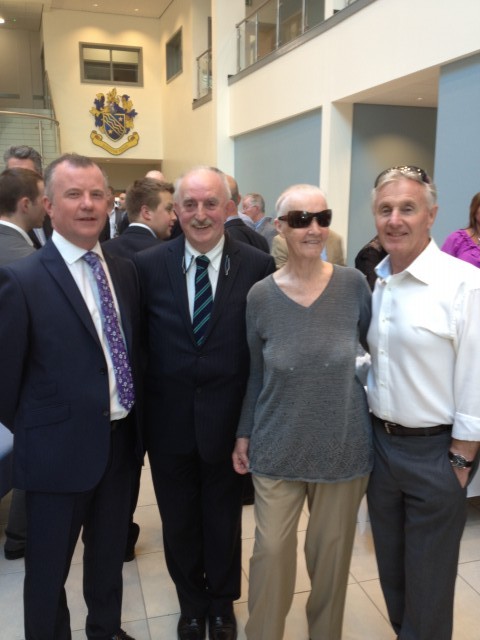
Eddie’s manager, Keith Mallin, myself, and my friends Edmund senior and Kathleen Irvine at BGS. Eddie was interviewed by Pamela Ballantine

Posted in Article | Comments Off on The Business of Sport: Eddie Irvine

Lives of the First World War: Imperial War Museums


IWM & brightsolid partner to create digital platform  

Lives of the First World War

IWM (Imperial War Museums) and brightsolid, Lives of the First World War will hold the stories of over 8 million men and women who served in uniform and worked on the home front. It will be the official place for communities across the world to connect,explore,reveal and share even more about these people’s lives. .

This innovative platform will bring fascinating records from museums, libraries, archives and family collections across the globe together in one place. The team behind Lives of the First World War are working with national and international instutions and archives to make this happen.

Over the course of the centenary, Lives of the First World War will beccome a dynamic, permanent digital memorial-a significant digital legacy for future generations.The platform will go live later this year, in time for the start of centenary commemorations from summer 2014. Further information, including a short film about Lives of the First World War can now be found at  http://www.livesofthefirstworldwar.org

Diane Lees, Director-General of IWM said: “The Imperial War Museum was established while the First World War was still being fought to ensure that future generations would understand the causes and consequences of the war and to remember the men and women who played their role.

“Now that the First World War is outside living memory, we are the voice of those veterans and the custodians of their stories – which we can now tell through Lives of the First World War. We will be encouraging people of all ages,in all communities, to join us in this project to actively remember these men and women.” I am delighted that IWM will be working with brightsolid. Their focuson innovation, their specialism in yelling stories and making history accessible along with their international reach makes them our perfect partner on Lives of the First World War.”

Chris van der Kuyl, Chief Executive of brightsolid said: “We are proud to be working with IWM to create a digital memorial that will be an enduring and fitting tribute to the men and women of the First World War. I am sure that as the centenary approaches, members of the public will deepen these stories by uploading their own content in order to create a rich narrative tapestry for every man or woman whose life was shaped by the War.

“The UK has an incalculable wealth of historical archives. Institutions like IWM are world leaders in making those records available online to millions of people worldwide. We are only beginning to realise the cultural potential of these archives.”

brightsolid’s partnership with IWM consolidates its position as a private sector partner for leading public institutions digitising historical archives. The Group recently launched the British Newspaper Archive in partnership with the British Library, embarking on a project to digitise, and make fully-searchable, up to 40 million historic pages from the national newspaper collection over the next 10 years and has previously delivered the highly successful 1911census.co.uk project in partnership with The National Archives (TNA). In addition, brightsolid is the private sector provider for ScotlandsPeople, a partnership with National Records of Scotland and the Court of the Lord Lyon that serves an integrated online portal for Scottish genealogy records dating back to 1538.  

Lives of the First World War will be a part of IWM’s extensive programme to mark the First World War Centenary. IWM’s programme includes new First World War Galleries at IWM London (opening summer 2014) and a major temporary exhibition at IWM North. IWM is also leading the First World War Centenary Partnership, a growing network of over 1,000 local, national and international cultural and educational organisations spanning 25 countries. The Centenary Partnership will present a four-year vibrant programme of cultural events and activities engaging millions of people across the world. 

First World War Centenary

2014-2018 marks the centenary of the First World War, a landmark anniversary for Britain and the world. IWM will mark the centenary by leading a vibrant, four year programme of cultural activities across the country, including the opening of brand new First World War Galleries at IWM London in 2014. For more information visit www.1914.org

IWM 

IWM (Imperial War Museums) tells the story of people who have lived, fought and died in conflicts involving Britain and the Commonwealth since the First World War.

Our unique Collections, made up of the everyday and the exceptional, reveal stories of people, places, ideas and events. Using these, we tell vivid personal stories and create powerful physical experiences across our five museums that reflect the realities of war as both a destructive and creative force. We challenge people to look at conflict from different perspectives, enriching their understanding of the causes, course and consequences of war and its impact on people’s lives.

IWM’s five branches attract over 2 million visitors each year. IWM London, our flagship branch, is transforming with new First World War Galleries and a new Atrium with large object displays, which will open in summer 2014 to mark the Centenary of the First World War (Please note IWM London is closed until July 2013 when it will partially re-open, and in June 2014 the museum will fully reopen). Our other branches are IWM North, housed in an iconic award-winning building designed by Daniel Libeskind; IWM Duxford, a world-renowned aviation museum and Britain’s best preserved wartime airfield; Churchill War Rooms, housed in Churchill’s secret headquarters below Whitehall; and the Second World War cruiser HMS Belfast


Posted in Article | Comments Off on Lives of the First World War: Imperial War Museums

Donegal ~ Irish Diaspora Conference

DSC_2811DSC_2822

This conference addressed the history, experiences and legacy of the Irish Diaspora.  This history and experience has, over a number of centuries, had a profound effect on the countries to which Irish people migrated and on Ireland itself.  The conference dealt with the experiences and impact of this broad diaspora in different countries and on different continents.  There are broad and indeed individual experiences.  Ireland and its diaspora have a shared, yet a diverse history, as dictated by circumstances.  Its diaspora has become a key resource for Ireland in economic, political and cultural terms, not least as evidenced by its influence on the Irish Peace Process and its contribution to the economic development of the country.  The conference  saught to give an understanding of this important aspect of our history and the experiences of our Irish and indeed Donegal diaspora.  It will addressed the situation of those migrating from Ireland in the present day.  It  addressed a shared history and pointed to a shared future.

DSC_4434DSC_4445

Tuesday June 4th 2013, Letterkenny, Co.Donegal

8.30 – 9.00

Sign in & Refreshments

9.00 – 9.15

Welcome Address & Opening 

Clr. Frank McBrearty, Mayor of the County of Donegal 

9.15 – 9.30

Conference Overview

Mr. Seamus Neely, Manager Donegal County Council 

9.30 – 9.45

Chair Professor Paul Arthur, University of Ulster

9.45 – 10.30


Tír Chonaill and Inis Eoghain (i.e. County Donegal) – Some links with the rest of Europe in the 16th and 17th Centuries’

An Dr Nollaig Ó Muraíle, Roinn na Gaeilge, Aras na Gaeilge,Oliscoil na hEireann, Gaillimh

10.30 – 10.45 

BREAK – TEA & COFFEE

10.45 – 11.30


‘The Donegal Irish in Scotland since the Great War’ 

Professor Tom Devine OBE, Director of the Scottish Centre for Scottish Studies at Edinburgh

11.30 – 12.15 

‘The Venniconian Kingdoms: Donegal’s migratory links to the rest of the North West of Ireland including Ulster Scots migratory patterns’

Dr Ian Adamson OBE, President of the Ullans Academy

12.15 – 1.00

LUNCH


Chair Dr Patrick Fitzgerald, Mellon Centre for Migration Studies Ulster American Folk Park

1.15 -2.00

‘Butte, Montana and the Donegal Connection: McGowan, McDonald, and Boyce in the Mining City’ 

Professor David M. Emmons, Emeritus Professor of History University of Montana

2.00-2.45


‘The Donegal and Irish Migrant Experience in New Zealand’ 

Professor Angela McCarthy, Professor of Scottish and Irish History and Associate Director of the Centre for Irish and Scottish Studies,University of Otago, New Zealand.

2.45 – 3.00 

BREAKTEA & COFFEE

3.00 – 5.00

Panel Discussion – Immigration Reform United States Case Study 

Chair – Frank Galligan Wtiter and Broadcaster

Kevin Cullen Boston Globe  Reporter co-author of “Whitley Bulger: America’s Most Wanted Gangster” and co-author “Betrayal: The Crisis in the Catholic Church”.

Sister Lena Deevy Director Emeritus Irish International Immigrant Centre Boston. 

Michael Patrick MacDonald Author ” All Souls: A Family Story from Southie” & “Easter Rising: A Memoir of Roots and Rebellion”. 

Gene O’Flaherty Massachusetts State Representative. 

Professor Frank Talty Co-Director of the UMass Lowell Centre for Irish Partnerships, for mutual benefit. 

The Hands of History Project is being led by Donegal County Council under the auspices of the Donegal CDB Peace and Reconciliation Partnership.  This project is supported by the Special European Union’s European Regional Development Fund, through the EU programme for Peace and Reconciliation and is managed for the Special EU Programmes Body by Donegal County Council. 


For further information on the conference please contact Donegal County Council 074 9373718.

Posted in Article | Comments Off on Donegal ~ Irish Diaspora Conference

Irish Military History Museum


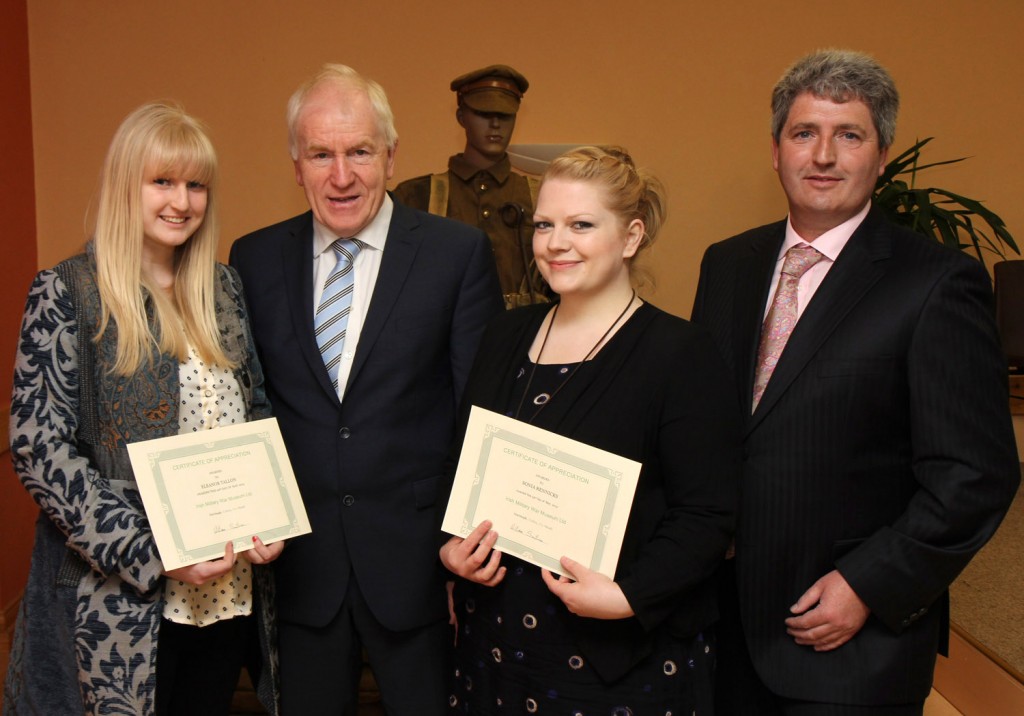
DKIT Students Eleanor Tallon Kentstown and Sonya Rennicks who are pictured here with Minister Jimmy Deenihan TD and Farmer entrepreneur William Sullivan at the sod turning ceremony for The Irish Military History Museum at Broomfield County Meath. The students received certificates for their part in designing a detailed marketing plan for the new business.

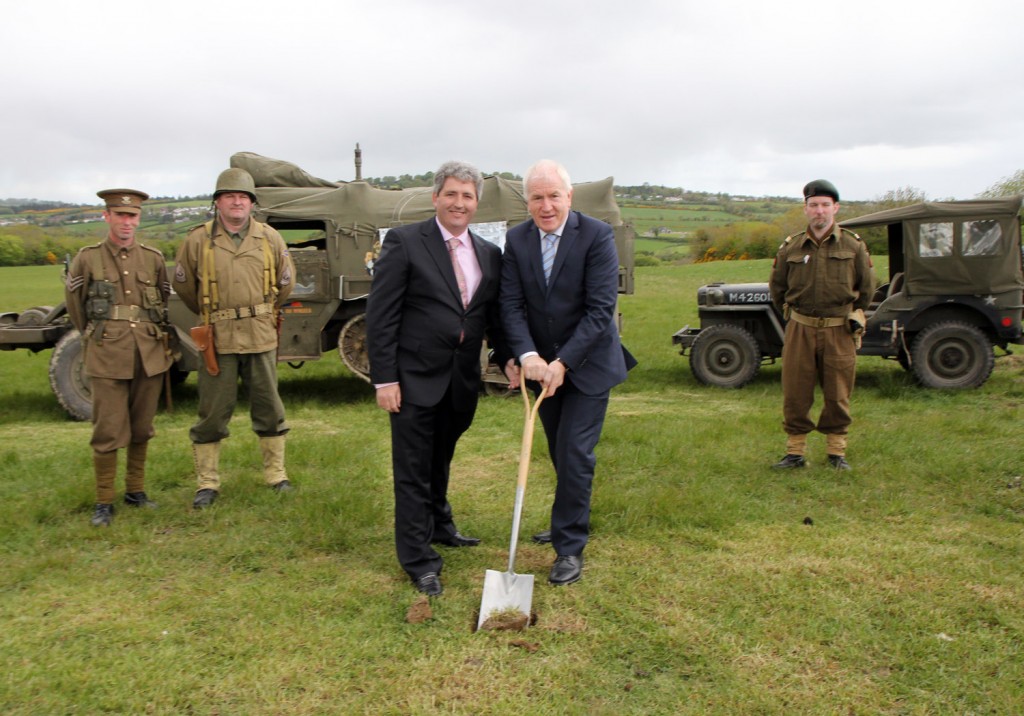
Jimmy Deenihan TD , Minister at the Department of Arts, Heritage and The Gaeltacht and Farmer Entrepreneur William Sullivan are pictured turning the sod for the Irish Military History Museum at Bloomfield County Meath

 
Posted in Article | Comments Off on Irish Military History Museum

The 60th Anniversary of the Coronation of Her Majesty the Queen

After her marriage in 1947, Princess Elizabeth paid formal visits with The Duke of Edinburgh to France and Greece, and in autumn 1951 they toured Canada.

Princess Elizabeth also visited Malta four times while Prince Philip was stationed there on naval duties, and enjoyed the life of a naval wife and young mother.

This way of life was not to last long, as her father’s health was deteriorating. In 1952, King George VI’s illness forced him to abandon his proposed visit to Australia and New Zealand. The Princess, accompanied by Prince Philip, took his place.

On Wednesday, 6 February 1952, Princess Elizabeth received the news of her father’s death and her own accession to the throne, while staying in a remote part of Kenya.

The tour had to be abandoned, and the young Princess flew back to Britain as Queen. She was greeted by Prime Minister Winston Churchill and other officials at the airport.

The Queen’s Coronation took place in Westminster Abbey on 2 June 1953. It was a solemn ceremony conducted by Dr Geoffrey Fisher, Archbishop of Canterbury.

Representatives of the peers, the Commons and all the great public interests in Britain, the Prime Ministers and leading citizens of the other Commonwealth countries, and representatives of foreign states were present.

Crowds of people viewed the procession all along the route, despite heavy rain. The ceremony was also broadcast on radio around the world and, at The Queen’s request, on television for the first time.

Television brought home to hundreds of thousands of people around the Commonwealth the splendour and significance of the Coronation in a way never before possible.

The Coronation was followed by drives through every part of London, a review of the fleet at Spithead, and visits to Scotland, Northern Ireland and Wales.

View details of a major exhibition being held to mark the 60th anniversary of The Queen’s Coronation on the Royal Collection website (opens in new window).


Posted in Article | Comments Off on The 60th Anniversary of the Coronation of Her Majesty the Queen

Service to mark the 60th anniversary of the Coronation – Belfast Cathedral

Belfast Cathedral

The Cathedral Church of St. Anne: Hope in the City 

<!– –>


This afternoon I attended a special service marking the 60th Anniversary of the Coronation of HM Queen Elizabeth II at St Anne’s Cathedral, Belfast at 3.30pm. St Anne’s Cathedral is one of many cathedrals and churches across the UK holding celebratory services to mark the event. The service in Belfast was led by the Dean, The Very Revd John Mann, and the preacher was the former Presbyterian Moderator, the Revd Dr Ivan Patterson. The service, attended by many from across Northern Ireland, included the hymns ‘All people that on earth do dwell’ and ‘Come Holy Ghost our souls inspire’ and other elements taken from the Coronation Service of 1953, including the Introit, ‘O taste, and see, how gracious the Lord is’ (Psalm 34:8) and the anthem ‘Zadok the Priest’ by Handel.

Speaking ahead of this afternoon’s service, Dean John Mann said: ‘This magnificent and symbolic event in 1953 is one that remains in the minds of many people – sometimes for the simple reason that they bought their first television set in order to watch it; or the whole street gathered in the living room of a neighbour who had managed to afford one! It was a different world, a world that has changed rapidly. I hope that in bringing to mind this historic day in celebration in St Anne’s on Sunday, that those recalling it with affection in Belfast may be in joyful mood and uplifted in heart and soul.’


Posted in Article | Comments Off on Service to mark the 60th anniversary of the Coronation – Belfast Cathedral

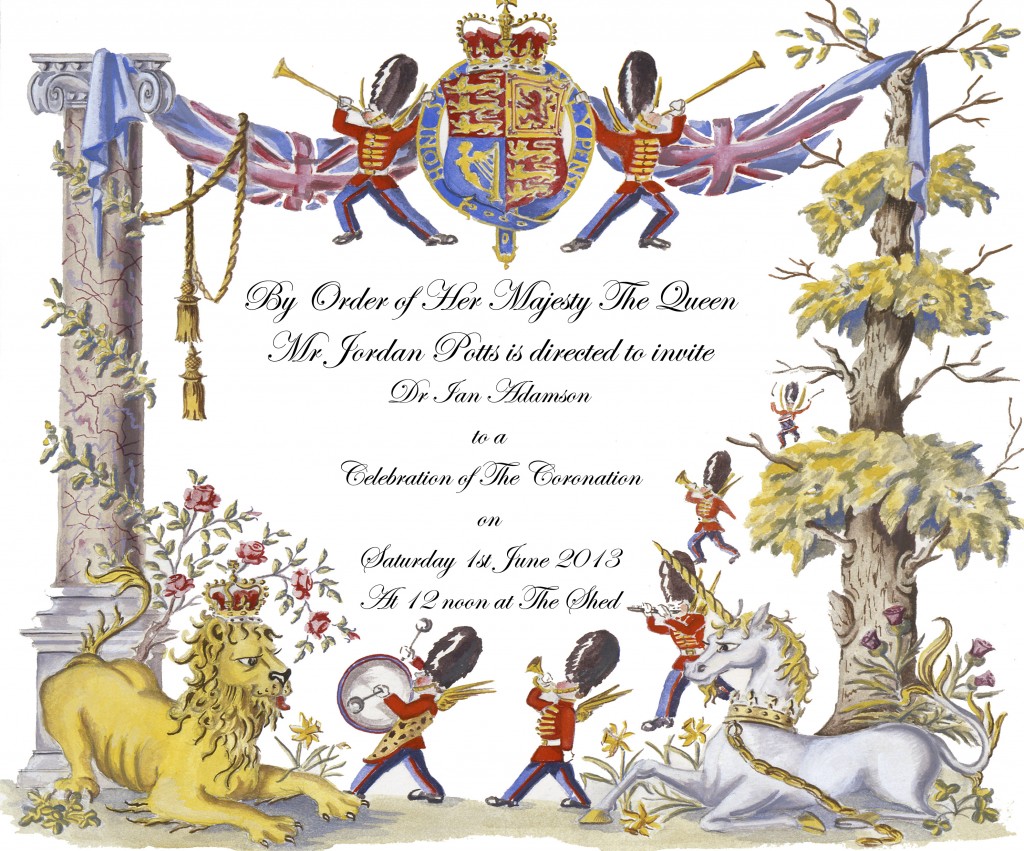
Jordan’s Coronation Party


Photo
PhotoWith Jordan Potts and Her Majesty
PhotoWith Jordan, Her Majesty and her representative, the High Sheriff Brian Kingston
Photo

Jordan, the High Sheriff Brian Kingston and Jim Potts


Posted in Article | Comments Off on Jordan’s Coronation Party