Jesus o Nazareth: Luke 11 v 14-25 – the Ullans

 Yinst, he wus castin oot a divil, an it wus dum. An it cum tae pass, whan the divil haed left him an the man startit tae taak, the fowk wur dumfoonert. But sum o thaim sayed, He casts oot divils throu the pooer o Beelzebub, the heidyin o the divils. But ithers tempted him bi axin him for a sign frae haiven,But he, kenin whut wus in thair mines, sayed,
 
Iverie kingdom divid agin itsel wull gae tae reck an ruin, an a hoose divid agin itsel wull faa doon.
Sae if Satan is divid agin hissel, hoo shall his kingdom stan? fur ye say that A cast oot divils throu Beelzebub.
An if bi Beelzebub A cast oot divils, bi whom dae yer ain fowk cast thaim oot? sae they wull be yer judges.
But if A, wi the fing’r o God, cast oot divils, nae doot the kingdom o God is here amang ye. Whaniver a strang man, wha’s well-airmed, gairds his palace, his belangins is safe:
But whaniver a  man stranger than he attacks him an gets the better o him,  he taks frae him aa the armour he lippens on, an the belangins is aa divid oot.
Him that’s no fir me is agin me an him that is no getherin wi me is scatterin.
Whan the ill spirit is gang oot o a man, he daunders throu the desert lukin fir rest; an findin nane, he says,”A’ll gae bak tae ma hoose whar A was leevin afore.”
An whan he gaes bak, he fins it swep and clain.
 
 
Posted in Article | Comments Off on Jesus o Nazareth: Luke 11 v 14-25 – the Ullans

Victoria Cross recipients at heart of UK Government’s centenary plans

First World War Centenary
Brought to you by the Imperial War Museum
by Kate Clements; August 5, 2013


The Victoria Cross is the highest award for bravery

The UK Government has unveiled the latest stage of its plans to mark the First World War Centenary.

Victoria Cross (VC) recipients will be at the heart of the commemorations.

Special paving stones will be laid in the hometowns of all those in the United Kingdom who were awarded the Victoria Cross. The VC is the highest decoration for bravery under enemy fire.

As part of the four year centenary programme, Communities Secretary Eric Pickles has announced a national competition to design specially commissioned paving stones.

These will be presented to councils in the areas where First World War Victoria Cross recipients were born.

It is hoped that the stones will provide an enduring legacy of local heroes and enable residents to gain a greater understanding of the impact the war had on their community.

Communities Secretary Eric Pickles said:

“It is our duty to remember the British and Commonwealth troops who lost their lives fighting in the Great War and we are determined to make sure their bravery for King and Country is not forgotten.”

Culture Secretary Maria Miller said:

“It is really important that we mark the centenary, which saw some of the darkest days in our history, and remind everyone of the sacrifice that was made – and how it has affected all our lives today.”

Help will be made available for local communities to restore and refurbish their war memorials

With one year to go until commemorations begin, the Government has also announced that more help will be made available for local communities to restore and refurbish their war memorials.

A new website will be created, to help make sure that people across the country can get funding and support so that all First World War memorials are in good condition for November 2018.

Today also sees the launch of a campaign to get 100 employers signed up to the new Centenary Apprenticeship scheme in 100 days.

The aim is to get companies who existed 100 years ago, who focus on crafts with a modern application, to join the scheme.

Find out more about these plans on the DCMS First World War Centenary website.

IWM London has the largest collection of Victoria Crosses in the world on display in The Lord Ashcroft Gallery.


Posted in Article | Comments Off on Victoria Cross recipients at heart of UK Government’s centenary plans

The William Carlton Summer School: 2

Today I attended the 22nd William Carlton Summer School at Corick House, Clogher, County Tyrone. I was accompanied by Helen Brooker, our Chair, who is also my colleague on Pretani Associates, Consultants in Common Identity. This is an amended version of my speech.

It is a pleasure to be here again at the Carlton Summer School, as President of the Ullans Academy (The Academy of Common Identity (Ullans) Ltd). I  enjoyed my last visit several years ago, when I spoke on the subject of the Mythological Yoyagers, JRR Tolkien and CS Lewis. From the 1891 Census we know that 50% of protestants in this area of the Clogher Valley in County Tyrone were Presbyterians and so Ulster Scots would have been commonly spoken here. Although the Plantation Undertakers of the area were English, as Paddy Fitzgerald says, Scottish settlement in the Seventeenth Century was substantial. William Carleton, the 19th-century writer who came from the Clogher Valley, once proudly boasted that he had ‘studiously avoided that intolerable Scoto-Hibernic jargon’. But then Carlton, by the end of his life had managed to offend just about everyone.

He was not alone, however, in his attitude to the Scots language. With the appearance of the Geneva Bible in 1560 (and the Authorized Version of the Bible or King James Bible in 1611) and the Union of the Crowns in 1603 (when James VI of Scots also became James I of England) the prestige and status of Scots declined. John Knox, the Scottish Reformer, was extremely hostile to Scots. Knox viewed Scots as ‘the language of Popery’ because the most formal writing (or the highest register, as a sociolinguist might observe) in Scots was religious and Roman Catholic in content. It was increasingly displaced as the language of government, commerce and writing in both Ulster and Scotland by English because it lacked status and prestige.The Reformation, therefore, essential though it was, could be said to have destroyed Scottish civilisation.

 
The educational system also frowned on Ulster-Scots. As Dr Ivan Herbison of Queen’s University, Belfast, has noted: ‘The new education policy of the 1830s was an additional pressure on Ulster-Scots.  State control of education through the National School system enabled the Anglo-Irish establishment to frame a curriculum which privileged English language, literature and cultural values, and marginalised Ulster’s Scottish cultural heritage’. Marginalization and even denigration of Ulster-Scots was the inevitable result.Scots and Ulster-Scots continued as the language of the home and the countryside but encountered serious prejudice.  This may be evidenced by observations in the Ordnance Survey Memoirs describing Ulster-Scots as ‘disagreeable’ and ‘coarse’.

I was born in Bangor in County Down and reared in Conlig a village between Bangor and Newtownards. When I attended Bangor Grammar School as a boy many thought I came from Ballymena because of my speech, even though Conlig was only 2 miles away  From the hills of Conlig I used to look over at Ayrshire and Galloway on a clear day.  I was descended from the Sloans of Kinelarty through my two grandmothers who were sisters.  One grandfather Robert Kerr from Lanarkshire in Scotland was a devotee of James Keir Hardie and fought for the flame of idealism, and working for socialism and the unemployed.  I travelled extensively in my youth through the Highlands of Scotland with my grandfather, to the Isle of Skye were I was taught the legend of Cuchulainn, to Stornoway on the Isle of Lewis and to Galloway where he taught me about the Covenanters, whom he loved.

I learned that Catholic and Protestant Gaelic speakers on the Scottish Highlands and Islands were in the majority Protestant.  The first book printed in Irish Gaelic was the Book of Common Order commonly called John Knox’s Liturgy, published in Edinburgh in 1567 for the use of Presbyterians.  Scottish Gaelic was not a literary language until the early 17th Century.  Old British was displaced in Ireland by Gaelic just as English Literature displaced Gaelic.  When Gaelic was planted on the British mainland its verbal system was on along the lines of the old British language.  Scottish Gaelic was to preserve archaic features now lost in Irish Gaelic.

The division of Ulster Gaelic from that of the rest of Ireland developed well before the arrival of English in the 17th century and there was an increasing influence of Scottish Gaelic on Ulster.  TF O’Rahilly in 1932 outlined the features which distinguished the two languages and regarded the position of word stress as the most important of these. The southern language of Gaelic stretches from south County Meath running through West Meath to Longford in Co Galway.  This is more than homogenous than the Ulster dialects. Modern Irish Gaelic was basically developed from Munster and Connaught dialects.

In 1770 Ulster Lallans was used by Rhyming Weaver poets until about 1870.  My ancestor Edward Lennox Sloan of Conlig was one of these. These Rhyming Weavers were self taught in Greek and Latin to a level unknown among any section of the peasantry in Western Europe.They were not merely writing in imitation of Robert Burns but in a tradition which went back to Allan Ramsey in Scotland and beyond. Ramsay was a member of the Easy Club along with the Jacobite leader Dr Archibald Pitcairn and had strong Jacobite sympathies following the 1715 rising.  During the occupation of Edinburgh in 1745 he was a highly respected figure but probably disapproved of Prince Charles Edward Stuart’s policy of invading England.  He supported the aims of the French moderate Cardinal Fleury who died shortly before the 1745 Rising was embarked on.

Ramsay lived to influence the Whig “Pacifiers” following defeat at Culloden Moor.  “The Gentle Shepherd” deals with the Restoration of the Stuarts following the Cromwellian interregnum. It contains Jenny an early advocate of Women’s Liberation.   He stands midway between the Scots renaissance poets Henryson, Gawain Douglas and Dunbar and the later Romantic group, of which Burns personifies the French Revolution, Scott is the product of imperial compromise and MacDiarmid adheres to the Russian Revolution.  At first Ramsay appears the least conspicuous but he is the still small voice between the two storms, right at the beginning of the Scottish Enlightenment..

The first known Ulster Scots poet William Starrat of Strabane was closely associated with Ramsay. Indeed nine editions of Ramsay’s “The Gentle Shepherd” were printed in Ulster between 1743 and 1792 (five in Belfast, three in Newry and one in Strabane). When the first edition of Burns’ poems, the Kilmarnock edition, was published in July 1786 , extracts appeared in the Belfast News Letter– the first paper in Ireland to do so. The Edinburgh edition appeared in 1787 and James Magee of Bridge Street, Belfast reprinted and republished it the same year, the first to do so outside Scotland. Indeed extracts from the Ayrshire Ploughman appeared in the News Letter before they were published in book form.

Edward Lennox Sloan (1830–1874) was a Latter-Day Saint editor and publisher. He was the arranger of the text of the hymn “For the Strength of the Hills” into the version currently contained in the hymnal of The Church of Jesus Christ of Latter-Day Saints (LDS Church). But he was also “Uncle Ned”, the Bard of Conlig, to my grannie Isabella Sloan Kerr, who bought me my first book on Robert Burns. Born in the village of Conlig, he was the  son of  John Sloan (1789-1853) and Mary Lennox (1794-Unknown) of Conlig, County Down, Ireland. His father’s first wife died, possibly in childbirth of her third child. Only one of his half siblings is known to have reached adulthood and died in England. Little is known of his older full brother, Samuel Lennox Sloan, Isabella’s antecedent.

Edward was married on 14 April 1853 at Bangor, County Down, Ireland to Mary Elizabeth Wallace, also of Conlig. Their first 6 children were born there, two of them dying before the family emigrated to America in 1863. Their last 5 were born in Utah. In 1865 he married by plural choice, Phoebe Louisa Watts (2 children) & in 1866, Emma Jones (3 Children). His family suffered the loss of many. My two grannies were sisters, so that Edward was “Uncle Ned” to both. Martha (1879-1946) was the eldest, Isabella (1896-1983) the ninth child.  Their father was Alexander Sloan  (1853-1913) , who married, at the age of of 25, Jane Gamble (1858-1937). In Conlig at this time there were three predominent families the Sloans, the Gambles and the Montgomerys. These three families underpinned the community and intermarriage between them resulted in every one being related to everyone else in some way or other.

 
Uncle Ned was trained as a weaver. At some point in his teens, he joined the LDS Church. He was ordained an Elder in the church at age 18 and then served as a missionary throughout the British Isles.  In 1854 he published a volume of poetry he had written, entitled The Bard’s Offering. In 1851, Edward had  married Mary Wallace, who was also a native of Conlig. After having served as editor of the Millenial Star , with his young family, he emigrated to Utah Territory in 1863. They crossed the ocean on the Amazon on which he served as the first counselor in the presidency over the Latter-day Saints on board. He was interviewed on the boat by a young journalist called Charles Dickens. In Utah, Edward was the founder of the Salt Lake  Daily Herald in 1870, which he ran with W.C. Dunbar. When his efforts to get a column on women’s issues included in the Herald were defeated by Dunbar, Edward went ahead and organized the Women’s Exponent with Lula Greene as editor. Edward also published the first City Directory of Salt Lake City.
In his famous directory, Edward  reported that  on January 10, 1870, the Utah Central Railroad was complete to Salt Lake City, its southern terminus. In spite of inclement weather, a huge crowd assembled to hear speeches and witness the ceremonies. The last spike, made of Utah iron, was driven by Brigham Young. This railroad was an immediate success. Most of the mining, manufacturing and trade of the territory was concentrated in Salt Lake Valley, and this connection with the main line of America’s greatest railway, the Union Pacific, at Ogden was vital. Two days after completion, the first carload of ore was shipped over the line. Edward also served as secretary of the Deseret Sunday School Union at the time of its organization in 1872. Prior to the founding of the Herald, he had assisted George Q Cannon in editing the Deseret News. He was also the recorder of many of the discourses included in theJournal of Discourses. Trully Uncle Ned was a great man of the early American West.


In Conlig  I also learned from my Grandmother the story of Archibald Wilson, the Carpenter of Conlig, who was hanged for his part in the United Irish rebellion on 26th  June 1798.   His grave slab in Bangor Abbey graveyard is one of the best preserved in Ireland, so history was always different to me than to many of my friends. History is primarily a record of human relationship with a vast network of variation in the manner of its evolution.  Now is the time to widen its perspective beyond the religious and political divide.  People do not change their minds rather their horizons are widened.  We begin to comprehend that what we thought was the whole of reality is but a small part and that a representation.  Nobody can claim to own reality just as nobody can legitimately claim that theirs is the only view of history.

Common Identity is the total expression of all the inter-relationships within the island of Ireland, which defines who we are. It creates a sense of belonging, which takes people beyond their religious divide. Understanding Common Identity will empower all sections of our community to achieve cultural expression and allow freedom of thought.  Common Identity is neutral and inclusive. The vision of the Ullans Academy is to promote Common Identity so creating stability for the people on the island of Ireland resulting in lasting peace for the benefit of the whole community in Northern Ireland and for future generations. Thank you….


Posted in Article | Comments Off on The William Carlton Summer School: 2

The William Carlton Summer School

Tuesday 6th August (Day Five)Location: Corick House Hotel, Clogher


Augher Castle

09:30am Registration: Tea/coffee
10:15am ‘Language in the Clogher Valley in the 19th Century’. Irish: Dr Ciaran Mac Murchaidh, St Patrick’s Drumcondra. Ulster Scots: Dr Ian Adamson
11:50am Break
12:00 noon President of the William Carleton Society, Jack Johnston: ‘Augher: from landlord, Sir Thomas Ridgeway to George Duffy, the Miller.‘
12:45pm Lunch


Augher cornmill, where George Duffy was a miller.

2:15pm Josephine Treanor tells the story of her relative, mentioned by Carleton:
‘Anne Duffy, the Miller’s daughter from Augher‘
3:00pm Break
3:15pm ‘Carleton’s influence on modern Irish literature’.
Literary Symposium with Ciaran Collins, Patricia Craig, Anthony Quinn and Tony Bailie.
4:15pm Tea/coffee break
4:30pm Seminar continues & discussion to close of session 6:00pm.

7.00pm Walk on the Carleton Trail with the Clogher Valley Ramblers.
8:30pm Junior Ulster Scots Pipes & Drums; Bagpipers Jim Brady & Frank Gildernew; traditional music with the McKenna Family (Clogher) at Somers Cafe, Fardross, Clogher (off A4 road). Wine and cheese reception sponsored by Daly’s SuperValu Aughnacloy. Admission FREE

Dr Ciarán Mac Murchaidh
Before his appointment as Dean of Research & Humanities, Ciarán Mac Murchaidh was Senior Lecturer in the Department of Irish at St Patrick’s College, Drumcondra. His principal teaching and research interests lie in the area of 18th century religious literature in Irish.

His grammar of the Irish language for undergraduate students, ‘Cruinnscríobh na Gaeilge’ (Cois Life) was published in 2002, the fourth edition of which appeared in 2012. He was editor of a general collection of essays in English on the importance of the Irish language in 2004, ‘Who needs Irish? Reflections on the importance of the Irish language today’ (Veritas). Dr Mac Murchaidh has also published two bilingual and thematic anthologies of Irish language poetry. Among his latest publications is a volume of essays on the interface between the Irish and English languages, co-edited with Professor James Kelly: ‘Essays on the Irish linguistic and cultural frontier, 1600-1900’ (Four Courts, 2012).

Ian Adamson
is a former Lord Mayor of Belfast and former Ulster Unionist Councillor. He is a retired medical doctor. He studied at Bangor Grammar School, then Queen’s University Belfast.

He speaks ten languages, including Scots, Lakota Sioux and Swahili. He is founder Chair of the Ulster-Scots Language Society, and remains a Vice-President. In association with Professor Robert Gregg in 1992, he founded the Ulster-Scots (Ullans) Academy.

He is the author of several books on subjects, such as folk poetry, history and religion. He is the author of ‘The Cruthin’ (1974), laying claims to Ulster descent from a pre-Gaelic people in Ireland. He also wrote ‘The Identity of Ulster’ (1982), and other works dealing with the ethnology of a group of pre-Celtic settlers in Ulster whose mentality is said to pervade the modern province.

He is President of Belfast Civic Trust, founder Chair of The Somme Association and a founder of the Farset Youth and Community Development group in Belfast.

Jack Johnston
is President of the William Carleton Society and a former Director of the Summer School. He was a former Chairman of the Ulster Local History Trust. Jack has written and lectured widely on local history, and has a particular knowledge of his native Clogher Valley. His publications include articles in a wide range of journals while he has edited local studies in Cavan, Monaghan, Tyrone, Fermanagh and Sligo. One of his earliest articles was ‘The Hedge Schools of Tyrone and Monaghan’ in the Clogher Record, (1969). He has planted over 100 trees and was one of the first to introduce the Texel breed of sheep to County Tyrone. His tours of the local area have been a popular part of the annual Summer School.

Josephine Treanor
is originally from Clogher, Co. Tyrone but has lived in North Monaghan for the past twenty five years where she was nominated for the Monaghan Person of the Year in 2003 for her contribution to Community Development and Peace Building Projects within the County. A graduate of Queen’s University Belfast, she is currently employed by Clones Regeneration Partnership and Castleblayney Arts & Community Development Company. Josephine is a great great grand daughter of Anne Duffy and has always been fascinated by the link with William Carleton. She has had several short stories published in national publications and her contribution to this year’s Summer School is a short story based on Anne Duffy’s account of William Carleton’s visit to her marital home in Ballyscally, Clogher in 1847.

Ciarán Collins
grew up in the village of Innishannon, Co. Cork. He studied English and Irish at University College Cork, and completed an MA in 2001, specialising in Modern Drama, especially the work of Tom Murphy, Brian Friel, Eugene O’Neill, Arthur Miller, David Mamet and Marsha Norman.

In 2003 he began his career as a secondary school teacher of English and Irish in South Dublin and in 2009 moved back to County Cork to take up a post at his alma mater in Bandon. He lives in Kinsale with his wife and has one daughter.

‘The Gamal’ is his first novel and is published by Bloomsbury Circus. Before writing ‘The Gamal’ he had written a couple of plays and some short stories. He is currently working on his second novel, another play, a screenplay and writes an occasional short story.

Patricia Craig
is from Belfast. She moved to London in the 1960s but always retained strong links with her native city, returning to live in Northern Ireland in 1999. She was a guest at the Summer School in 1999. A leading literary critic and anthologist, she regularly contributes to the Independent, London Review of Books, Times Literary Supplement, Irish Times and New Statesman, and has appeared on various television and radio programmes.

She is the author of ‘Brian Moore: A Biography’ (Bloomsbury, 2002) and has edited many anthologies, including ‘The Oxford Book of Ireland’ (Oxford University Press, 1998), ‘The Rattle of the North’ (Blackstaff, 1992), ‘The Belfast Anthology’ (Blackstaff, 1999) and ‘The Ulster Anthology’ (Blackstaff, 2006).

Her other works include ‘Asking For Trouble’ (Blackstaff, 2008), a memoir of a teenage escapade with disproportionate consequences growing up in 1950s Belfast and more recently ‘A Twisted Root’ (Blackstaff, 2012) in which she traces the remarkable stories of her ancestors from different traditions.

Anthony Quinn
was born in 1971 in the Clogher Valley and after completing an English degree at Queen’s University and a Masters in Social Work followed various callings – social worker, counsellor, lecturer, organic market gardener – before becoming a journalist. His short stories have been short-listed twice for a Hennessy/New Irish Writing Award. He was also the runner-up in a Sunday Times New Food Writer competition.

‘Disappeared’, his first novel, was published in 2012 by the Mysterious Press, New York, and has been nominated for a Strand Best Debut Award by book critics at the Washington Post, the LA Times, the San Francisco Chronicle and the Guardian. ‘Border Angels’, the sequel, is due to be published on October 22, 2013.

Tony Bailie
from Co. Down is a novelist, poet, and journalist. His third novel ‘A Verse to Murder’ was published as an ebook in October 2012. His previous two novels, ‘Ecopunks’ (2010) and ‘The Lost Chord’ (2006) were both published in paperback by Lagan Press.

He has also written two collection of poems, ‘Coill’, (2005) and ‘Tranquillity of Stone’ (2010) both published by Lapwing Publication.

His story ‘The Druid’s Dance’ appeared in the award-winning Irish crime-fiction anthology ‘Requiems for the Departed’, published in June 2010 by Morrigan Books. Individual poems and short stories have been published in various journals and magazines including Verbal, Boyne Berries, Books Ireland, Crannog, and Revival.

He works as a journalist for The Irish News and has also written for the Guardian, the Irish Independent and reviews for The New York Journal of Books.

The Mc Kenna Family

have become a household name in Irish traditional music both locally and nationally, where they have enjoyed playing at functions, fleadhs and festivals across the country. Their solid traditional style of music is played at a standard which defies their young age. They are the current All Ireland Trio champions on fiddle, uileann pipes and concertina. They have starred in American television as backing musicians in the production of Irish documentary Coast to Coast , Ceili House radio programme and the Heather Breeze. They comprise James on concertina, Eugene on fiddle, Peter on uileann pipes and tin whistle, Sinéad on flute, fiddle, guitar and traditional singing, Martin (their father) on banjo, Daniel on button accordion and 7 year-old Ciarán on the tin whistle.


Posted in Article | Comments Off on The William Carlton Summer School

Think tank British Future urges Britain: Do mention the war


http://www.1914.org/wp-content/uploads/2013/08/Brit-Fut-214x300.jpg 

Research shows work still to be done to raise awareness about First World War

by Kate Clements; August 5, 2013 

Think tank British Future urges Britain: Do mention the war 

Just a year before the centenary of the First World War, most Britons struggle to tell the two world wars apart, a new report by the think tank British Future reveals.

But they also challenge Britons to use the centenary of the war as a chance to learn the history that shaped the country we are today.

‘Do Mention the War’ features polling carried out for British Future by YouGov, which found that: 

– More people think Britain declared war in August 1914 because Germany invaded Poland (as was the case in 1939) than Belgium: only 13% knew the right answer. 

– 81% do know that Germany was an enemy of Britain in 1914 – but 8% of the under-24s believe that Britain and Germany were allies in the Great War trenches. 

– 47% do know that it was the assassination of Archduke Franz Ferdinand that sparked the First World War – but with a big gender gap, with 39% of women knowing this, compared to 58% of men.

– More people chose Neville Chamberlain than Herbert Asquith as the man who was in Downing Street in 1914, but most people couldn’t guess.

 17% know that Lloyd George was Prime Minister when the war ended – but 7% of the under-24s think Margaret Thatcher was PM in 1918. 

The think tank’s research into public attitudes around the country finds a strong commitment to using the centenary to learn more about how the war changed Britain. 

Director of British Future, Sunder Katwala, said:  “Most people do know that there was a
war in 1914, and four out of five of us that Germany was an enemy then. Most can identify France and America as allies too, but almost everything else is minority knowledge.” 

Diane Lees, Director-General of Imperial War Museums, said: “This is the first major anniversary of the First World War without any living veterans or eyewitnesses alive who can give us new insights into their experiences. It’s for the generations alive today to make the centenary into an anniversary with meaning.” 

Posted in Article | Comments Off on Think tank British Future urges Britain: Do mention the war

EI Sports: Team Endurance

SUNDAY 4TH AUGUST
6.30pm
OPEN TEAM ENDURANCE RACE

120 min Kart Endurance Race
120 min Le Mans Simulator Race

10 TEAMS – 4 DRIVERS PER TEAM
£20 PER PERSON
 

To enter a team or if you require further information call:
02891 451457


Posted in Article | Comments Off on EI Sports: Team Endurance

Van at Notodden Blues Festival

Notodden

Posted in Article | Comments Off on Van at Notodden Blues Festival

We Deserve Better – Role for new Civic Forum in Reconciliation: Declan Kearney

We Deserve Better – Role for new Civic Forum in Reconciliation. 

Richard Haass made an advance trip to the North last week, before the all-Party talks he will chair.  His appointment is a welcome development.

Whilst the timing of his visit was unconnected to the post Twelfth violence in Belfast, the coincidence is another reminder that we have still to fully embrace a spirit and culture of dialogue here. This is essential to give effect to the fundamental principles of the Good Friday Agreement, parity of esteem, mutual respect, and equal treatment.

If Haass can inspire an acceptance by all Parties and sections of our community of the need for proper engagement his efforts will be worthwhile.

There is an urgent need for fresh thinking and new ideas.

The post Twelfth violence was demoralising for all reasonable people. However,the bogus attempts to rationalise itas a response to a cultural war by republicans represent for some, a desire to resurrect a failed past and to avoid giving leadership for a shared future.

A historical context exists.  Violence and contested parades has a 200-year history in Belfast, in reaction to political and demographic change.

A huge sectarian fault line divides our people in the north.  From partition, this state was based on “them and us” segregation.

The sustained focus upon equality arises because inequality existed.  Fifteen years after the Good Friday Agreement, we must now agree the practical meaning of equality, respect and parity of esteem.

Orange traditions and the British identity deserve respect.  So too do the Irish identity and republican tradition.  None need lose out. But sectarian abuse, violence or intolerance can be no part of either.

Equality and parity of esteem are not about winners and losers.  Their basis rests in democratic compromise and accommodation, agreed through engagement and dialogue.

That means unionists and republicans listening to each other’s fears and suspicions, real and imagined, and seeking solutions.

To accept that the current status quo is as good as it gets, means settling for less

Our people regardless of political allegiance, and those of all faiths and none, deserve better.

Republicans and unionists can become guarantors for a new phase of the Peace Process.

That is a phase based upon reconciliation, new human and political relationships, and building trust.

We can do this with united political leadership and a focus on big thinking and bold initiatives to tackle sectarianism and segregation; and entrench equality, respect and parity of esteem for every citizen.

I believe that is what the great majority of our people want.

It will not be easy.  “Uncomfortable conversations” will be unavoidable, but discussion threatens no one.

There is a moral imperative to ensure future generations grow up in a better place than we did.

There is also broad agreement our society needs reconciliation. 

That represents common ground.

An inclusive healing process isrequired to address the suffering caused during the conflict.

It is an uncomfortable conversation in itself to accept the suffering of each other and the context of actions, practices and injustices, which created that pain.

An initiative of common acknowledgement by all sides – British, Irish, republican and unionist – of the hurt and injustices caused by and to each other could introduce a powerful new dynamic to the Peace Process.  It could encourage healing and create space for friendship, trust and forgiveness to grow.

It would challenge us all – but that is what conflict resolution is about.  That is leadership.

Reconciliation must not be reduced to a poker game about the past. 

Unless we can agree to decommission the past as a political weapon it will continue to destabilise the present and future.

Colin Parry, whose son the IRA killed in Warrington, said courageously, “Seeking personal justice may not always sit well with the search for peace.  You may have to set aside your own goals for the greater good.”

That may provoke uncomfortable feelings for some.  However, we need a new framework for dealing with the past.

As a community we should begin inclusive discussions about the decisions and possible compromises required to stop the past holding back the future.  We need to work out what truth and justice mean, and whether or not they can be achieved, and with maximum cooperation from all sides.

Sinn Fein believes our relationship with the past will be enabled with an authentic reconciliation process.

Our collective priority must be to do our best to heal our community’s wounds.

Many things happened which we may all wish had been done differently or not at all.  As a society, we have much to forgive and have forgiven.

Archbishop Tutu advised, “Having looked the beast in the eye, having asked and received forgiveness, let us shut the door on the past, not to forget, but to allow it not to imprison us.”

There is no design plan for reconciliation, but we all share a responsibility, as churches, academics, business, civic society, and politicians to give leadership in spite of opposition and adversity. I believe the Civic Forum should be re-established as a vehicle to progress that task.

We have a strategic choice to make, to stay as we are or open a new phase of the Peace Process, which embraces reconciliation, promotes friendship, and guarantees equality and parity of esteem.

Posted in Article | Comments Off on We Deserve Better – Role for new Civic Forum in Reconciliation: Declan Kearney

A Vision for Belfast: 2 The Lord Mayor of Belfast Máirtín Ó Muilleoir


NewBelfast.com
Blog of Belfast’s Lord Mayor, Máirtín Ó Muilleoir
Follow Máirtín on Twitter and LinkedIn

Vision-1170x779


Former Lord Mayor of Belfast and Ullans Academy founder Dr Ian Adamson uttered the four most beautiful words in the English language at the launch this morning of my Vision for Belfast (he repeated the words in Irish where they are the most beautiful in that tongue too).

“The war is over,” went one line in a special poem he penned for the occasion, “Tá an cogadh thart.”

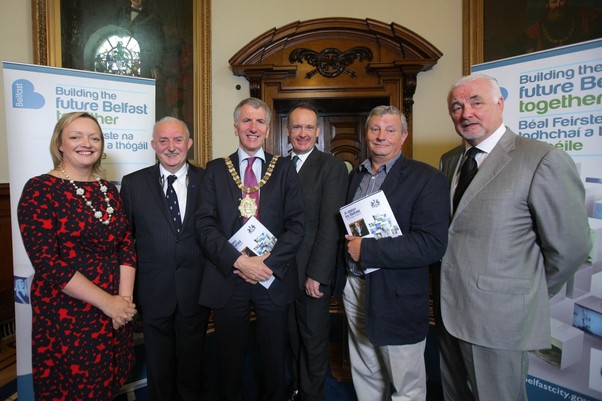
Ian’s moving ode to a peaceful Belfast was but one highlight among many as five of our outstanding civic leaders lined out to endorse my call to Build the Future Belfast — Together.

ICTU General Secretary Peter Bunting gave voice to the workers when he demanded an end to unemployment; Maze-Long Kesh Panel Chairman Terence Brannigan vowed to do everything possible to assure all could enjoy the dignity of work; Howard Hastings, Chair of NI Tourist Board pledged more ‘wow’ moments like the World Police and Fire Games, while Mary Trainor-Nagele, CEO of Arts & Business welcomed the appointment of the first-ever Belfast Poet Laureate — Sinéad Morrissey.

You can read the fine detail of the Vision online and while this isn’t everything we’ll do in the time ahead, there’s a fair bit crammed in there for the remaining 43 weeks and five days (not that I’m counting) of my term. If I had to summarise: the Vision is about belief in Belfast, confidence in the people of Belfast, boundless ambition for our future and a determination to deliver a peace dividend for all.

And that peace dividend will be for all. As Belfast Poet Laureate Sinéad Morrissey read us out with Cycling At Sea Level from her collection ‘Through the Square Window’ (and Waterstones note: you had only two volumes of Sinéad’s poetry on the shelves this morning, both are now gone), she went toe-to-toe with Ian Adamson with her own tribute to the peace:

“this single moment framed, what passes under a wheel’s

circumference,

or the curlew’s vanishing question in the sand:

for me, for me, for me?


Since the launch of the Vision for Belfast, I have had the thrill of attending the opening of the World Police and Fire Games and the good fortune to be invited over to the Shore Road to meet with community builders working at the very coalface. My visit was hosted by Heather Morris, the first woman President of the Methodist Church in Ireland and among those I met was Alison Clarke whose teenage son Dean took his own life in 2007. Since then she has set up a the Dean Clarke foundation which provides opportunities for young people who find themselves on the margins. An inspirational woman.


Stay in touch at my website www.newbelfast.com.

 
Posted in Article | Comments Off on A Vision for Belfast: 2 The Lord Mayor of Belfast Máirtín Ó Muilleoir

A Vision for Belfast: The Lord Mayor of Belfast Máirtín Ó Muilleoir

 
http://www.belfastcity.gov.uk/images/shim.gif
 
The Lord Mayor of Belfast Máirtín Ó Muilleoir invited my colleague in Pretani Associates, Helen Brooker, and me to the launch of ‘A Vision for Belfast’ in the Reception Room, Belfast City Hall today Wednesday 31 July 2013 at 10.30am
 
Helen is also Chair of the Ullans Academy, the Academy of Common Identity (Ullans) Ltd, of which I am President.
 

Cuireann Ard-Mhéara Bhéal Feirste Máirtín Ó Muilleoir fáilte romhat chuig seoladh ‘Fís do Bhéal Feirste’.
Seomra Fáiltithe, Halla na Cathrach.
10.30rn Dé Céadoine 31 Iúil 2013

Caithfear an cuireadh seo a thaispeáint ar Halla na Cathrach a shroiceadh.
Tá líon teoranta spásanna páirceála ar fáil do dhaoine faoi mhíchumas amháin. 

Launch of Lord Mayor’s Vision Document

Wednesday 31 July 2013 at 10.30 am

in Reception Room 

Programme 

10.30 am         Arrival of Guests 

                        Tea/Coffee/Scones served at Rotunda on arrival 

                        Background music by Gary Duffy and musicians from Cultúrlann McAdam Ó Fiaich 

10.45 am         Guests to proceed to Reception Room 

10.50 am         Lord Mayor to introduce event 

11:00 am         Short remarks by:

                        Mr Terence Brannigan  – Business Leader

(Job Creation) 

                        Dr Howard Hastings OBE  – Chairman NITB

(‘Belfast Day’ / Civic Life) 

                        Ms Mary Trainor- Nagele – Director of Arts and Business Northern Ireland

(Arts/Culture) 

                        Dr Ian Adamson OBE – Chairman of Somme Association

(Shared Belfast) 

                        Mr Peter Bunting – Assistant General Secretary of the Irish Congress of Trade

 Unions

(Poverty/Trade Union) 

11:25 am         Poet Laureate, Dr Sinead Morrissey, to conclude the event by reading a poem 

Notes:             Guests will be provided with a copy of the Vision document as they enter the Reception Room

http://www.belfastcity.gov.uk/images/shim.gif


Posted in Article | Comments Off on A Vision for Belfast: The Lord Mayor of Belfast Máirtín Ó Muilleoir