Ambassador’s Message – Irish Memorial Dedication Ceremony, South Korea 25th April

Embedded image permalink

Of course it rained. What Irish event would be complete without rain? So we sat under marquees avoiding the drips instead of being protected from the hoped for sun at our dedication ceremony yesterday morning. Our Embassy staff were busy with place names and all the myriad details that make an event unfold smoothly. The site had been checked and rechecked by Carol Walker of the Somme Association and Trevor Ross of the Royal Ulster Rifles Association and Colour Sergeant of the Royal Irish Regiment. The podium was put in place and sound system checked.

We assembled under gray skies: the Ministers for Veterans Affairs of the RoK and Canada, Mr Park Sung-choon and Mr Steven Blaney; the Ambassadors and Defence Attachés of Britain, Canada, New Zealand and Australia; Director of the War Memorial of Korea, Mr Sun Young-jae; Deputy Director of Foreign Intelligence, Korean Defense Intelligence Agency, Brigadier Moon Yong-seok; Chairman of United Nations Korean War Allies Association, Mr Chi Kap-jong; Director of 60th Anniversary of Korean War Commemoration Group, Ministry of National Defense, Brigadier General Park Young-bae; Chief Warrant Officer, Oliver Cunningham, of the US Forces and native son of Ireland; Father Donal O’Keefe representing the Columban Order; Lt Col Owen Lyttle of the Royal Irish Regiment and his NCOs and soldiers, resplendent in their caubeens and dark green dress uniforms with scarlet sashes.

As we took our seats, the RIR piper led the procession of veterans and their escorts down the ramp that sweeps into the recessed memorial cove under the looming Seoul War Memorial. Carol Walker of the Somme Association acted as MC and I gave the opening address, below, translated into Korean by our own Kevin O’Rourke, retired Columban Father, writer and professor of Korean literature. Minister Park of Patriots and Veterans Affairs as well as the Director of the War Memorial spoke, recognising the Irish contribution, particularly at Happy Valley.

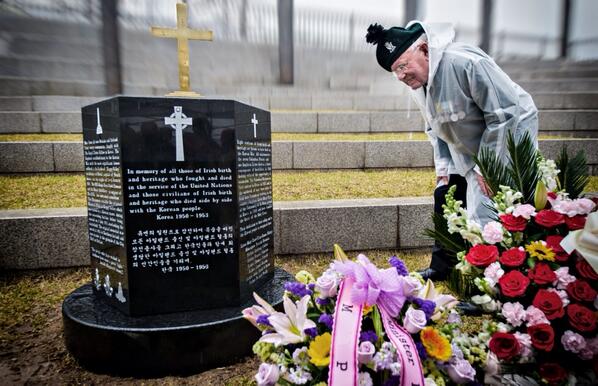
The memorial itself was unveiled by Ranger Geoffrey Edgar, veteran Albert Morrow, Sister Catherine Oh of the Anglican sisters and Stephanie McNamara, niece of Columban priest Thomas Cusack. Canon Jennings placed the brass cross, made from spent shell casings from the battlefields of Korea, beside our Memorial and offered his prayers.

There was a hush as veteran Mark McConnell was brought forward to recite his beautiful and rending Korean Lament. His strong and clear recitation was deeply felt by all. Fourteen wreaths were laid, the ritual officiated smartly and solemnly by the RIR. Father Mick McCarthy of the Columban Order, still serving in Korea after fifty years, laid one on behalf of the seven Columban Fathers who died during the War. Henry O’Kane, veteran, ex-POW and author of O’Kane’s War, laid the wreath on behalf of the veterans.

The dedication of the Irish Memorial is very appropriate this year. It is eighty years since the Columbans arrived in Korea, sixty since the end of the Korean War and thirty since we established diplomatic relations.

With this Memorial in place at the Memorial of the Korean War, Seoul, the memory of those of Irish birth and heritage who lost their lives here and those who fought for Korea’s freedom will not be forgotten. The Memorial will serve as a focal point for annual commemorations, for visitors who will come to search for it and for the casual visitor who will come upon it.

The project to erect the Memorial was a collective effort; by the Irish Government, the Embassy here in Seoul, the Somme Association, the Royal Ulster Rifles Association, the Royal Irish Regiment and the Irish Association of Korea.

Over the last week it was wonderful to meet the veterans and encounter in those conversations the living tradition of Irish recruitment to the armed services of Britain and the Commonwealth, not to mention other Diaspora destinations like the US, by Dublin men and men from our towns and villages, by our emigrants and our emigrant generations. It is a part of our history that is rich and exciting to explore as we approach the anniversaries of our State’s founding in the years ahead.

On my own behalf and on behalf of the Deputy Head of Mission, Ruth Parkin, my wife Mary and all the staff at the Embassy, I would like to say what a pleasure it was to work with our partners on this. And as someone who formerly was involved in the Irish peace process, it was great to experience such a collective effort by people from all the different traditions and identities on the island of Ireland. We worked united in good will and dedication to the preservation of the memory of those who made in the greatest sacrifice in the name of enduring ideals.

Finally, I wish to thank our sponsors, the Irish Government’s Emigrant Support Programme, the fundraisers at the Somme Association and Irish Association of Korea, Hanwha Chemical, Hyundai Motors, Standard Chartered Bank and Korean Air whose generous support made this project and its associated revisit for Irish veterans possible.

You can see photos of the event at our Twitter Account at @IrishEmbKorea.

[Dedication Ceremony / Thursday, 25 April 2013 – Presiding Remarks / H.E. Dr. Eamonn McKee, Ambassador of Ireland to the Republic of Korea]

[Greetings and thanks]

We have gathered here in this quiet dell, on the hallowed ground of the War Memorial of Korea, to honour and remember those of Irish birth and heritage who died in the Korean War.

It is a stone monument because stone is an enduring material and we inscribe on it memories that must not be lost to time.

It is a simple plinth topped by an image of the island of Ireland. For the Irish of birth and heritage, irrespective of their affiliation with an identity or another citizenship, the island of Ireland is home, the repository of our culture, our community, our family roots and our sense of what we are.

It is a hexagon because each facet serves to commemorate a particular aspect of the Irish contribution to the Korean War.

We recall the Irish missionaries who came to Korea, built communities through faith and compassion and who, in the dark hours of war, refused to leave those communities.

We recall those of Irish birth who joined Irish regiments in the British Army and who shipped under the UN flag to Korea as part of the Commonwealth forces; and those who had emigrated to America and came here with US forces. Ireland’s tide of emigration carried many into the armed services of the many countries that would fight here under the UN flag.

We recall those of Irish heritage who fought in so many and in such large numbers of the UN Command, predominantly British and US forces but also in Canadian, Australian and New Zealand units. Their sense of being Irish, of Irish stock and character, was a strong feature of their identity.

In Ireland, we value and guard that sense of Irishness, the sense of belonging for all of our Diaspora. And we do so here today.

This monument will bear symbols. They are symbols of a complex Irish historical narrative where Irish identity can mean different affiliations, different identities and different perspectives.

Because of the Irish peace process and the historic reconciliation between the people of Ireland and Britain, we can embrace all of those traditions and identities are part of the story of Ireland, part of what we are.

This is a work in progress. The unveiling of this monument is part of that process, a recovery and an acknowledgement of the service rendered in the armies of other nations, in the service of the United Nations.

Unveiling this stone monument is a simple act but it is symbolic of so much more.

It is a reverential acknowledgement of the role of the Irish in the Korean War.

It is a testament to the Ireland’s complex history and our embrace of that complexity.

Above all it is a remembrance that Irish lives were given in compassion and service to the people of Korea, in the defence of freedom and in the cause of the United Nations.

Thank you.

Ambassador’s Message – Irish Memorial Dedication Ceremony, 25th April

26 April 2013

Of course it rained. What Irish event would be complete without rain? So we sat under marquees avoiding the drips instead of being protected from the hoped for sun at our dedication ceremony yesterday morning. Our Embassy staff were busy with place names and all the myriad details that make an event unfold smoothly. The site had been checked and rechecked by Carol Walker of the Somme Association and Trevor Ross of the Royal Ulster Rifles Association and Colour Sergeant of the Royal Irish Regiment. The podium was put in place and sound system checked.

We assembled under gray skies: the Ministers for Veterans Affairs of the RoK and Canada, Mr Park Sung-choon and Mr Steven Blaney; the Ambassadors and Defence Attachés of Britain, Canada, New Zealand and Australia; Director of the War Memorial of Korea, Mr Sun Young-jae; Deputy Director of Foreign Intelligence, Korean Defense Intelligence Agency, Brigadier Moon Yong-seok; Chairman of United Nations Korean War Allies Association, Mr Chi Kap-jong; Director of 60th Anniversary of Korean War Commemoration Group, Ministry of National Defense, Brigadier General Park Young-bae; Chief Warrant Officer, Oliver Cunningham, of the US Forces and native son of Ireland; Father Donal O’Keefe representing the Columban Order; Lt Col Owen Lyttle of the Royal Irish Regiment and his NCOs and soldiers, resplendent in their caubeens and dark green dress uniforms with scarlet sashes.

As we took our seats, the RIR piper led the procession of veterans and their escorts down the ramp that sweeps into the recessed memorial cove under the looming Seoul War Memorial. Carol Walker of the Somme Association acted as MC and I gave the opening address, below, translated into Korean by our own Kevin O’Rourke, retired Columban Father, writer and professor of Korean literature. Minister Park of Patriots and Veterans Affairs as well as the Director of the War Memorial spoke, recognising the Irish contribution, particularly at Happy Valley.

The memorial itself was unveiled by Ranger Geoffrey Edgar, veteran Albert Morrow, Sister Catherine Oh of the Anglican sisters and Stephanie McNamara, niece of Columban priest Thomas Cusack. Canon Jennings placed the brass cross, made from spent shell casings from the battlefields of Korea, beside our Memorial and offered his prayers.

There was a hush as veteran Mark McConnell was brought forward to recite his beautiful and rending Korean Lament. His strong and clear recitation was deeply felt by all. Fourteen wreaths were laid, the ritual officiated smartly and solemnly by the RIR. Father Mick McCarthy of the Columban Order, still serving in Korea after fifty years, laid one on behalf of the seven Columban Fathers who died during the War. Henry O’Kane, veteran, ex-POW and author of O’Kane’s War, laid the wreath on behalf of the veterans.

The dedication of the Irish Memorial is very appropriate this year. It is eighty years since the Columbans arrived in Korea, sixty since the end of the Korean War and thirty since we established diplomatic relations.

With this Memorial in place at the Memorial of the Korean War, Seoul, the memory of those of Irish birth and heritage who lost their lives here and those who fought for Korea’s freedom will not be forgotten. The Memorial will serve as a focal point for annual commemorations, for visitors who will come to search for it and for the casual visitor who will come upon it.

The project to erect the Memorial was a collective effort; by the Irish Government, the Embassy here in Seoul, the Somme Association, the Royal Ulster Rifles Association, the Royal Irish Regiment and the Irish Association of Korea.

Over the last week it was wonderful to meet the veterans and encounter in those conversations the living tradition of Irish recruitment to the armed services of Britain and the Commonwealth, not to mention other Diaspora destinations like the US, by Dublin men and men from our towns and villages, by our emigrants and our emigrant generations. It is a part of our history that is rich and exciting to explore as we approach the anniversaries of our State’s founding in the years ahead.

On my own behalf and on behalf of the Deputy Head of Mission, Ruth Parkin, my wife Mary and all the staff at the Embassy, I would like to say what a pleasure it was to work with our partners on this. And as someone who formerly was involved in the Irish peace process, it was great to experience such a collective effort by people from all the different traditions and identities on the island of Ireland. We worked united in good will and dedication to the preservation of the memory of those who made in the greatest sacrifice in the name of enduring ideals.

Finally, I wish to thank our sponsors, the Irish Government’s Emigrant Support Programme, the fundraisers at the Somme Association and Irish Association of Korea, Hanwha Chemical, Hyundai Motors, Standard Chartered Bank and Korean Air whose generous support made this project and its associated revisit for Irish veterans possible.

You can see photos of the event at our Twitter Account at @IrishEmbKorea.

[Dedication Ceremony / Thursday, 25 April 2013 – Presiding Remarks / H.E. Dr. Eamonn McKee, Ambassador of Ireland to the Republic of Korea]

[Greetings and thanks]

We have gathered here in this quiet dell, on the hallowed ground of the War Memorial of Korea, to honour and remember those of Irish birth and heritage who died in the Korean War.

It is a stone monument because stone is an enduring material and we inscribe on it memories that must not be lost to time.

It is a simple plinth topped by an image of the island of Ireland. For the Irish of birth and heritage, irrespective of their affiliation with an identity or another citizenship, the island of Ireland is home, the repository of our culture, our community, our family roots and our sense of what we are.

It is a hexagon because each facet serves to commemorate a particular aspect of the Irish contribution to the Korean War.

We recall the Irish missionaries who came to Korea, built communities through faith and compassion and who, in the dark hours of war, refused to leave those communities.

We recall those of Irish birth who joined Irish regiments in the British Army and who shipped under the UN flag to Korea as part of the Commonwealth forces; and those who had emigrated to America and came here with US forces. Ireland’s tide of emigration carried many into the armed services of the many countries that would fight here under the UN flag.

We recall those of Irish heritage who fought in so many and in such large numbers of the UN Command, predominantly British and US forces but also in Canadian, Australian and New Zealand units. Their sense of being Irish, of Irish stock and character, was a strong feature of their identity.

In Ireland, we value and guard that sense of Irishness, the sense of belonging for all of our Diaspora. And we do so here today.

This monument will bear symbols. They are symbols of a complex Irish historical narrative where Irish identity can mean different affiliations, different identities and different perspectives.

Because of the Irish peace process and the historic reconciliation between the people of Ireland and Britain, we can embrace all of those traditions and identities are part of the story of Ireland, part of what we are.

This is a work in progress. The unveiling of this monument is part of that process, a recovery and an acknowledgement of the service rendered in the armies of other nations, in the service of the United Nations.

Unveiling this stone monument is a simple act but it is symbolic of so much more.

It is a reverential acknowledgement of the role of the Irish in the Korean War.

It is a testament to the Ireland’s complex history and our embrace of that complexity.

Above all it is a remembrance that Irish lives were given in compassion and service to the people of Korea, in the defence of freedom and in the cause of the United Nations.

Thank you.

Ambassador’s Message – Irish Memorial Dedication Ceremony, 25th April

26 April 2013

Of course it rained. What Irish event would be complete without rain? So we sat under marquees avoiding the drips instead of being protected from the hoped for sun at our dedication ceremony yesterday morning. Our Embassy staff were busy with place names and all the myriad details that make an event unfold smoothly. The site had been checked and rechecked by Carol Walker of the Somme Association and Trevor Ross of the Royal Ulster Rifles Association and Colour Sergeant of the Royal Irish Regiment. The podium was put in place and sound system checked.

We assembled under gray skies: the Ministers for Veterans Affairs of the RoK and Canada, Mr Park Sung-choon and Mr Steven Blaney; the Ambassadors and Defence Attachés of Britain, Canada, New Zealand and Australia; Director of the War Memorial of Korea, Mr Sun Young-jae; Deputy Director of Foreign Intelligence, Korean Defense Intelligence Agency, Brigadier Moon Yong-seok; Chairman of United Nations Korean War Allies Association, Mr Chi Kap-jong; Director of 60th Anniversary of Korean War Commemoration Group, Ministry of National Defense, Brigadier General Park Young-bae; Chief Warrant Officer, Oliver Cunningham, of the US Forces and native son of Ireland; Father Donal O’Keefe representing the Columban Order; Lt Col Owen Lyttle of the Royal Irish Regiment and his NCOs and soldiers, resplendent in their caubeens and dark green dress uniforms with scarlet sashes.

As we took our seats, the RIR piper led the procession of veterans and their escorts down the ramp that sweeps into the recessed memorial cove under the looming Seoul War Memorial. Carol Walker of the Somme Association acted as MC and I gave the opening address, below, translated into Korean by our own Kevin O’Rourke, retired Columban Father, writer and professor of Korean literature. Minister Park of Patriots and Veterans Affairs as well as the Director of the War Memorial spoke, recognising the Irish contribution, particularly at Happy Valley.

The memorial itself was unveiled by Ranger Geoffrey Edgar, veteran Albert Morrow, Sister Catherine Oh of the Anglican sisters and Stephanie McNamara, niece of Columban priest Thomas Cusack. Canon Jennings placed the brass cross, made from spent shell casings from the battlefields of Korea, beside our Memorial and offered his prayers.

There was a hush as veteran Mark McConnell was brought forward to recite his beautiful and rending Korean Lament. His strong and clear recitation was deeply felt by all. Fourteen wreaths were laid, the ritual officiated smartly and solemnly by the RIR. Father Mick McCarthy of the Columban Order, still serving in Korea after fifty years, laid one on behalf of the seven Columban Fathers who died during the War. Henry O’Kane, veteran, ex-POW and author of O’Kane’s War, laid the wreath on behalf of the veterans.

The dedication of the Irish Memorial is very appropriate this year. It is eighty years since the Columbans arrived in Korea, sixty since the end of the Korean War and thirty since we established diplomatic relations.

With this Memorial in place at the Memorial of the Korean War, Seoul, the memory of those of Irish birth and heritage who lost their lives here and those who fought for Korea’s freedom will not be forgotten. The Memorial will serve as a focal point for annual commemorations, for visitors who will come to search for it and for the casual visitor who will come upon it.

The project to erect the Memorial was a collective effort; by the Irish Government, the Embassy here in Seoul, the Somme Association, the Royal Ulster Rifles Association, the Royal Irish Regiment and the Irish Association of Korea.

Over the last week it was wonderful to meet the veterans and encounter in those conversations the living tradition of Irish recruitment to the armed services of Britain and the Commonwealth, not to mention other Diaspora destinations like the US, by Dublin men and men from our towns and villages, by our emigrants and our emigrant generations. It is a part of our history that is rich and exciting to explore as we approach the anniversaries of our State’s founding in the years ahead.

On my own behalf and on behalf of the Deputy Head of Mission, Ruth Parkin, my wife Mary and all the staff at the Embassy, I would like to say what a pleasure it was to work with our partners on this. And as someone who formerly was involved in the Irish peace process, it was great to experience such a collective effort by people from all the different traditions and identities on the island of Ireland. We worked united in good will and dedication to the preservation of the memory of those who made in the greatest sacrifice in the name of enduring ideals.

Finally, I wish to thank our sponsors, the Irish Government’s Emigrant Support Programme, the fundraisers at the Somme Association and Irish Association of Korea, Hanwha Chemical, Hyundai Motors, Standard Chartered Bank and Korean Air whose generous support made this project and its associated revisit for Irish veterans possible.

You can see photos of the event at our Twitter Account at @IrishEmbKorea.

[Dedication Ceremony / Thursday, 25 April 2013 – Presiding Remarks / H.E. Dr. Eamonn McKee, Ambassador of Ireland to the Republic of Korea]

[Greetings and thanks]

We have gathered here in this quiet dell, on the hallowed ground of the War Memorial of Korea, to honour and remember those of Irish birth and heritage who died in the Korean War.

It is a stone monument because stone is an enduring material and we inscribe on it memories that must not be lost to time.

It is a simple plinth topped by an image of the island of Ireland. For the Irish of birth and heritage, irrespective of their affiliation with an identity or another citizenship, the island of Ireland is home, the repository of our culture, our community, our family roots and our sense of what we are.

It is a hexagon because each facet serves to commemorate a particular aspect of the Irish contribution to the Korean War.

We recall the Irish missionaries who came to Korea, built communities through faith and compassion and who, in the dark hours of war, refused to leave those communities.

We recall those of Irish birth who joined Irish regiments in the British Army and who shipped under the UN flag to Korea as part of the Commonwealth forces; and those who had emigrated to America and came here with US forces. Ireland’s tide of emigration carried many into the armed services of the many countries that would fight here under the UN flag.

We recall those of Irish heritage who fought in so many and in such large numbers of the UN Command, predominantly British and US forces but also in Canadian, Australian and New Zealand units. Their sense of being Irish, of Irish stock and character, was a strong feature of their identity.

In Ireland, we value and guard that sense of Irishness, the sense of belonging for all of our Diaspora. And we do so here today.

This monument will bear symbols. They are symbols of a complex Irish historical narrative where Irish identity can mean different affiliations, different identities and different perspectives.

Because of the Irish peace process and the historic reconciliation between the people of Ireland and Britain, we can embrace all of those traditions and identities are part of the story of Ireland, part of what we are.

This is a work in progress. The unveiling of this monument is part of that process, a recovery and an acknowledgement of the service rendered in the armies of other nations, in the service of the United Nations.

Unveiling this stone monument is a simple act but it is symbolic of so much more.

It is a reverential acknowledgement of the role of the Irish in the Korean War.

It is a testament to the Ireland’s complex history and our embrace of that complexity.

Above all it is a remembrance that Irish lives were given in compassion and service to the people of Korea, in the defence of freedom and in the cause of the United Nations.

Thank you.

Ambassador’s Message – Irish Memorial Dedication Ceremony, 25th April

26 April 2013

Of course it rained. What Irish event would be complete without rain? So we sat under marquees avoiding the drips instead of being protected from the hoped for sun at our dedication ceremony yesterday morning. Our Embassy staff were busy with place names and all the myriad details that make an event unfold smoothly. The site had been checked and rechecked by Carol Walker of the Somme Association and Trevor Ross of the Royal Ulster Rifles Association and Colour Sergeant of the Royal Irish Regiment. The podium was put in place and sound system checked.

We assembled under gray skies: the Ministers for Veterans Affairs of the RoK and Canada, Mr Park Sung-choon and Mr Steven Blaney; the Ambassadors and Defence Attachés of Britain, Canada, New Zealand and Australia; Director of the War Memorial of Korea, Mr Sun Young-jae; Deputy Director of Foreign Intelligence, Korean Defense Intelligence Agency, Brigadier Moon Yong-seok; Chairman of United Nations Korean War Allies Association, Mr Chi Kap-jong; Director of 60th Anniversary of Korean War Commemoration Group, Ministry of National Defense, Brigadier General Park Young-bae; Chief Warrant Officer, Oliver Cunningham, of the US Forces and native son of Ireland; Father Donal O’Keefe representing the Columban Order; Lt Col Owen Lyttle of the Royal Irish Regiment and his NCOs and soldiers, resplendent in their caubeens and dark green dress uniforms with scarlet sashes.

As we took our seats, the RIR piper led the procession of veterans and their escorts down the ramp that sweeps into the recessed memorial cove under the looming Seoul War Memorial. Carol Walker of the Somme Association acted as MC and I gave the opening address, below, translated into Korean by our own Kevin O’Rourke, retired Columban Father, writer and professor of Korean literature. Minister Park of Patriots and Veterans Affairs as well as the Director of the War Memorial spoke, recognising the Irish contribution, particularly at Happy Valley.

The memorial itself was unveiled by Ranger Geoffrey Edgar, veteran Albert Morrow, Sister Catherine Oh of the Anglican sisters and Stephanie McNamara, niece of Columban priest Thomas Cusack. Canon Jennings placed the brass cross, made from spent shell casings from the battlefields of Korea, beside our Memorial and offered his prayers.

There was a hush as veteran Mark McConnell was brought forward to recite his beautiful and rending Korean Lament. His strong and clear recitation was deeply felt by all. Fourteen wreaths were laid, the ritual officiated smartly and solemnly by the RIR. Father Mick McCarthy of the Columban Order, still serving in Korea after fifty years, laid one on behalf of the seven Columban Fathers who died during the War. Henry O’Kane, veteran, ex-POW and author of O’Kane’s War, laid the wreath on behalf of the veterans.

The dedication of the Irish Memorial is very appropriate this year. It is eighty years since the Columbans arrived in Korea, sixty since the end of the Korean War and thirty since we established diplomatic relations.

With this Memorial in place at the Memorial of the Korean War, Seoul, the memory of those of Irish birth and heritage who lost their lives here and those who fought for Korea’s freedom will not be forgotten. The Memorial will serve as a focal point for annual commemorations, for visitors who will come to search for it and for the casual visitor who will come upon it.

The project to erect the Memorial was a collective effort; by the Irish Government, the Embassy here in Seoul, the Somme Association, the Royal Ulster Rifles Association, the Royal Irish Regiment and the Irish Association of Korea.

Over the last week it was wonderful to meet the veterans and encounter in those conversations the living tradition of Irish recruitment to the armed services of Britain and the Commonwealth, not to mention other Diaspora destinations like the US, by Dublin men and men from our towns and villages, by our emigrants and our emigrant generations. It is a part of our history that is rich and exciting to explore as we approach the anniversaries of our State’s founding in the years ahead.

On my own behalf and on behalf of the Deputy Head of Mission, Ruth Parkin, my wife Mary and all the staff at the Embassy, I would like to say what a pleasure it was to work with our partners on this. And as someone who formerly was involved in the Irish peace process, it was great to experience such a collective effort by people from all the different traditions and identities on the island of Ireland. We worked united in good will and dedication to the preservation of the memory of those who made in the greatest sacrifice in the name of enduring ideals.

Finally, I wish to thank our sponsors, the Irish Government’s Emigrant Support Programme, the fundraisers at the Somme Association and Irish Association of Korea, Hanwha Chemical, Hyundai Motors, Standard Chartered Bank and Korean Air whose generous support made this project and its associated revisit for Irish veterans possible.

You can see photos of the event at our Twitter Account at @IrishEmbKorea.

[Dedication Ceremony / Thursday, 25 April 2013 – Presiding Remarks / H.E. Dr. Eamonn McKee, Ambassador of Ireland to the Republic of Korea]

[Greetings and thanks]

We have gathered here in this quiet dell, on the hallowed ground of the War Memorial of Korea, to honour and remember those of Irish birth and heritage who died in the Korean War.

It is a stone monument because stone is an enduring material and we inscribe on it memories that must not be lost to time.

It is a simple plinth topped by an image of the island of Ireland. For the Irish of birth and heritage, irrespective of their affiliation with an identity or another citizenship, the island of Ireland is home, the repository of our culture, our community, our family roots and our sense of what we are.

It is a hexagon because each facet serves to commemorate a particular aspect of the Irish contribution to the Korean War.

We recall the Irish missionaries who came to Korea, built communities through faith and compassion and who, in the dark hours of war, refused to leave those communities.

We recall those of Irish birth who joined Irish regiments in the British Army and who shipped under the UN flag to Korea as part of the Commonwealth forces; and those who had emigrated to America and came here with US forces. Ireland’s tide of emigration carried many into the armed services of the many countries that would fight here under the UN flag.

We recall those of Irish heritage who fought in so many and in such large numbers of the UN Command, predominantly British and US forces but also in Canadian, Australian and New Zealand units. Their sense of being Irish, of Irish stock and character, was a strong feature of their identity.

In Ireland, we value and guard that sense of Irishness, the sense of belonging for all of our Diaspora. And we do so here today.

This monument will bear symbols. They are symbols of a complex Irish historical narrative where Irish identity can mean different affiliations, different identities and different perspectives.

Because of the Irish peace process and the historic reconciliation between the people of Ireland and Britain, we can embrace all of those traditions and identities are part of the story of Ireland, part of what we are.

This is a work in progress. The unveiling of this monument is part of that process, a recovery and an acknowledgement of the service rendered in the armies of other nations, in the service of the United Nations.

Unveiling this stone monument is a simple act but it is symbolic of so much more.

It is a reverential acknowledgement of the role of the Irish in the Korean War.

It is a testament to the Ireland’s complex history and our embrace of that complexity.

Above all it is a remembrance that Irish lives were given in compassion and service to the people of Korea, in the defence of freedom and in the cause of the United Nations.

Thank you.

Posted in Article | Comments Off on Ambassador’s Message – Irish Memorial Dedication Ceremony, South Korea 25th April

Anzac Day: Eamon Gilmore TD

Emerald Isle salutes fallen

Published: April 25, 2013 – 3:00AM

On Anzac Day this year, in keeping with tradition, Australians and New Zealanders will commemorate their compatriots who have fallen in war, as they take part in dawn services, marches and processions to honour those who suffered and died at Gallipoli and in all wars before and since.

In Ireland we will remember them, too. In Grangegorman Military Cemetery on Blackhorse Avenue in Dublin – a small, little-known cemetery tucked away near the Phoenix Park – Irish people will maintain this well-established tradition when they gather at dawn. They will lay wreaths and they will honour the dead. Similar commemorative services will take place elsewhere in the country.

The iconic place names around Gallipoli, in France and in Belgium, which became the resting places for many Australian soldiers who fought in World War I, are well known. Less well-known are ones such as Grangegorman where diggers were also laid to rest.

Australian war graves are to be found around Ireland. Australians are commemorated, too, on memorials in Irish towns and villages, often young men from the locality who had emigrated to Australia and lost their lives fighting with the Australian Imperial Force.

Some 6600 Irish-born men and women served in the Australian forces during World War I.

Many of those who served in Australian uniform at Gallipoli were born in Ireland – Henry Stoker from Dublin commanded the Australian submarine which first breached the mined defences of the Dardanelles.

Alongside them, many Irish also fought as part of the British forces. At Lone Pine, where the men of the Connaught Rangers fought beside the Australian 1st Division; at Suvla Bay, where men of the 10th Irish Division landed in August 1915 in support of Australian and New Zealand troops in the Anzac sector.

In total, more than 4000 Irishmen died during the Dardanelles campaign. Their memory was neglected for too long.

Ireland and Australia were both affected profoundly by the Gallipoli campaign, but in very different ways. For Australia, Gallipoli helped define what it means to be Australian. For Ireland, it was one in a series of momentous events that ultimately re-shaped our relations with Britain.

As Ireland set about defining a distinct and independent sense of nationhood, the sacrifice of these Irish men and women did not fit the emerging definition of what it meant to be Irish – and it slowly faded from public memory.

But personal memories were maintained, and the loss endured was felt in cities, towns and farms across Ireland for decades to come.

Their role in our national life was finally acknowledged in 2010 when the then President of Ireland, Mary McAleese, visited the war graves in Gallipoli accompanied by representative groups from Ireland, North and South, to recall all those Irishmen who lost their lives in 1915. Their memory, she said, had been ”put in shoe boxes in the attic because of the vanities of history”.

As we in Ireland recall our losses at Gallipoli, we recall a history shared with Australia. And as we approach the centenary of these momentous events, I hope that we do so in a way that recognises this great bond between our two countries.

In a simple gesture of respect, Irish people stand shoulder to shoulder with their Australian friends whether in Dublin or Darwin, Canberra or Cork, to remember and honour all those who gave their lives in that campaign.

And we recall, too, the many and varied motives that brought young men from opposite sides of the world to a barren peninsula between the Aegean and the Dardanelles. Some answered the call of Empire. Others served, in the words of the Irish war poet, Tom Kettle:

”… not for Crown, nor King nor Emperor –

But for a dream, born in a herdsman’s shed,

And for the secret scripture of the poor”.

Today we remember them and we honour them all.

Eamon Gilmore is Ireland’s Deputy Prime Minister and Minister for Foreign Affairs and Trade.

This story was found at: http://www.canberratimes.com.au/comment/emerald-isle-salutes-fallen-20130424-2iex8.html


Posted in Article | Comments Off on Anzac Day: Eamon Gilmore TD

Irish Ambassador’s Message – Commemoration at Happy Valley, South Korea 24th April


Thanks to the pioneering efforts of Col. Robin Charley, his daughter Catherine, the Somme Association and the indefatigable commitment of historian and journalist Andrew Salmon, the memory of the Battle of Happy Valley has been recovered. As you know from previous messages, this desperate action in January 1951 saw heavy casualties for the Royal Ulster Rifles (157 dead, wounded or captured), the 8th Royal Irish Hussars (10 tanks lost) and other units of the Commonwealth’s 29th Brigade. They delayed the Chinese advance on Seoul, allowing for many of its citizens to evacuate in what Korea remembers simply as “1.4”, the lapidary code for the 4th January evacuation across the Han.

The recovery of the memory of the action at Happy Valley was manifest on Wednesday in a simple ceremony of dedication at the battle site. The dedicated efforts of the Ministry of Patriots and Veterans affairs and the 30th Mechanised Infantry Division meant that the site for the battle’s memorial plaque was cleared and terraced and a temporary wooden arch erected.

A military band welcomed the Irish veterans as they debussed in the bright afternoon sunshine. Deputy Head of Mission Ruth Parkin and Carol Walker of the Somme Association marshalled everyone and everything in place. I gave an opening address (see below). Speeches were offered by Major General Ryu Sung-sik and Lt Col Lee Young-hyok of the 30th Mechanised Infantry Division, ROK Army, and Lt Col Owen Lyttle, CO, 2nd Battalion Royal Irish Regiment. Canon Robert Jennings, now of Co. Wicklow, Veteran and Chaplin of the Korean War took the service. The Royal Irish Regiment bugler sounded Reveille for a minute’s silence and the Regiment’s piper played a lament. Wreaths were laid by the RIR, the Somme Association, the Ministry of the Patriots and Veterans Affairs, the RoK Army and the Embassy. We all felt the poignancy of the moment as veteran Spencer McWhirter laid a wreath on behalf of his comrades, fallen and present.

After the ceremonies, the veterans, relatives and supporters were taken on a battlefield tour by Andrew Salmon, including the location where the bodies of the fallen were first buried before their final internment at the UN Cemetery in Busan. It was a solemn and moving day for all concerned.

The site of the commemoration bore the hallmarks of its recent and temporary, if meticulous, construction – terraces of beaten earth held in place with planks and stakes, grassy approaches underfoot, wild shrubs along its margins. It is very gratifying to report that the Koreans who have come to know of this battle and its direct relationship to “1.4” have taken to it to heart now. Lt. Col Nam of the Ministry of National Defence and Major General Ryu underlined their commitment not only to making the site permanent but also to re-establishing the battlefield memorial that was erected in 1951 and moved in 1962 to Northern Ireland.

I will be in touch again later with news of yesterday’s dedication ceremony of the Irish memorial at Seoul War Memorial.

Best regards,

Eamonn McKee / Ambassador

[“Commemoration of the Battle of Happy Valley” / Wednesday 24th April 2013 – Remarks / Dr. Eamonn McKee, Ambassador of Ireland to the Republic of Korea]

Mayor of Yangju, Mr Hyun Sam-sik; Major General Ryu; Brigadier General Park; Brigadier Lemay; General Park; distinguished guests; veterans of the Korea War; our Korean hosts; local residents; those who have travelled far to come here, and supporters and relatives of those who fought here.

The Irish Government’s support for this project, the revisit and the Memorial are part of an important process. That is a process of recovery of the many interpretations and experiences of what is Irish identity.

The recovery of all the strands of Irishness is part of the wider embrace, born of the Northern Ireland peace process, of all of the identities and traditions of those who share the territory of the island of Ireland. It is therefore my privilege and honour to be here at this service in Happy Valley.

It is a sombre occasion. We recall the many fine men lost their lives here, often in defence of their comrades in desperate circumstances. They knew that disengagement would be extremely dangerous. It was made fatally so by an accident of war and the onslaught of the Chinese army.

It is also an inspiring occasion. The Royal Ulster Rifles and the Irish Hussars gave no ground to the enemy and only pulled back under orders.

There was much heroism on this field of battle.

It was in keeping with the martial tradition of the Royal Ulster Rifles, stretching back to the Napoleonic Wars and including much action in World War II.

It was in keeping with that of the 8th Royal Irish Hussars who traced their lineage back to Derry in the 17th century.

It was in keeping with the martial tradition of so many Irishmen over the generations that enlisted for military service with distinctly Irish regiments in the British Army.

Dogged in defence and valiant in this action here, the men of the 29th Brigade gave vital breathing space for the evacuation of Seoul, inscribed now in the memory of all Koreans as simply “1.4”.

Looking about us now, it is difficult to imagine that key actions of the Korean War were fought here. This is not a comment about the passage of time. Rather, it is a measure of what was achieved here.

For in fighting, under the UN flag, the forces of North Korea and of China, the men of the Royal Ulster Rifles, the 8th Royal Irish Hussars and other units of the Brigade such as the Northumberland Fusiliers, and Glosters and the 45th Field Regiment, were fighting for freedom. Because of the freedom won, the Republic of Korea was enabled to begin an astonishing journey of development.

That journey would take them from being a war-torn aid recipient to being the 13th largest economy in the world and now an aid donor. The peace and prosperity of South Korea today is a direct result of the sacrifices made in these fields in defence of liberty and the international rule of law.

I wish to commend the Korean people and their authorities for their deep and abiding acknowledgement of this sacrifice. No effort is spared, no courtesy refused when it comes to the veterans of the Korean War.

I wish to pay a particular tribute to the Ministry of National Defence, the RoK Army and particularly today to the 30th Mechanised Infantry Division for their unstinting support in our efforts to mark this site of the Battle of Happy Valley.

This service today and the erection of the information plaque are vitally important to the preservation of the memory of what was done here, why and by whom.

I wish to acknowledge that one veteran of this battle, who has done so much to make this week possible, cannot be here today. Col. Robin Charley had planned to be part of this, along with his daughter Catherine who also contributed so much to the events of this week. Regrettably his loved wife is seriously ill and he remains at her side.

On behalf of the fallen and all those who fought at Happy Valley, we salute the veterans who have come here to recall this Battle and to honour their comrades.

Thank you.

Posted in Article | Comments Off on Irish Ambassador’s Message – Commemoration at Happy Valley, South Korea 24th April

Fianna Fáil Commemoration of the Easter Rising 24th April, 1916: Micheál Martin TD

Speech of Micheál Martin TD Leader of Fianna Fáil at the Fianna Fáil 1916 Commemoration,

Arbour Hill, Sunday 21st April 2013
 

Every state should take time to commemorate and celebrate the people and events of their founding. This commemoration is organised by Fianna Fáil the Republican Party, but we come here as Irish men and women to fulfil our responsibilities to the great generation of 1916.

After 97 years their deeds resonate even more than ever.  They saw an Ireland which should not accept limits on its future.  They committed everything to the vision of a country with the right to shape its own destiny.

As we quickly approach the centenary of the Rising no one can doubt that the Irish people see the men and women of 1916 as noble and courageous.  No one can question their central place in our history.

It is right that we take the time to come to this place as a mark of our gratitude for their vision and sacrifice.

On the 24th of April members of the Irish Volunteers, the Citizens Army and Cumann na mBan came out to take a stand for a people who had suffered much and been denied the right to their own state.

They were from all parts of Irish society but were united by the strength of their commitment to their country.

What is still so deeply impressive about them is how they understood and were part of the international spirit of their time.  They were leaders of a rising people, long downtrodden but reclaiming the right to their country and their culture.  They represented not just a movement towards national self-determination but a movement to genuine republicanism.

Even though they had amongst them many people who had taken the lead in working for the revival of our language they also both respected the role of the Anglo-Irish tradition.  For example, Thomas MacDonagh’s most important academic work, which is still taught in our universities, was a passionate argument for how works in English produced in Ireland had a uniquely Irish voice which should be recognised and valued as a national treasure.

The men and women of 1916 were at the vanguard of patriots who helped preserve our national language in the face of the ravages of official policy and depopulation.  Many people have quite wrongly said that they used the language as a divisive force – that they saw this island as divided between Gaels and foreigners.  This is completely untrue.

They formed part of a long and inclusive tradition which saw a shared gaelic heritage as something which should unite everyone on this island.  The first printed book in Irish was the Book of Common Prayer.  Time and again over two centuries it was scholars of non-nationalist traditions that had the biggest impact in helping preserve folk memories and to turn Irish into an accessible written language.

The men and women of 1916 were inspired by the Gaelic League and the prospects of reviving the language – equally they were inspired by the potential of the language as something which could reach across class and traditions.

I believe we need to be true to this in our support for the language today.  More children than ever are being taught through Irish and for the first time there is a proper long-term strategy, published three years ago, for its permanent development.

This party will always be true to the vision of a country where our cultural history is open to all and can unify all.

In a travesty of analysis some people try to point to 1916 as a narrow and sectarian affair.  Nothing could be further from the truth.

The Proclamation provides a statement of values which are profoundly generous and reflect enlightened European thought.  There is much there that any modern liberal democracy would be proud to have in its founding document.

At a time when Europe was engaged in the largest war the world had ever seen and extreme ideologies were on the rise, Pearse and his comrades set out a different vision.  They took up arms for the rights of all citizens, not just those they shared an allegiance with.

The Republic they founded did not seek the mastery of one group but guaranteed “religious and civil liberty, equal rights and equal opportunities to all”.  This was a guarantee for “the whole nation and all of its parts” and sought to overcome the division “of the minority from the majority”.  Radically, for that time, they also said that the right to vote should be held equally by men and women. 

These are generous and timeless values which are as relevant today as they have always been.  They are values which can be shared by all Irish people no matter what their background.  They are values which we, as republicans, must have at the core of our response to citizens who continue to seek full equality.

Unfortunately there have been groups who have claimed allegiance to the Proclamation but have continually undermined its values.  They have been deaf to the demand that none who claim to serve the Republic “shall dishonour it”. 

There is not the slightest connection between the Republic declared in 1916 and the Provisional movement.  Their campaign was waged against the constantly reaffirmed and overwhelming opposition of the Irish people.  The inhumanity of many of their actions, the lasting damage they caused and their sectarian behaviour disqualifies them from claiming to be part of an unbroken chain. 

Through their sacrifices the men buried here and their comrades radically transformed the opportunities for this country.  There is no greater insult to them than claiming that nothing changed, that the same methods they used continued to be required up to recently or even to today.

If we want to know where the men and women of 1916 would have stood in later years all we have to do is to look at what most of those who lived did – and this shows that they took the route of constitutional republicanism.

I always find it amusing that another party names cumainn after Constance Markiewicz but fails to acknowledge that she chaired the founding meeting of Fianna Fáil and was elected as a Fianna Fáil TD.

The Irish republican tradition is one which has constantly developed over more than 200 years.  Its great strength is that it does not stand still, it always responds to the needs of today.  Constitutional republicanism has had the allegiance of the Irish people for many decades and I believe it will continue to because it is as relevant as ever.

The Good Friday Agreement marked a triumph for constitutional republicanism.  A framework was agreed for the shared development of this island and it was endorsed by an overwhelming majority of the people.

This government has taken a more partisan approach to commemoration than any predecessor for at least 30 years.  It has constantly failed to properly acknowledge national milestones when they are linked to other parties and traditions.  This is narrow-minded and petty.

The failure to mark the anniversary of the Good Friday Agreement in any meaningful way stands in contrast to the wider civil society which has used it as a moment to reflect on what has been achieved and what is not working.

Unfortunately, what we are seeing today is a clear and dangerous lack of commitment on the part of both the Irish and British governments to making sure that the institutions established under the Agreement are working properly and that there is no backsliding.

The flag protests, increased dissident activity and growing public discontent at a dysfunctional Executive and Assembly have coincided with two years of a hands-off strategy from the Irish and British Governments.

Northern Ireland’s political establishment, in the form of Sinn Fein and the DUP are too deeply invested in their own party self-interest to be left to get on with things by themselves.  Sinn Fein in particular seem content to allow the Northern Executive cruise along on autopilot while they focus all their energy on trying to pull together some sort of coherent plan in Dublin.  Of course, for a party like the DUP, whose raison d’être is maintenance of the status quo, this suits just fine.

Peace has been too hard won and is too fragile to be taken for granted, yet this is exactly what we are getting from the two governments.

No one expects there to be the same type of intensive contacts that there were when the agreements were being negotiated and regular roadblocks to implementation were being confronted.  But what no one should accept is the relegation of the peace process to set-piece meetings and empty communiques.

The Taoiseach recently told the Dáil that everything is fine because there are lots of meetings.  The government has many important things on its agenda, and I respect that, but there is no excuse for the failure to show any serious engagement with the North.

When I first pointed to the increasing dysfunction of the Executive I was loudly criticised by Sinn Fein in particular.  They claimed everything was fine and they were achieving great things.  However, over the last year public dissatisfaction has become clearer by the week – so much so that even the DUP and Sinn Fein now acknowledge it.  In the last week they have each put out statements admitting that the Executive isn’t working, but each of course claims that the old bogey man – “the other side” is to blame.

They continue to prioritise manoeuvres which make short-term gains over each other and over their direct competitors.

In a recent exposé, The Irish News reported that in the Assembly only 11 pieces of legislation have been passed in the two years since the last election.  The majority of these have been essential pieces of financial legislation required to keep the lights on at Stormont.  Parties elected on platforms of “delivering” for people have signally failed to use the Assembly to do this.

In the Executive, Sinn Féin and DUP ministers show no interest in using their strength to bridge differences – in fact they do the exact opposite.  More than at any stage since they took control of the Executive from the SDLP and UUP, they are adopting a strategy of playing to their own section of the community, even if this means attacking the very institutions they are supposed to oversee.

As recently as last weekend for example, Sinn Féin’s Justice Spokesperson and member of the Policing Board Gerry Kelly led the party’s condemnation of the PSNI, announcing that his party has lost all confidence in the Chief Constable.  His crime?  It seems to have stemmed from the fact that he had the temerity to follow through an investigation and arrest a high profile Sinn Fein party member in connection with an ongoing murder investigation.

The DUP are little better.  As we approach another marching season with trepidation; as residents in enclaves like Belfast’s Short Strand continue to deal with the effects of regular sectarian attacks, it is worth remembering the intervention of DUP Leader Peter Robinson last August.  Instead of insisting the loyalist bands comply with legally binding decisions, he co-signed an open letter condemning the Parades Commission – the statutory body established to deal with parading.

What we are getting from these parties is what has rightly been termed all politics and no governance. 

But what they don’t seem to understand is that if the Assembly and Executive are not focused on the issues of concern to people every day like jobs and living standards – if all they do is reinforce suspicion, division and confrontation – then they are promoting disillusionment and failing to fulfil the promise of peace and reconciliation.  As a party that claims to promote a Republican ethos, Sinn Fein is also letting down nationalist and republican voters in a very profound way.  No number of half baked border poll gimmicks should be allowed to distract from this basic fact. 

The DUP and Sinn Féin are creating a dangerous vacuum.  We watched this year as the flags protests exploded onto the streets.  All of us who care about the North should worry about what will move next to fill that vacuum.

Fianna Fáil will never back away from its commitment to active and constructive engagement between all parts of this island.  We will never accept that the new dispensation so eagerly grasped by the people should be allowed to be undermined through a combination of neglect and partisan self-interest. 

Next weekend we will have our Árd Fheis.  Thousands of members will come from every part of the country to participate in debates on the full range of issues and in my speeches I will address what I believe are the key challenges which must be overcome if our country is to recover strongly and do so in a way which is fair.

I will leave these issues until then, but it is important today to refer to the fact that this week trade unionists rejected a national agreement for the first time in over a quarter of a century.

A modernised and motivated public service is an absolutely essential foundation for the success of our country.  In recent years our public servants have made a significant contribution to helping bring the public finances under control.  This contribution deserves to be acknowledged and they should be respected as partners in helping Ireland to recover.

Instead of this, a government always obsessed with public relations over substance has treated them as if they are to be faced down and fought.  It has briefed against public servants, disrespected their work and introduced a policy of trying to divide and conquer.  Worst of all have been the threats which caused so much damage in recent weeks.

This is a crisis of the government’s own making.  The only way to begin to undo this damage is to go back to negotiations, to treat all public servants equally and respect their good will towards the process.

Fianna Fáil is absolutely committed to being a strong, effective and constructive opposition.  We know that the people want every party and every representative to focus on getting Ireland through this crisis and building a fairer future.


We have rejected the destructive opposition policies followed by Fine Gael and Labour before the last election and this is one of the reasons why we have been able to reengage with people.

Our membership is rising, our organisation is reformed and we are absolutely committed to renewing ourselves in the spirit of our great founding generation. 

In doing this we will always remember and work to be true to the inspirational words and actions of the men and women of 1916.


Posted in Article | Comments Off on Fianna Fáil Commemoration of the Easter Rising 24th April, 1916: Micheál Martin TD

Gustav Wilhem Wolff Centenary Plaque

  Presenting Cathy Nesbitt, occupier of No 6, with a framed biography of Wolff - PHOTO Pat Devlin

On a wet and windy Wednesday a group of local historians and others gathered at 6 Station Road, Sydenham to mark the life and achievements of one of the world’s great shipbuilders, Gustav Wilhelm Wolff, exactly 100 years after the day of his death.Chris Spurr, Chairman of the Circle, welcomed all to East Belfast for this special event, the latest of he Circle’s blue plaques. In this area of the City were plaques to playwright Stewart Parker in Larkfield Road, CS Lewis in Circular Road and WR Rodgers in Belmont Avenue. The three writers were now joined by the shipbuilder and entrepreneur, Gustav Wilhelm Wolff – the ‘W’ on the mighty cranes that are such iconic landmarks. His business partner, Sir Edward Harland has a statue at the City Hall but until now Wolff has had no tribute in Belfast to mark his work and his legacy. Wolff’s enterprise and expertise helped create what were in their day the world’s biggest shipyard and the largest ropeworks. Together they employed thousands of people and brought great benefit to Wolff’s adopted city of Belfast. Today, exactly 100 years after his death, the Ulster History Circle was delighted to celebrate his life and achievements.Since the early 1980s, the Ulster History Circle has put up more than 150 plaques all over Northern Ireland to celebrate the achievements of those men and women who have contributed significantly to our history, locally, nationally, and internationally. It is an entirely voluntary organisation, and relies on the support of local authorities, individuals, organisations, and businesses to fund the plaques. He thanked Belfast City Council and its Development Committee for funding this plaque. He also thanked Brian Fulton, the present owner of No 6 Station, for allowing the erection of the plaque on his property, which was next to the site of ‘The Den’, Wolff’s residence when he lived here in Belfast.When the Circle wanted to invite someone to speak about Gustav Wolff and unveil the plaque it was thought a good idea to invite a former Lord Mayor of Belfast and also a former High Sheriff of the City, a former MLA for East Belfast, a man who served several times as a City Councillor and a renowned local historian and author, but instead of inviting six people, only one was needed to fulfil all these roles and that person was Ian Adamson OBE.

Ian Adamson said it was a great privilege to be invited to unveil the plaque in this fine area of Sydenham. In the history of the early development of the shipyard there were three musketeers – Edward Harland, Gustav Wolff and William James Pirrie. When asked about the roles of the three in the business Wolff is reported to have replied that Sir Edward built the ships, Mr Pirrie made the speeches and he smoked the cigars. He used his influence in Europe to develop Belfast’s shipbuilding industry. Wolff’s contribution has largely been left out of the account of the shipyard’s development, as have those their wives who were instrumental in the greatness of all three. Also important in Gustav’s life were his mother Annie Schwabe and her brother Gustav Schwabe, who was his favourite uncle and after whom he was called. The three personalities together made a really powerful force that was able to develop the greatest shipyard in the world.

As well as being a great shipbuilder, Gustav was a great entrepreneur, a great financier and a great MP, representing East Belfast for 15 years. He only left Belfast in the last couple of years of his life to reside in London where he died on 13 April 1913.

He concluded that it was a great privilege to be here to recognise the work of Gustav and to make sure that people would know about him in the future.

Here are some photos of the event.

People gather for the plaque unveiling - PHOTO Pat Devlin
People gather for the plaque unveiling
Circle Chairman, Chris Spurr - PHOTO Pat Devlin   Circle Chairman, Chris Spurr         Unveiling the plaque With the plaque - PHOTO Pat Devlin Presenting Cathy Nesbitt, occupier of No 6, with a framed biography of Wolff - PHOTO Pat Devlin With the plaque Presenting Cathy Nesbitt, occupier of No 6, with a framed biography of Wolff
The plaque in place  - PHOTO Pat Devlin The plaque in place
Archive
Wolff Plaque
Posted in Article | Comments Off on Gustav Wilhem Wolff Centenary Plaque

Solly Lipsitz

Jazz man: Solly Lipsitz

Solly Lipsitz, a prominent member of Northern Ireland’s Jewish community died on Saturday aged 92 years and was buried today in Carnmoney cemetery. Solly, lovingly known as ‘Northern Ireland’s Mr. Jazz’ enjoyed a distinguished and influential career in the local music scene.

He was a former music critic (jazz) with the Belfast Telegraph, and was also employed by the Newsletter, having been engaged by the incomparable Charlie Fitzgerald to review jazz events. He owned the famous Atlantic Record shop specialising in Jazz imports and the Jazz Club on the Embankment in Belfast.

Charlie attended the funeral along with Solly’s other great friends, the poet Michael Longley, the critic Edna Longley and the artist Neil Shawcross, who painted with Raymond Piper the famous duo of portraits of Charlie , exhibited at the Royal Ulster Academy of Arts.

In a number of interviews Van Morrison has described the influence Lipsitz and the music he brought to Belfast had on his development. Lipsitz is credited in the liner notes of a number of Morrison’s own works (Magic Time, Born to Sing: No Plan B).

He was an Honorary Member of the Royal Ulster Academy of Arts and is credited for discovering a number of important local talents.

A highly cultured Jazz and arts aficionado he brought much needed sophistication to a Belfast and Northern Ireland during some of its most calamitous times.

A note from Van Morrison on Solly Lipsitz

Posted in Article | Comments Off on Solly Lipsitz

The Legend of Cu Chulainn

Published next week, ‘Celtic Warrior – the Legend of Cu Chulainn’ is a graphic novel that will shock traditionalists and delight teenage readers.

The tale is retold as an epic saga of greed, butchery and sorcery.

The stunning illustrations bring to life the story of the boy who was renamed after the giant guard dog he killed and who as a young man singlehandedly defended Ulster against the marauding army of Queen Maeve of Connacht.

This is the myth of the Tain Bo Cuailnge, the story of Queen Maeve’s obsession to acquire the Brown Bull of Cooley.

The Tain story appeared in written form in 12th-century Irish manuscripts and was translated into English by poet Thomas Kinsella in 1969 and illustrated by Louis le Brocquy.

This new version is very different.

The 128-page book is the work of Will Sliney, an awardwinning Cork-based illustrator who broke on to the worldwide scene illustrating graphic novels such as ‘Star Wars’, ‘Farscape’ and ‘MacGyver’.

The story centres on the myth of The Tain, but we also get flashbacks to the hero’s early life and how, having been born Setanta, he acquired the name Cu Chulainn (Hound of Culainn); how he was rewarded by Morrigan, the goddess of war, for saving her life; and how he acquired his supernatural abilities.

At the visceral climax of the story, Cu Chulainn stands alone against the thousands of warriors controlled by the enchantress Queen Maeve who is determined to capture the bull and claim the lands of Ulster.

He dies like a true superhero.

Supernatural feats of strength, ferocious battles and the tragic destinies of Cu Chulainn and his friend Ferdia are recreated in this actionpacked retelling of one of the most famous stories from Celtic myth.

The book finishes with the incident in which the dying Cu Chulainn is bound upright to a post so he can face his enemies – the image recreated in the statue that stands in the GPO.

‘Celtic Warrior – the Legend of Cu Chulainn’ will be published next week by O’Brien Press at €14.99.


Posted in Article | Comments Off on The Legend of Cu Chulainn

Towards Commemoration:Royal Irish Academy Dublin

Towards Commemoration

Today, with my friend and Pretani colleague Helen Brooker, I attended in the Royal Irish Academy, Dawson Street, Dublin the launch of their book Towards Commemoration.

How should we commemorate the past? What are the potential benefits and dangers? How does commemoration relate to history? Contemporary Ireland, north and south, was founded in the decade 1912-1923. From the signing of the Ulster Unionists’ Solemn League and Covenant to the partitioning of the country and subsequent Civil War in the Irish Free State, a series of events shaped Ireland for the century to come.

Towards Commemoration arises from a project led by the Centre for War Studies, Trinity College Dublin, in association with the Princess Grace Irish Library, Monaco. It features essays by leading historians, journalists and civic activists debating how to make the most, and avoid the worst, of the centenary decade.

Contributors Include:

Ian Adamson, Tom Hartley, Paul Bew, Fintan O’Toole, Tom Burke, Anne Dolan, David Fitzpatrick, Paul Clark, John Horne, Keith Jeffery, Pierre Joannon, William Mulligan, Brian Hanley, Edward Madigan, Catriona Pennell, Stuart Ward, Jay Winter, Fearghal McGarry, Heather Jones.

The book was launched by the Minister for Arts, Culture and the Gaeltacht, Jimmy Deenihan TD who introduced former President Mary McAleese. The editors Professor John Horne of the Centre for War Studies,Trinity College Dublin and Dr Edward Madigan of the Commonwealth War Graves Commission also spoke.

Posted in Article | Comments Off on Towards Commemoration:Royal Irish Academy Dublin

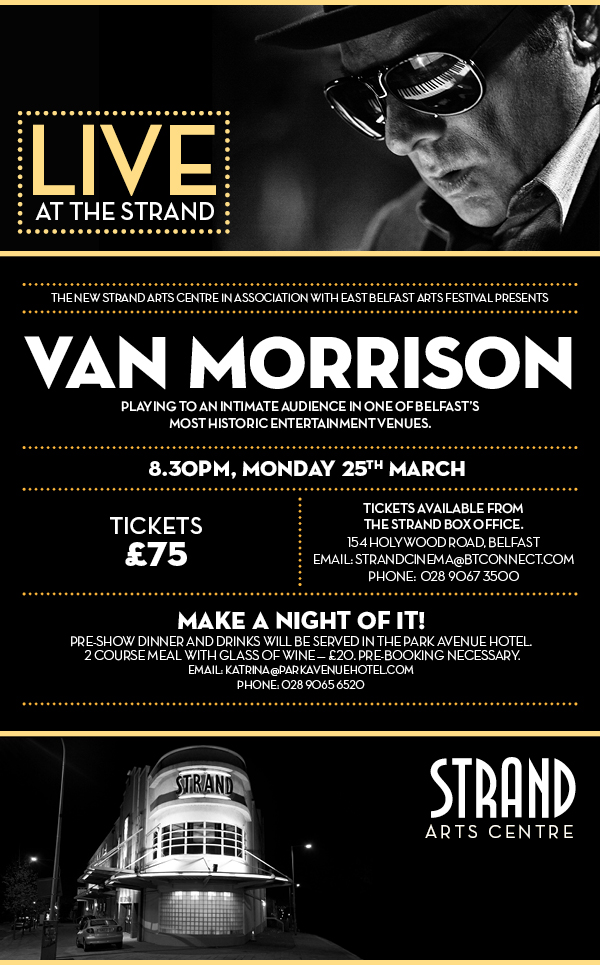
Van at the Strand

I attended with my friends Eddie and Zoe Irvine and Helen Brooker.

Stuart Baillie writes:

I’m at The Strand cinema in east Belfast, one of 150 people who have gathered here to witness Van Morrison, back on the scene. He once featured here during the skiffle boom, playing tunes between the matinee features. He was a teenager, Lonnie Donegan ruled and rock was young. Did he play with Deanie Sands and George Jones, or the Sputniks, the original combo from Hyndford Street? I’m not the Vanorak I once was, but there are a few here who will know the chapter and the verse. I meet one wide- eyed individual who has seen Morrison perform almost 1,000 times. He’s rather excited but hey, to see the legend close-up, intense and revisiting his own history, that’s quite a deal.

Van is affable, connected and seemingly glad to be here. He hears that this is a hardcore audience and counters with the admission that this is a hardcore band. Sure enough they have the chops to play the blues the jazz and the country – whatever suits the drift. He plays a few selections from ‘Pay The Devil’ – Nashville in spirit but apparently recorded “with a bunch of cowboys in south Wales”. Therefore we roll with the sentiments of ‘This Has Got To Stop’, even though the author tells you that it never will.

I’ve probably mused a few times about Van’s senior years and the tightening circle of his art, the salmon returning to the spawning ground. Tonight is the most glorious illustration of this. His daughter Shauna on backing vocals, the players vamping and riffing and the quiet sizzle of ‘Baby Please Don’t Go’. Once he sang it with rage. These days, there’s an acceptance that you may lose a few lovers to the allure of New Orleans. But onwards, inevitably.

He plays sweet blues in the tradition of T Bone Walker. He rails about the UK media in a manner that is acutely conditioned by experience, even though he speaks for all of us. ‘Thanks For The Information’ is tender. ‘Monte Carlo’ is a slow drive down a beautiful corniche and ‘Pagan Heart’ summons up the spirits of John Lee Hooker and Robert Johnson, way back to Dockery’s plantation.

What a trip, such a privilege and yes, a magic location. The ley lines of east Belfast pulsate beneath us. We are wholely, into the music.


Posted in Article | Comments Off on Van at the Strand

St Patrick’s Weekend Festival

St Patricks Weekend Festival
Belfast, Northern Ireland 
 
March 16 & 17, 2013 Europa Hotel, Belfast, Northern Ireland
 
17-March-2013
Europa Hotel 
Belfast, Northern Ireland

I attended with my friend and colleague Helen Brooker and Malcolm McClean from Stornoway.

Brendan Hynes sent this review.

This was the second night of Van’s St. Patrick’s weekend stint in the Europa and, as on the previous night, Shana Morrison opened with a short set. This time, however, she did all Irish songs given the day that was in it and was accompanied acoustically by Paul Moore on bass and Dave Keary on guitar with Chris White joining them on tin whistle for the last number, The Blacksmith which really livened up the audience before the main event.
 
Bang on 9.00 pm Van hit the stage playing saxophone on Celtic Swing before doing a cover of I Get a Kick Out of You during which he gave a little kick(not of Caravan proportions unfortunately). Making Whoopee and Open the Door to Your Heart followed before Van informed us he was going to change things around a bit.What followed was (to my ears anyway) The Showstopper of the two concerts-a magnificent version of Thanks for the Information on which Van’s vocals were brilliant,  aided by Dave Keary’s terrific chunky guitar sound and the brass section coming in and out to supplement the sound beautifully. A young lady at the table who was seeing Van for the first time turned to me when the song had finished and ecstatically exclaimed that it was unbelievable. It was indeed! A fine duet between Van and Shana on Sometimes we Cry was followed by a country cover, Things have Gone to Pieces. Van then moved to piano to deliver a long version of Going Down to Monte Carlo. This song is developing well during the live performances and becoming a bit of a crowd favourite. Next up was another high point- a long version of All in the Game during which Van shared his affection for journalists and the Fleet Street Press in particular with us(very moving) before doing a monologue on famous people perceived to be grumpy who in reality are not and others who escape such perceptions but who probably are. Covers of I Can’t Stop Loving You and That Old Black Magic(both with Shana) were followed by the greatest hits numbers Moondance and Brown Eyed Girl. Then it was time for the blues as Van and the band ripped through Baby Please Don’t Go and Help Me (at the end of which Van exited the stage but continued to sing on in the wings for another couple of minutes as the band played on frantically, not sure whether he was coming or going). It was terrific! I was surprised that Van hadn’t included Star of the County Down (given the day that was in it) but when he returned for the encore he put things right and played it followed by an explosive Gloria with the band getting to express themselves with extended solos. The crowd had by now abandoned their tables and surged to the front of the stage to join in. Van asked for “a big hand for the band”and then he was gone after 1 hour 45 minutes of exhilarating music.
 
I wish St.Patrick’s Day could be like this all the time!

-Brendan Hynes


Setlist
Celtic Swing
I Get A Kick Out of You
Making Whopee
Open The Door (To Your Heart)
Thanks For The Information
Sometimes We Cry
Things Have Gone To Pieces
Goin’ Down To Monte Carlo
It’s All In The Game
Old Black Magic
I Can’t Stop Loving You
Moondance
Brown Eyed Girl
Baby, Please Don’t Go
Help Me
Star of the County Down
Gloria

 
Posted in Article | Comments Off on St Patrick’s Weekend Festival