James Viscount Bryce OM (1838-1922)

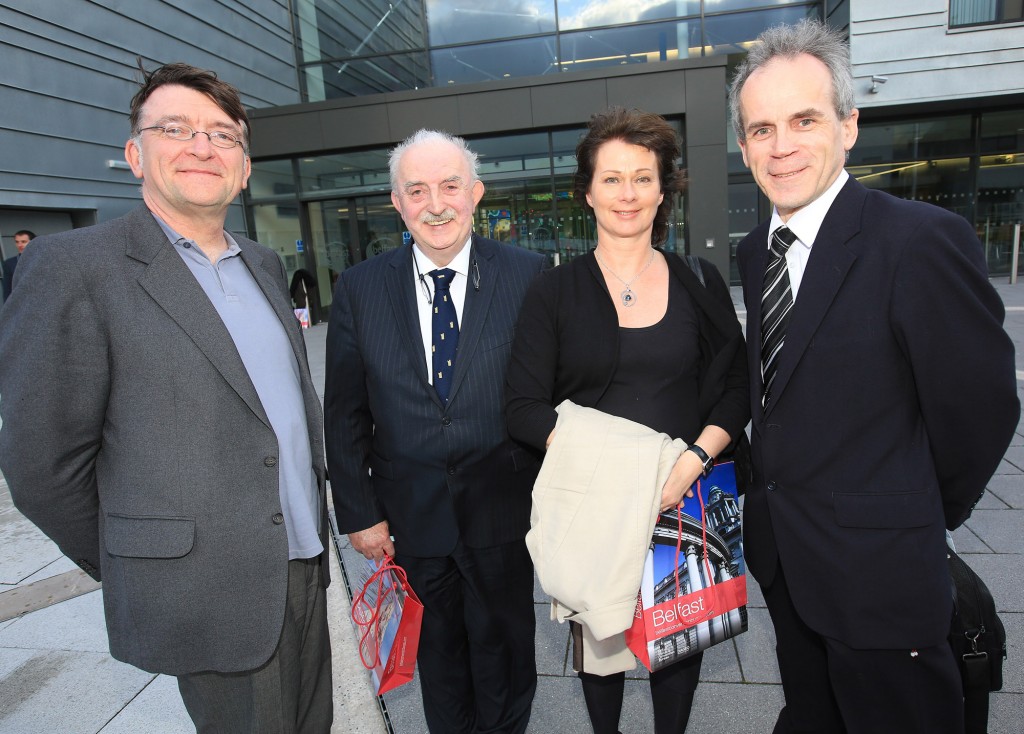
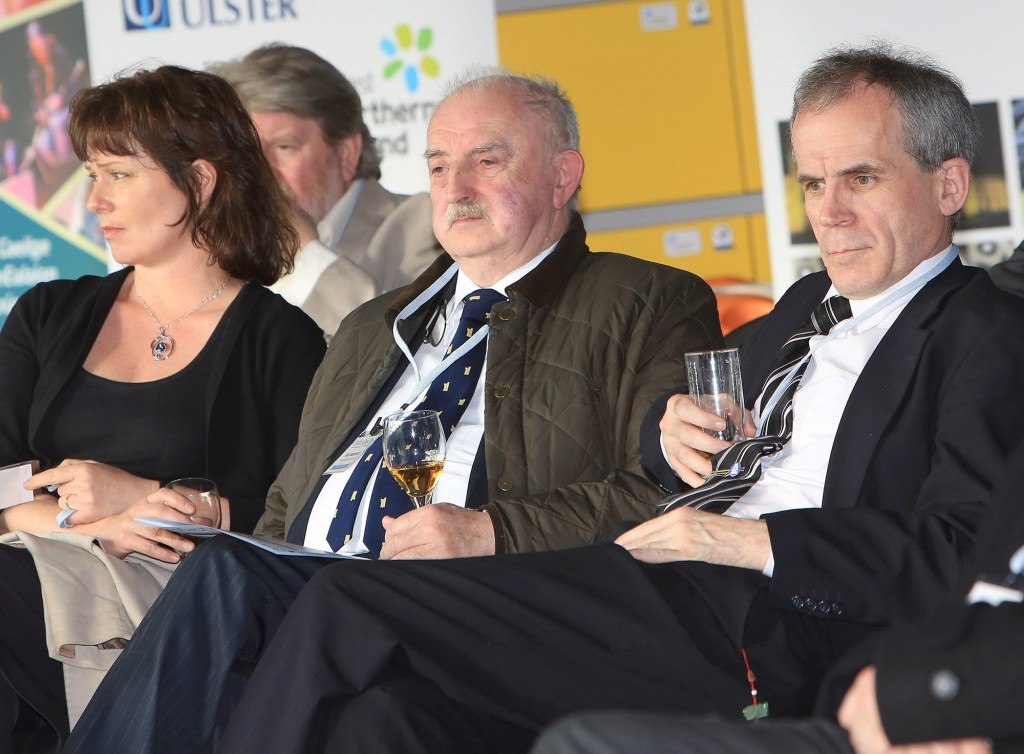
Belfast One City Conference Day 2…I attended with Professor Wesley Hutchinson who is  Senior Professor of Irish Studies at the Sorbonne Nouvelle, Paris 

MAY 10 || TITANIC BELFAST

8am Continental Breakfast and Registration

9am A New Chapter for Belfast

Lord Mayor of Belfast Alderman Gavin Robinson

9:10am The Cristo Rey Secret Sauce

Fr Joe Parkes, SJ, President Cristo Rey School New York

9:20am From Vacant Sites to Hubs of Wealth-Creation

How can we view our many vacant building sites and buildings — a hangover from the Great Recession — as an opportunity

 James Bryce ca 1907.jpg

The Ulster History Circle (Chris Spurr) and the Ulster-Scots Agency (Maynard Hanna) next requested the pleasure of Dr Ian Adamson OBE and Professor Hutchinson at the unveiling of a blue plaque JAMES VISCOUNT BRYCE OM 13 Chichester Street, Belfast BT1 4JB (in Upper Arthur Street) on Friday 10 May 2013 at 11.00 a.m.

Refreshments afterwards,with a presentation by Gordon Lucy,were held in the Ulster-Scots Agency, 68-72 Great Victoria Street, Belfast BT2 7BB.

James Bryce was born in 40 Arthur Street, Belfast on 10th May 1838, the eldest son of James Bryce (1806-1877), who was teacherof mathematics at Belfast Academy.The Bryce family had been bonnet lairds (landowning farmers) in Dechmont, near Coatbridge in Lanarkshire. Bryce’s grandfather, James Bryce the elder (1767- 1857) was a Presbyterian minister who came over from Scotland to Killaig, outside Coleraine, in 1805. His son James married Margaret Young, daughter of the Belfast merchant James Young of Abbeyville.

As Ulster Scots the Bryces were part of that Presbyterian enlightenment which had its issue in the United Irishmen and in the political ideas of William Drennan and Henry Joy McCracken: a political community which was virtually indivisible from the covenanting radicalism of South West Scotland.In 1847, Bryce went to study at the High School of Glasgow, where his father had been appointed Mathematics and Geography Master. He returned home in 1852 to study at Belfast Academy under his uncle, Reuben John Bryce, (who was Headmaster of the school for over 50 years), before entering the University of Glasgow the following year. In 1857 he went on a scholarship to Trinity College, Oxford, graduating BA in 1862 (as a non-Anglican, he was barred from taking an MA). Bryce retained a lifelong commitment to Liberalism, consistent with his Ulster-Scots roots.

 In the 1860s he campaigned for the reform and extension of Oxford University (including the scrapping of religious tests); and was a founding member of Girton College, the first female college at Cambridge. He was called to the bar and practised in London for a few years, but soon returned to Oxford as Regius Professor of Civil Law, a position he held between 1870 and 1893. He founded the Law Quarterly Review in 1883 and (with Lord Acton) the English Historical Review in 1885.  entered Parliament in 1880 as Liberal MP for Tower Hamlets in London. In 1885, he was returned as MP for the safe seat of South Aberdeen, which he held for the next 22 years. Various posts in the Liberal governments of Gladstone and Campbell-Bannerman followed, including Chancellor of the Duchy of Lancaster (1892); President of the Board of Trade (1894–95); and Chief Secretary for Ireland (1905-1907). King Edward VII appointed Bryce as a Member of the Order of Merit (O.M.) in 1907.

Throughout his career, James Bryce authored an impressive range of publications. By far his best known work is The American Commonwealth , published in 1888, a thorough examination of the constitutional system of the United States, which became a standard work on the subject. His unsurpassed knowledge of the U.S. and his excellent links with academics and politicians there led to his appointment in 1907 as British Ambassador in Washington DC, a post he held for seven years. During his tenure he improved UK-US relationships, due as much to his popularity among the American people as his relationships with Presidents, although he did share strong affinity with Woodrow Wilson, another Ulster-Scots Presbyterian, who entered the White House in 1913. On his return from Washington, Bryce was raised to the peerage as Viscount Bryce of Dechmont. He was also appointed to the International Court at The Hague.

Following the outbreak of the First World War, he was asked by Prime Minister Asquith to prepare the official report into German atrocities in Belgium, which was damning of attacks on Belgian civilians. The following year, he spoke out strongly against Turkish genocide against the Armenians in the Ottoman Empire; and with the assistance of the historian Arnold J. Toynbee, he produced a documentary record of the massacres, published by the British government in 1916 as the Blue Book In his earlier life, Bryce was a notable mountain climber, the first European to climb Mount Ararat in 1876. He climbed all over the world and was President of the Alpine Club from 1899 to 1901. Mount Bryce in the Canadian Rockies is named in his honour. Appointed as a Fellow of the Royal Society in 1894; he was President of the British Academy from 1913 to 1917. Viscount Bryce died on 22 January 1922. His memorial service was held at Westminster Abbey. After cremation, his remains were interred in Edinburgh.

Professor Hutchinson and I then attended a reception to mark the finale of the Belfast One City Conference 2013 at 7pm at Ardnavally, Shaw’s Bridge, Belfast on the invitation of Gregory S. Burton, Consul General of the United States of America.
 

Posted in Article | Comments Off on James Viscount Bryce OM (1838-1922)

Belfast One City Conference

I attended in the evening with Helen Brooker (Pretani Associates), John Kennedy (Dept of Arts ,Heritage and the Gaeltacht) and Professor Wesley Hutchinson (Sorbonne, Paris).

 Agenda

Comhdháil Aon-Chathrach Bhéal Feirste Conference Belfast One City

Lifting the City

MAY 9 || e3

10amm Folktown —— A Reborn Market Place in the Heart off Belfast.

Venue: Berry Street Presbyterian Church

Belfast’s Folktown area (Castle St, King St, Berry St, Marquis St, Bank Sq and Chapel Lane) is being regenerated and re-imaged through the provision of community-based cultural events (market, festival, art work, etc) to encourage inclusion of an emerging diversity of cultures and tradition, thereby encouraging community involvement, increasing footfall, tourism and trade in the area

Noon Skainos — A dynamic hub at the very heart of East Belfast..

Venue: Skainos, Newtownards Road

The Skainos Project is an urban regeneration development in inner East Belfast providing shared space for community transformation and renewal. Growing out of the work of the East Belfast Mission, it brings together a range of strategic partnerships which will contribute to the holistic regenerationof one of the most economically and socially deprived communities in Northern Ireland.

5:30pm e3,, Belfast MET.. Registration

6pm An Opening Reception in Song & Verse

Joby Fox ‘Belfast’. Michael McKernon will read from ‘Sea – 60 Years of Poetry’, the latest anthology of Pádraic Fiacc, at 89, still Belfast’s poet laureate

6:25pm A Warm Welcome to the West: Paul Maskey MP

6:30pm Opening of Conference: Naomi Long MP: ‘Lifting the City’

6:40pm Bridging the Gap: Peace,, Prosperity and Our Inner–City Communities

Debate in recent months has focused on the peace dividend for working class communities. How can we guarantee that the educational, economic and social benefits of the peace are felt across Belfast and in every section of society?

Chair: Alan McBride

Paul Nolan, Community Relations Council; Cllr Jim McVeigh, SF; Cllr John Kyle, PUP; Cllr Tim Attwood, SDLP

7.20pm Re–Stitching the City

Mark Hackett, Forum for an Alternative Belfast

(Introduced by Alderman Tom Ekin: ‘A City Architect for Belfast’)

7.35pm An Ambitious Agenda for Belfast

Minister Carál Ní Chuilín MLA

7..50pmm Democratising the Arts

Belfast has enjoyed a renaissance of the arts in recent years with The Mac, Ulster Museum, An Chultúrlann and The Lyric leading the way but how do we ensure that everyone has access to and enjoys the arts?

Chair: Lucy Caldwell, Author; Jim McGreevy, National Museums NI; Martin Lynch, playwright; Jenny Elliott, CEO Arts Care; Ciarán Mackel, Chair Gaeltacht Quarter

8.40pm Spirit of Belfast/Spiorad Bhéal Feirste Award

Recipients: Féile an Phobail and East Belfast Arts Fest. Presented by Tony McCusker, Honorary Chair of Conference and Chair

Community Foundation for NI.

9pm Conference Club:: Dánlann Dillon,, An Chultúrlann

Céad Míle Fáilte to Juan Karlos Izagirre Hortelano, Mayor of Donostia-San Sebastian with live Music and Sean-Nós Dance performance.


Posted in Article | Comments Off on Belfast One City Conference

Professor Geza Vermes

Professor Geza Vermes, the world’s leading authority on the Dead Sea Scrolls, died today, aged 88. An exceptional scholar, his translations and analysis of the Dead Sea Scrolls did much to aid our understanding of one of the most precious texts in history.

Born in Hungary in 1924, Vermes’s early years were marked by tragedy. Though Catholic converts, both his parents were deported and murdered in the Holocaust due to their Jewish background. Vermes was training as a priest at the time of their deportation and, protected by the Catholic Church, was able to survive the war. Having been ordained he left Hungary in 1946 and pursued academic studies in Belgium and Paris. At that point in the Judaean Desert the Dead Sea Scrolls had been discovered and his fascination with early Judeo-Christian scripture began. In 1957, on a visit to England, he met and fell in love with Pamela, a married mother of two children. After he left the priesthood and she divorced her husband, they were married and would remain together until her death in 1993.

After his marriage Vermes was able to devote himself to his studies, publishing his much lauded English translation of the Dead Sea Scrolls in 1962, which would go on to sell half-a-million copies. Having relocated to Oxford University in 1972, Vermes became heavily involved in Jewish Studies and the history of the Holy Land in the time of Jesus. As editor of the Journal of Jewish Studies and in his books on early Christianity – Jesus the Jew (1973), The Changing Faces of Jesus (2000) and The Authentic Gospel of Jesus (2003) – he was instrumental in transforming Jewish Studies from an often disregarded theological speciality to an academic discipline.

In 1991 after a long struggle, he achieved success in his campaign for all academics to have access to all the Dead Sea Scrolls, a right previously reserved for a small editorial team at the Jordanian Department of Antiquities.

His final book, Christian Beginnings from Nazareth to Nicaea, AD 30-32 was published in 2012. His friends and family have commented that his curiosity and intellect were largely undimmed by age and up until the week of his death, he was writing and planning his next work.

At the time of his death he was Professor Emeritus of Jewish Studies at Oxford University, a Fellow of the British Academy and was regarded as ‘the greatest Jesus scholar of his generation’ (Sunday Telegraph).

The Folio Society was proud to have collaborated twice with Geza Vermes, firstly on our edition of his translation of The Dead Sea Scrolls in 2000 and secondly on The Authentic Gospel of Jesus in 2009.

Posted in Article | Comments Off on Professor Geza Vermes

Century Ireland Launch

Pat Kenny – Century Ireland – 07-05-2013

Century Ireland, a major new online initiative marking ‘Decade of Centenaries’, launched 

·         Century Ireland brings the most momentous period in Irish history to life.  

·         Free access news service will chart major developments between 1913 and 1923, along with everyday news items to show what life was really like at the time.

·         Supported by Department of Arts, Heritage and the Gaeltacht, Century Ireland is a partnership between RTÉ, Boston College, and the National Cultural Institutions. 

Tuesday 7th May, 2013 Jimmy Deenihan TD, Minister for Arts, Heritage and the Gaeltacht, has officially launched Century Ireland, a major new online news service which will chart both ground-breaking and everyday news events which took place from the time of the Home Rule debate to the Civil War (1913 to 1923). 

Supported by Department of Arts, Heritage and the Gaeltacht, Century Ireland is a partnership between RTÉ, Boston College, the National Cultural Institutions and other partners. 

Century Ireland will make a range of archival material available to the public in the most accessible way possible, and will accompany this material with expert commentary. Alongside news reports from the time, the site will feature primary sources, academic research, and a wealth of visual imagery. The reach of the Century Ireland online news site will also be complemented with a daily blog and Twitter feed to bring information about the 1913 to 1923 period to the widest possible audience in the most easily accessible way. 

Jimmy Deenihan TD, Minister for Arts, Heritage and the Gaeltacht commented: 

“Over the course of 2013, and in the decade ahead, we will celebrate a rolling succession of centenaries that mark the most momentous period in modern Irish history. In a mere decade, the social and political landscape in Ireland changed completely. The Century Ireland initiative is important because it takes our history and makes it tangible and accessible for the audience of today. The major stories featured will explain the events that shaped modern Ireland, but the everyday ones will help us imagine what it was really like to live through this decade of change.” 

Professor Mike Cronin, Boston College commented: 

“Century Ireland offers a decade long history of the major and everyday news events from a hundred years ago. Produced by Boston College, delivered by RTE and supported by the national cultural institutions, Century Ireland will bring the 1913-23 period to life. A rich mix of digital content, supported by social media, will allow the public to access a range of material and lead them through the decade of centenaries in real time.” 

Noel Curran, Director General of RTÉ, commented: 

“RTÉs involvement in the Century Ireland project is reflective of its commitment to opening up and showcasing some of the wealth of materials available within the RTÉ Archive. Online and mobile engagement nationally and internationally increases every year and we feel confident Century Ireland’s positioning within the RTÉ.ie website will help this project secure the recognition and visits that it truly deserves. It has been a privilege to have worked in partnership with such esteemed organisations to create a national cultural resource of such quality and value.” 

From 2pm today the Century Ireland online news site will be live at [insert]. The Century Ireland  

Media queries:

Press and Information Office

Tel: 087-2908193 / (01) 631 3807 / 3838 / 3848(direct)

E-Mail: press.office@ahg.gov.ie

Web site: www.ahg.gov.ie 

Note for Editors 

·         Century Ireland will be live from 2013 – 2023. An online ‘newspaper’ featuring archival content from this period will be produced every two weeks. 

·         In addition to the archival content feeding the main stories, the site will also feature a daily blog and Twitter feed building a more complete picture of what was happening at any given point during the decade. The site also features videos and podcasts presenting contemporaneous commentaries on the period by eminent historians, a gallery for visual material and a section for the online presentation of primary source documents. 

·         Partners in this project include the Department of Arts, Heritage and the Gaeltacht, Boston College, RTÉ, National Library of Ireland, National Archives of Ireland, National Museum of Ireland, National Gallery of Ireland, Dublin City Gallery: The Hugh Lane, Dublin City Library and Archives, University College Dublin, NUI Galway and Dictionary of Irish Biography.


Posted in Article | Comments Off on Century Ireland Launch

May Day Message: Colin Dykes

I find it scary that if it were not for you and your one-man crusade to throw light upon actual Early Irish History, and the role of the Cruthin, the fiction that currently passes for Irish History could actually pass as truth. Now it can’t.

When I walk down a street in County Donegal and see most of the people passing me with the same pale skin, dark hair, and blue eyes, and not having any idea that they represent the original (post last Ice-age) inhabitants of Ireland, but cling to a fictional account of Irish history, it makes me feel sad at first and then angry.

Father Thomas O’Connor feels equally angry for a different reason. The Powers That Be in the Irish Republic are wantonly destroying the evidence of the great invasions of Ireland by the Fir Bolg into Connacht that correlate with the Tales of “The Ulster Cycle” and the struggles of the native Irish against the invaders.

Tara was a province of the ancient Kingdom of Ulster, which I am coming to believe was the last vestige of the “native Kingdom of Ireland” rather than a Northern “Ulster” Kingdom. That “Ulster” covered only the entire northern third of the island by the time of Ptolemy’s Map because of the Belgic invasion, but may have covered most of the island previously.

Certainly Ptolemy recorded only two Regia in Ireland – The Capital (at Emaim Macha) and the other Capital at Turoe (Temhroit, mirroring the Temhroit in Belgic Gaul)

The actual Irish history that your well-researched works have exposed is much more interesting and inspiring than the romantic nonsense that passes for Irish History today.

So, Ian, I salute you for your valiant efforts and your scholarly works.

But much more needs to be done, and I would love you and Tom O’Connor to meet, discuss all that you know, and produce a major authoritative piece reconciling the true history of Ireland into something that rings so true that the romantic pseudo-history nonsense will be consigned irrevocably to the dustbin of history

Posted in Article | Comments Off on May Day Message: Colin Dykes

Suffer the Little Children

“A man sat at a metro station in Washington DC and started to play the violin; it was a cold January morning. He played six Bach pieces for about 45 minutes. During that time, since it was rush hour, it was calculated that 1,100 people went through the station, most of them on their way to work.

Three minutes went by, and a middle aged man noticed there was musician playing. He slowed his pace, and stopped for a few seconds, and then hurried up to meet his schedule.

A minute later, the violinist received his first dollar tip: a woman threw the money in the till and without stopping, and continued to walk.

A few minutes later, someone leaned against the wall to listen to him, but the man looked at his watch and started to walk again. Clearly he was late for work.

The one who paid the most attention was a 3 year old boy. His mother tagged him along, hurried, but the kid stopped to look at the violinist. Finally, the mother pushed hard, and the child continued to walk, turning his head all the time. This action was repeated by several other children. All the parents, without exception, forced them to move on.

In the 45 minutes the musician played, only 6 people stopped and stayed for a while. About 20 gave him money, but continued to walk their normal pace. He collected $32. When he finished playing and silence took over, no one noticed it. No one applauded, nor was there any recognition.

No one knew this, but the violinist was Joshua Bell, one of the most talented musicians in the world. He had just played one of the most intricate pieces ever written, on a violin worth $3.5 million dollars.

Two days before his playing in the subway, Joshua Bell sold out at a theater in Boston where the seats averaged $100.

This is a real story. Joshua Bell playing incognito in the metro station was organized by the Washington Post as part of a social experiment about perception, taste, and priorities of people. The outlines were: in a commonplace environment at an inappropriate hour: Do we perceive beauty? Do we stop to appreciate it? Do we recognize the talent in an unexpected context?

One of the possible conclusions from this experience could be:

If we do not have a moment to stop and listen to one of the best musicians in the world playing the best music ever written, how many other things are we missing?”

Photo: "A man sat at a metro station in Washington DC and started to play the violin; it was a cold January morning. He played six Bach pieces for about 45 minutes. During that time, since it was rush hour, it was calculated that 1,100 people went through the station, most of them on their way to work.

Three minutes went by, and a middle aged man noticed there was musician playing. He slowed his pace, and stopped for a few seconds, and then hurried up to meet his schedule.

A minute later, the violinist received his first dollar tip: a woman threw the money in the till and without stopping, and continued to walk.

A few minutes later, someone leaned against the wall to listen to him, but the man looked at his watch and started to walk again. Clearly he was late for work.

The one who paid the most attention was a 3 year old boy. His mother tagged him along, hurried, but the kid stopped to look at the violinist. Finally, the mother pushed hard, and the child continued to walk, turning his head all the time. This action was repeated by several other children. All the parents, without exception, forced them to move on.

In the 45 minutes the musician played, only 6 people stopped and stayed for a while. About 20 gave him money, but continued to walk their normal pace. He collected $32. When he finished playing and silence took over, no one noticed it. No one applauded, nor was there any recognition.

No one knew this, but the violinist was Joshua Bell, one of the most talented musicians in the world. He had just played one of the most intricate pieces ever written, on a violin worth $3.5 million dollars.

Two days before his playing in the subway, Joshua Bell sold out at a theater in Boston where the seats averaged $100.

This is a real story. Joshua Bell playing incognito in the metro station was organized by the Washington Post as part of a social experiment about perception, taste, and priorities of people. The outlines were: in a commonplace environment at an inappropriate hour: Do we perceive beauty? Do we stop to appreciate it? Do we recognize the talent in an unexpected context?

One of the possible conclusions from this experience could be:

If we do not have a moment to stop and listen to one of the best musicians in the world playing the best music ever written, how many other things are we missing?"

Share if you took the time to read this :)

 
Posted in Article | Comments Off on Suffer the Little Children

Historians complain Government’s WW1 commemoration ‘focuses on British defeats’

Historians complain Government’s WW1 commemoration ‘focuses on British defeats’

A row has broken out over the Government’s plans to mark the centenary of the First World War as ministers have been accused of doing “too little, too late” to commemorate the 1914-1918 conflict.

Historians complain Government's WW1 commemoration 'focuses on British defeats'

British troops of the 4th East Lancashire Regiment in trenches near Nieuport Bains Photo: Alamy

Jasper Copping

By Jasper Copping

6:45AM BST 05 May 2013

Historians and campaigners have also criticised the tone of the plans unveiled so far; they believe politicians and officials are focusing too much on British defeats and the carnage and futility of the war, because they are too anxious to avoid upsetting Germans and want to make sure the events are not considered triumphalist.

However, the critics argue that by doing so, the Government is presenting only the modern, orthodox view of the conflict: that it was avoidable and unnecessary. It thus ignores arguments that, like the Second World War, it was a fight for survival.

They say that under the current plans, the Government has missed an opportunity to explain why the war was fought and failed fully to recognise the achievement of British forces.

The historians also compare the proposals unfavourably with more ambitious events being organised by Australia, Canada and New Zealand, whose men fought alongside the British.

In Britain, £50million has so far been committed by the Government and National Lottery to support centenary events, although £35million of it is for refurbishing the Imperial War Museum.

The Australian government, meanwhile, has already pledged to spend £72million.

Criticism has been led by the research and education organisations the British Commission for Military History (BCMH) and the Western Front Association (WFA).

Prof Gary Sheffield, chairman of war studies at the University of Birmingham and a vice president of the WFA, said: “The Government has come to this ridiculously late. The present government may have only come in 2010, but their predecessors should have been planning this for the last decade. Australia and New Zealand are a long way advanced with their preparations, because they have taken the trouble to think through what they are going to do. We are simply throwing it all together at the last minute.

“I would like to think the Government has a solid idea, but it strikes me that they are simply floundering and don’t know what they are doing properly.”

Under plans revealed so far, a delegation from every secondary state school will visit battlefields, and money is being made available for community projects.

The announcements suggest that the major events will be mainly linked to battles that have become a byword for senseless sacrifice.

The programme begins next year with the centenary of Britain’s declaration of war on August 4, followed by centenaries of the Battle of Gallipoli in 2015; the Battle of the Somme in July 2016; Jutland, in 2016, a sea battle in which both sides claimed victory; and the slaughter at Passchendaele in 2017. It will end with the centenary of Armistice Day in November 2018.

Both the WFA and BCMH argue that equal prominence should be given to victories such as the Battle of Amiens in 1918.

Prof Sheffield added: “The plans seem to miss out the fact that Britain won the war in 1918 altogether. There’s a disproportionate concentration on defeats. They are part of the story, but you need the pay-off of the victory in 1918.

“I have seen very little in the plans providing the context about why Britain was fighting in the first place, what issues were at stake and why people volunteered in their millions to fight.

“The war was an enormous national achievement and this can be remembered without triumphalism. Germany would not be in the least offended by a celebration in this way.”

David Cameron has appointed the MP Andrew Murrison as a special representative to coordinate the plans, and has established a high-level committee, chaired by Maria Miller, the Culture Secretary, to plan ceremonies and events, but divisions over the tone of the commemorations have even emerged here.

Some members, such as Sebastian Faulks, the author of the First World War novel Birdsong, are resisting moves to include a celebratory element, while others, such as the historian Prof Sir Hew Strachan have called for more celebration and accused the Government of ducking the debate.

Among academics there have been concerns that the panel is not sufficiently balanced. One said: “There is concern that the Government has co-opted on to the panel people whose work is best known through novels, and that some more from the historical community have not been co-opted on. The perspective represented by these writers shouldn’t overwhelm the perspective offered by operational historians.”

Critics believe the Government is formulating its plans based on a narrow view, articulated by war poets such as Wilfred Owen, Siegfried Sassoon and Robert Graves and later cemented in popular culture by Joan Littlewood’s hit musical Oh! What a Lovely War.

According to this interpretation, it was a futile, avoidable and unnecessary war, the brutality of which was made worse by the incompetence of the generals in charge.

In recent years, this has been increasingly challenged, with historians arguing that, like the Second World War, it was a fight for survival against a Germany bent on European domination. As such it was neither accidental nor futile but just and necessary.

Bruce Simpson, chairman of the WFA, which has 7,000 members, said: “Put together, what we are going to get are four years of remembrance. The Australians and Canadians have already got so much in place. It seems all the British have thought is, ‘We’ve got cemeteries, we’ve got the ann­iversaries, we’ll just send a few representatives. Job done’.

“But there has to be something beyond remembrance and wreath laying. Otherwise we have failed these men. They didn’t join up to die. They joined up to fight for freedom.”

Maj Gen Mungo Melvin, president of the BCMH, said: “The generation who fought thought it was a war worth fighting, and the commission takes the view that there was a great deal of sacrifice, but none the less it was fought with reason.

“British soldiers, sailors and airmen fought for their country, for freedom and a set of values they felt very deeply about. These aspects are often overlooked.”

A spokesman for the Department of Culture, Media and Sport said the final programme would encourage people to “learn and think” about the war’s “huge social and political significance” and “the enormous sacrifices”.


Posted in Article | Comments Off on Historians complain Government’s WW1 commemoration ‘focuses on British defeats’

Let This Be Our Secret: Deric Henderson

Ulster Reform Club
 
FORMAT –
Arrive from 6.45pm.
Presentation on the Book at 7.15pm followed by a Q & A Session.
Supper served at 8.15pm.
 
I attended with Helen Brooker..Deric Henderson was interviewed by Hugh Jordan..Introduced by Club Chairman Jim Neilly
  
Deric Henderson is Ireland Editor of the Press Association, the national news agency for the UK and Ireland, and is responsible for all editorial and photographic output from the Dublin and Belfast offices. He began his journalistic career at the Tyrone Constitution in his home town of Omagh in August 1968, moving to the Belfast Telegraph in 1973 and then to the PA’s Fleet St. HQ in 1980. Deric was appointed Ireland Editor in 1998.
 
He was named Northern Ireland Journalist of the Year in 2010, the year he began researching his best-selling book, “Let This Be Our Secret”, the extraordinary story of dentist Colin Howell and his lover Hazel Stewart who murdered their respective partners in 1991 before deceiving the police into believing the deaths were suicides. Deric hopes the story will eventually be turned into a film with the Northern Ireland actor James Nesbitt playing the leading role.
 
MENU
Char-grilled Pork Cutlet lightly dusted with Cracked Pepper & Thyme
served with a Mushroom & Irish Whiskey Cream
Apple Crumble with warm Vanilla Custard
Freshly ground & brewed Coffee.
Dress: Smart Casual


Posted in Article | Comments Off on Let This Be Our Secret: Deric Henderson

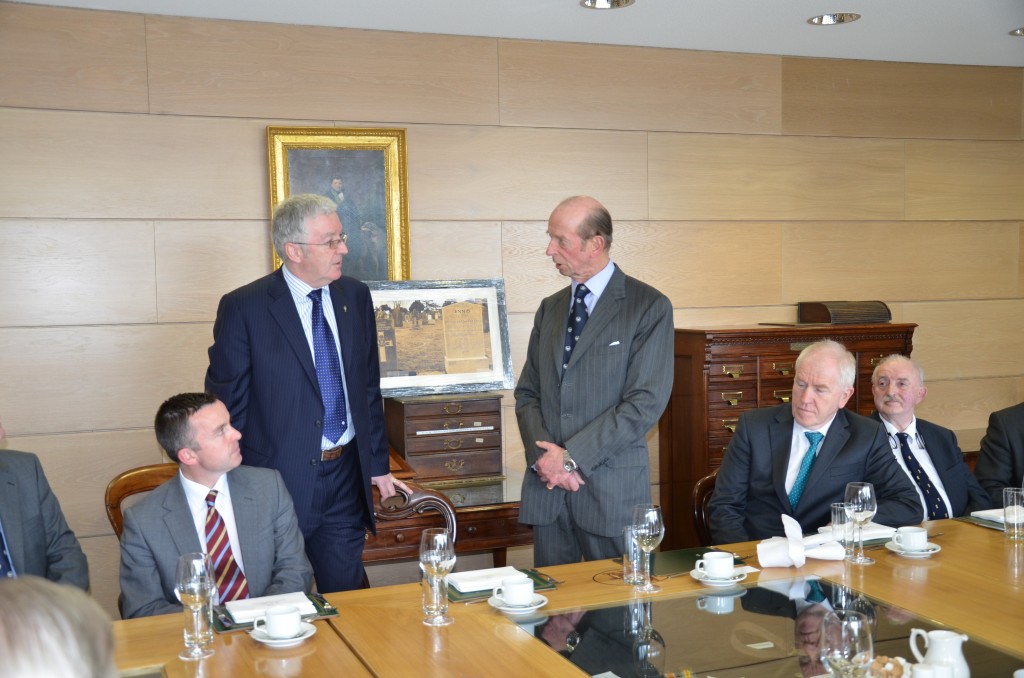
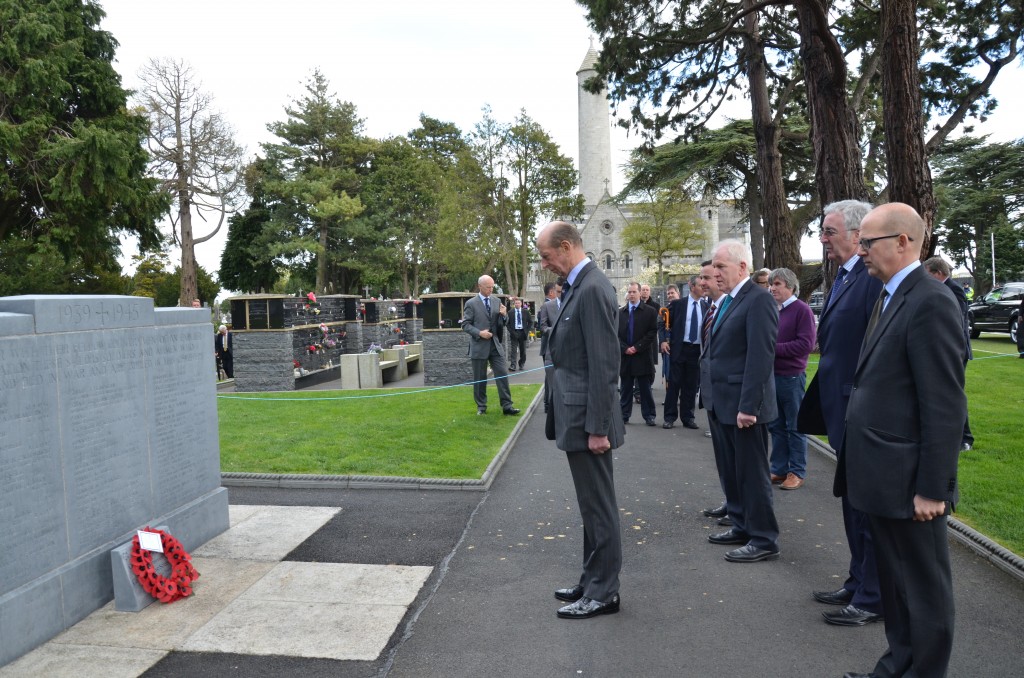
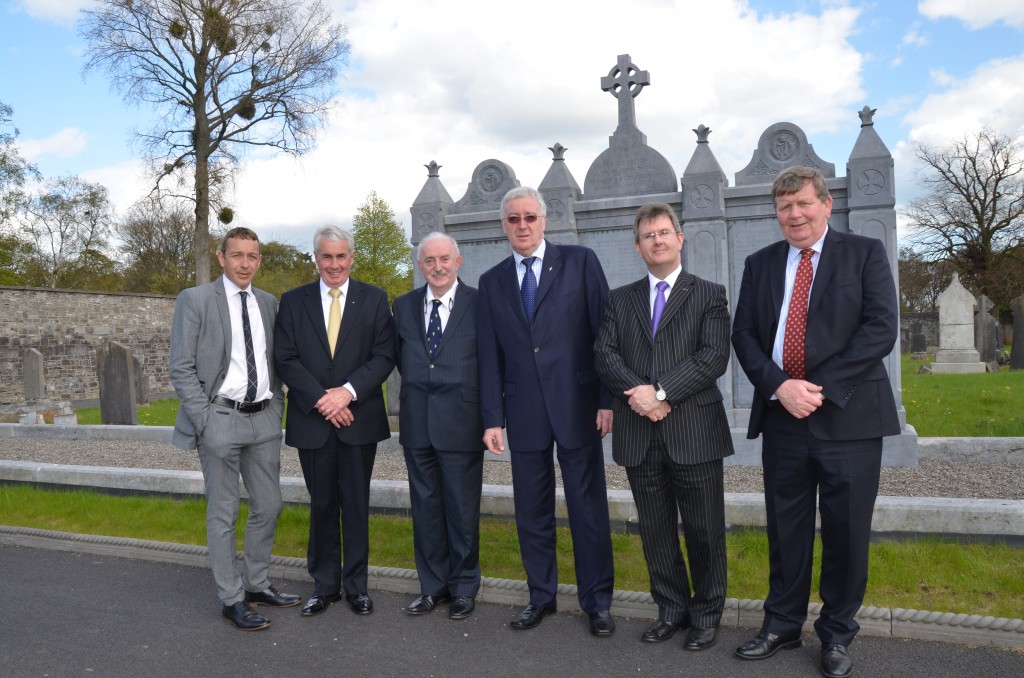
HRH Prince Edward Duke of Kent’s Visit to Glasnevin Cemetery

12:45        HRH Prince Edward The Duke of Kent arrived at Glasnevin (Prospect) Cemetery, Dublin ,the first Royal to visit the historic site since Princess Grace of Monaco. 

The visit included a short tour of the Glasnevin Museum

13:05        Lunch hosted by Mr John Green, Chairman of the Glasnevin Trust

David O’Morchoe, President RBL (RoI); Msgr Eoin Thynne, Head Chaplain Defence Forces; Michael Dillon, Glasnevin Trust; Dominick Chilcott, British Ambassador; Jeffrey Donaldson MP; John Kennedy; David Casey, Glasnevin Trust; Nicholas Marden, P Sec to HRH; George McCullough, Glasnevin Trust; Antony Rose, Regional Supervison Ireland CWGC; John McMahon Commissioner OPW; Chris McLean, Director UK Area, CWGC; MoS at Finance, Brian Hayes TD; John Green Chairman Glasnevin Trust; HRH Prince Edward The Duke of Kent; Minister AHG, J Deenihan TD;Dr Ian Adamson OBE, Chairman Somme Association Belfast; Terry Leach CWGC; Jonathan Bailey Glasnevin Trust; Brian Nason. 

13:50        Tour of Glasnevin Cemetery,led by Mr Shane MacThomáis, Historian, Resident Author

·         Further information regarding this cemetery can be found in provided booklet.  Key points to note are:

§  Many notable people of Ireland are buried in this cemetery

§  The Commission has a commitment of over 200 scattered war graves.

§  The cemetery is a proposed site for a Commission Visitor Information Panel

§  In 2012, two Commission Screen Walls were moved to a more prominent position by Glasnevin Trust. 

Followed By: 

A short wreath laying ceremony at the relocated Screen Walls (Front Wall).


§  Wreath provided for HRH Duke of Kent and British Ambassador.

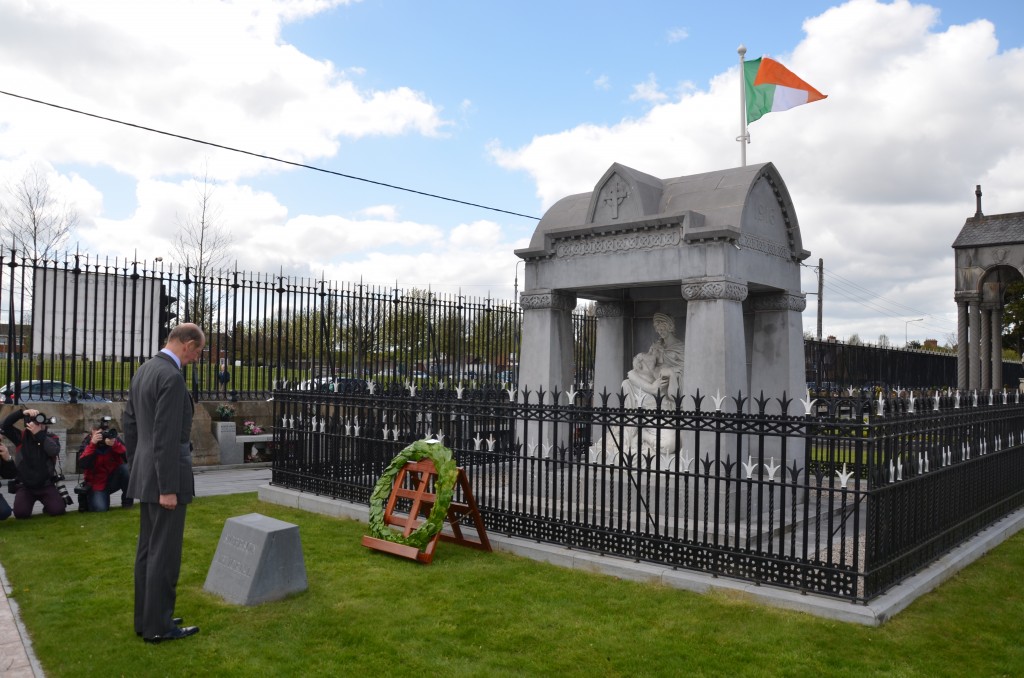
§  HRH The Duke of Kent  laid a wreath at the Sigerson Memorial


14:20        Depart Glasnevin

Posted in Article | Comments Off on HRH Prince Edward Duke of Kent’s Visit to Glasnevin Cemetery

Dalaradia Workshop

 Dalaradia Culture & Historical Group

Below are the details for the Saturday 27th April Dalaradia workshop.

  • 11:00am – Belfast Bus Company to start pick-up from the Hubb, Shore Road then to N’abbey Taxi’s, Rathcoole for next pick-up.


  • 11:30am – Arrive at Barron Hall, (230, Antrim Road, Glengormley, Newtownabbey BT36 7QX) to pick up Ian Adamson and leave for Crew Hill, Glenavy.


  • 12:15pm – Arrive Crew Hill for site visit of the inauguration stone of ancient Ulster (The Kings of Uladh were proclaimed on Crew hill).


  • 01:00pm – Leave for Barron Hall in Glengormley.


  • 01:45pm – Dalaradia (Kingdom of the Cruthin) history class with Ian Adamson OBE & former Lord Mayor of Belfast.


  • 04:00pm – Head for early dinner in the Thunder Dome (2 Farrier Court, Glengormley, N’abbey BT36 7XL).


  • 05:15pm – Bus for Rathcoole & Shore Road leaving the Thunder Dome.
Posted in Article | Comments Off on Dalaradia Workshop