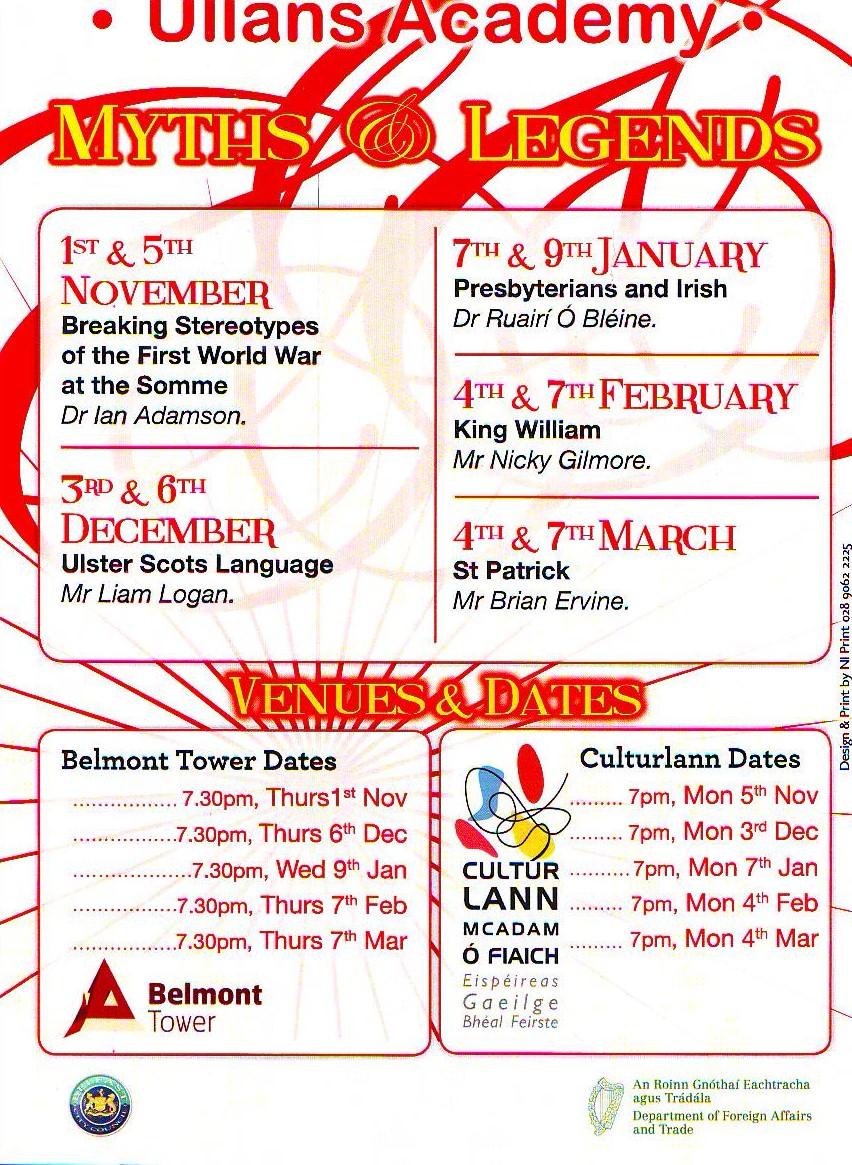
Ullans Academy Saint Patrick’s Breakfast 2013


                                                      Ullans Academy

                                                 St Patrick’s Breakfast

City Hall , Belfast

7th March, 2013 at 8.00am

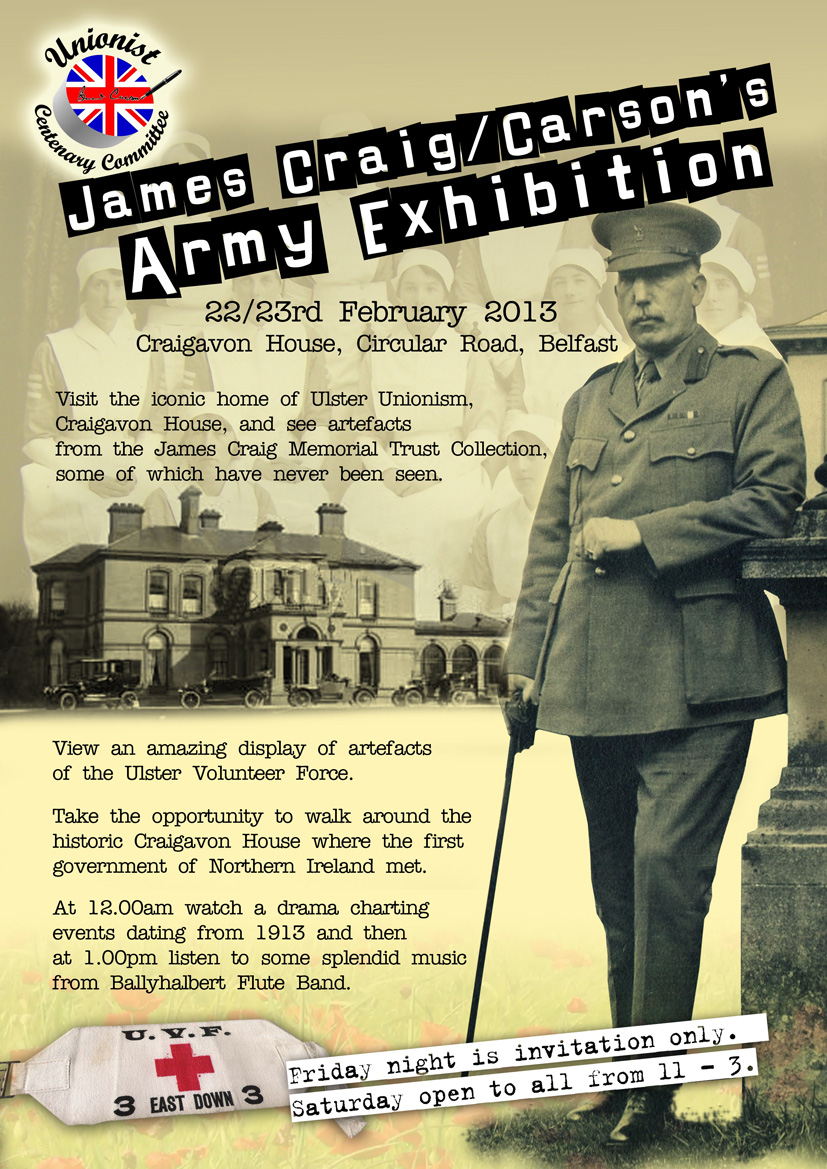
200 community activists and political leaders gathered at Belfast City Hall to celebrate Saint Patrick. The Master of Ceremonies was Sammy Douglas MBE, MLA. The Right Hon the Lord Mayor Gavin Robinson opened the proceedings, the Ullans President Dr Ian Adamson OBE explained the significance of the Shamrock, Dr Roger Blaney spoke about Saint Patrick, and thanks were extended by the chairman Liam Logan. Musical entertainment was provided by students of Saint Patrick’s College and the Boy’s Model School, Belfast.

Martha Eisenhower from Reno, Nevada, who is a Rotary Ambassadorial scholar in Belfast sponsored by Bangor Rotary Club

The Ullans Academy is a community based group established since 1992 to promote shared heritage and build strong community relations between all communities within Northern Ireland with particular reference to Belfast. Our aim is to help connect communities and to nurture mutual tolerance and respect.

The Academy aims to achieve this by improving understanding of our history. Events in Irish history have retained such emotive potency that they still impact upon the history of today. For many the understanding of key historical events often remains superficial, and slogans and stereotypes have substituted real understanding. By presenting a broader perspective to Irish history the aim is to allow the citizens of the island of Ireland to integrate historical events less emotively – and less divisively – into their rich historical inheritance. Such an integration is long overdue, particularly for the people of Northern Ireland who have suffered too much and too long for their past history 

The Ullans name was chosen as it was felt the name was inclusive and “neutral”. It is a neologism combining Ulaidh, the Irish Gaelic name for Ulster and Lallans, the name used by Robert Burns and Robert Louis Stevenson for the Scotch language. It can also be used as an acronym for Ulster Language, Literature And Native Speech, thus encompassing all languages and traditions in Ulster and the island of Ireland. 

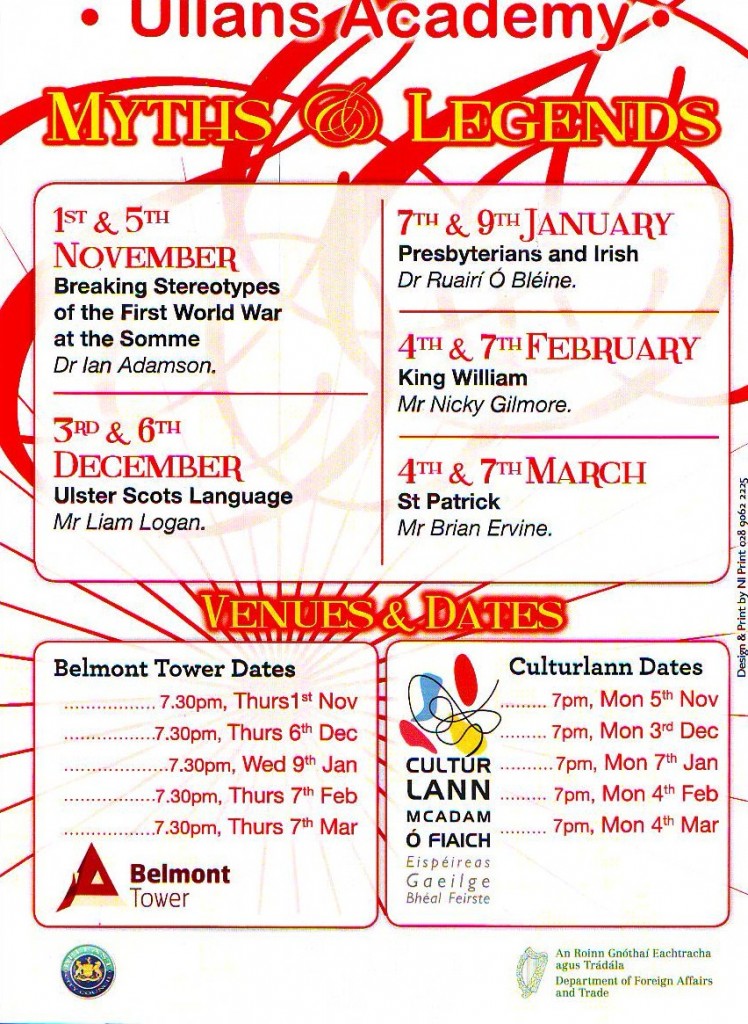
The Ullans Academy is a Company limited by guarantee and Directors work in a voluntary capacity receiving no remuneration for hours worked on behalf of the Academy. Currently the Academy hosts two annual events to mark St Patrick’s day and St Columbanus. The Academy has recently held a short series of lectures on key historical topics in Belmont Tower and Culturlann.

Posted in Article | Comments Off on Ullans Academy Saint Patrick’s Breakfast 2013

The Ullans Academy Talks; 5 St Patrick: Brian Ervine


Posted in Article | Comments Off on The Ullans Academy Talks; 5 St Patrick: Brian Ervine

President’s Saint Patrick Gathering/ St David’s Day/ The Massacre of Wassy


On this day in 1562 – 23 Protestant Huguenots were massacred by Catholics in Wassy, France, marking the start of the French Wars of Religion. One result was the eventual growth of the Linen industry in Ulster, which set the scene for the industrialisation of Belfast. My friend Professor Rene Frechet of the Sorbonne in Paris was a devout Huguenot, and to him I dedicate this day.

But it is also Saint David’s Day (Welsh: Dydd Gŵyl Dewi), the feast day  of Saint David, the patron saint of Wales, and falls on the 1st of March each year, the day having been chosen in remembrance of the death of Saint David for tradition holds that he died on that day in 589. The date was declared a national day of celebration within Wales in the 18th century.

St David (Welsh: Dewi Sant) was born towards the end of the fifth century. He was a scion of the British royal house of Ceredigion, and founded a Celtic monastic community at Glyn Rhosyn (The Vale of Roses) on the western headland of Pembrokeshire (Sir Benfro), at the spot where St David’s Cathedral stands today. David’s fame as a teacher and ascetic spread throughout the Celtic world. His foundation at Glyn Rhosin became an important Christian shrine, and the most important centre in Wales. The date of Dewi Sant’s death is recorded as 1 March, but the year is uncertain – possibly 588. As his tearful monks prepared for his death St David uttered these words: ‘Brothers be ye constant. The yoke which with single mind ye have taken, bear ye to the end; and whatsoever ye have seen with me and heard, keep and fulfil’.

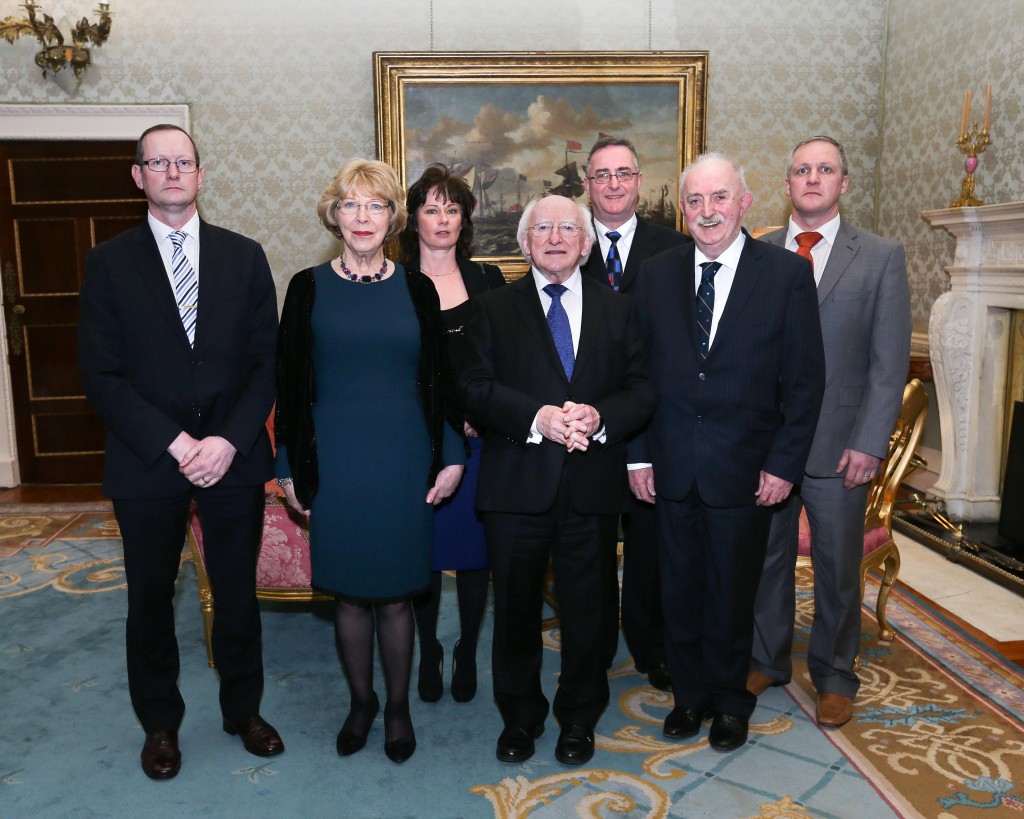
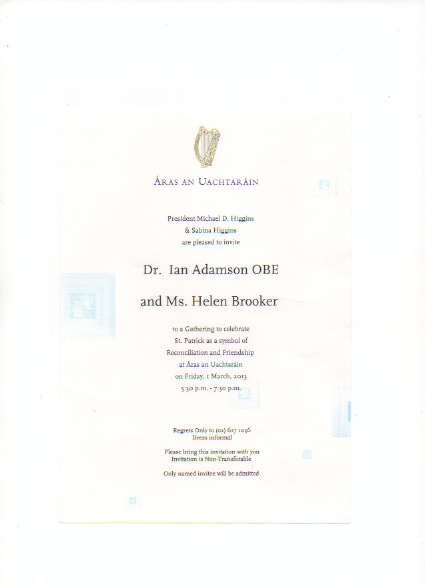
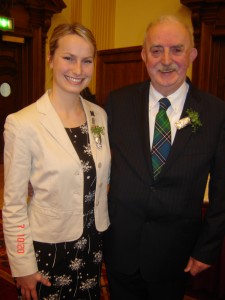
And today President Higgins invited our Ullans Academy to his Gathering at Aras an Uachtarain to celebrate St Patrick as a symbol of Peace and Friendship. 

Distinguished Guests, Ladies and Gentlemen:

Tá áthas orm féin agus ar Sabina fáilte a chuir róimh anseo tráthnóna. Is mór againn gur tháinig sibh, go mór mór na daoine a thaisteal ó Thuaisceart Éireann.

You are all most welcome to Áras an Uachtaráin – Sabina and I greatly appreciate your presence this evening.

A year ago, Sabina and I travelled to Ballynahinch in County Down to attend a dinner hosted by the Friends of the St. Patrick Centre in Downpatrick. The event was titled the “Spirit of St. Patrick” and what an inclusive and generous spirit it proved to be. What impressed me most about that evening was the ease with which senior political representatives of both major traditions on this island were very happy to come together in the name of St. Patrick. It was very clear to me that the narrative of Patrick, the values that he represented and the impact of his legacy were widely shared among all communities in Ireland.

The story of Patrick’s life provides a common ground from which all traditions draw inspiration. It was only in recent times however that it has become our practice to come together on this island to celebrate the shared heritage of Patrick.

For the best part of two decades political representatives from both parts of the island have travelled to the United States to participate in St. Patrick’s Day celebrations. Indeed, these occasions may even have provided the first opportunities for political representatives of both traditions to meet each other in the perceived safe space of Washington or New York.

These were crucial moments in the peace process and that engagement around St. Patrick’s Day in the United States has yielded, and continues to yield, important political and economic dividends for the entire island. But perhaps it is time to complement that overseas engagement with a greater emphasis on a coming together in Ireland to celebrate, explore and reflect on our shared Patrician heritage.

Building on the good work of the St. Patrick’s Centre in Downpatrick and indeed other Patrician centres, I was anxious to host a gathering that would bring together representatives of organisations who are active in promoting cross-community and North/South contact and cooperation, as well as people who come from locations that are linked with the life and legacy of St. Patrick. So while this evening’s gathering may be somewhat of an eclectic congregation, there is at least one thing we all share – a huge respect for St. Patrick as the symbol of peace and friendship on this island.

As an academic and politician, I have always been deeply interested in migration. I have been particularly fascinated by the paradox of the migrant being both marginalised and vulnerable and yet, over time, developing the capacity to become a major agent of change in his or her adopted homeland. Neither the Scots-Irish nor post-Famine Irish emigrants had an easy time of it on arrival in the United States; indeed the hardships they endured were severe. Yet, they had the resilience and ingenuity to not only overcome these obstacles but actually transform their host society.

In his life, Patrick embodied this paradox. He was the ultimate involuntary migrant. His life as an immigrant slave in Ireland was lived in misery and hardship; cut off from his family and banished to mind sheep on Slemish. Despite this marginalisation and powerlessness, Patrick in all his human vulnerability still found the courage, the faith and the strength to become the catalyst for the spiritual transformation of Ireland.

In his Confessio, he says: “I am the sinner Patrick. I am the most unsophisticated of people, the least of Christians”. He was an ordinary and very vulnerable man who had the generous vision and the resources within himself to transform this island. At a time of great economic challenge, we should remember that Patrick refused to be defined by his apparent weakness and vulnerability. On the contrary, he actually used them as powerful agents of change to achieve his vision of a Christian Ireland.

The other quality that strikes me most forcibly from Patrick’s life was his decision to forgive. This was not a casual forgiveness or an expedient amnesia. Patrick was the victim of a huge injustice; a terrible hurt was inflicted upon him by people who regarded his life as of little value. After years of suffering misery at their hands, he managed to escape to return to his family in Britain. In what can only be regarded as a completely counter-intuitive move, Patrick then decided to return to Ireland to minister to the community that had enslaved him.

From our historical experience in this island, we are sadly familiar with the phenomenon and consequences of the negative spiral of hatred and hurt. As Séamus Heaney wrote: “Human beings suffer. They torture one another. They get hurt and they get hard”.
Patrick had been hurt but he refused to get hard. He did the opposite; he devoted his life to addressing the needs of those who had hurt him and, through conscious acts of generosity and forgiveness, set about dismantling the infrastructure of hate of which he had been a victim. In the words and prayers ascribed to him, Patrick also showed a great respect for symmetry with nature and the power of blessing.

Thankfully, in recent years many people on this island have emulated the vision, generosity and forgiveness of Patrick. I commend all the people in leadership positions – at community and political level – who have made the conscious and strategic decision not to get hard but to tackle the mountain of accumulated hurt by acts of courage and generosity towards the other community. These decisions were made not because they were easy, but because they were right and because they represented the only pathway out of the cul-de-sac of injustice and violence that offered only embedded misery to every community in Northern Ireland.

The life and legacy of St. Patrick has, therefore, a lot to teach us and it is a matter of great celebration that all communities on this island can now come together in the name of our shared Patron.

Like St. Patrick, our flags – the Union Jack and the Tricolour – also represent a noble aspiration. The Tricolour signifies the peaceful coexistence of the Gaelic and Orange traditions while the Union Jack brings together the cross of St. Patrick with that of St. George and
St. Andrew. How sadly ironic then that the flags which reflect this positive aspiration should in recent months have become a source of division and contention in certain communities.

The achievement of peace and inclusive politics over recent years has given us the space to examine and explore our respective identities in all their complexity – celebrating what we share in common (such as St. Patrick and our wonderful music and heritage) and, where we differ, to at least respect the perspective of the other. Those positive threads of commitment to a discourse that, not only tolerates difference, but is able to place oneself in the narrative of the other, including the opinions of opposites, are most valuable threads on the loom of democracy.

I believe in politics. I have devoted much of my life to its practice.
I know that, at its best, politics is a creative and healing art. We need that healing now. I hope that over the coming weeks and months, we will see politics at its best; deployed constructively and collectively towards the achievement of a shared society in Northern Ireland, one where difference is a source of strength rather than division.

On a lighter note, one thing all traditions on this island share is our love of culture – of music, dance, literature, theatre and art.  The season of St. Patrick is a time when it is very apt to celebrate that culture in all its richness and diversity and to show-case its excellence to the world. I have said on many occasions that while the experience of the so called Celtic Tiger failed to live up to the best versions of Irishness, we have not been failed by our artists. In fact, the artists that come from both parts of our island are a huge moral resource and great reputational asset for Ireland.

In recent days, I have invited to Áras an Uachtaráin some of Ireland’s best artists to demonstrate through conversation and performance the depth and breadth of our island’s cultural richness and its reach across the global diaspora. Titled “The Glaoch” or Calling, the fruits of that endeavour will be broadcast and available world-wide over the St. Patrick’s Day week-end. I hope it makes a contribution to our celebration of Irishness and that it demonstrates why there are very good reasons to be proud of our island in all its diversity.

The artists we have invited this evening – The West Ocean String Quartet – reflect that diversity. They hail from three provinces across Ireland; only the Pale is unrepresented. The Quartet operates in the interface between traditional and classical music and their programme this evening reflects both Irish and Scottish influences.

Ba mhaith liom buíochas a ghabháil leis an West Ocean String Quartet as ucht seinm dúinn, agus libhse ar fad as ucht a bheith linn tráthnóna. Is mór agam sibh a bheith i láthair in onóir ár nÉarlamh Naofa, agus i mbaol a bheith roimh am, guím beannachtaí na Féile Pádraig oraibh.

Go raibh mile maith agaibh go léir – thank you very much. 
Posted in Article | Comments Off on President’s Saint Patrick Gathering/ St David’s Day/ The Massacre of Wassy

St Patrick at Aras an Uachtarain

Scan

Posted in Article | Comments Off on St Patrick at Aras an Uachtarain

Blogspot: Cruthin, Fir Bolg, and Gael


Celtic Languages: Minding your Ps and Qs

The term “Celtic” is primarily a linguistic one, referring to a group of related languages, detailed discussion of which is beyond the scope of this article. The P-Celtic/Q-Celtic hypothesis is a categorization for the Celtic languages, linking Gaulish with Brythonic as P-Celtic; and Goidelic/Gaelic with (the now extinct) Celtiberian as Q-Celtic. The difference between the P and Q languages is the treatment of Proto-Celtic *kw, which became *p in the P-Celtic languages but stayed as *k in Goidelic. For example the word for head is pen in Brythonic languages but ceann in Goidelic; the word for son is mab (earlier map) in Brythonic but mac in Goidelic/Gaelic – maqq on the Primitive Irish Ogham inscriptions. 
 
   
This is important in the context of Irish history because Ptolemy’s Map shows an Ireland with P-Celtic names, including the P-Celtic speaking Manapi, whereas Ireland subsequently became a land of Q-Celtic Gaelic speakers. This implies some subsequent event that catalysed the change from one language to the other. Typically such an event involves the arrival of some group with sufficient power or influence to force or persuade the previous inhabitants to learn to speak the new language. For example if a new group, inferior in numbers, but powerful enough to become rulers, conducts business in their new language, it would probably be a good idea for the majority population to learn that language if they want to have any influence with their new masters.
 
Ireland rapidly switched from being a land of Gaelic Q-Celtic speakers to a land of English speakers because of English military and political domination between the 16th and 20th Centuries. Similarly, it seems likely that sometime after the era depicted in Ptolemy’s Map, a powerful group of Q-Celtic speakers arrived in Ireland and gradually established military and political dominance that eventually resulted in the adoption of their older, archaic, language, where the switch from Q (*K) to P had never taken place.
 
Thus the Pretani who lived in Ireland came to be called Qreteni, subsequently modified to Cruithin, which is how they are recorded in history, because Q-Celtic had become the dominant language by the time history began to be written down, and the “P” was switched to a “Q” (sounding like a hard “C”).
 
Similarly the Manapii became known as Fir Managh (and part of the Fir Bolg) because of another important difference between Q-Celtic and P-Celtic – the continued use of “f” in the archaic Q-Celtic, instead of the “g” used in the later P-Celtic tongues. Thus, in Q-Celtic, the words for “man” and “white” are “fir” and “fionn”, respectively, whereas the P-Celtic equivalents are “gwr” and “gwyn”. So the P-Celtic speaking Belgae were recorded historically as Fir Bolg, and the Manapii as the Fir Managh. It seems likely that they would have been called Gwr Bolg, and Gwr Managh, or some similar derivative, in P-Celtic speaking times.
 
It is also worth noting that despite being related, “Q” and “P” -Celtic were very different languages, and essentially unintelligible to speakers of the other form. There are historical examples where Gaelic Q-Celtic speakers required translators to speak to P-Celtic speakers in Ireland and in Scotland.
 
This also reinforces a very important difference between language and ethnicity. As noted above “Celtic” primarily describes a group of languages NOT a group of people. One may describe the Cruthin as Gaelic-speakers in the 8th Century, but they were no more ethnically-Gaelic than the Irish who now speak English as their first language, are ethnically English. Language, like Religion and Politics, is a matter of choice, although sometimes that choice is enforced.
 
This leaves two important questions unanswered! “Who were the Gaels, and where did they come from”? We know that P-Celtic was spoken throughout the British Isles and also in Gaul (Continental Celtic). Where was Q-Celtic still spoken? Perhaps Q-Celtic was still spoken in several locations, but we know with some certainty of one such – in the Northern part of Spain shown shaded in blue below – the region where “Celtiberian” was spoken.

 
Author: Luís Fraga da Silva, Associação Campo Arqueológico de Tavira, Tavira, Portugal, www.arqueotavira.com  mail@arqueotavira.com
Celtiberian was a (now extinct) language that showed the characteristic sound changes that define Celtic languages, and enough records of the language remain to show that it can be considered a Q-Celtic language related to Goidelic/Gaelic.  The origin legends of the Gaels in Ireland written down in the fictitious Lebor Gabála Érenn, (histories of the invasions of Ireland) say that they came from Spain and were led by Mil Espanae – the Spanish Soldier. This has led some to believe that the legendary invasion of Ireland by the Milesians, preserved in the fictitious Lebor Gabála Érenn, had some basis in fact, although most of that work is pure fiction.
 
At any rate, let us take the theory that the Q-Celtic-speaking Gaels arrived in Ireland direct from Northern Spain, and introduced their language to the Island. The next question is when?————————————————————————————————————————–
 
(Some additional notes on Celtic and Indo-European languages follow ….)
 

Brythonic is P-Celtic, but as an Insular Celtic language (i.e. from the British Isles) more closely related to the Q-Celtic Goidelic than to P-Celtic Gaulish,[3] it follows that the P/Q division is paraphyletic: the change from to p occurred in Brythonic and Gaulish at a time when they were already separate languages, rather than constituting a division that marked a separate branch in the “family tree” of the Celtic languages.

A change from (q) to p also occurred in some Proto-Indo European  (PIE) languages (see below) e.g. in Italic and Ancient Greek dialects: compare Oscan pis, pid (“who, what?”) with Latin quis, quid; or Gaulish epos (“horse”) and Attic Greek ἵππος hippos with Latin equus and Mycenaean Greek i-qo.

Celtiberian and Gaulish are usually grouped together as the Continental Celtic languages, but this grouping too is paraphyletic: no evidence suggests the two shared any common innovation separately from Insular Celtic.

Proto-Indo-European

Celtic languages are distinguished from Proto-Indo-European (PIE) languages based on a  number of criteria including

  • loss of voiced aspiration e.g. *bʰr̥ǵʰ- meaning ‘high’ in PIE, compared to *brig- in the Celtiberian and Gaulish placename element -brigā.
  • loss of  *p, as in Latin pro- and Sanskrit pra- compared to ro-in Celtiberian, Old Irish and Old Breton.
  • Change from *ō (and *oH and *eh) in PIE to *ū in final syllables and *ā in non-final syllables, in Celtic (e.g. IE *dh3-tōd to Celtiberian TaTuz meaning “he must give”.
  • Change from *ē (and *eh) to Celtic *ī, e.g. from *h3rēg-s meaning “king, ruler” in PIE to  -reiKis (Celtiberian), -rix (Gaulish) RiX (British), ri meaning “king” (Old Irish, Old Welsh, Old Breton)
  • Change from *HR̥C in PIE to Celtic aRC (where H stands for a laryngeal, stands for a syllabic resonant, and C for a consonant), e.g. Latin argentum, Sanskrit rajata. vs Celtiberian arKa(n)to-, Lepontic arkato-, Old Irish argat, Old Welsh argant meaning “silver, money”.

Suggested Reading

Posted in Article | Comments Off on Blogspot: Cruthin, Fir Bolg, and Gael

James Craig/Carson’s Army Exhibition, Craigavon House

Posted in Article | Comments Off on James Craig/Carson’s Army Exhibition, Craigavon House

The Great Famine-The Choctaw Send Aid

Photo: Irish Famine — The Choctaw Send Aid<br /><br /><br /><br /><br /><br />
One hundred and sixty years ago this week in 1847, the Indians of the Choctaw nation took up a collection. Moved by news of starvation in Ireland, a group of Choctaws gathered in Scullyville, Oklahoma to raise a relief fund. Despite their meager resources, they collected $170 and forwarded it to a U.S. famine relief organization. It was both the most unlikely and the most generous contribution to the effort to relieve Ireland’s suffering.<br /><br /><br /><br /><br /><br />
Begun two years before in the fall of 1845, the potato blight and subsequent famine had reached its height in 1847. It was, of course, much more than a mere natural disaster. British colonial policies before and during the crisis exacerbated the effects of the potato blight, leading to mass death by starvation and disease. For example, in March of 1847, at the time of the Choctaw donation, 734,000 starving Irish people were forced to labor in public works projects in order to receive food. Little wonder that survivors referred to the year as “Black ’47.”<br /><br /><br /><br /><br /><br />
First through letters and newspaper accounts, and later from the refugees themselves, the Irish in America learned of the unfolding horror. Countless individuals sent money and ship tickets to assist friends and family. Others formed relief committees to solicit donations from the general public. Contributions came from every manner of organization, from charitable societies and businesses to churches and synagogues. By the time the famine had ended in the early 1850s, millions in cash and goods had been sent to Ireland.<br /><br /><br /><br /><br /><br />
What made the Choctaw donation so extraordinary was the tribe’s recent history. Only 16 years before, President Andrew Jackson (whose parents emigrated from Antrim) seized the fertile lands of the so-called five civilized tribes (Chickasaw, Cherokee, Creek, Seminole, and Choctaw) and forced them to undertake a harrowing 500-mile trek to Oklahoma known as the Trail of Tears. Of the 21,000 Choctaws who started the journey, more than half perished from exposure, malnutrition, and disease. This despite the fact that during the War of 1812 the Choctaws had been allies of then General Jackson in his campaign against the British in New Orleans.<br /><br /><br /><br /><br /><br />
Perhaps their sympathy stemmed from their recognition of the similarities between the experiences of the Irish and Choctaw. Certainly contemporary Choctaw see it that way. They note that both groups were victims of conquest that led to loss of property, forced migration and exile, mass starvation, and cultural suppression (most notably language).<br /><br /><br /><br /><br /><br />
Increased attention to the Great Famine in recent years has led to renewed recognition of the Choctaw donation. In 1990 a delegation of Choctaw officials was invited to participate in an annual walk in County Mayo commemorating a tragic starvation march that occurred during the Famine. In honor of the special guests, the organizers (Action From Ireland, or AFRI) named the march The Trail of Tears. Two years later, two dozen people from Ireland came to the U.S. and retraced the 500-mile Trail of Tears from Oklahoma to Mississippi. That same year the Choctaw tribe made Ireland’s President Mary Robinson an honorary chief.<br /><br /><br /><br /><br /><br />
Perhaps the most remarkable aspect of these events is that while they commemorate dark chapters of the past, they are focused on the present and future. In other words, they seek to dramatize the need to stop starvation and suffering worldwide. As the plaque on Dublin’s Mansion House which honors the Choctaw contribution reads: “Their humanity calls us to remember the millions of human beings throughout our world today who die of hunger and hunger-related illness in a world of plenty.
In 1847, the Indians of the Choctaw nation took up a collection. Moved by news of starvation in Ireland, a group of Choctaws gathered in Scullyville, Oklahoma to raise a relief fund. Despite their meager resources, they collected $170 and forwarded it to a U.S. famine relief organization. It was both the most unlikely and the most generous contribution to the effort to relieve Ireland’s suffering. Begun two years before in the autumn of 1845, the potato blight and subsequent famine had reached its height in 1847. 
 
First through letters and newspaper accounts, and later from the refugees themselves, the Irish in America learned of the unfolding horror. Countless individuals sent money and ship tickets to assist friends and family. Others formed relief committees to solicit donations from the general public. Contributions came from every manner of organization, from charitable societies and businesses to churches and synagogues. By the time the famine had ended in the early 1850s, millions in cash and goods had been sent to Ireland.
 
What made the Choctaw donation so extraordinary was the tribe’s recent history. Only 16 years before, President Andrew Jackson (whose parents emigrated from Antrim) seized the fertile lands of the so-called five civilized tribes (Chickasaw, Cherokee, Creek, Seminole, and Choctaw) and forced them to undertake a harrowing 500-mile trek to Oklahoma known as the Trail of Tears. Of the 21,000 Choctaws who started the journey, more than half perished from exposure, malnutrition, and disease. This despite the fact that during the War of 1812 the Choctaws had been allies of then General Jackson in his campaign against the British in New Orleans. Perhaps their sympathy stemmed from their recognition of the similarities between the experiences of the Irish and Choctaw. Certainly contemporary Choctaw see it that way. 
 
Increased attention to the Great Famine in recent years has led to renewed recognition of the Choctaw donation. In 1990 a delegation of Choctaw officials was invited to participate in an annual walk in County Mayo commemorating a tragic starvation march that occurred during the Famine. In honor of the special guests, the organizers (Action From Ireland, or AFRI) named the march The Trail of Tears. Two years later, two dozen people from Ireland came to the U.S. and retraced the 500-mile Trail of Tears from Oklahoma to Mississippi. That same year the Choctaw tribe made Ireland’s President Mary Robinson an honorary chief.
 
Perhaps the most remarkable aspect of these events is that while they commemorate dark chapters of the past, they are focused on the present and future. In other words, they seek to dramatize the need to stop starvation and suffering worldwide. As the plaque on Dublin’s Mansion House which honors the Choctaw contribution reads: “Their humanity calls us to remember the millions of human beings throughout our world today who die of hunger and hunger-related illness in a world of plenty.
Posted in Article | Comments Off on The Great Famine-The Choctaw Send Aid

Lunch at Glasnevin

This afternoon I attended a lunch at Glasnevin Cemetery and Museum in honour of the visit of Dr Andrew Murrison MP, British Minister for International Security Strategy  in the Ministry of Defence, given by Jimmy Deenihan TD, Irish Minister for Arts, Heritage and the Gaeltacht. The lunch was also attended by the British Ambassador to Ireland, Dominick Chilcott, Dinny McGinley TD Irish Minister of State with responsibility for Gaeltacht and the Islands and senior British and Irish Officials.

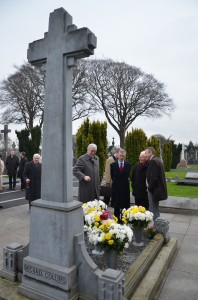
I attended as Advisor on History and Culture to Rev Dr Ian Paisley, The Lord Bannside and Baroness Paisley, with whom I had previously visited the Cemetery and Museum, as well as Chairman of the Somme Association . Sitting with John Kennedy, his colleague George McCullough spoke of the UVF man buried in the Republican plot in Glasnevin Cemetery. He has sent me the following report from Shane MacThomais.

Now they say politics makes strange bedfellows but in my mind graveyards make the strangest bedfellows of them all. Such is the case of Richard Simpson, a Belfast Loyalist who signed the Ulster Covenant and ended up being buried side by side with Irish Volunteers and members of the Irish Citizen Army in the Republican plot in Glasnevin Cemetery.

Richard Simpson was born in Belfast in 1877, Presbyterian in faith he married Ann Jane Briggs in St Anne’s Church in 1900 and lived in Oregon Street Belfast. They had three children, Effra, Ann Jane and Robina. Richard earned his living as a  casual labourer.

In 1912 as a protest against the Third Home Rule Bill, Sir Edward Carson drafted The Ulster Covenant, which asked people to “defeat the present conspiracy to set up a Home Rule Parliament in Ireland”.  On the 28 September 1912, 471,414 men and women across Ireland followed Edward Carson, the first signatory, and declared their resistance to any form of Irish Independence. Richard Simpson was one of these. One year later when the Ulster Volunteer Force was founded Richard, as a signatory of the covenant became a member. 

When World War One broke out 90,000 members of the UVF joined the British army and made up the 36th (Ulster) Division. Richard Simpson followed these into the army when he enlisted into the Royal Irish Regiment in Belfast on the 12th April 1915. A month later due to him being unfit for overseas service Rifleman Simpson was assigned to the 18th Battalion (reserve) of the regiment. As his comrades from the UVF were fighting in France, Richard was transferred to the Royal Irish Fusiliers in Wellington Barracks (Now Griffith College) Dublin on the 31st  March 1916. 

Two days before the 1916 Rebellion was to start, on the 22nd April 1916, three soldiers entered into a room in Wellington barracks. They were later to testify that on entering they could smell a strong smell of gas. In the room they found the motionless body of Richard Simpson. A coroner’s inquest was ordered and the body was placed in the barracks morgue. The coroner’s inquest was never to take place. As the city burned with the flames of insurrection the body of the rifleman from Belfast was simply forgotten about.

During the  Easter Rebellion, General Maxwell had declared marital law and no funerals took place.  The bodies of those killed during the Rising were wrapped in canvas and held in Dublin Castle. Some were temporarily buried but most were laid out in the Upper Square.  On the 1st May, with the rebellion over, the first funerals were allowed and over 250 corpses were transported across shell-shocked city to Glasnevin Cemetery. Amongst these was placed the remains of Rifleman Simpson.

In Glasnevin a trench had been dug in the St Paul’s section of the cemetery. It was eight graves wide and thirty graves long. Into this trench was placed the remains of the Irish Volunteers, and Citizen Army who had fallen in battle for the Republic and with them wearing the uniform of a British soldier is the mortal remains of a proud member of the UVF.

Posted in Article | Comments Off on Lunch at Glasnevin

The Ullans Academy Talks: 4 King William III: Nicky Gilmore


Posted in Article | Comments Off on The Ullans Academy Talks: 4 King William III: Nicky Gilmore

The Belgic Spear – The Gae Bolg by Colin Dykes

It occurred to me, as I referred briefly to the Gae Bolg, that it was a feared weapon, and wondered why. It made me think of Roman Military tactics, and Roman use of the Pilum, especially during the battle during which Boudicca’s army was slaughtered. 
 
The Romans drew  Boudicca’s army into a narrow field, where the 80,000 warriors had to funnel through a narrow space, densely-packed and perfect targets for a volley of 10,000 spears from the Romans. 
 
The Pilum was a fiendishly-clever weapon, and the Romans each carried two Pili. This throwing spear had a barbed point, making it difficult to extricate from anything it pierced (shield or body). Behind the point it was made of soft iron that bent on impact. So it couldn’t be picked up and thrown back and if it penetrated a shield it would bend and make it almost impossible to continue to use the shield. Being barbed it was almost impossible to extricate from a shield, so most of Boudicca’s warriors would have abandoned their pierced shields and charged on – and that’s when the Romans launched their second volley of Pili, into massed ranks of now unprotected warriors. Fiendishly clever, on the right battlefield.
 
The Belgae had fought huge battles against the Romans and must have experienced the terror of the two waves of Pili.
 
If the Fir Bolg (Men of the Belgae) adopted that two Pilum tactic and took it with them to an Ireland accustomed to walking up close to your opponent for close-range fighting, it must have been terrifying to have showers of barbed spears raining down on them – The Gae Bolg WAS feared. Maybe that’s why?
 
Notably, Laeg had to retrieve one of Cuchulain’s spears from a dead victim, by cutting the victim open, supporting the idea of a barbed spear, but personally, I have some doubt that this was a weapon used in one-on-one combat, as in Hector vs Achilles, but rather a weapon used as part of a volley. Of course skilled individuals might have been able to aim at particular targets, maybe at exceptional distances ….
 
Posted in Article | Comments Off on The Belgic Spear – The Gae Bolg by Colin Dykes